

Weekly Market Update: Oil and Yields Pressure Markets Ahead of the Fed
Markets traded lower this week as rising oil prices and long-term interest rates weighed on risk assets.
The S&P 500 fell 2.0%, the Nasdaq declined 1.2%, and the Russell 2000 small-cap index returned -2.6%. Growth (-1.7%) outperformed Value (-2.4%), while the Equal-Weight S&P 500 fell 3.1%, signaling broad weakness beneath the major indexes.
Energy (+0.7%) was the only sector to finish higher, while Technology was nearly flat. Health Care (-4.3%), Consumer Discretionary (-3.9%), and Materials (-3.6%) led to the downside.
Bonds declined as Treasury yields rose, with long-maturity Treasuries falling 1.7% and the 10-year yield approaching 5%. Corporate bonds also declined but outperformed Treasuries. Oil surged 12.5%, volatility increased, the U.S. dollar was little changed, and Bitcoin fell nearly 6% after a 20% rally.

Key Takeaways
Labor Conditions Improved in August After Several Weak Months of Hiring
Employers added 162,000 jobs, while the unemployment rate held at 4.1%. Prior months also looked better after revisions: June payroll growth was raised to +31,000 from +20,000, and July was revised from an initially reported -23,000 jobs to +21,000. Combined, the revisions added 55,000 jobs to the previous two months. The report does not suggest the labor market has returned to the strength of earlier years, but it paints a less concerning picture than investors saw after July's initial release.
Why it matters: The labor market still appears to be cooling, but August suggests that deterioration is occurring more gradually than previously feared.
Middle East Conflict is Becoming Harder for Markets to Treat as a Temporary Disruption
Oil prices moved sharply higher as fighting intensified and disruptions to energy shipments through the Strait of Hormuz continued. U.S. crude moved back above $100 per barrel after falling substantially earlier in the summer. More importantly, repeated escalations are making it harder to assume that each increase in energy prices will quickly unwind.
Why it matters: The longer the disruption persists, the more relevant energy becomes as an ongoing source of inflation uncertainty rather than a series of isolated weekly price swings.
Long-Term Borrowing Costs Continue to Rise Across Global Bond Markets
The 10-year Treasury yield climbed above 4.90% this week, its highest level since October 2023, while the 30-year moved above 5.3%. Government-bond yields also rose across several major developed markets as investors weighed inflation, higher energy costs, government borrowing needs, and tighter monetary policy. The breadth of the move suggests that higher long-term rates are not simply a reaction to one U.S. economic report or a shift in Fed expectations.
Why it matters: A wider set of global forces is putting upward pressure on long-term borrowing costs, making it harder to attribute elevated yields to any single economic report or shift in central-bank policy.
Expectations for a Rate Hike at Next Week's Fed Meeting Continue to Build
The Fed held rates at 3.50% to 3.75% in July, although three policymakers preferred a 0.25% hike. At Jackson Hole, Chair Warsh described the labor market as stable and said inflation should remain the Fed's predominant focus. Since then, stronger August job growth, higher oil prices, and renewed producer-price pressure have strengthened the case for an increase. Futures markets now place roughly a 70% probability on a +0.25% move at the September 15 to 16 meeting.
Why it matters: Next week's decision will show whether firmer labor data and persistent inflation pressure have been enough to move the Fed from considering a rate hike to delivering one.
AI Infrastructure Spending Remains Resilient Despite Volatile Macro Backdrop
Oil prices and long-term yields have risen, inflation pressure has increased, and the market expects a Fed hike. Those shifts would normally make large capital projects more expensive and could lead companies to reconsider spending plans. So far, however, the largest tech companies have continued committing substantial capital to data centers, computing capacity, and other AI infrastructure.
Why it matters: AI investment has become a significant contributor to both economic growth and corporate earnings, and so far, the largest tech companies appear willing to continue that spending despite volatility in rates, energy prices, and inflation.


Monthly Market Update: Stocks Set Broad Records as Rates Climb
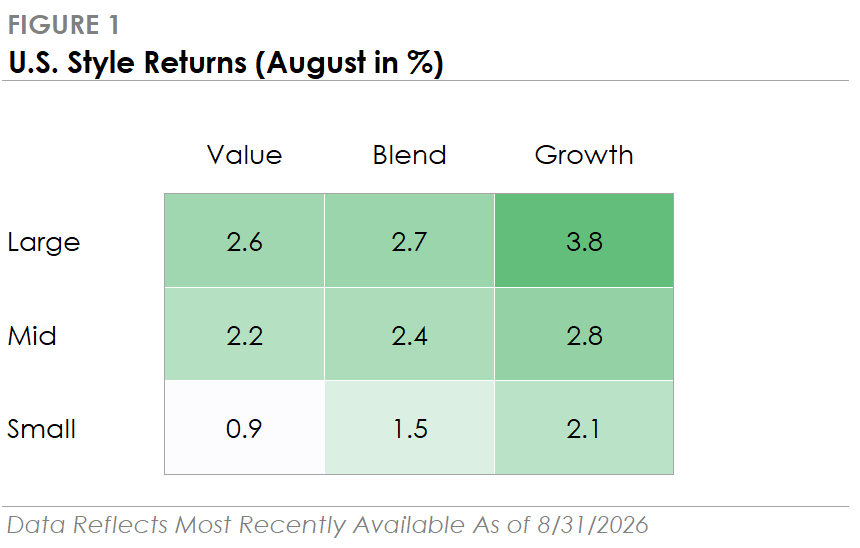
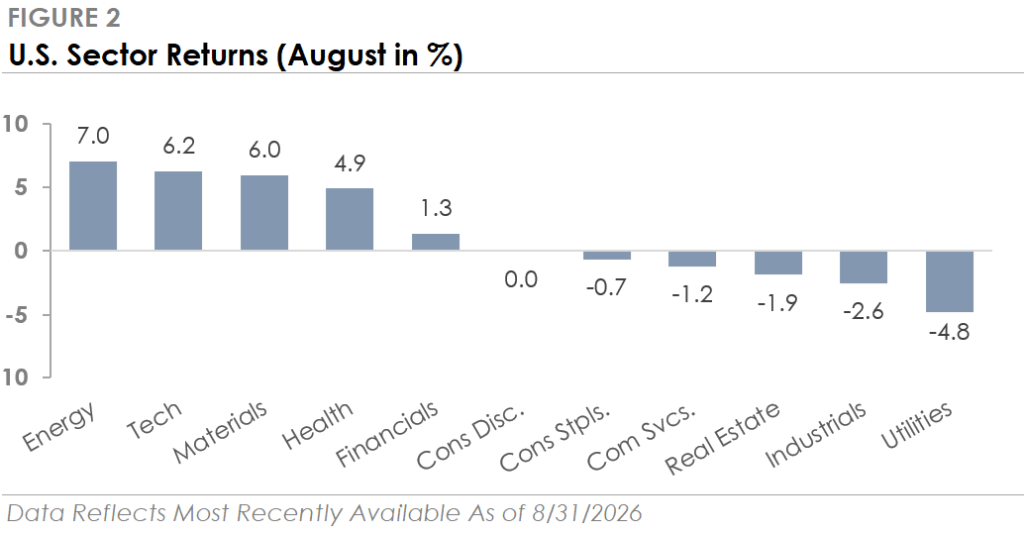
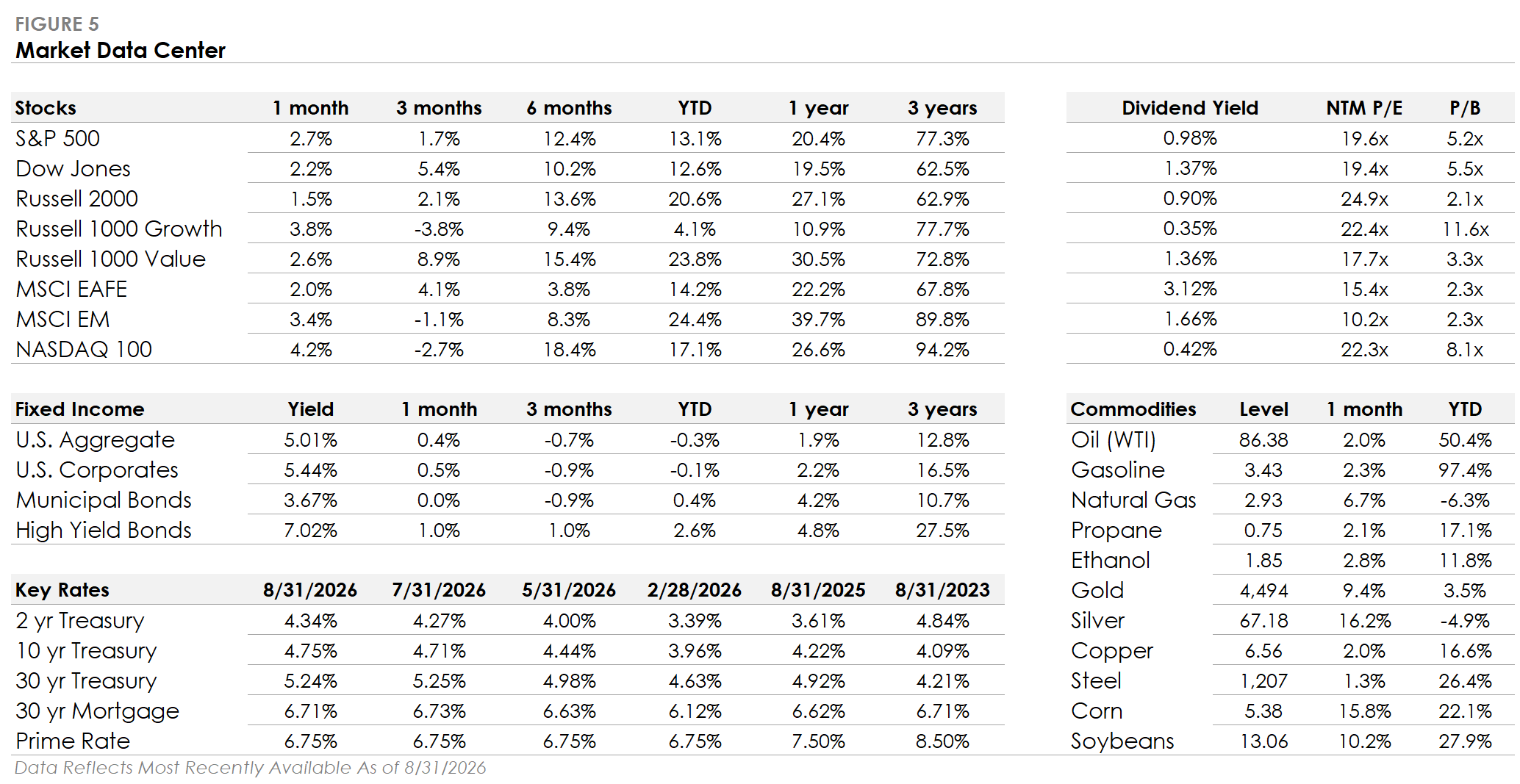
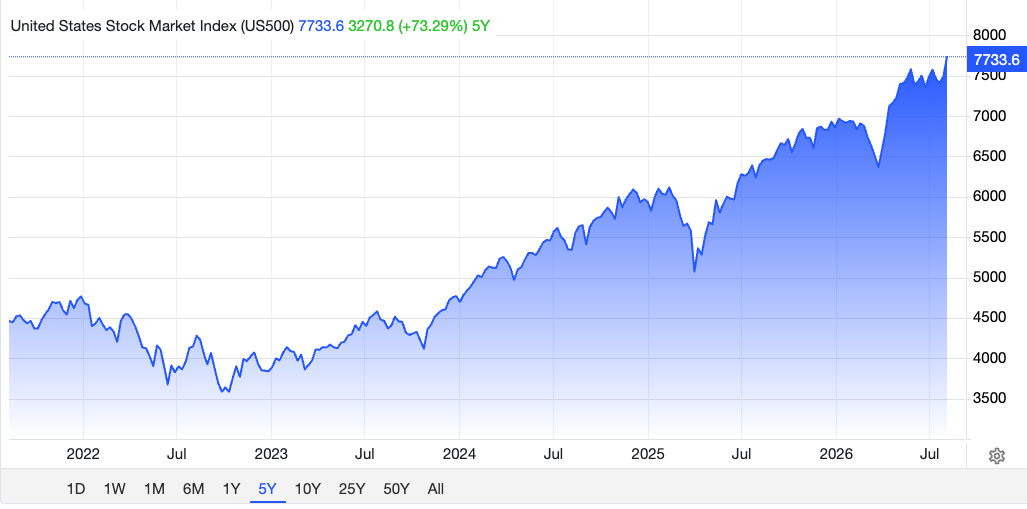
The S&P 500 Index returned +2.7% in August and set a new high. Five of the eleven S&P 500 sectors traded higher, with four outperforming the broad index. Energy (+7.0%) led all sectors, followed by Technology (+6.2%) as the sector rebounded from a July selloff and Materials (+6.0%) as gold gained nearly 10%. Utilities (-4.8%) led to the downside, followed by Industrials (-2.6%) and Real Estate (-1.9%).
Bonds traded higher despite Treasury yields rising throughout the month, with the U.S. Bond Aggregate returning +0.4%. Investment-grade corporate bonds modestly outperformed with a +0.5% total return, while high-yield gained 1.0%.
International stocks traded higher in August. Developed markets gained 2.0% and underperformed the S&P 500, while emerging markets returned +3.4% and outperformed as international tech stocks rebounded alongside U.S. tech stocks.
Stocks Set New Highs as Rates Climb
Equity markets traded higher in August, with strength extending across most broad stock market indexes. The S&P 500, Dow Jones, Russell 2000, and equal-weight S&P 500 all set new all-time highs during the month, and the Nasdaq 100 approached its June high.
The breadth of records was notable because the indexes capture very different parts of the market, from mega-cap tech to small-caps and the average S&P 500 company.
Market leadership has shifted multiple times this year, alternating between broad participation and concentration. August looked different, with strength spread across a wide range of companies and equity market segments.
The bond market offered a counterpoint to the strength in stocks. Treasury yields faced broad upward pressure during August, with the 10-year yield climbing above 4.75%, the highest since January 2025, and the 30-year approaching 5.30%, its highest level since 2007.
The rise in longer-term yields reflected several concerns, including persistent inflation, elevated government borrowing, and renewed uncertainty around energy prices.
Near the end of the month, Fed Chair Kevin Warsh's Jackson Hole speech signaled that the Fed's next move could be a rate hike rather than a rate cut, which added further upward pressure on Treasury yields. Despite the rate volatility, corporate credit spreads remained relatively calm and sit near record lows, suggesting investors are more concerned about the path of interest rates than companies' ability to repay their debt.
Markets Learn to Live with Headline Volatility
Geopolitics have dominated headlines this year, but their impact has changed as the year progresses. Oil prices continue to move when Middle East developments alter the outlook for global energy supply.
The difference is that investors appear less willing to treat each new headline as an economic shock. Earlier this year, the start of the conflict and disruption in the Strait of Hormuz caused oil prices to surge and contributed to a broad stock market selloff. Since then, investors have experienced several rounds of escalation and de-escalation.
Oil still jumps on new developments, but markets are increasingly waiting for evidence that a headline will affect energy supply, inflation, and economic growth before reacting as dramatically as they did in March.
Artificial intelligence is the second dominant market theme. Investors continue to debate whether the large sums being spent on data centers, computer chips, power generation, and networking equipment will ultimately generate adequate returns, but the companies making those investments keep moving ahead.
Nvidia's earnings report provided another indication that demand for AI infrastructure remains strong, with quarterly revenue more than doubling from a year ago. Spending plans across the industry keep rising as companies race to add computing capacity and build the infrastructure needed to support AI.
There are still questions about the eventual return on the hundreds of billions being spent, but the debate in financial markets has done little to slow the companies making the investments.

Weekly Market Update: Softer Data Cools Rate-Hike Bets
Markets traded higher for a third straight week as participation broadened.
The S&P 500 gained 1.2%, the Nasdaq 100 rose 2.4%, and the Russell 2000 small-cap index rose 1.8%. Both the S&P 500 and Russell 2000 reached new all-time highs.
Growth and high-beta stocks led the market higher, though strength wasn't limited to the largest companies.
The equal-weight S&P 500 gained 1.9%, which suggests participation stayed relatively broad.
Technology rose 2.9%, and Energy was the week's strongest sector as oil prices climbed nearly 5%. International stocks generally kept pace with U.S. equities, while the U.S. dollar was little changed.
Bonds traded higher as investors reduced expectations for another Federal Reserve rate hike, with shorter-maturity bonds outperforming longer-maturity bonds. Gold continued to drift higher, while the VIX fell below 15 and remains near its lowest level of the year.

Key Takeaways
The Labor Market Softened in July
The labor market showed more signs of cooling in July. Employers cut 23,000 jobs, and previously reported gains for May and June were revised lower by a combined 103,000, suggesting hiring had already been weaker than first reported.
Even so, the broader picture hasn't fallen apart. The unemployment rate held relatively low at 4.1%, and private-sector employment rose by 30,000.
The report points to a labor market losing momentum, but not yet the kind of deterioration typically tied to a recession.
Why it matters: A softer labor market weakens one of the arguments for keeping interest rates higher. If employment continues to cool without a meaningful rise in unemployment, the Fed may have less reason to tighten policy further.
Inflation Stayed Contained
The latest inflation reports were relatively encouraging. Consumer prices rose just 0.1% in July, and producer prices were unchanged. Both came in below expectations and helped ease concerns that rising oil prices were pushing inflation broadly higher again.
Energy remains a pressure point. The energy component of CPI is still 14.5% higher than a year ago, but that increase hasn't translated into a similar acceleration across broader inflation measures.
Higher energy prices can squeeze households and businesses without necessarily setting off another broad inflation cycle.
Why it matters: Inflation remains above the Fed's target, but July's reports suggest the recent energy shock hasn't spread meaningfully into the rest of the economy. That reduces some of the immediate pressure on the Fed to respond with higher rates.
September Rate-Hike Odds Fell
The outlook for Fed policy shifted meaningfully over the week. Heading into the employment report, markets were assigning better than a 50% probability to a September hike, with persistent inflation concerns and three dissents at the Fed's July meeting keeping another increase firmly on the table.
Then the data changed the conversation. Expectations for a September hike fell after the weaker payroll report, declined again following Wednesday's CPI release, and moved lower still after Thursday's flat producer-price report. In other words, investors are looking at a different backdrop than they were several weeks ago: a softening labor market alongside relatively contained inflation.
Why it matters: With the Fed offering less forward guidance, each incoming report carries more weight. This week's data shifted the balance away from another near-term increase, though that outlook can change quickly if inflation or employment data surprise again.
AI Demand Stayed Strong
The investment boom around artificial intelligence continues to show up in the companies building its infrastructure. CoreWeave, which buys advanced chips, installs them in data centers, and leases that computing capacity to customers, reported quarterly revenue of $2.58 billion and a backlog that climbed to $104 billion.
Other AI-infrastructure companies also reported strong growth during the week, suggesting demand isn't isolated to a single name.
The story increasingly extends beyond software firms and chipmakers to the data centers, power, networking equipment, and computing capacity needed to train and run more sophisticated AI models.
Why it matters: Questions remain about how much companies will ultimately spend on AI and what returns those investments will generate. Even so, rapid growth in demand for computing capacity suggests the underlying buildout remains strong.
Small-Business Confidence Climbed
Small-business owners grew more optimistic in July. The NFIB Small Business Optimism Index rose to 99.8, its highest reading since August 2025 and above its long-term average.
That's notable given the past several years of higher inflation, elevated borrowing costs, and persistent difficulty finding qualified workers.
Those pressures haven't disappeared, but July's survey showed improvement across several categories, including a meaningful increase in hiring plans.
Since small businesses account for nearly half of private-sector employment, improving sentiment offers a useful read on conditions beneath the surface of the broader economy.
Why it matters: Rising confidence suggests some of the pressures weighing on small businesses may be starting to ease. If that continues, it could support hiring, investment, and activity even as growth elsewhere moderates.
Weekly Market Update: Stocks Set Records as Tensions Ease and Oil Retreats
Markets rebounded this week as geopolitical tensions eased and oil prices declined. The S&P 500 gained nearly 4% and set a new all-time high, with the Dow Jones, S&P 500 Equal Weight, and Russell 2000 also setting records.
Technology, Consumer Discretionary, and Communication Services led all sectors, as the mega cap tech stocks known as the Magnificent 7 gained nearly 6.5%.
Energy was the worst-performing sector as oil prices fell nearly 7%, with defensive sectors also lagging the rally.
Bonds gained as oil and Treasury yields fell. Shorter-maturity bonds outperformed as easing inflation fears trimmed the odds of a rate hike, while high-yield corporates outperformed as credit spreads re-tightened, a sign of risk appetite.
The U.S. dollar strengthened slightly, the VIX declined, and gold rose to its highest level since mid-June.
Key Takeaways
Fed Holds Rates Steady for a Fifth Meeting
The Fed held its benchmark rate at 3.50% to 3.75% for a fifth consecutive meeting, the second under Chair Kevin Warsh. Three officials dissented in favor of a quarter-point increase, the most in that direction since 2016, and Warsh offered little guidance on the path ahead.
Stocks declined and Treasury yields rose to multi-year highs after the decision, with the 30-year yield trading near a 19-year high, on concern the Fed was not moving fast enough on inflation and might have to raise rates more later. Markets place around a 60% probability on a hike at the September meeting.
Why it matters: The Fed is providing less guidance about its intentions, which makes its policy path harder to forecast and, in turn, has made interest rates more volatile.
Oil Whipsaws on Middle East Tensions
Oil spiked more than 30% in July as the U.S.-Iran conflict escalated again, with West Texas Intermediate crude above $90 a barrel. It has since reversed by nearly 20% as a planned U.S. strike was paused and talks turned to reopening the Strait of Hormuz, a critical route for global oil trade.
Crude now trades near $75, roughly where it stood before the latest flare-up in early July. The headlines and move in oil prices are the latest in a pattern that has repeated multiple times this year, with each escalation followed by a round of de-escalation and one set of headlines countered by the next.
Why it matters: The conflict and swings in oil prices have added to interest-rate volatility and uncertainty about Fed policy.
Big Tech Earnings Split on AI Payoff
Several of the Magnificent 7 reported quarterly results this week, and investor reactions diverged sharply. The difference came down to how much growth each could show in return for its AI spending.
Microsoft rose 16% after its Azure cloud business grew 43%, the biggest one-day market-value gain for a stock on record, and Amazon gained 10% after its cloud division drove the first ever $200 billion quarter. In contrast, Meta declined as its heavy AI spending and a profit miss weighed on its ad business.
Why it matters: Investors are differentiating among the big tech companies, rewarding clear returns on AI spending and turning more cautious on the rest.
Q2 Growth Slowed but Core Demand Held Firm
The U.S. economy grew at a 1.5% annualized rate from April through June, down from 2.1% in Q1. The slowdown traced mainly to an increase in imports, which count against GDP, and a decline in government spending.
A measure of private demand that combines consumer spending and business investment rose 3.9%, more than double the 1.7% pace of the first quarter, as consumers continued to spend.
Why it matters: The economy's core held up despite the slowdown, with consumer and business demand still growing even as the headline number cooled.
Manufacturing Hit a Four-Year High in July
A widely followed gauge of factory activity, the ISM's manufacturing index, rose to 55.6 in July from 53.3 in June, its strongest reading since 2022. A level above 50 signals expansion.
The improvement was broad: production led the gain, new orders held firm, factory hiring expanded for the first time in nearly three years, and cost pressures eased.
Why it matters: Manufacturing continues to strengthen after several sluggish years, when elevated interest rates and reduced capital spending weighed on activity.
July Market Update: A Loud Month, a Quiet Market
July gave investors plenty to think about.
Geopolitical tensions flared again in the Middle East. AI stocks pulled back after a strong start to the year. And the Federal Reserve had another rate decision to make.
Yet when the month was over, the market had barely moved.
The S&P 500 returned -0.1%.
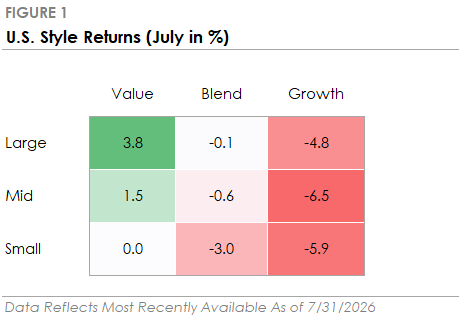
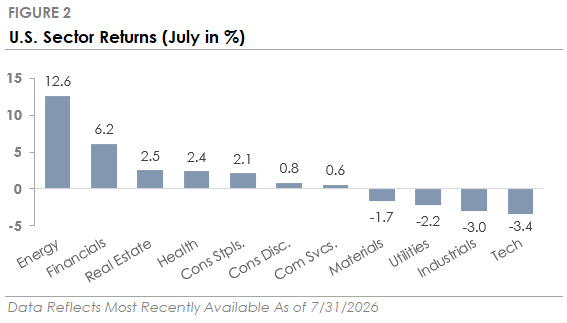
Beneath that flat headline, though, there was quite a bit going on. Energy led every sector with a +12.6% return as geopolitical tensions pushed oil prices higher. Financials followed at +6.2%. The more defensive corners of the market held up well too, with Real Estate (+2.5%), Health Care (+2.4%), and Consumer Staples (+2.1%) all gaining ground.
Technology was the outlier. The sector fell -3.4% as AI stocks gave back some of the gains they'd built up earlier in the year.
Bonds had a tougher month.
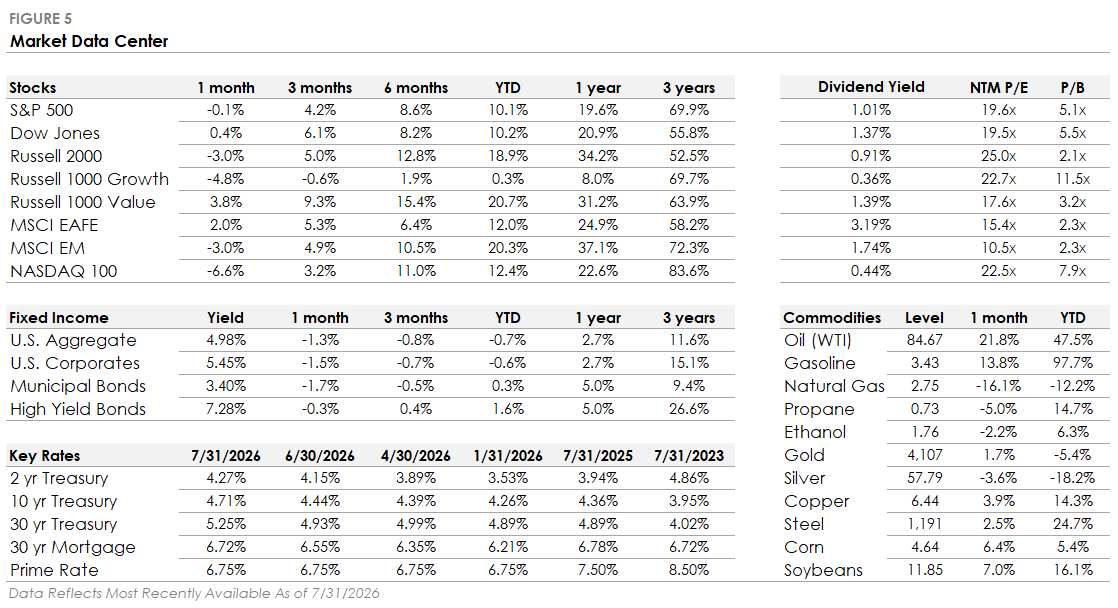
The U.S. Aggregate Bond Index returned -1.3% as Treasury yields moved higher. The culprit was familiar: rising oil prices, tied to the renewed U.S.-Iran conflict, brought inflation concerns back to the surface. Investment-grade corporate bonds lagged with a -1.5% return, while high-yield corporates held up a bit better at -0.3%.
Overseas, the picture was mixed. Developed international markets gained +2.0% and outperformed the S&P 500. Emerging markets went the other way, returning -3.0%, as the same U.S. tech selloff weighed on South Korean stocks.
Markets Turn Back to the Middle East as Tensions Resurface
The ceasefire from earlier this spring didn't hold.
Renewed conflict between the U.S. and Iran brought back the same headlines and the same concerns we saw earlier in the year. Once again, uncertainty around the Strait of Hormuz raised the risk of reduced oil supply. Late in the month, there were signs of another round of de-escalation, but the situation remains fluid.
This matters for the same reason it did the first time around.
After all, energy prices feed directly into inflation. And inflation, in turn, shapes what the Federal Reserve decides to do next.
In July, the Fed held interest rates steady for the fifth consecutive meeting. But it wasn't a unanimous call. A handful of officials pushed for a +0.25% rate hike, pointing to the renewed inflation risk.
If this feels familiar, that's because it is.
We've now moved through this same cycle several times this year. Conflict escalates. Oil prices rise. Tensions ease. And then the pattern repeats. The specific headlines shift from week to week, but the market has absorbed this same shock more than once.
The Fed's split decision reflects that uncertainty. Officials are debating their next move, but for now they're choosing to gather more information rather than react to the latest headline.
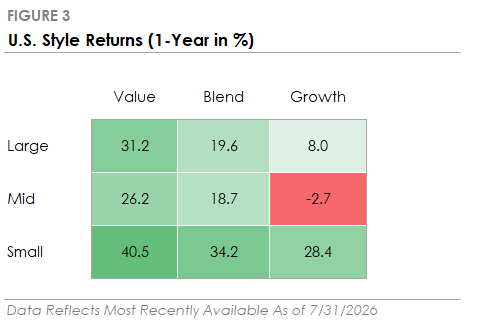
And here's the part worth remembering: despite all the noise, the net impact on markets has been limited. Stocks rebounded from the March selloff, and the S&P 500 has returned nearly +10% this year.
AI Stocks Trade Lower as Investors Shift Focus from Growth to Discipline
Second-quarter earnings season kicked off in July, and the biggest names in AI all reported: Alphabet, Microsoft, Meta, Apple, and Amazon.
These are the companies pouring money into data centers and the other infrastructure needed to power artificial intelligence. This quarter, they laid out their forecasts and their spending plans.
Something had changed in how investors received them.
For the past two years, the AI conversation was all about scale. How much are these companies spending? How fast are they building? How big could the opportunity get? This quarter, the focus shifted to a different question: profitability and return on investment.
In plain English, investors started pushing back on the spending.
Companies whose investments are clearly translating into growth, like Microsoft's cloud business, were rewarded. Companies whose spending has outpaced their cash flow, or started to weigh on profit margins, saw their stocks move lower.
The market is no longer content to reward growth and big spending numbers on their own. It's asking a harder question: is the spending actually profitable, or are expenses climbing faster than revenue?
This is a healthy development.
Every major technological buildout eventually reaches a point where investors stop rewarding growth for its own sake and start looking for results to match. July was the month that question arrived for AI.
As that scrutiny set in, semiconductor stocks and other parts of the AI trade gave back some of their earlier gains, with investors questioning whether the current pace of spending could last.
But it's worth keeping the pullback in perspective.
The volatility stayed relatively contained. For instance, the equal-weight S&P 500, a proxy for the average S&P 500 stock, set a new all-time high late in the month, and seven of the eleven sectors finished higher. Credit spreads, which measure how worried the market is about credit risk, widened only modestly and remain very tight by historical standards. And even after the pullback, semiconductor stocks are still up nearly +60% for the year.
As for the companies doing the spending? They're forecasting even higher spending levels in the quarters ahead.

What This Means for Investors
July was a busy month that, on the surface, went almost nowhere.
Geopolitical tension returned. AI leadership wobbled. The Fed stood pat, but not without disagreement. And through all of it, the S&P 500 finished essentially flat.
That's a useful reminder.
A lot can happen in a month without much of it showing up in your account balance. The headlines were loud, but the market's response was measured, and in some ways more disciplined than it's been in a while.
That discipline is the theme worth holding onto. Whether it's a geopolitical shock the market has already learned to absorb, or a shift toward asking harder questions about AI spending, the through-line is the same. Markets are starting to separate noise from results.
For long-term investors, that's not something to fear. It's something to build around.

Weekly Market Update: Oil Shock Pushes Yields to Fresh Highs
Markets traded lower this week as the conflict in the Middle East intensified and oil prices surged 17%.
The S&P 500 and Nasdaq each declined roughly 2%, while the Russell 2000 finished the week down about 1.5%. Most equity factors also moved lower, including Growth, Value, and Equal Weight, as market participation weakened.
Momentum and High Beta were the two exceptions. Both outperformed after lagging in recent weeks, helped in part by continued weakness across semiconductor stocks.
At the sector level, Energy and Utilities led the market higher. Meanwhile, Consumer Discretionary declined nearly 7% as investors considered how higher fuel and transportation costs could affect household spending and corporate profit margins.
Bonds also traded lower as interest rates rose across the yield curve. Longer-maturity bonds underperformed, which is typically what we’d expect when investors become more concerned about inflation. The VIX climbed back toward 20 late in the week, while the U.S. dollar strengthened as interest rates rose and market volatility increased.
Key Takeaways
Oil Prices Rise as the U.S.-Iran Conflict Escalates
The United States carried out a twelfth consecutive night of strikes this week, while Iran continued targeting tankers traveling through the Strait of Hormuz. The strait is one of the world’s most important energy corridors and carries a significant share of the global oil trade.
Meanwhile, Yemen’s Houthi rebels added another layer of uncertainty by threatening a naval blockade against Saudi Arabia. That threat raises the possibility of disruption not only in the Strait of Hormuz, but also across shipping routes in the Red Sea.
Oil prices responded quickly. West Texas Intermediate crude climbed above $90 per barrel, while Brent crude, the international benchmark, briefly touched $100. Both reached their highest levels in roughly six weeks.
At the same time, there’s been little visible diplomatic progress. Secretary of State Marco Rubio said Iran was “not serious about talks,” reducing near-term expectations for a negotiated resolution.
Why It Matters: The conflict had shown signs of stabilizing, but each additional strike, tanker attack, or threat to shipping routes introduces a new risk premium into oil prices.
The issue isn’t simply whether oil reaches a particular price. What matters is how long prices remain elevated and whether those higher costs begin working their way through transportation, manufacturing, utilities, and consumer spending.
In other words, the longer the conflict continues, the greater the chance that an overseas geopolitical event turns into a broader inflation and economic-growth concern for the United States.
Rising Oil Prices Push Treasury Yields to Fresh 52-Week Highs and Revive Expectations for a Fed Rate Hike
This week’s move in Treasury yields was a direct extension of the Middle East story.
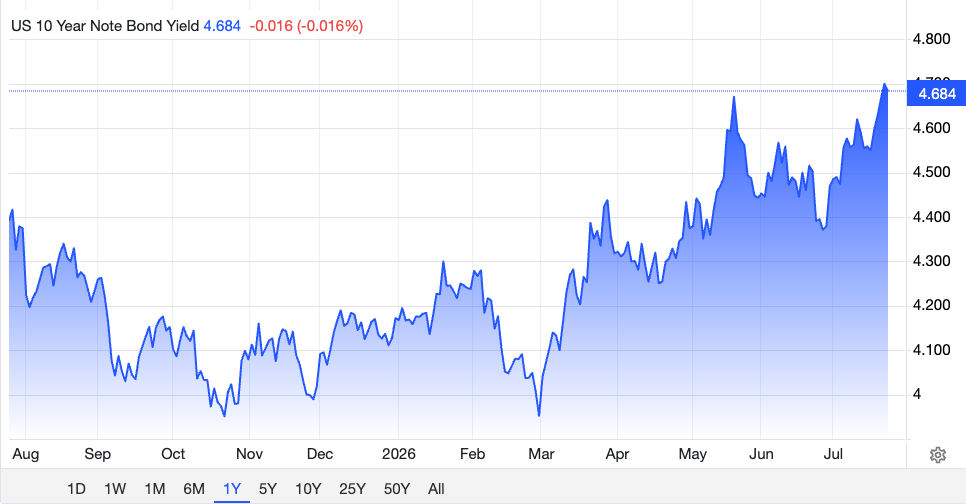
The 10-year Treasury yield rose above 4.70%, reaching a new 52-week high, as investors began pricing a greater risk that higher energy costs could keep inflation elevated.
Expectations for Federal Reserve policy also shifted. Fed funds futures now assign a greater than 80% probability to an interest-rate increase at the Fed’s September meeting, up from approximately 50% one week ago.
That’s a meaningful change in a short period of time. It suggests that investors are no longer viewing the rise in oil prices as an isolated market event. Instead, they’re considering whether higher energy costs could affect the Fed’s broader inflation outlook.
Why It Matters: Treasury yields are now closely tracking developments in the Middle East, which highlights how interconnected energy markets, inflation expectations, and interest rates have become.
Higher yields can create pressure across several parts of the economy. They can raise borrowing costs for households and businesses, weigh on bond prices, and make it more difficult for highly valued stocks to justify their current prices.
However, the key question for the Fed is whether the rise in energy prices is temporary or whether it begins affecting wages, consumer expectations, and the prices of other goods and services.
A short-lived oil shock may not change the Fed’s plans. A prolonged inflationary shock could.
Alphabet’s Strong Quarter Was Overshadowed by a Growing AI Capital-Spending Commitment
Alphabet reported second-quarter results Wednesday that exceeded expectations across several major areas.
Revenue increased 24% to $120 billion, Google Cloud revenue jumped 82%, and operating margins expanded. By most traditional measures, it was a strong quarter.
However, Alphabet shares still declined approximately 5% in after-hours trading as investors focused on the amount of spending required to produce that growth.
The company increased its 2026 capital-expenditure guidance to between $195 billion and $205 billion, up from its previous range of $180 billion to $190 billion. Management also indicated that spending would increase again in 2027.
Meanwhile, quarterly free cash flow turned negative for the first time in the company’s history as capital spending exceeded the cash generated by its operating businesses.
Why It Matters: The market doesn’t appear to be questioning whether artificial intelligence is contributing to growth. Alphabet’s results provide strong evidence that it is.
Instead, investors are asking a more difficult question: How much will companies have to spend to generate that growth, and when will those investments begin producing an attractive return?
That distinction matters because revenue growth alone doesn’t necessarily create shareholder value. Companies also need to demonstrate that the cash invested in data centers, chips, energy, and other AI infrastructure can eventually produce sustainable profits and free cash flow.
For now, the market appears willing to support substantial AI investment. However, investors are becoming less willing to accept an unlimited spending commitment without clearer evidence of the eventual payoff.
Next Week’s Calendar Could Answer Many of These Questions
Several of the market’s biggest current debates will be tested within a two-day period next week.
The Federal Reserve’s two-day meeting concludes Wednesday, July 29, with an interest-rate decision and press conference. Investors will be listening closely for signs that officials view higher energy prices as a temporary disruption or as a reason to reconsider the path of monetary policy.
Microsoft and Meta will report earnings after the market closes that same day. Their results will provide two more important data points in the debate over AI-related spending, revenue growth, and investment returns.
Then, on Thursday, investors will receive the advance estimate of second-quarter gross domestic product and the June Personal Consumption Expenditures Index, the Fed’s preferred inflation gauge.
Apple and Amazon will report earnings after Thursday’s closing bell, adding additional information about consumer demand, cloud computing, and corporate technology spending.
Why It Matters: Nearly every major question discussed this week will face a real-world test next week.
The inflation data may show whether price pressures were already building before the latest rise in oil. The Fed’s comments may clarify whether officials are prepared to respond to energy-driven inflation. Meanwhile, the technology earnings reports may reveal whether AI spending is continuing to generate enough growth to justify its rapidly rising cost.
Any one of these events could move markets. Taken together, they could determine whether this week’s volatility was a temporary response to geopolitical uncertainty or the beginning of a more meaningful shift in the market’s outlook for inflation, interest rates, and corporate profits.
Weekly Market Update: Tech Stumbles, but the Broader Market Holds Steady
Markets finished the week mixed as leadership continued to rotate beneath the surface.
The S&P 500 slipped -0.1%, while the Nasdaq declined -2.5% as investors moved away from Technology stocks. However, the weakness in the major indexes didn’t tell the full story.
Both value stocks and the equal-weighted S&P 500 outperformed, which suggests that the average stock held up better than the largest companies driving the headline indexes. Meanwhile, high-beta and momentum stocks led the market lower because of their heavy exposure to Technology, which declined -4.3% for the week.
Even so, eight of the eleven S&P 500 sectors finished higher, led by Energy and Consumer Staples. That broader participation helped offset some of the weakness in Technology.
Bonds were mostly unchanged. However, longer-dated Treasury bonds modestly underperformed as oil prices surged nearly +10% following renewed conflict in the Middle East.
Elsewhere, the VIX, a measure of expected market volatility, held steady. The U.S. dollar was little changed, while Bitcoin gained +1.0%.
Key Takeaways
Inflation Cooled Sharply in June as Energy Prices Fell
Consumer inflation declined sharply in June.
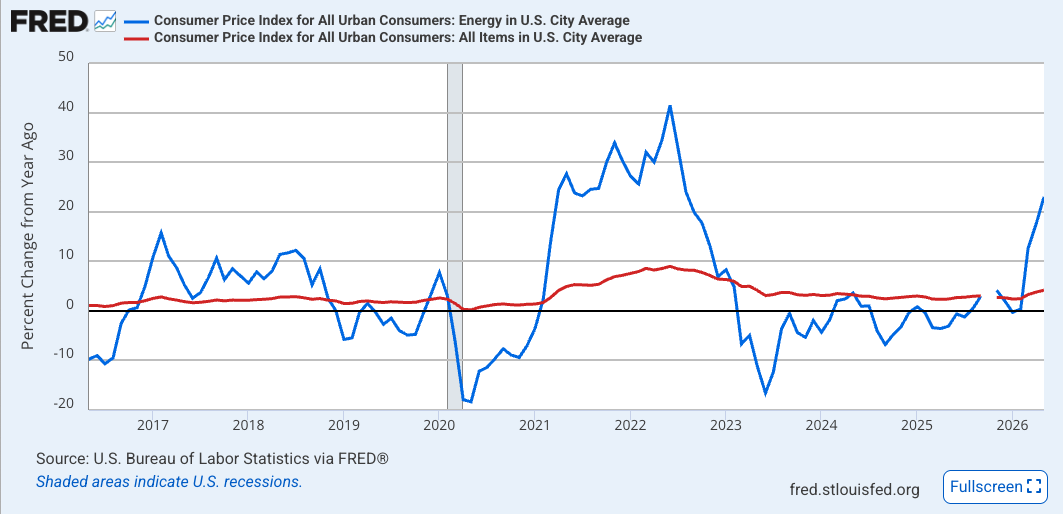
The Consumer Price Index, or CPI, fell -0.4% for the month, marking its largest monthly decline in more than six years. As a result, the annual inflation rate slowed to +3.5% from +4.2% in May.
Wholesale inflation eased as well, suggesting that some price pressures were moderating before reaching consumers.
However, much of the improvement came from energy. Gasoline prices declined nearly -10%, which pulled down both consumer prices and wholesale costs.
That distinction matters because June’s report reflects a period when oil prices were falling and were significantly lower than they are today. Since the beginning of July, the U.S.-Iran ceasefire has broken down, and crude oil has climbed back toward $80 per barrel after starting the month below $70.
Why it matters: June’s inflation improvement was real, but it depended heavily on lower energy prices that have already begun to reverse. With inflation still above the Federal Reserve’s 2% target and oil prices climbing again, the central bank has signaled that it may need to raise interest rates.
Wall Street Banks Reported Strong Second-Quarter Earnings
Wall Street banks benefited from a busy and volatile second quarter.
Banks earn fees when companies issue debt or stock, complete mergers, go public, or increase their trading activity. During the second quarter, all of those areas were active.
A wave of dealmaking and initial public offerings, including the roughly $75 billion SpaceX debut, helped drive investment banking revenue higher. At the same time, market volatility tied to the Middle East conflict and the continued AI boom supported trading revenue.
AI-related financing added another source of activity. Companies continued raising debt and equity to fund the construction of data centers and other infrastructure needed to support AI development.
As a result, Goldman Sachs reported the strongest quarter in its history. JPMorgan Chase, the nation’s largest bank, increased earnings by more than +40% compared with the same period a year ago.
Why it matters: The same active and volatile market environment that created uncertainty for investors worked in the banks’ favor. When companies raise capital and investors trade more frequently, banking fees and trading revenue tend to rise.
The Broader Market Held Steady as Technology Turned Volatile
Semiconductor stocks continued to experience sharp day-to-day swings as investors questioned the pace, cost, and potential payoff of the AI buildout.
However, that volatility hasn’t spread across the broader market.
Instead, market leadership has rotated. As investors reduced exposure to chipmakers and other Technology stocks, they moved into areas such as Financials, Industrials, Energy, and Consumer Staples.
Because of that rotation, the S&P 500 remains within 1% of its early June record despite the recent weakness in Technology.
There are also few signs of broader financial stress. The VIX remains in the mid-teens, while credit markets have stayed calm and credit spreads remain extremely tight.
Why it matters: This year’s most popular trade has become more volatile, but the weakness hasn’t pulled the entire market lower. Other sectors have begun to participate, helping offset the decline in semiconductor and Technology stocks.
Consumer Spending Continued to Rise in June
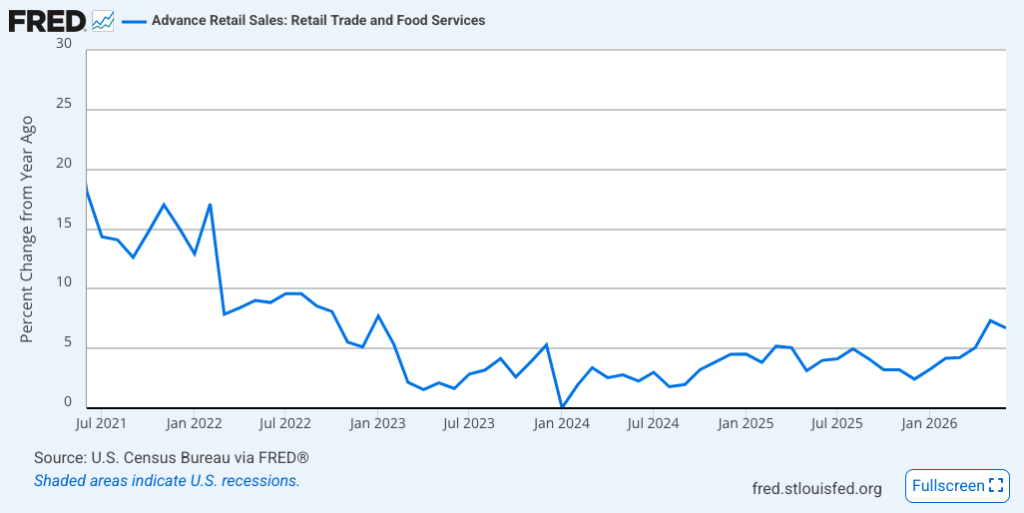
Retail sales increased +0.2% in June. That was slower than May’s revised +1.0% gain, but it was in line with expectations.
Once again, energy prices played an important role.
Lower gasoline prices reduced sales at gas stations, which weighed on the headline retail sales figure. However, those same lower energy costs also helped ease inflation and left consumers with more money to spend elsewhere.
Excluding gasoline, retail sales increased +0.7%. Online shopping contributed to the gain as consumers took advantage of promotions surrounding Amazon’s Prime Day.
Why it matters: Consumer spending drives most of the U.S. economy. June’s report suggests that spending is continuing to hold up rather than stall, particularly once the effect of lower gasoline prices is removed.
Weekly Market Update: Markets Pull Back as Oil Keeps Inflation in Focus
Markets fell for a second straight week, pausing the nearly two-month rally that began in late March. The market’s recent winners, especially technology, semiconductors, and growth stocks, continued to lead the decline. Weakness in mega-cap tech weighed on the S&P 500 and Nasdaq, while small caps, value stocks, and the equal-weight S&P 500 held up better.
The rotation was notable. Defensive sectors led the week, and ten of the eleven S&P 500 sectors outperformed the index. That marked a reversal from recent weeks, when technology drove most of the market’s gains.
Treasury yields ended the week lower as oil prices fell on headlines pointing toward a possible diplomatic resolution, even though headline inflation came in hotter than expected. Bonds traded higher as yields declined, with longer-maturity bonds outperforming. Commodities moved lower as oil fell more than 6%, while bitcoin stabilized after falling toward $60,000 last week.
The week’s market action was less about something breaking and more about markets digesting a rally that had become increasingly narrow. The same areas that carried stocks higher are now creating most of the pressure. That does not make the pullback unusual, but it does make the market more sensitive to changes in sentiment around technology, oil, inflation, and the Fed.
The central question heading into next week is whether this remains a normal pullback after record highs, or whether higher oil prices and renewed inflation pressure force markets to rethink the path of interest rates.
Key Takeaways
A Pullback After Record Highs
The S&P 500 and Nasdaq opened June at fresh record highs, but both have given back roughly 5% over the past few weeks. Technology and semiconductor stocks have led both the recent rally and this month’s pullback, which makes the decline feel sharper at the index level than it does beneath the surface.
There are still signs of rotation rather than broad breakdown. Small caps, value stocks, and the equal-weight S&P 500 held up better, and market breadth has remained steady.
Why it matters: Pullbacks after record highs are normal and do not mean something is broken. But they are a reminder that concentrated leadership cuts both ways. The same areas that help the market on the way up can create pressure when sentiment turns.
Inflation Was Hot, But Mostly Because of Energy
Inflation climbed to a three-year high in May. Consumer prices rose 4.2% year-over-year, up from 3.8% in April, with energy accounting for more than 60% of the monthly increase. Gasoline rose about 7% during the month and roughly 40% over the past year.
The details underneath the headline were calmer. Core inflation, which excludes food and energy, slowed to 2.9% and rose just 0.2% month-over-month, slightly below expectations. Shelter inflation, one of the larger and stickier parts of the inflation basket, also continues to ease.
Why it matters: Inflation remains above the Fed’s target, but the source of the pressure matters. For now, the spike appears concentrated in fuel. The risk is that higher energy prices eventually spread into broader prices, wages, and expectations.
The Labor Market Is Still Growing, But Not Without Soft Spots
Employers added 172,000 jobs in May, more than double expectations, and the unemployment rate held steady at 4.3%. Hiring for the prior two months was revised higher by a combined 93,000 jobs.
That is a better headline than markets expected. But the labor market is not sending an entirely clean signal. Job gains were concentrated in a handful of industries, long-term unemployment remains elevated compared to a year ago, and wage growth cooled to 3.4% year-over-year.
Why it matters: The economy continues to improve after slowing in late 2025, but the data are not one-sided. The Fed has to balance a labor market that is still expanding against inflation that remains above target.
Oil Remains the Swing Factor
Oil and the Iran conflict remain the thread running through this week’s market story. Renewed military strikes and ongoing shipping disruptions in the Strait of Hormuz have kept energy prices elevated, even though oil remains below its spring peak.
The latest strikes spared energy infrastructure, which helped prevent a larger move higher, but oil remains near $90 per barrel and well above where it traded a year ago.
Why it matters: Oil is the main force pushing headline inflation higher, and it is also the variable that could pull inflation lower if tensions ease. The longer the Strait of Hormuz remains disrupted, the more pressure it puts on inflation, interest rates, and market sentiment.
The Fed Has Less Room to Maneuver
The Fed meets next week for its first meeting chaired by Kevin Warsh. Markets expect the Fed to hold rates steady at both the June and July meetings, but this week’s inflation data and the continued Middle East conflict have reshaped the outlook for later this year.
A few weeks ago, the question was when the Fed might cut rates. Now, markets are paying more attention to whether the Fed may need to raise rates again if inflation pressure persists. The market is leaning toward a potential rate increase in the fourth quarter, especially if oil prices stay elevated.
Why it matters: Interest rate expectations affect mortgages, savings yields, bond prices, stock valuations, and the broader planning environment. The Fed’s decision next week may be uneventful, but its tone and outlook could set the market’s direction for the coming months.
Weekly Market Update: May's Record Rally Runs on a Short Leash
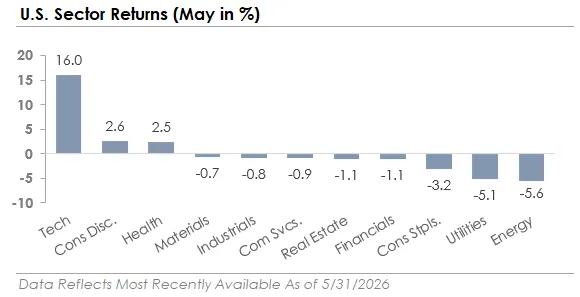
May was a month of records, though the rally's foundation was narrower than the headlines suggested. The S&P 500, Nasdaq, Dow, and Russell 2000 all set new all-time highs, powered almost entirely by technology and semiconductor stocks. The gains came despite a genuine rate scare: back-to-back hot inflation readings put a Federal Reserve rate hike back on the table and pushed long-term Treasury yields sharply higher. The pressure faded when oil prices fell more than 13%, taking inflation fears with them and clearing the way for the AI trade to reassert itself.
Beneath the surface, the picture was more complicated. Technology gained nearly 20% on the month; strip it out, and the remaining sectors were slightly negative in aggregate. Only three of the eleven sectors finished higher. Bond markets reflected the same tension, with shorter-term yields rising while longer maturities ended roughly flat. In credit, spreads generally tightened, though the riskiest tier of high-yield bonds diverged and widened. Oil fell 13.2% as the geopolitical risk premium unwound, dragging the broader commodity complex down more than 5%. Corporate earnings offered a bright spot: first-quarter blended growth came in at 28.6% against a 13.1% estimate, with profit margins reaching a record 14.8%. But like the rally itself, the earnings strength was concentrated in a handful of large semiconductor and mega-cap names.
The month also brought a change at the Federal Reserve. Jerome Powell's term expired in mid-May, and Kevin Warsh was confirmed as the new chair. Warsh inherits a complicated environment: the base case points to a rate hike by December if the Strait of Hormuz disruption keeps oil prices elevated, the administration has expressed a preference for lower rates, and inflation remains above the 2% target. Markets will need to adjust to a new communication style just as the Fed's independence faces heightened scrutiny.
The economic backdrop offers a similarly mixed read. The labor market has firmed after softening last fall, and manufacturing has returned to expansion territory. The consumer, however, is moving the other way, with income growth slowing and confidence near record lows by some measures. What has kept households spending is balance-sheet strength from elevated home values and a rising stock market. That support, as long as it holds, keeps the expansion intact. Whether it holds is the central question heading into the summer.
Key Takeaways
Records Built on Narrow Leadership
May's market gains were real, but the breadth underlying them was not. Technology accounted for nearly all of the S&P 500's advance, and most sectors finished negative. The Dow, Russell 2000, and equal-weight S&P each returned between 2% and 3%, a fraction of the Nasdaq's performance. Momentum and high-beta factors led; defensive and dividend-oriented stocks lagged.
Why it matters: An index sitting at all-time highs on such concentrated leadership is more fragile than the scoreboard implies. Any shift in sentiment around AI and semiconductors would leave most of the market without a catalyst to offset the pressure.
Oil Was the Swing Factor
WTI crude fell 13.2% in May as the geopolitical risk premium tied to the Strait of Hormuz unwound. That decline did the critical work of easing inflation pressure mid-month, pulling Treasury yields lower and giving equities room to recover. The broader commodity complex fell more than 5% in sympathy.
Why it matters: The rally's trajectory is directly tied to oil. The Strait of Hormuz remains functionally closed, and the physical supply disruption is unresolved. If oil prices move higher again, the inflation and rate-hike risk that rattled markets mid-month returns with it.
A New Fed Chair Adds Policy Uncertainty
Kevin Warsh replaced Jerome Powell as Federal Reserve chair in mid-May, inheriting an environment with inflation above target, a December rate hike increasingly priced in, and an administration publicly favoring lower rates. Futures markets, which began the year expecting cuts, now assign meaningful odds to a hike by year-end.
Why it matters: A leadership transition at the Fed introduces communication uncertainty at a moment when policy expectations are already shifting. Markets priced in cuts and got a possible hike. How Warsh navigates that gap, and the political pressure that surrounds it, will shape rate expectations for the remainder of the year.
Earnings Growth Is Strong but Concentrated
First-quarter blended earnings growth came in at 28.6%, well above the 13.1% estimate entering the quarter, with profit margins reaching a record 14.8%. Analysts have continued to raise forecasts, with upgrades outpacing downgrades by roughly two and a half to one.
Why it matters: Strip out the largest semiconductor names and technology's growth rate is cut roughly in half. The same concentration that defines the price rally defines the earnings beneath it. As estimates keep rising, the bar future quarters must clear keeps rising with them.
The Consumer Is the Key Risk to Watch
The labor market has firmed and manufacturing has returned to expansion, but consumer confidence is near a record low by at least one closely watched measure, and income growth continues to slow. Households have stayed spending largely because elevated home values and a rising stock market support balance-sheet health.
Why it matters: Several years of consumer-led growth have kept the expansion intact. If the asset-price support that underlies household spending begins to weaken, reduced consumer outlays could translate into slower economic growth at the same moment the Fed may be tightening rather than easing.
Weekly Market Update: Long-Term Yields Climb as Tech Leads
Markets were mixed this week as gains in large-cap technology stocks offset broader market weakness, while long-term Treasury yields rose sharply.
The S&P 500 gained 0.9% and the Nasdaq rose 3.5%, while the Russell 2000 small-cap index fell -1.3%. Growth 2.5% outperformed Value -0.7%, and the Equal-Weight S&P 500 declined -1.0%, signaling narrow leadership.
Technology led all sectors with a 3.6% return, while Utilities -4.4%, Energy -2.3%, Financials -2.1%, and Real Estate -1.8% lagged the market.
Bonds declined as Treasury yields rose across the yield curve, with long-maturity Treasuries falling -2.8% and investment-grade bonds declining -1.9%. The U.S. dollar strengthened 1.0% as rates rose, oil declined -2.0% despite intra-week volatility, and Bitcoin gained 10%.
Key Takeaways
Consumer Sentiment Nears Its Record Low
The preliminary University of Michigan Consumer Sentiment Index fell to 47.8 from 51.7, moving back toward the record low set in May. Consumers grew notably less optimistic about their personal finances and future business conditions, and one-year inflation expectations rose to 4.6% as higher fuel prices and trade-related concerns added to worries about household costs.
The weaker sentiment contrasts with recent data showing that consumers continue to spend despite a more cautious mood.
Why it matters: Consumers remain active, but they're increasingly concerned about inflation, borrowing costs, and the outlook for their finances and the broader economy.
Long-Term Yields Keep Climbing
The 10-year Treasury yield approached 5.15%, its highest level since 2007, while the 30-year climbed above 5.40%, its highest since 2004. Several factors contributed to the continued rise, including stronger economic data, persistent inflation pressure, higher oil prices, and heavy Treasury issuance.
Why it matters: The move is notable not just because yields are high, but because of how fast they've risen. The faster rates move, the more quickly markets have to adjust expectations for economic growth, inflation, and borrowing costs, which can increase volatility.
Business Activity Picks Up, Price Pressures Persist
The preliminary S&P Global U.S. Composite Purchasing Managers Index rose to 58.4 in September from 56.0 in August, well above expectations and its strongest reading since 2021. Businesses reported the fastest hiring in more than four years, while input costs rose at their quickest pace in four years. The index is based on a survey of businesses rather than hard economic data, but it provides an early read on how activity is changing.
Why it matters: The survey suggests economic activity remains solid. The combination of firm activity and persistent price pressures is contributing to higher Treasury yields and reinforcing expectations that the Fed may need to keep rates elevated or tighten further.
Meta's Muse Lifts AI, Weighs on Consumer Businesses
Muse, Meta's new personal AI agent, surpassed ChatGPT to become the top free app in the U.S. Meta shares rose sharply, the Nasdaq set a new all-time high, and semiconductor stocks rallied as investors considered how AI agents could increase demand for computing power.
The launch also pressured travel, financial, insurance, and other consumer-facing stocks, as investors questioned whether AI agents could make it easier for customers to compare prices, negotiate bills, and switch providers.
Why it matters: Strong early adoption reinforces the case for continued demand for AI infrastructure, but the reaction across travel, financials, and other industries shows that investors are still determining who ultimately benefits and who faces disruption.