

Weekly Market Update: Stocks Set Records as Tensions Ease and Oil Retreats
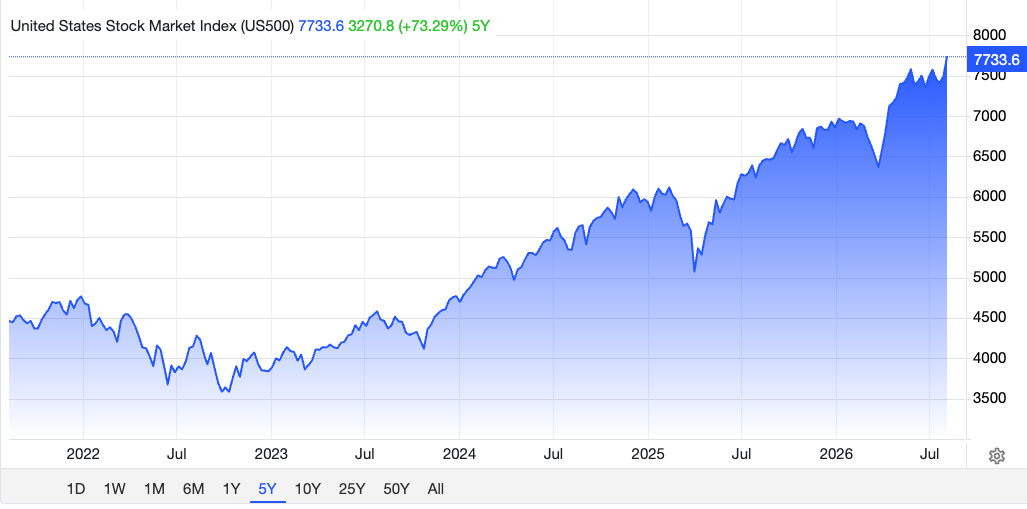
Markets rebounded this week as geopolitical tensions eased and oil prices declined. The S&P 500 gained nearly 4% and set a new all-time high, with the Dow Jones, S&P 500 Equal Weight, and Russell 2000 also setting records.
Technology, Consumer Discretionary, and Communication Services led all sectors, as the mega cap tech stocks known as the Magnificent 7 gained nearly 6.5%.
Energy was the worst-performing sector as oil prices fell nearly 7%, with defensive sectors also lagging the rally.
Bonds gained as oil and Treasury yields fell. Shorter-maturity bonds outperformed as easing inflation fears trimmed the odds of a rate hike, while high-yield corporates outperformed as credit spreads re-tightened, a sign of risk appetite.
The U.S. dollar strengthened slightly, the VIX declined, and gold rose to its highest level since mid-June.
Key Takeaways
Fed Holds Rates Steady for a Fifth Meeting
The Fed held its benchmark rate at 3.50% to 3.75% for a fifth consecutive meeting, the second under Chair Kevin Warsh. Three officials dissented in favor of a quarter-point increase, the most in that direction since 2016, and Warsh offered little guidance on the path ahead.
Stocks declined and Treasury yields rose to multi-year highs after the decision, with the 30-year yield trading near a 19-year high, on concern the Fed was not moving fast enough on inflation and might have to raise rates more later. Markets place around a 60% probability on a hike at the September meeting.
Why it matters: The Fed is providing less guidance about its intentions, which makes its policy path harder to forecast and, in turn, has made interest rates more volatile.
Oil Whipsaws on Middle East Tensions
Oil spiked more than 30% in July as the U.S.-Iran conflict escalated again, with West Texas Intermediate crude above $90 a barrel. It has since reversed by nearly 20% as a planned U.S. strike was paused and talks turned to reopening the Strait of Hormuz, a critical route for global oil trade.
Crude now trades near $75, roughly where it stood before the latest flare-up in early July. The headlines and move in oil prices are the latest in a pattern that has repeated multiple times this year, with each escalation followed by a round of de-escalation and one set of headlines countered by the next.
Why it matters: The conflict and swings in oil prices have added to interest-rate volatility and uncertainty about Fed policy.
Big Tech Earnings Split on AI Payoff
Several of the Magnificent 7 reported quarterly results this week, and investor reactions diverged sharply. The difference came down to how much growth each could show in return for its AI spending.
Microsoft rose 16% after its Azure cloud business grew 43%, the biggest one-day market-value gain for a stock on record, and Amazon gained 10% after its cloud division drove the first ever $200 billion quarter. In contrast, Meta declined as its heavy AI spending and a profit miss weighed on its ad business.
Why it matters: Investors are differentiating among the big tech companies, rewarding clear returns on AI spending and turning more cautious on the rest.
Q2 Growth Slowed but Core Demand Held Firm
The U.S. economy grew at a 1.5% annualized rate from April through June, down from 2.1% in Q1. The slowdown traced mainly to an increase in imports, which count against GDP, and a decline in government spending.
A measure of private demand that combines consumer spending and business investment rose 3.9%, more than double the 1.7% pace of the first quarter, as consumers continued to spend.
Why it matters: The economy's core held up despite the slowdown, with consumer and business demand still growing even as the headline number cooled.
Manufacturing Hit a Four-Year High in July
A widely followed gauge of factory activity, the ISM's manufacturing index, rose to 55.6 in July from 53.3 in June, its strongest reading since 2022. A level above 50 signals expansion.
The improvement was broad: production led the gain, new orders held firm, factory hiring expanded for the first time in nearly three years, and cost pressures eased.
Why it matters: Manufacturing continues to strengthen after several sluggish years, when elevated interest rates and reduced capital spending weighed on activity.


The Market Does Not Need a Recession to Correct
When markets fall, investors often assume something must be wrong with the economy.
They start looking for evidence of a recession, weakening employment, falling consumer spending, or deteriorating corporate profits.
However, markets don't need an economic contraction to experience a meaningful decline.
Sometimes prices simply get ahead of fundamentals.
Indeed, according to Ned Davis Research, moderate corrections of 10% or more happen, on average, once per year. Market declines greater than 15-20% happen once every 2-3 years according to their research.
That’s because valuations can become stretched, interest-rate expectations can change, or investors can crowd into the same companies or sectors.
Additionally, sentiment can shift after a modest earnings disappointment.
And when markets are priced for an unusually favorable outcome, it doesn't take a crisis to force a reset.
That distinction matters because markets and the economy aren't the same thing.
The economy measures activity across businesses, consumers, employment, and production. Markets, on the other hand, reflect what investors are willing to pay today for the cash flows they expect to receive in the future.
As a result, the economy can remain relatively stable while stock prices decline. Corporate earnings may still be growing. Consumers may still be spending. Businesses may still be investing. Yet markets can fall if those outcomes are weaker than investors expected or if the price attached to those outcomes becomes harder to justify.
To be sure, we're seeing some of the forces that can create that vulnerability today.
For example, investors have become more selective about whether artificial-intelligence spending will translate into revenue, cash flow, and profits.
At the same time, higher oil prices and Treasury yields have brought inflation and interest-rate risk back into focus. None of this means a broad correction is underway.
However, it does illustrate how expectations can become more fragile even when the economy isn't falling apart.
In other words, a correction doesn't require a recession. It only requires the market's expectations to change.
Markets Trade on Expectations, Not Just Economic Conditions
One of the most important distinctions we make when evaluating markets is the difference between what's happening in the economy and what investors had already assumed would happen.
The economy tells us what's happening today. Markets are forward-looking, meaning they attempt to price what may happen next.
That means a company can continue growing revenue and profits while its stock declines. If investors expected faster growth, stronger margins, or a clearer return on investment, otherwise respectable results may still disappoint.
Suppose a company reports that earnings increased 10 percent from the prior year. On its own, that sounds like a good result, right?
Well, if the market had expected earnings to grow 15 percent, the stock may still decline. The company hasn't stopped growing, and the business may not be fundamentally impaired. Its results simply weren't strong enough to support the assumptions already reflected in its share price.
The same principle applies to the broader market.
Prices don't fall only when economic conditions become bad. They can also fall when conditions remain good but no longer appear good enough to support current valuations.
That's why a correction can occur before a recession becomes visible in the economic data. It's also why a correction can happen without a recession ever arriving.
Valuation Determines the Margin for Error
Now, a key factor we look at when it comes to market corrections valuations.
That’s because valuation affects how forgiving the market will be when expectations aren't met.
When investors are paying relatively modest prices for future earnings, some uncertainty may already be reflected in stock prices. A company may be able to report a mixed quarter or lower its outlook without producing an extreme reaction.
However, that dynamic changes when valuations become elevated.
A higher valuation often reflects confidence that revenue will keep growing, profit margins will remain strong, interest rates will cooperate, and management will execute with few setbacks. The more favorable assumptions already included in the price, the less room there is for disappointment.
The Federal Reserve describes elevated valuation pressure as a condition in which asset prices are high relative to economic fundamentals or historical norms, often alongside a greater willingness by investors to accept risk.
To be sure, elevated valuations don't tell us exactly when prices will decline, but they can increase the potential for larger losses when expectations change.
That's why a market priced for perfection doesn't need a recession to decline. It may only require the future to look slightly less perfect.
A company might still report higher revenue, but investors may become concerned that expenses are rising faster. A new product may continue attracting customers, but the path to profitability may take longer than anticipated.
An industry may still have a compelling long-term future, but investors may decide they've already paid too much for that potential.
None of those developments requires an economic collapse. They simply require investors to reconsider what they're willing to pay.
Interest Rates Can Reset Prices Without Breaking the Economy
Interest rates can create another source of market pressure.
The value of an investment partly depends on the cash flows investors expect to receive in the future. When the return available elsewhere in the market rises, investors may apply a higher required return to those future cash flows. That can reduce what they're willing to pay today.
At the same time, higher bond yields give investors a more competitive alternative to stocks. Investors may become less willing to accept equity risk when high-quality fixed-income investments offer more attractive yields.
Consequently, the market may demand a lower stock price, a higher expected return, or both.
This effect can be particularly significant for growth companies whose valuations depend heavily on profits expected many years from now. Even when the underlying business outlook remains positive, a change in rates can reduce what investors are willing to pay for those distant earnings.
Bonds can also decline as interest rates rise. Therefore, a period of higher yields can place pressure on both stocks and fixed income without signaling that a recession has begun.
The market may simply be adapting to a different cost of capital.
That's also why inflation matters to investors even when economic growth remains intact. If inflation causes interest rates to stay higher than investors expected, asset prices may need to adjust around that new reality.
Again, the economy doesn't have to contract for that adjustment to take place.
Positioning Can Magnify an Otherwise Ordinary Disappointment
Market corrections aren't driven by fundamentals alone. They're also influenced by how investors are positioned.
When enthusiasm builds around a company, sector, or investment theme, more investors begin owning the same assets for many of the same reasons. Rising prices attract additional capital, recent performance reinforces confidence, and the trade can become increasingly crowded. That process can continue longer than many investors expect.
However, crowded positioning can work in reverse.
A modest disappointment may lead some investors to reduce exposure. Those initial sales push prices lower, which can encourage additional selling from investors who were comfortable with the risk only while prices were rising. Before long, the decline can appear disproportionate to the news that caused it.
The headline may be the catalyst, but valuation, positioning, and sentiment often determine the size of the reaction.
That's another reason markets don't need a recession to correct. A crowded trade can unwind because the expectations supporting it have changed, even when the broader economy remains relatively stable.
Today's Environment Shows the Ingredients, Not the Outcome
The current market environment helps illustrate these forces, but it's important not to overstate what the recent data tells us.
The market hasn't experienced a broad correction simply because some growth and technology investments have come under pressure. Instead, investors have started applying greater scrutiny to companies making large artificial-intelligence investments. The question is shifting from how much those companies can spend to whether that spending can generate sufficient growth, cash flow, and profitability.
Meanwhile, renewed inflation concerns and higher interest rates have complicated the valuation backdrop. These developments don't prove that a correction is coming, and they certainly don't tell us when one might occur. They do, however, show how the assumptions supporting market prices can change.
A company can remain profitable while investors become less willing to pay a premium for its future growth. The economy can remain intact while interest rates force investors to reconsider valuations. A popular investment theme can continue having long-term potential while the stocks associated with it experience a short-term reset.
The current environment makes the subject timely. It doesn't serve as evidence that a broad correction has already occurred.
For evidence of the thesis itself, history provides a cleaner example.
The Fourth Quarter of 2018 Offers a Useful Example
During much of 2018, the Federal Reserve described asset valuations and investor appetite for risk as elevated. The economy, meanwhile, remained in an expansion.
Then, during the fourth quarter, market volatility rose sharply and equity prices declined. That drop reduced valuation pressure in stocks and corporate bonds, even though the underlying economic expansion continued.
The Federal Reserve later reported that economic growth remained solid during the second half of the year, with real gross domestic product growing a little less than 3 percent for 2018 as a whole.
The economy didn't enter a recession in 2018. According to the National Bureau of Economic Research, the expansion that began in June 2009 continued until economic activity peaked in February 2020.
That doesn't mean the 2018 decline was unimportant or that investors knew the economy would continue expanding. It means a meaningful market reset occurred without a concurrent recession.
Investors reassessed valuations, interest rates, global growth expectations, and their appetite for risk. Stock prices adjusted even though the economic expansion still had more than a year to run.
That's the distinction investors often miss.
A market decline may reflect concern about what could happen next. It may reflect a lower price investors are willing to pay for the same earnings. Or it may simply reverse some of the optimism that had already been built into prices. It doesn't automatically mean the economy has entered a recession.
How We Read a Market Decline
In our investment process, we don't treat every pullback as evidence that the long-term plan is broken. Over the years, we've learned to ask the same question first, before anything else. Is the market repricing expectations, or is the economy actually deteriorating?
That single question does most of the work. The market can reprice for all the reasons we've described, stretched valuations, higher rates, crowded positioning, a modest earnings disappointment, without the economy changing at all. So the first thing we look for isn't a headline. It's evidence of genuine financial stress.
Credit conditions tend to tell us the most. When investors grow truly concerned about borrowers' ability to repay, that worry shows up in credit markets before it appears almost anywhere else. When credit spreads stay calm while stocks fall, the decline usually looks more like repositioning than a fundamental break.
When spreads widen meaningfully, we pay closer attention. That's the same signal we've relied on through past pullbacks, and it rarely misleads us.
From there, the rest of the read fills in around that question. We look at whether weakness is broad or concentrated, because a decline led by a handful of highly valued companies tells us something different from weakness spreading across most sectors and company sizes.
We look at whether corporate fundamentals are deteriorating across the market or whether a smaller group of companies is simply failing to meet elevated expectations, because there's a real difference between profits falling throughout the economy and a profitable company disappointing investors who wanted more.
And we consider whether interest rates are changing the return investors demand, because a higher discount rate can lower prices even when the expected cash flows haven't weakened at all.
None of those readings, though, answers the only question that ultimately matters to you. Does this decline change your plan?
That's where we finish, every time. We return to the purpose of the money.
Has your time horizon changed?
Have your near-term spending needs increased?
Is there enough liquidity in place?
Has your willingness or ability to accept risk changed?
We also look at whether prior performance has quietly left the portfolio more concentrated than intended, because an investment that did well can grow into a larger position and leave you more dependent on one company, one sector, or one outcome than you meant to be.
A correction that doesn't change your goals, time horizon, or cash-flow needs may not require any change to the long-term strategy.
However, a portfolio that was too concentrated, too aggressive, or too dependent on near-term withdrawals may reveal a weakness that deserves attention.
This approach doesn't let us predict the market's exact bottom.
Nothing does.
But it does help us tell the difference between normal repricing, broader financial stress, and a portfolio problem that actually requires action. That distinction is the one that protects the plan.
Diversification Matters When Leadership Changes
The purpose of portfolio construction isn't to eliminate every decline. That isn't realistic.
Instead, the goal is to build a portfolio that doesn't require every part of the market to perform well at the same time.
Market leadership changes. Growth can outperform value for an extended period before the relationship reverses. Domestic stocks can lead international markets until valuation differences begin to matter. Longer-term bonds can provide diversification in one environment and struggle when inflation and interest rates rise. No allocation works best under every condition.
That's why diversification isn't simply about owning more investments. It's about reducing the portfolio's dependence on one company, one investment style, or one economic outcome.
The SEC describes asset allocation as dividing investments among categories such as stocks, bonds, and cash. It also emphasizes that investors should look beneath fund labels and examine underlying holdings, because owning several funds doesn't necessarily create meaningful diversification.
Diversification can't prevent losses or guarantee better returns. However, it can reduce the risk that weakness in one narrow part of the market disrupts the entire plan.
Rebalancing provides another layer of discipline. When one area has risen far beyond its intended allocation, rebalancing can reduce unintended concentration.
When another area has fallen below its target, the process can create a systematic way to restore exposure without relying entirely on emotion or short-term predictions.
The SEC identifies asset allocation, diversification, and rebalancing as related tools for managing portfolio risk over time.
Adequate liquidity matters as well. Investors who have their near-term spending needs covered are generally in a better position to tolerate volatility. They're less likely to become forced sellers during a decline and less dependent on correctly predicting when the correction will end.
In our experience, these decisions are best made before markets become unsettled. It's far easier to build discipline into a portfolio when nothing is going wrong than to manufacture it in the middle of a selloff.
Build for the Reset Before It Arrives
Corrections are uncomfortable because they create uncertainty without providing a clear endpoint.
Nevertheless, they're a normal part of investing.
A durable investment plan shouldn't depend on the economy avoiding every slowdown, interest rates moving exactly as expected, or investors remaining permanently enthusiastic about the same companies.
It should assume that valuations will occasionally reset, market leadership will change, and prices will sometimes decline even when the economic backdrop remains relatively stable.
Therefore, the important question isn't whether the market will experience another correction. It will.
The more important question is whether your portfolio was built to withstand one.
A pullback isn't automatically evidence that the plan has failed. Sometimes it's simply the market adjusting expectations, demanding greater discipline, and returning prices to a level that better reflects the risks ahead.
The market doesn't need a recession to correct. Likewise, a disciplined investor doesn't need to predict every correction to be prepared for one.
So the real question isn't whether you can see the next correction coming. It's whether your plan is ready when it does.
Sources
Federal Reserve Board, Financial Stability Report: Asset Valuation Pressures, November 2018; https://www.federalreserve.gov/publications/2018-november-financial-stability-report-asset-valuation-pressures.htm
Federal Reserve Board, 2018 Annual Report: Monetary Policy and Economic Developments; https://www.federalreserve.gov/publications/2018-ar-monetary-policy.htm
National Bureau of Economic Research, Determination of the February 2020 Peak in US Economic Activity, June 8, 2020; https://www.nber.org/news/business-cycle-dating-committee-announcement-june-8-2020
U.S. Securities and Exchange Commission, Investor.gov, Asset Allocation and Diversification; https://www.investor.gov/introduction-investing/getting-started/asset-allocation
Stock Market Corrections Are Normal — Ned Davis Research (PDF); https://www.ndr.com/hubfs/NDR/Business%20Developer/pdfs/EDU_8_WM_public.pdf?hsLang=en

July Market Update: A Loud Month, a Quiet Market
July gave investors plenty to think about.
Geopolitical tensions flared again in the Middle East. AI stocks pulled back after a strong start to the year. And the Federal Reserve had another rate decision to make.
Yet when the month was over, the market had barely moved.
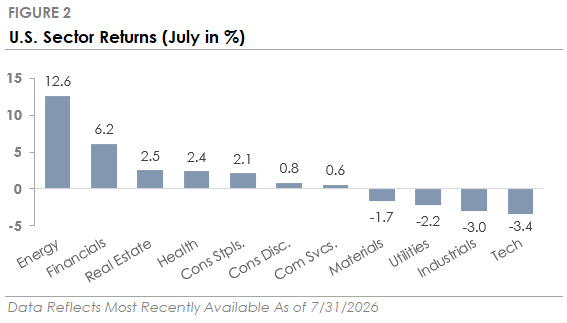
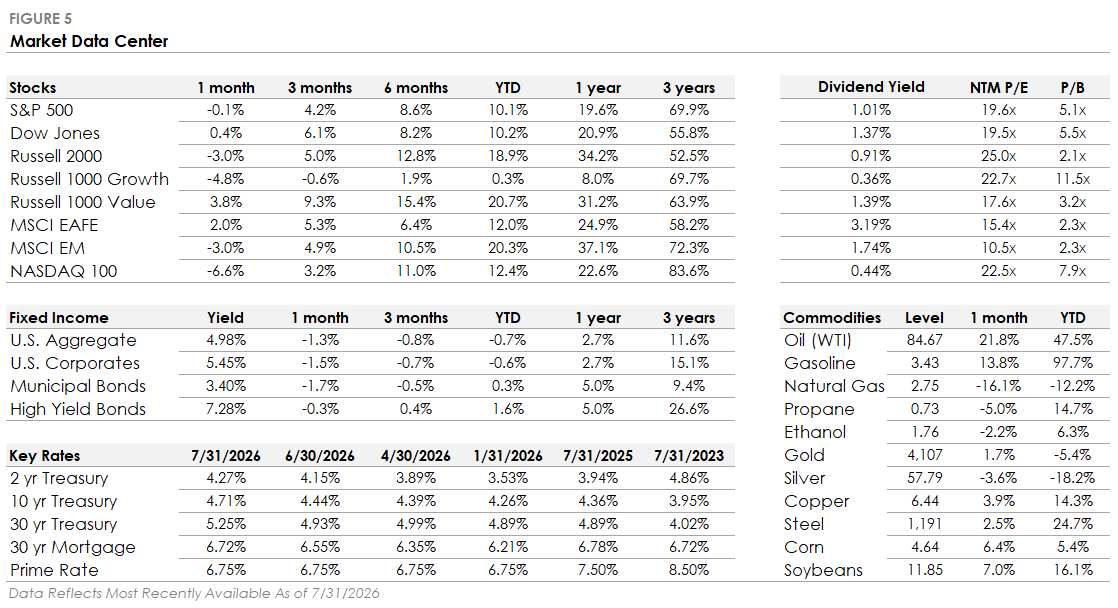
The S&P 500 returned -0.1%.
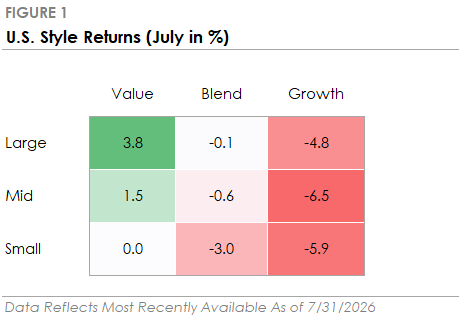
Beneath that flat headline, though, there was quite a bit going on. Energy led every sector with a +12.6% return as geopolitical tensions pushed oil prices higher. Financials followed at +6.2%. The more defensive corners of the market held up well too, with Real Estate (+2.5%), Health Care (+2.4%), and Consumer Staples (+2.1%) all gaining ground.
Technology was the outlier. The sector fell -3.4% as AI stocks gave back some of the gains they'd built up earlier in the year.
Bonds had a tougher month.
The U.S. Aggregate Bond Index returned -1.3% as Treasury yields moved higher. The culprit was familiar: rising oil prices, tied to the renewed U.S.-Iran conflict, brought inflation concerns back to the surface. Investment-grade corporate bonds lagged with a -1.5% return, while high-yield corporates held up a bit better at -0.3%.
Overseas, the picture was mixed. Developed international markets gained +2.0% and outperformed the S&P 500. Emerging markets went the other way, returning -3.0%, as the same U.S. tech selloff weighed on South Korean stocks.
Markets Turn Back to the Middle East as Tensions Resurface
The ceasefire from earlier this spring didn't hold.
Renewed conflict between the U.S. and Iran brought back the same headlines and the same concerns we saw earlier in the year. Once again, uncertainty around the Strait of Hormuz raised the risk of reduced oil supply. Late in the month, there were signs of another round of de-escalation, but the situation remains fluid.
This matters for the same reason it did the first time around.
After all, energy prices feed directly into inflation. And inflation, in turn, shapes what the Federal Reserve decides to do next.
In July, the Fed held interest rates steady for the fifth consecutive meeting. But it wasn't a unanimous call. A handful of officials pushed for a +0.25% rate hike, pointing to the renewed inflation risk.
If this feels familiar, that's because it is.
We've now moved through this same cycle several times this year. Conflict escalates. Oil prices rise. Tensions ease. And then the pattern repeats. The specific headlines shift from week to week, but the market has absorbed this same shock more than once.
The Fed's split decision reflects that uncertainty. Officials are debating their next move, but for now they're choosing to gather more information rather than react to the latest headline.
And here's the part worth remembering: despite all the noise, the net impact on markets has been limited. Stocks rebounded from the March selloff, and the S&P 500 has returned nearly +10% this year.
AI Stocks Trade Lower as Investors Shift Focus from Growth to Discipline
Second-quarter earnings season kicked off in July, and the biggest names in AI all reported: Alphabet, Microsoft, Meta, Apple, and Amazon.
These are the companies pouring money into data centers and the other infrastructure needed to power artificial intelligence. This quarter, they laid out their forecasts and their spending plans.
Something had changed in how investors received them.
For the past two years, the AI conversation was all about scale. How much are these companies spending? How fast are they building? How big could the opportunity get? This quarter, the focus shifted to a different question: profitability and return on investment.
In plain English, investors started pushing back on the spending.
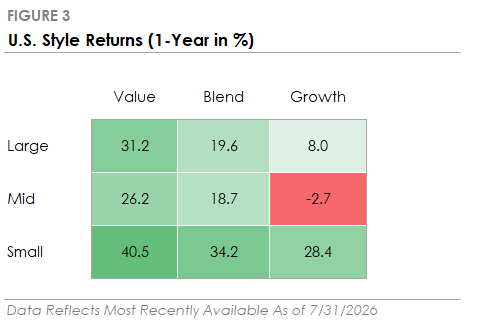
Companies whose investments are clearly translating into growth, like Microsoft's cloud business, were rewarded. Companies whose spending has outpaced their cash flow, or started to weigh on profit margins, saw their stocks move lower.
The market is no longer content to reward growth and big spending numbers on their own. It's asking a harder question: is the spending actually profitable, or are expenses climbing faster than revenue?
This is a healthy development.
Every major technological buildout eventually reaches a point where investors stop rewarding growth for its own sake and start looking for results to match. July was the month that question arrived for AI.
As that scrutiny set in, semiconductor stocks and other parts of the AI trade gave back some of their earlier gains, with investors questioning whether the current pace of spending could last.
But it's worth keeping the pullback in perspective.
The volatility stayed relatively contained. For instance, the equal-weight S&P 500, a proxy for the average S&P 500 stock, set a new all-time high late in the month, and seven of the eleven sectors finished higher. Credit spreads, which measure how worried the market is about credit risk, widened only modestly and remain very tight by historical standards. And even after the pullback, semiconductor stocks are still up nearly +60% for the year.
As for the companies doing the spending? They're forecasting even higher spending levels in the quarters ahead.

What This Means for Investors
July was a busy month that, on the surface, went almost nowhere.
Geopolitical tension returned. AI leadership wobbled. The Fed stood pat, but not without disagreement. And through all of it, the S&P 500 finished essentially flat.
That's a useful reminder.
A lot can happen in a month without much of it showing up in your account balance. The headlines were loud, but the market's response was measured, and in some ways more disciplined than it's been in a while.
That discipline is the theme worth holding onto. Whether it's a geopolitical shock the market has already learned to absorb, or a shift toward asking harder questions about AI spending, the through-line is the same. Markets are starting to separate noise from results.
For long-term investors, that's not something to fear. It's something to build around.

Weekly Market Update: Oil Shock Pushes Yields to Fresh Highs
Markets traded lower this week as the conflict in the Middle East intensified and oil prices surged 17%.
The S&P 500 and Nasdaq each declined roughly 2%, while the Russell 2000 finished the week down about 1.5%. Most equity factors also moved lower, including Growth, Value, and Equal Weight, as market participation weakened.
Momentum and High Beta were the two exceptions. Both outperformed after lagging in recent weeks, helped in part by continued weakness across semiconductor stocks.
At the sector level, Energy and Utilities led the market higher. Meanwhile, Consumer Discretionary declined nearly 7% as investors considered how higher fuel and transportation costs could affect household spending and corporate profit margins.
Bonds also traded lower as interest rates rose across the yield curve. Longer-maturity bonds underperformed, which is typically what we’d expect when investors become more concerned about inflation. The VIX climbed back toward 20 late in the week, while the U.S. dollar strengthened as interest rates rose and market volatility increased.
Key Takeaways
Oil Prices Rise as the U.S.-Iran Conflict Escalates
The United States carried out a twelfth consecutive night of strikes this week, while Iran continued targeting tankers traveling through the Strait of Hormuz. The strait is one of the world’s most important energy corridors and carries a significant share of the global oil trade.
Meanwhile, Yemen’s Houthi rebels added another layer of uncertainty by threatening a naval blockade against Saudi Arabia. That threat raises the possibility of disruption not only in the Strait of Hormuz, but also across shipping routes in the Red Sea.
Oil prices responded quickly. West Texas Intermediate crude climbed above $90 per barrel, while Brent crude, the international benchmark, briefly touched $100. Both reached their highest levels in roughly six weeks.
At the same time, there’s been little visible diplomatic progress. Secretary of State Marco Rubio said Iran was “not serious about talks,” reducing near-term expectations for a negotiated resolution.
Why It Matters: The conflict had shown signs of stabilizing, but each additional strike, tanker attack, or threat to shipping routes introduces a new risk premium into oil prices.
The issue isn’t simply whether oil reaches a particular price. What matters is how long prices remain elevated and whether those higher costs begin working their way through transportation, manufacturing, utilities, and consumer spending.
In other words, the longer the conflict continues, the greater the chance that an overseas geopolitical event turns into a broader inflation and economic-growth concern for the United States.
Rising Oil Prices Push Treasury Yields to Fresh 52-Week Highs and Revive Expectations for a Fed Rate Hike
This week’s move in Treasury yields was a direct extension of the Middle East story.
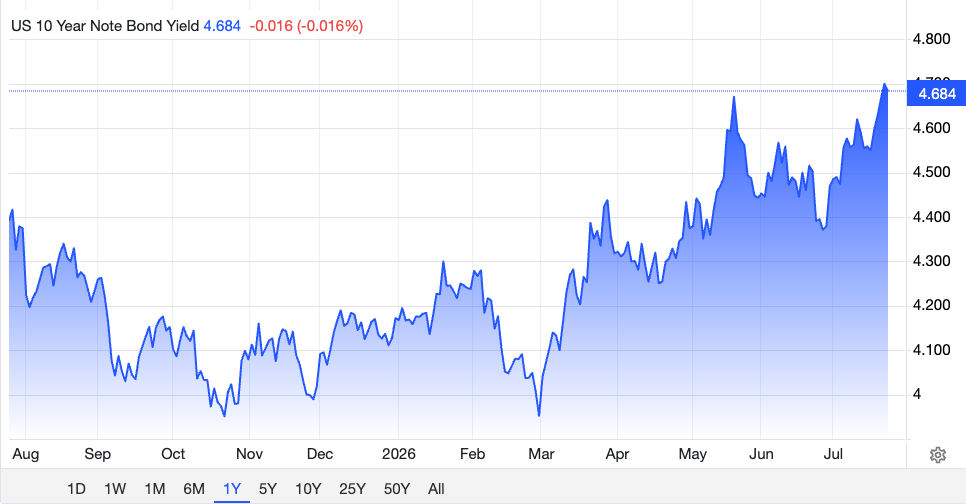
The 10-year Treasury yield rose above 4.70%, reaching a new 52-week high, as investors began pricing a greater risk that higher energy costs could keep inflation elevated.
Expectations for Federal Reserve policy also shifted. Fed funds futures now assign a greater than 80% probability to an interest-rate increase at the Fed’s September meeting, up from approximately 50% one week ago.
That’s a meaningful change in a short period of time. It suggests that investors are no longer viewing the rise in oil prices as an isolated market event. Instead, they’re considering whether higher energy costs could affect the Fed’s broader inflation outlook.
Why It Matters: Treasury yields are now closely tracking developments in the Middle East, which highlights how interconnected energy markets, inflation expectations, and interest rates have become.
Higher yields can create pressure across several parts of the economy. They can raise borrowing costs for households and businesses, weigh on bond prices, and make it more difficult for highly valued stocks to justify their current prices.
However, the key question for the Fed is whether the rise in energy prices is temporary or whether it begins affecting wages, consumer expectations, and the prices of other goods and services.
A short-lived oil shock may not change the Fed’s plans. A prolonged inflationary shock could.
Alphabet’s Strong Quarter Was Overshadowed by a Growing AI Capital-Spending Commitment
Alphabet reported second-quarter results Wednesday that exceeded expectations across several major areas.
Revenue increased 24% to $120 billion, Google Cloud revenue jumped 82%, and operating margins expanded. By most traditional measures, it was a strong quarter.
However, Alphabet shares still declined approximately 5% in after-hours trading as investors focused on the amount of spending required to produce that growth.
The company increased its 2026 capital-expenditure guidance to between $195 billion and $205 billion, up from its previous range of $180 billion to $190 billion. Management also indicated that spending would increase again in 2027.
Meanwhile, quarterly free cash flow turned negative for the first time in the company’s history as capital spending exceeded the cash generated by its operating businesses.
Why It Matters: The market doesn’t appear to be questioning whether artificial intelligence is contributing to growth. Alphabet’s results provide strong evidence that it is.
Instead, investors are asking a more difficult question: How much will companies have to spend to generate that growth, and when will those investments begin producing an attractive return?
That distinction matters because revenue growth alone doesn’t necessarily create shareholder value. Companies also need to demonstrate that the cash invested in data centers, chips, energy, and other AI infrastructure can eventually produce sustainable profits and free cash flow.
For now, the market appears willing to support substantial AI investment. However, investors are becoming less willing to accept an unlimited spending commitment without clearer evidence of the eventual payoff.
Next Week’s Calendar Could Answer Many of These Questions
Several of the market’s biggest current debates will be tested within a two-day period next week.
The Federal Reserve’s two-day meeting concludes Wednesday, July 29, with an interest-rate decision and press conference. Investors will be listening closely for signs that officials view higher energy prices as a temporary disruption or as a reason to reconsider the path of monetary policy.
Microsoft and Meta will report earnings after the market closes that same day. Their results will provide two more important data points in the debate over AI-related spending, revenue growth, and investment returns.
Then, on Thursday, investors will receive the advance estimate of second-quarter gross domestic product and the June Personal Consumption Expenditures Index, the Fed’s preferred inflation gauge.
Apple and Amazon will report earnings after Thursday’s closing bell, adding additional information about consumer demand, cloud computing, and corporate technology spending.
Why It Matters: Nearly every major question discussed this week will face a real-world test next week.
The inflation data may show whether price pressures were already building before the latest rise in oil. The Fed’s comments may clarify whether officials are prepared to respond to energy-driven inflation. Meanwhile, the technology earnings reports may reveal whether AI spending is continuing to generate enough growth to justify its rapidly rising cost.
Any one of these events could move markets. Taken together, they could determine whether this week’s volatility was a temporary response to geopolitical uncertainty or the beginning of a more meaningful shift in the market’s outlook for inflation, interest rates, and corporate profits.

Weekly Market Update: Tech Stumbles, but the Broader Market Holds Steady
Markets finished the week mixed as leadership continued to rotate beneath the surface.
The S&P 500 slipped -0.1%, while the Nasdaq declined -2.5% as investors moved away from Technology stocks. However, the weakness in the major indexes didn’t tell the full story.
Both value stocks and the equal-weighted S&P 500 outperformed, which suggests that the average stock held up better than the largest companies driving the headline indexes. Meanwhile, high-beta and momentum stocks led the market lower because of their heavy exposure to Technology, which declined -4.3% for the week.
Even so, eight of the eleven S&P 500 sectors finished higher, led by Energy and Consumer Staples. That broader participation helped offset some of the weakness in Technology.
Bonds were mostly unchanged. However, longer-dated Treasury bonds modestly underperformed as oil prices surged nearly +10% following renewed conflict in the Middle East.
Elsewhere, the VIX, a measure of expected market volatility, held steady. The U.S. dollar was little changed, while Bitcoin gained +1.0%.
Key Takeaways
Inflation Cooled Sharply in June as Energy Prices Fell
Consumer inflation declined sharply in June.
The Consumer Price Index, or CPI, fell -0.4% for the month, marking its largest monthly decline in more than six years. As a result, the annual inflation rate slowed to +3.5% from +4.2% in May.
Wholesale inflation eased as well, suggesting that some price pressures were moderating before reaching consumers.
However, much of the improvement came from energy. Gasoline prices declined nearly -10%, which pulled down both consumer prices and wholesale costs.
That distinction matters because June’s report reflects a period when oil prices were falling and were significantly lower than they are today. Since the beginning of July, the U.S.-Iran ceasefire has broken down, and crude oil has climbed back toward $80 per barrel after starting the month below $70.
Why it matters: June’s inflation improvement was real, but it depended heavily on lower energy prices that have already begun to reverse. With inflation still above the Federal Reserve’s 2% target and oil prices climbing again, the central bank has signaled that it may need to raise interest rates.
Wall Street Banks Reported Strong Second-Quarter Earnings
Wall Street banks benefited from a busy and volatile second quarter.
Banks earn fees when companies issue debt or stock, complete mergers, go public, or increase their trading activity. During the second quarter, all of those areas were active.
A wave of dealmaking and initial public offerings, including the roughly $75 billion SpaceX debut, helped drive investment banking revenue higher. At the same time, market volatility tied to the Middle East conflict and the continued AI boom supported trading revenue.
AI-related financing added another source of activity. Companies continued raising debt and equity to fund the construction of data centers and other infrastructure needed to support AI development.
As a result, Goldman Sachs reported the strongest quarter in its history. JPMorgan Chase, the nation’s largest bank, increased earnings by more than +40% compared with the same period a year ago.
Why it matters: The same active and volatile market environment that created uncertainty for investors worked in the banks’ favor. When companies raise capital and investors trade more frequently, banking fees and trading revenue tend to rise.
The Broader Market Held Steady as Technology Turned Volatile
Semiconductor stocks continued to experience sharp day-to-day swings as investors questioned the pace, cost, and potential payoff of the AI buildout.
However, that volatility hasn’t spread across the broader market.
Instead, market leadership has rotated. As investors reduced exposure to chipmakers and other Technology stocks, they moved into areas such as Financials, Industrials, Energy, and Consumer Staples.
Because of that rotation, the S&P 500 remains within 1% of its early June record despite the recent weakness in Technology.
There are also few signs of broader financial stress. The VIX remains in the mid-teens, while credit markets have stayed calm and credit spreads remain extremely tight.
Why it matters: This year’s most popular trade has become more volatile, but the weakness hasn’t pulled the entire market lower. Other sectors have begun to participate, helping offset the decline in semiconductor and Technology stocks.
Consumer Spending Continued to Rise in June
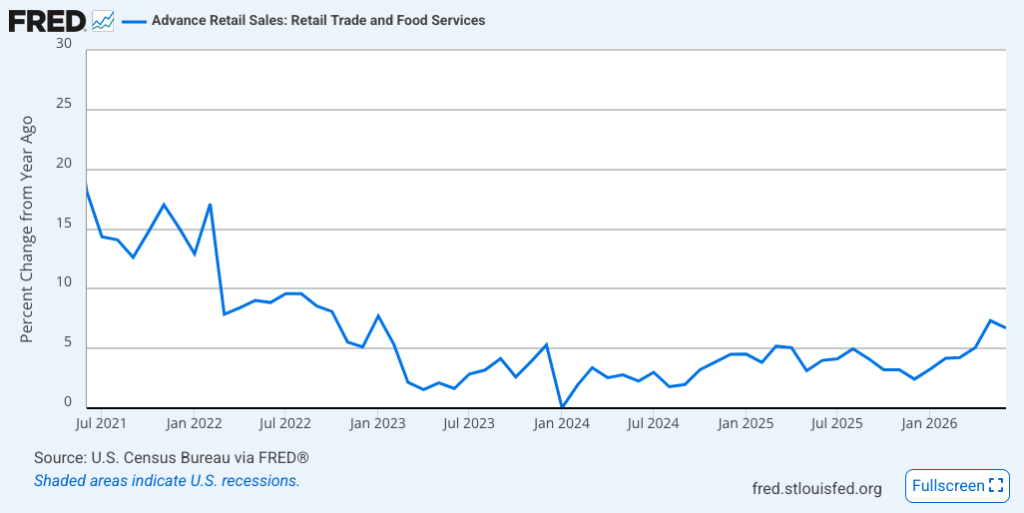
Retail sales increased +0.2% in June. That was slower than May’s revised +1.0% gain, but it was in line with expectations.
Once again, energy prices played an important role.
Lower gasoline prices reduced sales at gas stations, which weighed on the headline retail sales figure. However, those same lower energy costs also helped ease inflation and left consumers with more money to spend elsewhere.
Excluding gasoline, retail sales increased +0.7%. Online shopping contributed to the gain as consumers took advantage of promotions surrounding Amazon’s Prime Day.
Why it matters: Consumer spending drives most of the U.S. economy. June’s report suggests that spending is continuing to hold up rather than stall, particularly once the effect of lower gasoline prices is removed.

Weekly Market Update: May's Record Rally Runs on a Short Leash
May was a month of records, though the rally's foundation was narrower than the headlines suggested. The S&P 500, Nasdaq, Dow, and Russell 2000 all set new all-time highs, powered almost entirely by technology and semiconductor stocks. The gains came despite a genuine rate scare: back-to-back hot inflation readings put a Federal Reserve rate hike back on the table and pushed long-term Treasury yields sharply higher. The pressure faded when oil prices fell more than 13%, taking inflation fears with them and clearing the way for the AI trade to reassert itself.
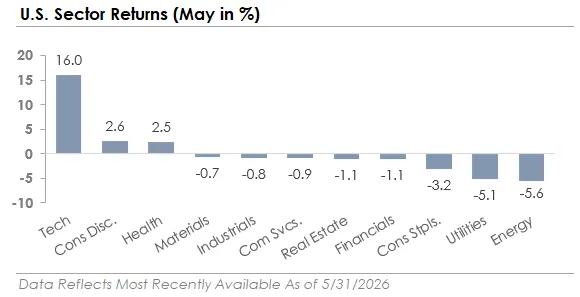
Beneath the surface, the picture was more complicated. Technology gained nearly 20% on the month; strip it out, and the remaining sectors were slightly negative in aggregate. Only three of the eleven sectors finished higher. Bond markets reflected the same tension, with shorter-term yields rising while longer maturities ended roughly flat. In credit, spreads generally tightened, though the riskiest tier of high-yield bonds diverged and widened. Oil fell 13.2% as the geopolitical risk premium unwound, dragging the broader commodity complex down more than 5%. Corporate earnings offered a bright spot: first-quarter blended growth came in at 28.6% against a 13.1% estimate, with profit margins reaching a record 14.8%. But like the rally itself, the earnings strength was concentrated in a handful of large semiconductor and mega-cap names.
The month also brought a change at the Federal Reserve. Jerome Powell's term expired in mid-May, and Kevin Warsh was confirmed as the new chair. Warsh inherits a complicated environment: the base case points to a rate hike by December if the Strait of Hormuz disruption keeps oil prices elevated, the administration has expressed a preference for lower rates, and inflation remains above the 2% target. Markets will need to adjust to a new communication style just as the Fed's independence faces heightened scrutiny.
The economic backdrop offers a similarly mixed read. The labor market has firmed after softening last fall, and manufacturing has returned to expansion territory. The consumer, however, is moving the other way, with income growth slowing and confidence near record lows by some measures. What has kept households spending is balance-sheet strength from elevated home values and a rising stock market. That support, as long as it holds, keeps the expansion intact. Whether it holds is the central question heading into the summer.
Key Takeaways
Records Built on Narrow Leadership
May's market gains were real, but the breadth underlying them was not. Technology accounted for nearly all of the S&P 500's advance, and most sectors finished negative. The Dow, Russell 2000, and equal-weight S&P each returned between 2% and 3%, a fraction of the Nasdaq's performance. Momentum and high-beta factors led; defensive and dividend-oriented stocks lagged.
Why it matters: An index sitting at all-time highs on such concentrated leadership is more fragile than the scoreboard implies. Any shift in sentiment around AI and semiconductors would leave most of the market without a catalyst to offset the pressure.
Oil Was the Swing Factor
WTI crude fell 13.2% in May as the geopolitical risk premium tied to the Strait of Hormuz unwound. That decline did the critical work of easing inflation pressure mid-month, pulling Treasury yields lower and giving equities room to recover. The broader commodity complex fell more than 5% in sympathy.
Why it matters: The rally's trajectory is directly tied to oil. The Strait of Hormuz remains functionally closed, and the physical supply disruption is unresolved. If oil prices move higher again, the inflation and rate-hike risk that rattled markets mid-month returns with it.
A New Fed Chair Adds Policy Uncertainty
Kevin Warsh replaced Jerome Powell as Federal Reserve chair in mid-May, inheriting an environment with inflation above target, a December rate hike increasingly priced in, and an administration publicly favoring lower rates. Futures markets, which began the year expecting cuts, now assign meaningful odds to a hike by year-end.
Why it matters: A leadership transition at the Fed introduces communication uncertainty at a moment when policy expectations are already shifting. Markets priced in cuts and got a possible hike. How Warsh navigates that gap, and the political pressure that surrounds it, will shape rate expectations for the remainder of the year.
Earnings Growth Is Strong but Concentrated
First-quarter blended earnings growth came in at 28.6%, well above the 13.1% estimate entering the quarter, with profit margins reaching a record 14.8%. Analysts have continued to raise forecasts, with upgrades outpacing downgrades by roughly two and a half to one.
Why it matters: Strip out the largest semiconductor names and technology's growth rate is cut roughly in half. The same concentration that defines the price rally defines the earnings beneath it. As estimates keep rising, the bar future quarters must clear keeps rising with them.
The Consumer Is the Key Risk to Watch
The labor market has firmed and manufacturing has returned to expansion, but consumer confidence is near a record low by at least one closely watched measure, and income growth continues to slow. Households have stayed spending largely because elevated home values and a rising stock market support balance-sheet health.
Why it matters: Several years of consumer-led growth have kept the expansion intact. If the asset-price support that underlies household spending begins to weaken, reduced consumer outlays could translate into slower economic growth at the same moment the Fed may be tightening rather than easing.

The Tax Items Congress Wants, But Probably Won’t Pass Yet
Most months, there isn’t much new tax law to report. This is one of those months.
No major tax rules have changed. But there’s still a useful update worth sharing, because what Congress is debating now can tell us something about where tax policy may be headed, even when nothing has changed yet.
The Short Version
Republicans are working on another budget reconciliation bill before the midterm elections.
Reconciliation is the procedural workaround that lets the Senate pass certain budget-related legislation with a simple majority instead of the usual 60-vote threshold. It’s how last year’s major tax bill became law on a strictly partisan vote, and it’s the most likely vehicle for any significant tax legislation between now and then.
GOP taxwriters would like to see tax provisions included in this next bill. Their wish list includes priorities that didn’t make it into last year’s bill, a framework for taxing digital assets, changes to health savings accounts, easings to the corporate alternative minimum tax, and reforms to refundable credits.
That’s the wish list. The problem is that the vehicle for carrying it may not be available this time.
The next reconciliation package now looks likely to be narrow. The current direction from the White House and congressional leadership is to limit the bill to funding for two Department of Homeland Security agencies, Immigration and Customs Enforcement and Customs and Border Protection.
The administration wants the bill enacted by June 1, which puts pressure on lawmakers to move quickly and reduces the appetite for expanding the package.
In other words, taxes probably aren’t in the next bill. But the wish list itself is still informative.
What We’re Watching, and Why
When tax provisions are debated and then deferred, it’s tempting to file the news away as not relevant yet.
We treat it differently.
The items being discussed today are often the items that resurface when the next legislative opportunity appears. The planning value of knowing what may be coming is highest before the rules are final, not after.
A few specific items are on our watch list.
Digital Assets
A clear federal framework for taxing cryptocurrency and other digital assets has been on the wish list for years and keeps getting pushed.
When it does pass, it could create new reporting obligations and may affect how gains, losses, and transactions are documented. Clients with meaningful digital asset positions should expect this issue to land eventually.
Health Savings Accounts
Proposed changes generally aim to expand who can contribute and how the funds can be used.
HSAs are already one of the most tax-efficient accounts in the code. Any expansion could create new planning opportunities for clients who qualify, especially those trying to coordinate healthcare costs, retirement planning, and long-term tax efficiency.
Refundable Credits
Reform here usually means tightening eligibility and increasing verification.
That connects directly to the broader IRS enforcement story we wrote about separately. The trend is toward more scrutiny of these credits, whether through legislation, enforcement, or both.
Corporate Alternative Minimum Tax
Most individual clients aren’t directly affected by the corporate alternative minimum tax.
But executives, business owners, and investors with exposure to companies affected by the rule may still care about how changes could flow through to valuation, cash flow, compensation, or transaction planning.
The Big Takeaway
None of these tax changes appear imminent.
But they’re still worth watching, because tax legislation tends to move in long pauses punctuated by short bursts of activity. The pauses are when planning happens. The bursts are when the rules change.
We watch the legislative calendar so that when something does move, we already know what it means for the clients it affects. More importantly, we’ve already had the conversations that need to happen.
If any of the items above touch your situation and you’d like to talk through the implications, we’re glad to do that.

A Smaller IRS, a Different Kind of Enforcement
The IRS is meaningfully different than it was eighteen months ago. The agency has lost more than a fifth of its workforce since the start of 2025, its budget has been cut, and most of the funding boost it received from the 2022 Inflation Reduction Act has been clawed back.
What this adds up to isn't just a smaller IRS. It's a different IRS.
The agency is reshaping what it enforces, how it enforces it, and which taxpayers are most likely to hear from it. That story is worth understanding, both because it's genuinely consequential and because the practical implications for taxpayers aren't what you might first assume.
The numbers behind the change
Congress set the IRS's fiscal year 2026 budget at $11.2 billion, about 9% below FY25. House appropriators are pushing for a further cut to $10.2 billion in FY27. The agency has lost more than 20% of its workforce since January 2025 through deferred resignations and layoffs, with additional departures expected this year.
The Trump administration's FY27 budget request includes an 18% reduction in enforcement activity and projects an enforcement workforce below 25,000. Within that already shrunken enforcement arm, some of the largest losses have hit the examination and collection groups, and many of those who left were experienced agents and managers carrying years of institutional knowledge that won't be easy to replace.
In plain English, the IRS has fewer people, fewer experienced reviewers, and less capacity to conduct traditional enforcement the way it once did.
Fewer audits, especially at the top
The audit rate for individuals has been well below 1% for several years, and we expect it to keep falling, at least over the next few years.
Audits of individuals with $10 million or more of income, which numbered 6,786 in FY25, dropped to 2,264 in FY26. Partnership audits fell from 3,174 to 2,932 over the same period. The agency forecasts further declines in both categories in FY27.
For clients in higher income brackets, who historically faced disproportionate audit attention, the near-term picture is meaningfully different than it was even two years ago. The headline probability of a traditional audit appears lower.
But that doesn't mean enforcement risk has disappeared. It means the nature of that risk is changing.
The odds of a traditional audit may be lower, but the audits that remain are less likely to be random noise. They're more likely to be tied to something specific in the return, such as a mismatch, an anomaly, a complex transaction, or an item that doesn't reconcile cleanly with third-party data.
What's replacing the lost capacity
That's the headline. The more interesting story is what's replacing the lost capacity.
IRS leadership has said publicly that fewer audits will be paired with more targeted ones, and the mechanism for that targeting is increasingly data analytics and artificial intelligence. The agency has been investing in software that mines taxpayer data to surface anomalies, flag suspicious activity, and identify cases for review.
Even with reduced funding, the direction of travel is clear: the IRS is leaning harder on technology because it no longer has the same human capacity. The intent is to compensate for the loss of human reviewers by being more precise about who gets reviewed in the first place.
We'll see how well it works in practice. But the direction is clear: less of the broad coverage that audit rates traditionally measured, and more of the targeted attention those same rates fail to capture.
Where enforcement is concentrating
Two areas in particular look like they'll absorb a disproportionate share of the enforcement capacity that remains.
The first is refundable credits, where the IRS estimated improper payments of $21.4 billion in FY24 alone. The earned income credit, the American Opportunity credit, and the premium tax credit are all on this list, and all are well-suited to algorithmic review.
For many higher-income households, refundable credit reviews may not be the primary concern. But they illustrate the broader enforcement shift. The IRS is favoring areas where software can flag returns quickly and where discrepancies can be identified without a large team of experienced agents.
For you, the more relevant version of that same shift is income matching.
The IRS's automated underreporting program compares the W-2s, 1099s, and other third-party tax forms it receives against what taxpayers report on their returns. Significant mismatches generate a CP2000 notice, which is computer-driven and doesn't require an experienced agent to produce.
This matters for households with brokerage accounts, equity compensation, retirement income, business income, K-1s, real estate activity, charitable giving, or multiple sources of income. The more moving pieces there are, the more important it becomes that the return tells a clean and consistent story.
Traditional enforcement may shrink, but automated enforcement can still expand because it requires fewer experienced agents to initiate. As enforcement leans further into automation, expect more of this kind of correspondence, not less.
What it means for you
For you, this all means a few things.
First, the headline audit risk for high-income clients is genuinely lower than it was. That's a real shift, and it's worth naming rather than dismissing. But it isn't a license for casual recordkeeping.
The audits that do occur will be more precisely chosen. That means the cases that get pulled are more likely to be cases where something genuinely doesn't reconcile. Clean books, good documentation, and coordinated reporting matter at least as much in this environment as they did before, possibly more.
Second, the surface area for automated correspondence is growing.
CP2000 notices, refundable credit reviews, and other algorithm-driven inquiries don't feel like audits and may not show up in the headline audit statistics. They may not require the same scope of work as a full audit, but they still require careful review, documentation, and a timely response.
If you receive one, the worst thing to do is ignore it. The deadlines on these notices are real, and the IRS's response to silence is rarely favorable.
Third, the shape of the agency is going to keep changing.
Budget proposals are still being debated, workforce attrition is ongoing, and the technology is still maturing. What looks like a settled picture today may shift again over the next year or two.
That's part of why we follow this closely. Tax planning is most useful when it accounts for where the enforcement environment is going, not just where it is.
Why coordination matters more now
This is also why tax planning and wealth planning shouldn't live in separate silos.
The more complex your income, investments, retirement withdrawals, equity compensation, business interests, or estate planning becomes, the more important it is that the tax return tells the same story as the financial plan.
A smaller IRS may conduct fewer traditional audits. But a more automated IRS may still notice when the pieces don't line up.
That's why tax planning isn't just about finding deductions or reacting before year-end. It's about making sure decisions are coordinated before they show up on a return. Investment decisions, retirement income decisions, Roth conversion decisions, charitable giving decisions, and estate planning decisions can all create tax consequences. The goal is to understand those consequences ahead of time rather than explain them after the fact.
The Big Takeaway
None of this changes the fundamentals of what we do for clients.
We aim to file accurately, document thoroughly, and structure things so that when the IRS does ask a question, the answer is already on the shelf.
That discipline mattered when audit rates were higher, and it matters now, even as the agency asking the questions becomes smaller, more automated, and more selective.
The goal hasn't changed: clarity in your filings, confidence in your position, and the peace of mind that comes from knowing the work was done right the first time.
Analysts Corner: 06/25/2024 – Mid Year Economic Outlooks
Weekly Market Recap
A look back at the financial markets over the past week and a look ahead at key economic developments this week.
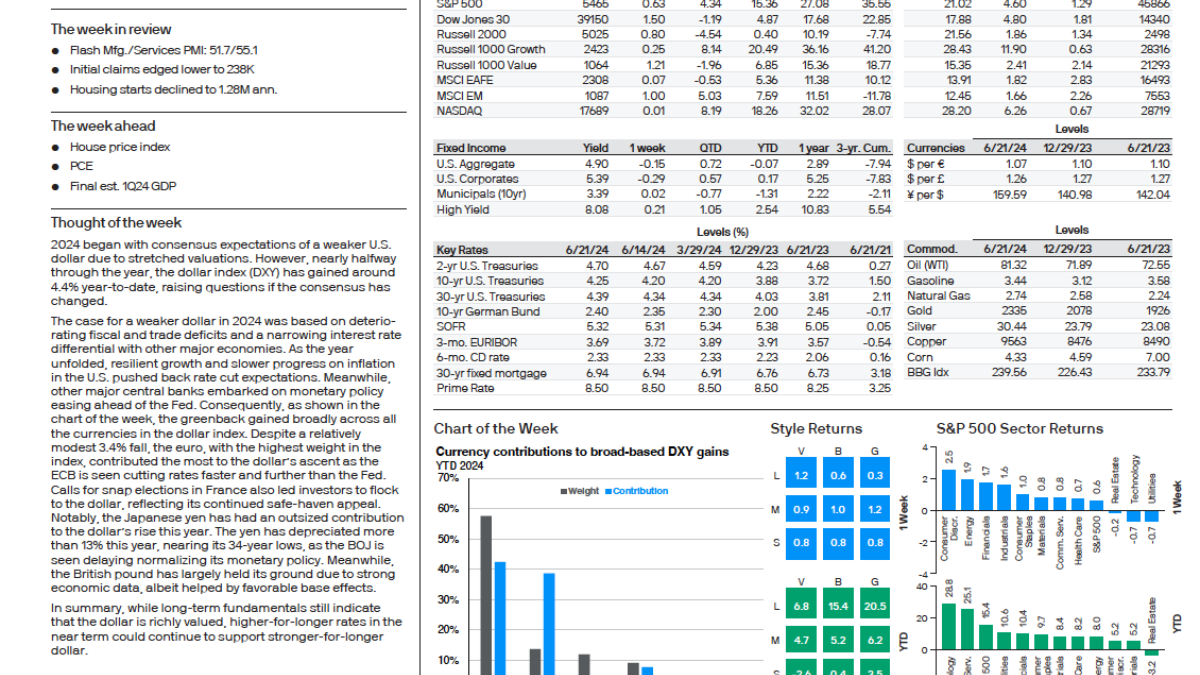
https://franklinmadisonadvisors.com/wp-content/uploads/2024/06/weekly_market_recap_20240624.pdf
Source: JP Morgan Asset Management
Weekly Macro Recap
A look back at key macroeconomic and geopolitical developments that help us contextualize the current investing landscape.

https://franklinmadisonadvisors.com/wp-content/uploads/2024/06/weekly_macro_recap_20240624.pdf
Source: Luke Gromen, FFTT
Opportunities Amidst Divergence
A significant risk that markets are overly positive and have not fully priced in potential problems. Given the positive macro backdrop, an overweight to risky assets is favored but keep risks tightly controlled, as very tight valuations limit the upside for risky assets.

https://franklinmadisonadvisors.com/wp-content/uploads/2024/06/Opportunities-Amidst-Divergence.pdf
Source: Invesco
Renewed Growth, New Challenges
Despite improvements, many investors are likely to be distracted by increasing noise as November’s US election draws near. This election is significant, but we believe it is unlikely to change the direction of the world economy and markets. That said, there are many other risks, including potential inflationary shocks and unpredictable geopolitical flareups.

https://franklinmadisonadvisors.com/wp-content/uploads/2024/06/Renewed-Growth-New-Challenges.pdf
Source: Citi
From Stability to Agility: Nine Implications for a New Investment Landscape
The underlying assumptions that have driven many investment strategies over the last 40 years must be reexamined. This paper explores nine implications that can help empower investors with the agility needed to navigate the uncertainties of the new economic environment.

Source: Nuveen
Monthly Market Update: Stocks Set Broad Records as Rates Climb
The S&P 500 Index returned +2.7% in August and set a new high. Five of the eleven S&P 500 sectors traded higher, with four outperforming the broad index. Energy (+7.0%) led all sectors, followed by Technology (+6.2%) as the sector rebounded from a July selloff and Materials (+6.0%) as gold gained nearly 10%. Utilities (-4.8%) led to the downside, followed by Industrials (-2.6%) and Real Estate (-1.9%).
Bonds traded higher despite Treasury yields rising throughout the month, with the U.S. Bond Aggregate returning +0.4%. Investment-grade corporate bonds modestly outperformed with a +0.5% total return, while high-yield gained 1.0%.
International stocks traded higher in August. Developed markets gained 2.0% and underperformed the S&P 500, while emerging markets returned +3.4% and outperformed as international tech stocks rebounded alongside U.S. tech stocks.
Stocks Set New Highs as Rates Climb
Equity markets traded higher in August, with strength extending across most broad stock market indexes. The S&P 500, Dow Jones, Russell 2000, and equal-weight S&P 500 all set new all-time highs during the month, and the Nasdaq 100 approached its June high.
The breadth of records was notable because the indexes capture very different parts of the market, from mega-cap tech to small-caps and the average S&P 500 company.
Market leadership has shifted multiple times this year, alternating between broad participation and concentration. August looked different, with strength spread across a wide range of companies and equity market segments.
The bond market offered a counterpoint to the strength in stocks. Treasury yields faced broad upward pressure during August, with the 10-year yield climbing above 4.75%, the highest since January 2025, and the 30-year approaching 5.30%, its highest level since 2007.
The rise in longer-term yields reflected several concerns, including persistent inflation, elevated government borrowing, and renewed uncertainty around energy prices.
Near the end of the month, Fed Chair Kevin Warsh's Jackson Hole speech signaled that the Fed's next move could be a rate hike rather than a rate cut, which added further upward pressure on Treasury yields. Despite the rate volatility, corporate credit spreads remained relatively calm and sit near record lows, suggesting investors are more concerned about the path of interest rates than companies' ability to repay their debt.
Markets Learn to Live with Headline Volatility
Geopolitics have dominated headlines this year, but their impact has changed as the year progresses. Oil prices continue to move when Middle East developments alter the outlook for global energy supply.
The difference is that investors appear less willing to treat each new headline as an economic shock. Earlier this year, the start of the conflict and disruption in the Strait of Hormuz caused oil prices to surge and contributed to a broad stock market selloff. Since then, investors have experienced several rounds of escalation and de-escalation.
Oil still jumps on new developments, but markets are increasingly waiting for evidence that a headline will affect energy supply, inflation, and economic growth before reacting as dramatically as they did in March.
Artificial intelligence is the second dominant market theme. Investors continue to debate whether the large sums being spent on data centers, computer chips, power generation, and networking equipment will ultimately generate adequate returns, but the companies making those investments keep moving ahead.
Nvidia's earnings report provided another indication that demand for AI infrastructure remains strong, with quarterly revenue more than doubling from a year ago. Spending plans across the industry keep rising as companies race to add computing capacity and build the infrastructure needed to support AI.
There are still questions about the eventual return on the hundreds of billions being spent, but the debate in financial markets has done little to slow the companies making the investments.