

A Playbook for the Prudent Speculator
Being a prudent speculator is like trying to "act natural", or being "clearly confused", or listening to the "deafening silence".
They're all things that typically don't go together.
Even so, it is possible to become a prudent speculator if you approach it the right way.
And why would you want to be a speculative investor?
Certainly, don't we all know that disciplined investing is the surefire way to achieving and maintaining financial independence?
Well, let's face it: For many of you out there, taking big bets is what's allowed you to achieve the level of success in your career or business that you're living today.
Indeed, you know all too well what it feels like to go all-in on yourself, and to see those efforts rewarded in many multiples of your initial time and financial outlay.
Now, while it's true that you've likely experienced some big professional wins in the past, a common mistake that many high achievers make is to extrapolate expertise in one domain by trying their hand at beating the markets.
And you know, all too often, this move rarely works.
That's because, all it takes is one wrong move in the markets, and you could see your years of hard work wiped out in short order, which is why a disciplined investment strategy works for the long-term.
Even so, if you're going to try your hand at speculative investing, there is a way to have your cake and eat it too, so long as you approach this act from a place of self-knowledge, order, and prudence.
Do You Have What it Takes?
So then, before we go into talking about how to get into speculative investing, the first thing we’ll need evaluate is whether you have what it takes to get started.
And what are we talking about here?
Well, image that you've got an extra $100,000 lying around, and you want to put it to work in the markets.
And by now, you've likely come across various so-called experts promising different ways to turn just a little bit of money into your ticket to financial independence.
So now, the big question here is, "do you have what it takes to put that money on the line?"
The Emotional Journey of Speculative Investing
Well, while the answer to that question might seem like an obvious "yes", given your professional success, the truth is that speculative investing introduces a different kind of emotional situation that you likely haven’t faced in your professional circumstances.
You see, while a disciplined investor puts their money to work by allowing time, a reasonable rate of return from their investments, and the power of compounding to produce gains, speculators tend to take big bets hoping that the price of an asset will rise AND that there will be a buyer at the other side of the table when it's time to sell.
Make no mistake, just as you might feel a rush when a new product takes off or a project succeeds, the potential gains in speculative investing can be exhilarating.
On the other hand, the lows can be profound, as has been the case for many "meme" stock and NFT speculators in recent years, because, unlike a product that can be tweaked or a business strategy that can be adjusted, investments can sometimes plummet with little warning.
So then, the question here is, are you emotionally equipped to handle this high level of volatility and uncertainty?
And why is this question relevant?
Well, as much as you might think you're ready to take speculative bets, it's essential to gauge your emotional resilience and ensure that you're not just chasing the highs associated with following the crowd but are indeed making informed decisions.
The Role of Self-awareness in Investment Decisions
To be sure, in your professional journey, you've likely honed your instincts and now trust them to guide you through complex decisions.
However, in the world of speculative investing, instincts can sometimes be clouded by personal biases. Now, these biases might stem from past experiences, current market trends, or even societal pressures.
And what are we talking about here?
Well, for example, you might be inclined towards a particular tech stock because you're familiar with its products or have an affinity for its CEO.
But you’ve got to ask yourself, “is this fact alone a sound reason to invest?”
The point here is that recognizing such biases is the first step in assessing your readiness for speculative investing.
Then, the next step is to actively challenge your biases to ensure that every investment decision is rooted in research and reason and not just personal preference or emotion.
Indeed, Michael Mauboussin, who is a financial strategist and author known for his work on decision-making, valuation, and behavioral finance, is frequently cited for his insights into the intersection of psychology and finance.
And in his work, he's described this concept known as the "outside view."
And what is the "outside view?"
Well, simply put, holding an outside view means stepping back from the specifics of a situation and instead looking at the broader set of similar situations to make a more informed prediction or decision.
In other words, instead of relying solely on your specific experience or the details of the current problem, you should consider how things generally turned out in comparable situations.
And why is this important?
Well, by taking this approach, you're likely to make more accurate assessments of your investments and avoid common biases that come from being too narrowly focused on the present situation.
The Ever-evolving Landscape of Speculative Investing
Now, another thing to consider as you evaluate whether you've got what it takes to be a speculative investor is that, just like the rapid changes we see in the tech industry, the speculative investment world is also in constant flux.
That's because new trends and opportunities arise, and old ones fade as market dynamics shift. So then, to successfully navigate this everchanging landscape, you need to be constantly in the know.
Now, this doesn't just mean staying up-to-date with the latest market news. Rather, it involves having a deeper understanding of market mechanics, global economic factors, and even behavioral finance.
Here again, it means taking a step back and looking at all of the factors that could influence the price movement, one way or another, of your speculative position.
That's why you'll have to put in the additional time and effort so that every investment decision you make is backed by a robust dataset, ensuring that you're not just reacting to market movements but getting ahead of them.
The Importance of the Right Tools and Resources
Finally, if you're going to engage in speculation, you've got to have the right tools at your disposal. Now, in your professional life, you already know the value of having the right tools, like the latest apps for product development or analytics for market research.
In a similar way, in speculative investing, the right tools can make all the difference. This might mean leveraging advanced analytics software for evaluating market trends or having access to high-quality research from financial experts who can provide insights beyond raw data.
And while having all of these tools at your disposal is a good start, the real magic is in your ability to use them effectively. To be sure, just as you wouldn't rely solely on one data point to make a business decision, you shouldn't base an investment decision on a single piece of analysis before pulling the trigger.
Indeed, as a tech professional or business owner, you likely possess a unique skill set in identifying value opportunities that can be invaluable in speculative investing.
But the real question here is, "do you have what it takes to be a prudent speculator?"
Make no mistake, it's crucial to approach this practice with the same diligence, self-awareness, and thirst for knowledge that has driven your professional success.
And why is this important?
Well, by recognizing and challenging biases, continuously learning, and leveraging the right tools, you can have a better chance at successfully navigating speculative investing without losing your shirt.
Is Your Financial House in Order
Alright, so now that you've done the work to determine whether you have the intestinal fortitude to engage in speculative behavior, the next thing you'll want to do before getting started is to ensure that your financial house is in order.
Now, this might sound like basic work, but listen up, because this step is essential for ensuring that you have the ability to stay in the game.
The Importance of a Financial Foundation
Now, throughout your career, you've likely built products, services, or entire companies from the ground up. So then, you likely understand the importance of a strong foundation.
In a similar way, when it comes to money, before you can explore the volatile world of speculative investing, it's crucial to have a solid financial base in place so you can bounce back from setbacks.
To be sure, as you know, speculative investments are high-risk by nature, and while they offer the potential for high returns, they also come with a greater likelihood of loss.
So then, if your basic financial needs, like emergency savings, debt management, and retirement funding, are not yet secure, then you risk jeopardizing your long-term financial health by engaging in speculative activities.
Indeed, having a solid financial foundation gives you the freedom to take calculated risks without endangering your or your family's overall financial well-being.
Now, this point is essential because, without this foundation, a single bad bet could have disastrous consequences, potentially setting you and your family back years and adding a host of various stresses to your life.
So, then, before you venture into the world of high-risk, high-rewards, make sure you've secured your basic financial needs so that you can weather potential losses without derailing your long-term goals or lifestyle.
Strategic Use of Windfalls
Now, in your professional life, sudden successes like a product going viral, a business deal exceeding expectations, or your company going public are events that bring along big windfalls that you might want to immediately put back to work and double or even triple your windfall.
But before you speculate with such a big gain, it's crucial first to consider your strategic opportunities.
And what do we mean here?
Well, when you experience a sudden windfall, it's tempting to see it as a ticket to the high-risk, high-reward pace of speculative investing. You've got to double your money, right?
Well, before you do, take a pause and consider the bigger picture.
In many ways, a windfall is a chance to solidify your financial position. Indeed, it's an opportunity to address areas in your life you might have previously neglected or as a way to accelerate your financial goals.
This could involve reducing or eliminating debt, which can save you significant interest costs over time. Or, your windfall could help bolster your savings and provide greater financial security and flexibility.
Either way, by addressing these financial needs first, what you're doing is ensuring that any venture into speculative investing is done from a position of prudence and strength, rather than on a hope and a prayer.
The Role of an Emergency Fund in Risk Management
And finally, think about your emergency fund.
Now, you're likely familiar with the importance of backups and redundancies or even understand the value of contingency plans in the business world. Now, these same concepts translate to your financial life, and underscore the importance of having a solid cash reserve in place before you engage in speculative activity.
Now, what we're talking about here isn't just about having money set aside for a rainy day.
Indeed, what we're talking about here is risk management.
And so, why is this important?
Well, can you imagine having all of your liquid cash tied up in a speculative position, and then having a sudden financial need come up in your life, like a healthcare emergency or job loss, and now you can't tap into your money?
That’s why with a robust emergency fund, or cash management strategy, you're free to explore speculative investing with the knowledge that, even if things don't go as planned, you still have a safety net when you need it.
Now, here again, it's crucial to note that this fund should be separate from your speculative investments, and contain enough liquid assets to cover living expenses from between 3 to 9 months, depending on your income and asset levels.
This way, you can ensure that market volatility doesn't directly impact your immediate financial security because, ultimately, it's about having the freedom to take calculated risks, knowing that you've mitigated the impacts from potentially disastrous events.
Become a Risk Manager
Alright, so now that you understand the emotional costs of engaging in speculative behavior and have taken the steps necessary to ensure that your finances are in order, let's take some time to talk about risk management.
Now, while speculative investing is about hoping that an opportunity will provide you with a high return in the future, risk management is a process that ensures you can stay in the game long enough to see that outcome come to pass.
And why is this approach important?
Well, speculative investments, by definition, are more volatile and uncertain than traditional investments. That's because they often involve assets or strategies that have a higher chance of rapid price fluctuation in short periods of time.
And these price moves could be due to various reasons, such as limited historical data, external macro or market factors, or the speculative nature of the asset itself.
Put differently, there are many more unknowns to account for when it comes to speculation. And even in situations where you might know everything about the market you're betting on, there might be outside events that you just can't control.
For example, a new tech startup's stock might be considered speculative because it doesn't have a long track record, and its success might hinge on factors like long-term market adoption of a product.
Or, in the case of real estate speculation, there's no guarantee that, when interest rates continue to creep higher, that the next buyer will want to pay a higher price than their neighbor.
Indeed, while risk management is essential for all forms of investing, its importance is magnified in when it comes to speculative behavior.
Alright, so now that we understand the importance of risk management, how does one actually go about becoming a risk manager?
Understanding Position Sizing
Well, when it comes to becoming a risk manager as it concerns speculative investing, the first thing you'll want to think about is sizing.
Now, from a risk management perspective, market traders (who are often known for their short-term speculative bets) talk about position sizing. And what they're referring to here is the amount of capital you allocate to a specific trade relative to your overall portfolio.
And why is this important?
Well, sizing is crucial because it's a way for you to effectively manage risk.
How so? Well, by determining the right position size, what you're doing is ensuring that even if a trade doesn't go in your favor, the loss won't be devastating to your overall finances.
At it's core, it's about deciding how much to invest in a particular trade or asset, so you can both maximize potential returns and limit potential losses in a manner consistent with your risk tolerance.
Either way, when you consider position sizing, just know that it's more than just a numerical decision. It's a reflection of your understanding of your financial situation and your comfort with risk.
The Imperative of a Clear Exit Strategy
Alright, so now that we've talked about one prudent way to enter a speculative position, let's talk about using a prudent risk management technique and setting your exit strategy.
Now, as you might well already know, venturing into speculative investments without a clear exit strategy is like sailing into stormy seas without a compass. That's because no matter how enticing the potential rewards are, without a plan to navigate the challenges, you risk being swept away and having your ship sunk.
Indeed, an exit strategy outlines the conditions under which you'll sell or otherwise exit your position, either to lock in profits or to your cut losses.
And so, by setting these parameters ahead of time, what you're doing is not leaving your decision to the heat of the moment, where emotions like fear or greed can cloud your judgment.
Ultimately, having an exit strategy allows you to enter speculative positions with a clearer sense of what you're aiming to achieve and what you're willing to risk.
At the same time, it helps you maintain discipline and helps ensure that you'll make decisions based on logic and strategy rather than purely on emotion.
Adopting a Gambler's Mindset
And finally, when it comes to risk management, the last thing you'll want to consider is adopting a gambler's mindset.
And what exactly are we talking about here?
Well, adopting a gambler's mindset can help you make better investment decisions by emphasizing risk management and probabilistic thinking in your approach.
And how's that possible?
Well, that's because in gambling, just like in speculative investing, the outcomes are uncertain, but the odds can often be quantified.
And so, by thinking like a gambler, what you're doing is becoming more attuned to assessing the probabilities of different outcomes, which allows you to better weigh potential risks against potential rewards.
Another reason to adopt this mindset is that gamblers who succeed in the long run know the importance of sticking to a strategy, setting limits on losses, and not chasing after bad bets.
In a similar way, a prudent approach to speculative investing, like knowing when to enter and exit positions and adhering to your risk management plan, can increase your likelihood of success over the long term.
A Playbook for the Prudent Speculator
You know, when it comes down to it, navigating the tumultuous waters of speculative investing is not for the faint of heart.
That’s because it demands a blend of courage, strategy, and self-awareness because, when not approached prudently, it can quickly wipe you out financially.
With that said, by understanding when to push forward, when to hold back, and most importantly, when to exit, you ensure that you're not just participating in the race, but that you have the chance to actually finish it.
In the end, the prudent speculator's voyage is not just about financial gains, it's about growth, learning, and resilience so you can take one step closer to becoming the master of your own financial independence journey.


Don't Keep All Your Eggs in One Basket
All it takes is just one stock to go to the moon, and that's it, you're set for life, right? Well, if it were only that simple. You see, concentrated investing, or keeping your eggs in one basket, seems to work until it doesn't.
Now, make no mistake, concentrated investing isn't all that bad. In fact, notable investor Warren Buffett is known to have made lots of money decade after decade because he takes big bets.
Even so, concentrated investing isn't for everyone.
In fact, if you were to personally ask the Oracle of Omaha for investment advice, he'd likely tell you to buy a diversified basket of stocks that tracks the S&P 500 index and simply hold on to your investments for the long haul!
And why would a sage investor give such seemingly conflicted advice?
Well, that's because Buffett knows that concentrated investing cuts both ways. You see, on the one hand, you could score big under the right circumstances or find yourself desperately holding onto a failing position that wipes away your life savings when fate turns against you.
Indeed, whether you've intentionally placed all your eggs in one basket or are simply trying to figure out what to do with your restricted stock or stock options, then having a plan is essential to preventing unfavorable outcomes.
And this approach starts with checking for concentrated holdings, assessing your risk tolerance to manage such a position, and then understanding how to rebalance away or hedge risk when necessary.
Understanding Concentrated Investment Positions
So then, how can you tell if you're holding on to a concentrated position in your portfolio or otherwise? Well, there are several straightforward methods to figure this out.
The first approach involves evaluating your portfolio's asset allocation. And, as you'll likely recall, your asset allocation refers to the mix of stocks and bonds, US and International holdings you might hold in your investment portfolio.
Now, a portfolio heavily weighted towards a single investment or a given sector or industry is typically indicative of a concentrated position. For example, a general rule of thumb is that if more than 20% of your portfolio is allocated to one stock or sector, then that's likely considered a concentrated investment.
Now, this sort of concentration typically happens when you have restricted stock units (RSUs) that vest, and you haven't decided what to do with your equity, so you just let it sit in your employer's stock plan account. Or, it can happen when you decide to exercise and hold your stock options but don't have a strategy in place for your equity now that you own it.
Now, another method for evaluating whether or not you have a concentrated investment position involves reviewing your exposure to a single asset or sector relative to a benchmark index.
And, what are we talking about here?
Well, let's say your portfolio has 30% invested in the tech sector while your equity benchmark has a 20% weighting in the sector itself. In this situation, you're likely to find yourself with a concentrated position from the perspective of owning more of a sector than you would otherwise like.
And finally, when it comes to determining whether you have a concentrated investment position, you should look at your holdings from the perspective of a worst-case scenario. For example, heading into the Global Financial Crisis, many employees of Wachovia Bank had their retirement savings stored up in company stock, which ultimately led to an unfortunate outcome.
That's because, when the bank failed, the value of their holdings was effectively wiped out, which canceled the retirement plans of many of the bank's former employees. So then, the moral of the story here is that if the failure of a single investment would lead to a significant loss that would severely affect your future financial plans, then you likely have a concentrated position.
Evaluating Your Risk Tolerance for Concentrated Investments
Alright, so now that you understand what it means to have a concentrated investment holding, the big question now is, "do you have what it takes to hold on to that concentrated position for the long-haul?"
And this question is so essential because, as you likely very well know, the road of investing is long and winding, with pitfalls and windfalls alike. It's like a journey where your risk appetite can significantly influence the trajectory and the destination of your investment returns.
And so, what do we mean here by risk tolerance?
Well, to be clear, risk tolerance refers to your ability and willingness to bear losses in exchange for potential gains, especially when a large portion of your net worth is potentially ebbing and flowing with the whims of the markets.
So then, for those of you out there considering or already maintaining concentrated positions, it's essential to have a deep understanding of not only your concentrated holdings, but also of how these investments are affected by market trends, narratives, and principles alike.
And why's that?
Well, it's one thing to know everything about your company stock. But to understand what Mr. Market might also think is a powerful money management skill. Indeed, financial acumen, paired with a disciplined approach, is often what separates successful investors from those who experience significant losses.
To be sure, for those of you out there who have studied market cycles or have simply lived through them, you likely already understand that downturns are inevitable and, more often than not, unpredictable.
Now, if you're a seasoned investor with a high tolerance for risk, then you're likely to remain steadfast in your investment strategy during periods of heightened market volatility because you understand the broader economic and market factors at work and anticipate the longer-term investment play at hand.
With all of that said, holding onto a concentrated position in market ups and downs isn't always as simple as understanding the technical of market or economic factors.
And why's that?
Well, that's because investing can, and often is, an emotional journey. To be sure, when market volatility picks up, and your net worth starts swinging to and fro, it can bring about strong emotional responses, like fear during downturns and euphoria during market rallies.
So then, within the context of investment risk tolerance, your emotional fortitude is a crucial trait to consider in these scenarios. Indeed, in these situations, you have to be able to resist reactive decision-making and stick to your long-term investment plan no matter what's ahead of you.
This approach is especially true when a large portion of your wealth is tied up in your company's stock, and so you'll need to be able to hold on without panicking during periods of negative news or poor earnings performance.
So then, how can you tell if you're fit for holding concentrated investment positions? Well, the first thing you'll want to do is to evaluate your inclination towards maintaining your financial acumen in your given investment holding.
More specifically, you'll need to ask yourself not only whether you're well-versed in the intricacies of a given sector of the market or your company's financials but also whether you have the mental bandwidth and time to stay on top of all the changes in both.
Remember, more often than not, all it takes is one lousy report to send an investment plummeting, so you'll need to stay on top of key developments so you can make wise decisions.
Next, you'll want to assess whether you have the intestinal fortitude to deal with a single large holding and its potential impact on your wealth. More specifically, you'll need to determine whether you can endure periods of market turbulence without making rash decisions. For example, if you're tempted to sell investments or simply move to the sidelines entirely during periods of heightened market volatility, then managing a concentrated position may not be the right fit for you.
And, when it comes to evaluating your risk tolerance within the context of managing a concentrated investment holding, you'll want to consider your broader financial position. More specifically, you'll want to look beyond your investments and evaluate your entire balance sheet.
That's why it's essential to take some time to ask yourself whether you have the ability to absorb potential losses when markets go against your holdings without it impacting your lifestyle or financial goals. And, if you don't have the financial flexibility to weather market downturns, then managing a concentrated position may not be for you.
Strategies for Managing Concentrated Investment Risk
Alright, so now that you understand what a concentrated position looks like, and have evaluated your own risk tolerance, what else can you do if you have concentrated investment risk that you can’t just walk away from, but you need to address in the present?
Well, managing concentrated investment risk often requires a strategic, multi-faceted approach that draws on a range of financial tools and principles to grow your wealth in a mindful way.
Indeed, when it comes to managing a concentrated position, you'll need to consider several factors, from complex things like tax consequences to finding the right trade-off between risk and reward to make prudent choices with your holdings.
Diversification, Asset Allocation and Rebalancing to Manage Risks
And so, how do you go about managing these risks?
Well, to start, let's come back to the first principles of diversification. Indeed, history has shown that, over the long term, you can reduce the overall risk in an investment portfolio when you spread your money across multiple holdings. To be sure, by investing in a broad range of assets, you reduce the risk associated with the poor performance of any one single investment.
And so, how do you achieve this outcome? Well, that's where a solid asset allocation strategy comes into play.
Remember, diversification is achieved by adding different asset classes (like stocks and bonds) to your portfolio, by investing in different sectors or countries, or by utilizing mutual funds or exchange-traded funds (ETFs) that offer instant diversification.
Now, asset allocation, on the other hand, involves determining how much to allocate to these various investments, and more often than not, will be determined by your investment goals, risk preferences, and time horizon.
Alright, with all that said, a common question that typically comes up with respect to diversifying a concentrated position is whether you should sell all of your holdings at once and just be done with it or whether to do so over an extended period of time?
Well, you could sell everything today, but there's a host of factors at play, including tax consequences and the potential for missing out on investment gains to consider as well.
And so, depending on your situation, this is where portfolio rebalancing comes into play.
Now, portfolio rebalancing is a proactive risk mitigation strategy that involves periodically buying or selling assets in your portfolio to maintain your desired asset allocation.
And, in your situation, this could mean reducing a concentrated position by selling some of your investment holdings and then using the proceeds to invest in other underrepresented sectors or asset types.
So then, by taking this approach, what you’re doing is preventing your portfolio from becoming overly concentrated in a single investment while ensuring it aligns with your investment goals and risk tolerance.
Okay, so now that you understand that to reduce concentration risk, you'll need to spread it out across various assets, the next question is, "over what time period?"
Well, if you have a long enough investment horizon, meaning that you don't need to tap into the proceeds from your concentrated position for quite some time, then you might be able to bear the short-term volatility associated with a concentrated position with the expectation of higher returns in the long run as you begin diversifying away this position.
With that said, however, if your investment horizon is short, meaning that you'll need to tap into those investments sooner rather than later for, let's say, a home purchase or for your early retirement, then an extended diversification strategy might be too risky since you likely won't have sufficient time to recover from a potential market downturn when unexpected volatility hits.
Hedging as a Way to Manage Risks
Now, outside of rebalancing as a way to mitigate the risk of a single investment holding, another way to deal with a concentrated position involves hedging.
And what do we mean here?
Well, hedging involves a rather deliberate process of making intricate investment decisions to transfer the risk of adverse price movements in a concentrated asset.
You're still with me, right?
Well, to put this process more simply, to achieve your desired outcome, what you're going to do more often than not is use financial derivatives like options and futures to transfer risk (or hedge against) a potential decline in the value of your concentrated position.
Now, this concept can get pretty technical rather quickly, so let me give you an example to explain here.
Let's assume that you anticipate that the value of your company stock is likely to decline in the months ahead for any number of reasons. Well, in this situation, you could enter into a contract to buy put options, which gives you the right (but not the obligation) to sell a portion of your concentrated position at a locked-in price in the future.
It's like an insurance policy if the value of your concentrated position falls significantly, but it comes with its own set of costs and trade-offs and is helpful in specific situations.
Either way, when it comes to managing a concentrated investment position, you have several options to consider. And so, what's critical to take away here is that if you do decide to hold onto a large position for the long-term, it's essential to find a strategy that works for you and ultimately stay committed to it.
Don't Keep All Your Eggs in One Basket
You know, when it comes down to it, the road to successful investing, especially when it involves concentrated positions, requires a mix of self-awareness, emotional resilience, and strategic execution. Indeed, managing a concentrated investment position is like trying to balance on a high wire where the rewards may be as significant as the risks.
Make no mistake, however, managing a concentrated investment position is often a full-time job, and likely one reason why Warren Buffett encourages individual investors to buy a diversified basket of investments early and often.
Even so, the risks are far from impossible, so long as you're armed with the right tools and strategies, like knowing when you're in a concentrated investment position and appreciating the risks and potential rewards of such positions.
And when it comes to successfully managing your concentrated investment position, understanding your investment horizon, portfolio rebalancing, and hedging strategies can help guide you through the often turbulent seas of investing.
To be sure, with these tools in hand, you'll not only be better equipped to navigate the often stressful but many times rewarding path of investing, you'll also be able to take one step closer to becoming the master of your own financial independence journey.

How to Calculate Your Life Insurance Need with Confidence
If you have people who depend on you financially, then you need life insurance. That’s all you need to know, right?
Well, if it were only that simple.
That’s because knowing that you need insurance is a first step, then comes the work of figuring out how much you need to cover estate expenses, debts, living expenses, college savings, and future financial goals.
To be sure, buying life insurance can be one of the most reassuring and, at the same time, the most stressful decisions you can make. On the one hand, you’re paying to transfer financial risk from yourself to a third party so that, should you pass unexpectedly, your family will be taken care of financially.
And on the other hand, purchasing financial protection for your life is stressful because how do you know if you’ve got too much or not enough? I mean, seriously, how do you put a price tag on your life and quantify your worth?
Well, the truth is that quantifying the value of your life is more than just looking at a number. It’s about putting a price on your ability to provide for your loved ones. You know, money will never do that for you, but it can help ease the uncertainties along the way.
And so, when it comes to figuring out how much life insurance you should buy, there are a few approaches you can take to calculate an ideal amount of coverage for your family to not only take care of their immediate need but also meet their needs for the rest of their lives.
The Multiples of Income Approach: A Simple Starting Point
One such method, revered for its simplicity, is the 'multiples of income' approach.
This method involves a straightforward multiplication of an individual’s income by a predetermined factor to determine the coverage amount. So, how exactly is this multiples of income approach put into practice? The first step revolves around the calculation of the coverage amount. This is where you must pinpoint the appropriate multiple, which can vary based on factors such as an individual's age, financial obligations, and family circumstances. It's a common guideline to use a multiple ranging from five to ten times an individual's annual income.
For example, with an annual income of $300,000 and a chosen multiple of seven, the coverage amount would be around $2,000,000.
Once you have this number, the coverage assessment stage begins. Here, you evaluate the obtained coverage amount against an individual's financial needs and goals. Consideration should be given to outstanding debts, mortgage payments, children's education costs, and the desired standard of living for the family in the event of an individual's untimely passing.
The third stage involves making adjustments. At this point, the calculated coverage amount can be modified to account for existing savings, other insurance policies, and potential future income from investments or pensions. This process is instrumental in aligning the coverage with an individual's specific circumstances.
And so, when should you use this approach?
Well, in certain situations, the multiples of income approach is useful because it’s an easily understandable way of estimating life insurance needs. It's also a convenient starting point that avoids complex financial calculations. Moreover, it zeroes in on income replacement, making it suitable for those with dependents relying on their earnings to maintain their lifestyle.
Yet, despite these benefits, it's important to keep the method's limitations in mind. Relying solely on a multiple of income may not provide a complete picture, as it might overlook individual circumstances. For example, it may not account for factors like specific financial goals, outstanding debts, or unique family situations which can result in insufficient coverage.
Another limitation is the assumption of a consistent income level throughout an individual's working years. Significant variations in income could lead to inaccuracies when choosing a multiple that reflects the actual income at the time of their death.
The method can also lead to overestimation or underestimation of coverage. For some, a multiple of income could result in excessive coverage and higher premiums, while for others, it might not provide enough to meet dependents' financial needs.
And finally, it’s worth noting that the multiples of income approach tends to overlook the value of non-monetary contributions made by an individual. For example, it may undervalue an individual's overall contribution to the family's well-being by not considering aspects like childcare or household responsibilities.
Either way, the multiples of income approach is a simple starting point to help you calculate your life insurance need.
The Human Life Value Approach: Factoring in Future Earnings
Alright, now that you have a solid base from which to calculate your life insurance needs, the next calculation method we’ll discuss is the human life value approach.
And so, what is exactly is the human life value approach?
Well, this approach is a method used to determine the appropriate amount of life insurance coverage an individual should have based on the idea that a person's life has economic value.
Now, under the human life value approach, several factors are taken into consideration to estimate the economic value of a person's life which include the individual's age, gender, occupation, income, potential future income growth, and other financial obligations or support provided to dependents.
And so, how do we calculate our life insurance need based on this approach? Well, to calculate a human life value, an individual's future income potential is projected over their remaining working years until retirement, accounting for factors such as inflation and expected salary increases. Then, the present value of these projected future earnings is determined by discounting them to their current value.
And when should you use this approach?
Well, the ideal set of circumstances for using the human life value approach could include situations where the primary objective of life insurance is income replacement for your dependents. It is especially relevant for individuals who are the primary earners in their families and have significant financial responsibilities, such as providing for children's education, paying off debts, or maintaining a certain standard of living for their loved ones.
Now, there are some drawbacks to using this approach that you should be aware of. First, it relies on assumptions and projections, such as future income growth and discount rates, which may not accurately reflect the actual circumstances. That’s because economic and personal factors can change over time, and this may make the estimated value less reliable when conditions change.
Another factor to take into consideration is that the human life value approach focuses primarily on income replacement and may not consider other financial needs, such as funeral expenses, outstanding debts, or specific financial goals. And, at the same time, it may also overlook the value of non-monetary contributions that an individual can provide, like childcare or homemaking so that’s something worth considering as well.
And so, while it can be helpful starting point, the human life value approach should be supplemented with careful consideration of personal circumstances, financial goals, and specific needs to arrive at an appropriate coverage amount.
The Financial Needs Analysis: A Comprehensive Assessment
Alright, so by now, you’re likely catching on that each life insurance calculation method serves a specific need and gets more complex as we move along. For example, the multiples of income approach gives us an easy back-of-the-envelope method for calculating life insurance need, while the human life value approach dials into what it would take to replace your income today for a specific period of time, considering inflation and other economic variables.
Now, the next two methods, the financial needs and capital needs approaches, each dial-in our life insurance calculations with a more granular set of assumptions.
For example, the financial needs analysis approach, unlike the others we’ve talked about so far, takes into account an assortment of factors such as income, expenses, debts, future financial goals, and existing assets. So then, by factoring in this detailed information, what we’re doing is providing a more tailored estimation of the coverage amount needed, embracing the unique circumstances of an individual.
And so, how does this comprehensive approach work in practice? Well, the process kicks off with an assessment of the income replacement need which involves determining how much money an individual makes over a given period of time that needs to be replaced.
Then, we factor in debts and liabilities with the focus on outstanding debts such as mortgages, loans, and credit card balances. Here, a thorough analysis is likely to reveal how much is owed and how life insurance can pay off these debts.
Next, we take a deeper dive into actual daily living expenses by looking at costs like housing, utilities, groceries, education, and healthcare. And so by considering these expenses, it becomes clearer how much money is needed to maintain the surviving family members' current standard of living.
And once we have an idea of what it will take to pay off debt and cover living expenses, we’ll then take a look at funding future financial goals. Here we can think of things like funding college education for your kids, retirement savings, and other long-term spending goals. What we’re doing is estimating the funds necessary to meet these targets and ensures they won't be compromised by an individual’s untimely passing.
Finally, the financial needs analysis approach takes into consideration existing savings, investments, and any other assets the family possesses. Then, we subtract out these assets from the total financial need, which leaves us a more accurate life insurance coverage need.
Now, that’s pretty comprehensive, right?
Well, given its systematic and comprehensive nature, the financial needs analysis approach has distinct advantages. For example, it provides a strategic way to estimate the right amount of life insurance coverage that takes into account the unique needs and goals of an individual and their family. And, by addressing income replacement, debt repayment, living expenses, and future financial goals, it offers a holistic view of a family’s financial needs.
With all that said, however, it's essential to be aware of the method's challenges. For one, conducting a thorough financial needs analysis can be complex because it requires detailed financial information and calculations and may also involve projections and assumptions, which could prove challenging for individuals without a financial background.
The Capital Needs Analysis: Evaluating Specific Financial Obligations
Alright, so the final life insurance calculation method we’ll discuss today is the capital needs analysis approach. Now, you’ll recall from our discussion a moment ago that the financial needs approach accounts for ongoing living expenses that your family likely will face, including groceries, utilities, and other regular bills. Indeed, it's about making sure that your family maintains their current standard of living in the absence of your income.
Now, the capital needs analysis approach takes a more specific look at things like the final expenses related to your passing (like funeral costs), your outstanding debts, your mortgage, and future expenses such as your children's education costs. In essence, it's about ensuring that there's a sum of money or "capital" available to cover these obligations. The idea here idea is to provide a lump sum to cover very specific current needs.
In essence, both approaches aim to provide financial protection for your loved ones in the event of your passing, but the capital needs approach is more about addressing specific large expenses and obligations, while the financial needs approach is more about ongoing living expenses and replacing lost income.
For example, let’s assume that you own enough income producing assets to provide regular income to cover your family’s living expenses should you pass unexpectedly, but not you don’t have enough saved to pay for your kid’s college expenses. In this case, you can use the capital needs analysis approach to calculate your capital, or life insurance need.
And how do you do this?
Well, to start, you'd first estimate the anticipated cost of college for each child. Now, this estimation should factor in the rising cost of tuition, room and board, textbooks, and other related expenses, all while accounting for inflation, since education costs tend to increase over time.
Once you have a projected college cost, consider any savings you've already saved for this purpose. For example, if you have a college savings fund, like a 529 plan, then take the time to project out its value by the time your child starts college and subtract that amount from your total anticipated education need.
Then, once you understand the projected costs for each child, combined with expected savings or aid, you can then aggregate these amounts to ascertain the total life insurance coverage you'd need to cover all your children's college expenses.
Now, it’s essential to note here that, like the financial needs approach, this calculation operates on a fixed capital requirement, which can fail to account for changes in your personal financial circumstances like income shifts, debt reduction, or investment return fluctuations.
Calculating Your Life's Worth: Choosing the Right Insurance Amount
So then, it goes without saying that figuring out how much life insurance you need can be a complicated task. And not because of all the calculations involved, but because trying to put a price tag on your life is hard!
That’s because there are a number of different ways to calculate how much insurance you need to protect your loved ones. Even so, just keep in mind that the multiples of income approach offers an imprecise, but simple starting point for calculating how much coverage you need.
Then, the human life value approach helps you calculate how much insurance you need to replace your income streams, while the capital and financial needs analysis approaches take a deeper dive in helping you get a more granular look at covering expenses, while paying off debts.
Now, it’s worth mentioning that when it comes down to it, none of these methods are perfect. They all have strengths and weaknesses and sometimes it might be helpful to use a combination of them to decide the best coverage for you.
With all that said, the crucial thing here is to ensure that your loved ones will be financially secure if something happens to you. Remember, insurance isn't about putting a price on your life, it's about giving you peace of mind and allowing your family to take one step closer to mastering their own financial independence journey.

Risk Mastery: The Key to Sustaining Wealth
What comes to your mind when you think of the word, “risk?”
Maybe when you hear the word “risk”, you think of the word danger, or the potential for of an undesirable outcome to your health, wealth or time.
Or maybe when you hear the word, “risk”, you think of all the possibilities associated with potential outsized financial gains as you put some of your money on the line for a solid investment.
Either way, whether you see it as a danger keep away from at all costs or an opportunity to make money, moving through risk carefully can open up a world of opportunities for you when approached thoughtfully.
Indeed, risk is like a powerful and unpredictable ocean wave faced head on by a skilled surfer. And, just like that surfer, when you skillfully navigate it, harness its energy and ride it skillfully, you can experience an exhilarating surge that propels your life forward, allowing you to reach new heights that you otherwise wouldn’t have been able to experience.
However, if you underestimate its strength or fail to maintain your balance on life’s surfboard, then that same wave can quickly overpower you, pull you underwater and humble you in an instant.
Indeed, just like riding the waves of your own life, sometimes you need to know which risks to take and which to avoid, how to prevent unnecessary losses when you do take risks as well as being prepared for when life throws you an unexpected curveball.
That’s why when it comes to achieving and maintaining financial independence, being able to master the way you prepare for risks is key to sustaining the wealth you build along the journey.
Knowing Which Risks to Avoid
Alright, so then how can you approach risk in a way that allows you to get around significant financial derailers? Well, one of the first ways is to know which risks to avoid in the first place.
And how do you do this? Well, imagine yourself standing before a steep cliff.
In this situation, risk avoidance is like choosing not to approach the cliff at all, and instead sidestepping the potential danger completely. Here what you’re doing is making a conscious decision to avoid the situation that poses a risk, thereby eliminating the risk from your reality.
Now, it’s crucial to note that on the one hand, this method completely removes the possibility of a risk event occurring, but at the same time, it eliminates the potential benefits that may come with it.
Avoiding High Risk Investments
For example, picture yourself facing a host of investment opportunities as you get ready to put your money to work. Now, the potential for profit is vast, but so is the risk, right? And so, does that mean you stay out of the markets entirely if you want to avoid risk?
Well, not necessarily.
Instead, when you know which risks to avoid, you might choose to stay away from certain investment vehicles known for their high volatility or uncertainty, like speculative stocks or cryptocurrencies, even if their potential returns are substantial. That’s because the goal here is to shield your hard-earned money from potentially devastating losses, and thereby opting for stability and security rather than unpredictable high gains.
Prudent Borrowing and Risk Avoidance
In a similar way, you can think of risk avoidance as an approach for thoughtfully using debt. For example, as a tech professional or business owner, you may be tempted to leverage debt to accelerate your wealth-building journey. And this could come from using margin to boost investment holdings.
Now, in this situation, while you have the potential for a massive gain in the markets based on a speculative bet, in many situations, excessive leverage is fraught with risks, including increased financial strain and the potential for bankruptcy. That’s because all it takes is one big market move in the wrong direction and that’s it, a margin call puts you out of business.
That’s why when you practice risk avoidance, what you’re doing is opting to maintain a prudent borrowing level with your investments, which ensures that even in worst-case scenarios, such as a market or economic downturn, you can stay in the markets without crippling your financial future.
Risk Avoidance in Business Ventures
And for you business owners out there, you’re likely to face numerous risks that can lead to operational setbacks in the best situations, and potential lawsuits in the worst. So then, in this situation practicing risk avoidance means choosing not to engage in potentially risky ventures or taking on clients that could jeopardize your business.
And what are we talking about here?
Well, a crucial part of effectively managing your business is knowing when to accept a client and when to walk away. You’ll have to accept that not all clients are beneficial to your business, and, in fact, some may even pose considerable risks.
For example, consider a scenario where a potential client consistently has trouble paying their bills on time. In this situation, you might be tempted to accept the job, considering the potential for increased revenue down the road. But the reality is that this relationship could lead to cash flow issues in your business when their payments are delayed or, worse yet, never arrive. Therefore, by having a process to identify such problematic clients in the first place, and choosing not to work with them, you’re proactively avoiding unnecessary financial risks.
Either way, risk avoidance isn't about dodging all financial decisions that carry any risk. Instead, it's about making informed choices that limit your exposure to unnecessary, potentially catastrophic decisions. To be sure, as a high earner, risk avoidance is a fundamental principle that you should be familiar with as a way to ensure that your financial health remains strong, regardless of what may come in uncertain market, economic or business conditions.
Preventing Unnecessary Losses
Alright, so, now that we’ve discussed how avoidance can help you side step unnecessary risks, let’s talk about risk prevention.
And how is risk prevention different from risk avoidance?
Well, as we highlighted earlier, risk avoidance is like seeing a cliff and choosing not to approach, right? Well, risk prevention is the process of putting barriers around the cliff, which allows you to approach without getting too close to the edge. Here again you're not avoiding the cliff entirely, instead, you're implementing measures to stop the risk from taking place in the first place.
And what are we talking about here?
Strategically Reviewing and Adjusting Investments
Well, when thinking about investments, risk prevention means more than just wisely choosing where to put your money, or which sectors of the markets to avoid. Indeed, risk prevention also involves regularly reviewing and adjusting your portfolio based on market trends and your personal financial goals.
For example, if you’ve experienced a period of strong market gains, and anticipate a significant market downturn, you may want to rebalance your portfolio by reducing holdings where you’re overallocated, or adding to positions where you’re underallocated relative to your strategic asset allocation decisions. And why is this important? Well, by rebalancing your portfolio, what you’re doing is preventing potential losses from being overexposed before an inevitable market downturn takes place.
Proactive Debt Management
And when it comes to borrowing money, risk prevention is about being proactive about the way you manage your debt by putting measures in place to address the unexpected.
So then, if you do decide to use margin to boost your overall investments, this might mean understanding this historic volatility of the asset you’re borrowing against, exploring worst-case volatility scenarios, and knowing how to size your positions before putting your money to work.
Implementing Safety Protocols in Business
In the context of a business, risk prevention might mean putting in place protocols to prevent potential financial risks before they turn into real problems. And what do we mean here?
Well, you’ll likely recall in our earlier example how we discussed the benefits of avoiding risky clients altogether. Now, if you do decide to work with clients who might seem risky, it's important to establish clear, contractual agreements that spell out the expectations and responsibilities of both parties.
For example, let’s say that you're dealing with a client with a history of delayed payments. So then, one way to mitigate this risk includes strict payment terms in your contracts, like requiring a substantial deposit upfront from risky clients or implementing a policy to charge additional fees when your payments are late. These sorts of provisions, while not always perfect, may help to incentivize prompt payment and protect your business from significant cash flow issues down the road.
Either way, risk prevention is about setting up guardrails, or putting processes in place, that allow you to take certain risks without getting burned.
Prudently Dealing with Unavoidable Risks
Alright, so we’ve talked about avoiding and preventing risks, what do you do in situations where a potential loss is going to come your way no matter how much you try to avoid or prevent it?
Well, that’s where risk mitigation comes into play. And what is risk mitigation?
Well, risk mitigation is like looking at that cliff, and, with the right equipment and safety gear, choosing to descend it ever so carefully. Indeed, in this situation, you’re aware of the risk, yet you decide to engage with it in a measured and calculated way.
Indeed, risk mitigation enables you to reduce the severity of a potential loss, without removing the risk entirely. In this situation, what you’re doing is accepting that the risk is there but you’re taking steps to lessen its potential impact on your overall financial well-being.
How so?
Well, this might mean taking out insurance, establishing contingency plans, or allocating resources strategically to reduce risk.
And what does this look like?
Investment Diversification and Hedging
Well, from an investment perspective, risk mitigation might mean strategically spreading your investments across different asset classes, like stocks, bonds, real estate, and others to diversify your investment portfolio.
And this approach can help reduce your vulnerability to a single concentrated stock, and minimize potential losses when markets head south without necessarily compromising on potential gains.
What’s more, you could consider hedging strategies for your investments that further allow you to protect investment holdings as you work your way towards diversification.
Professional Liability Insurance for Risky Ventures
And for you side hustlers or business owners out there, if you do decide to work with otherwise risky clients, you should consider insurance policies to help defray potential financial costs associated with these sorts of engagements.
More specifically, in this situations like these, what we’re talking about is professional liability insurance, also known as errors and omissions insurance, general liability insurance, and in some cases, specific coverage like malpractice insurance for healthcare providers or legal professionals.
And why would you want this kind of insurance?
Well, let’s imagine for a moment that one of your clients claims that an error in your service caused them financial loss and decides to sue you. In this case, your professional liability insurance would typically cover legal defense costs, as well as any damages or settlements that you're otherwise required to pay, up to the policy limits.
And how does this help when working with high-risk clients?
Well, high-risk clients often have more at stake, are more demanding, or are more likely to resort to legal action if something goes wrong. That makes them a liability risk. For example, you might be a freelance software developer working on a significant project for a high-profile client. If there's a delay in delivery or a bug in the final product that causes the client to lose revenue, they could sue you for the losses.
So then, in this situation, having professional liability insurance would be crucial in protecting you from the potentially massive costs of a lawsuit.
In a similar way, if you're a consultant giving advice to clients, and one of them claims that following your advice led to a business loss, professional liability insurance would step in to cover the costs associated with defending against such a claim and any resulting judgment or settlement.
Therefore, by having professional insurance, you create a safety net for your business. And, it gives you the confidence to take on higher-risk clients, knowing that if something goes wrong, you have some sort of financial protection in place. Now, with all that said, it's crucial to note that you need to understand the coverages, limits and exclusions of your insurance policy to ensure it aligns with your business needs and risk profile. So then, if you haven’t already, be sure to check out our recent discussion on buying insurance like a pro.
Risk Mastery: The Key to Sustaining Wealth
Now, when it comes down to it, mastering risk is the key to sustaining the wealth you’ve accumulated along your journey to financial independence. To be sure, whether risk evokes thoughts of danger or opportunity for you, approaching it with care and thoughtfulness can nevertheless unlock a world of possibilities. And like a skilled surfer riding a powerful wave, navigating risk skillfully can propel your life forward, allowing you to reach new heights. But with that said, underestimating its strength and losing your balance can lead to being overwhelmed and financially humbled in an instant.
That’s why, to become the master of your financial independence journey, it is crucial to know which risks to avoid. Remember, risk avoidance isn’t about dodging all risky financial decisions, but rather, it’s about making informed choices that limit exposure to unnecessary and potentially catastrophic risks. It could mean sidestepping certain investment vehicles known for high volatility, avoiding excessive leverage, and for you entrepreneurs out there, being selective with clients who pose considerable risks to your business.
At the same time, you’ll want to take into consideration risk prevention, which, just like navigating a cliff’s edge involves putting barriers in place and adjusting your strategies to avoid being too close to the edge. This might involve frequently reviewing and rebalancing your investment portfolio based on market trends and conditions. It could also mean establishing clear contractual agreements, maintaining open communication with clients, and utilizing risk prevention measures to safeguard your business and prevent adverse events from materializing.
And finally, there will be inevitable risks that cannot be avoided and this is where a solid risk mitigation strategy comes into play. Remember, mitigation involves accepting the presence of risk while taking measured steps to reduce its severity. And from an investment perspective, these strategies include diversifying your investment portfolio and employing hedging techniques. And from a business perspective, professional liability insurance, can protect you and your business against claims and financial repercussions arising from errors or omissions when working with risky clients.
Either way, risk doesn’t have to be something that keeps you up at night if you know when to avoid, prevent or mitigate them. Indeed, the process of mastering the risks in your life allows you to take one step closer to becoming the master of your own financial independence journey.

How to Buy Insurance Like a Pro
Whether you love it or hate it, getting and maintaining the right insurance coverage is one of the most crucial financial decisions you can make to build and preserve your financial independence.
Now, up until recently, the only way to get the coverage you needed was to work directly with an insurance salesperson.
Even so, with various options and so many policy decisions coming down to just a few mouse clicks, you now have more power than ever at your figure tips to protect your wealth.
To be sure, just like managing taxes and spending decisions, having the right insurance protections in place is akin to keeping more of what you make.
You see, that's because when the unexpected strikes, the right insurance policy can step in and transfer a potential financial loss from your pocketbook to that of an insurance company.
For example, if you suddenly become ill, and an emergency room visit turns into a month's long stay at the hospital, the right kind of insurance can potentially save you thousands of dollars in medical bills.
To be sure, at the end of the day, insurance, for all its negative connotations as an expense that rarely pays out, can actually one of the most valuable financial decisions you ever make.
Now, not all insurance companies are created equal. That's why understanding the basics of ideal providers and policies can help you buy insurance like a pro as you go out and purchase this essential coverage for yourself and your family.
Reputation and Financial Stability
Now, make no mistake, navigating the world of buying insurance can be daunting, yet it's a journey most of us need to undertake regardless of whether we're talking about Property and Casualty, Health, Life, or Disability insurance coverage. So then, what's the first step you need to take when evaluating your current or new potential insurance provider?
Well, a common mistake many individuals make is buying insurance based solely on the premium they anticipate paying. Indeed, many individual's first question is "how much is this going to cost me" or "is this my cheapest option?" But when it comes to buying insurance, the real question should be, "how will this insurance carrier provide for me over the long term?"
Why It's Important
You see, too often individuals focus on the policy, without first understanding who's underwriting that policy to begin with. To understand this perspective, you can imagine insurance as a safety net strung under you as a tightrope walker.
Now, the purpose of this safety net is to catch you if you slip, helping you bounce back in the event of an accident. However, it's absolutely crucial that the net is sturdy, reliable, and well-maintained. So then, from this perspective, the safety net is the insurance policy, and the insurance company is the keeper of your safety net. And while you may have purchased the best safety net available, the handler's ability to manage that net can make or break your financial situation when the unexpected arises.
So, how can you tell if you're in good hands? Well, this is where reputation comes in. Indeed, reputation tells you how well an insurance provider has maintained safety nets for others in the past.
More specifically, reputation reflects the company's past actions, speaking volumes about its credibility and track record of delivering on promises. And it sheds light on essential facets like their claim settlement ratio, their responsiveness to customer needs, and their willingness to step up when the need arises.
After all, it would be a cold comfort to have an insurance policy in place knowing your provider hesitates to act or complicates the claim settlement process during a critical time of need. So then, as you consider your insurance purchasing decisions, start with reputation first.
Now, let's discuss the next element to evaluate in your purchasing decision and that's financial stability. Here again let's say that you are commissioning a piece of artwork that's to be completed and delivered in a year. Naturally, you would consider the artist's reputation, their craftsmanship and commitment, right?
But wouldn't you also consider their financial stability?
After all, if they go out of business in six months, the commission won't serve its purpose. In a similar way, an insurance company's financial stability ensures they can fulfill their long-term commitments to you.
Now, a financially stable insurance company is one that can weather economic storms and come out unscathed. They can handle a sudden influx of claims in the wake of a natural disaster or a pandemic and continue their operations without a hitch.
What's more, they have sufficient reserves to fulfill their obligations, and they manage their investments wisely. So then, over the long run, their stability translates into consistent protection for you.
How to Determine Reputation and Stability
Now, how do you judge the reputation and stability of an insurance company? Well, you can start with a simple comparison. Imagine planning a trip to a distant, unfamiliar location. Just as you would rely on the reviews and experiences of past travelers, you should consider the reputation of the insurance company from those who've dealt with them before.
You can start by browsing through online customer reviews and ratings, testimonials, and complaint forums. These can provide invaluable insights into the real-world experiences of policyholders. As you're doing this work, look for patterns in the feedback to see if there are common issues raised by multiple customers, such as difficulties in claims processing or poor customer service.
At the same time, you can also check the company's ratings on the Better Business Bureau (BBB), which provides information about customer complaints and how they were resolved.
Remember, the goal isn't necessarily to find a company with zero negative reviews because that's nearly impossible. Instead, what you're looking for in an insurance provider is one that has consistently demonstrated good faith and efficiency in addressing customer concerns and fulfilling their claims.
Alright, and so now that we've discussed reputation, what about financial stability? Well, to gauge stability, one of the most straightforward approaches is to rely on the expert assessments made by insurance rating agencies such as A.M. Best, Standard & Poor's, Moody's, and Fitch. These agencies provide ratings based on their in-depth analysis of the insurer's financial strength and ability to meet ongoing insurance policy and contract obligations.
Intuitively, a high rating from these agencies suggests that the insurance company is financially capable of fulfilling its commitments to its policyholders. And a low rating might mean that you should tread cautiously as you consider purchasing a policy from a given provider.
Another approach you may want to consider when evaluating financial strength is diving into a company's annual financial reports. While these might seem a bit daunting at first, these reports can offer you key insights into the company's financial health.
Coverage, Benefits, Limits and Exclusion
Alright, once you've narrowed down your choice of insurance providers based on reputation and financial stability, you'll likely face the daunting task of dealing with the many terms and conditions, fine prints, and legal jargon when it comes to purchasing your property and casualty, health, life or disability coverage.
Now, while sifting through these details may seem daunting, understanding an insurance policy's coverages, benefits, limits, and exclusions forms the cornerstone of your insurance purchase decision and can, at times, make the difference between having the right protection in place when you need it most.
For example, consider a scenario where you're shopping for a new car. You wouldn't make your purchase based on the color alone, right? You'd also want to understand the car's features, like its mileage, safety ratings, and any potential issues it may have. In much the same way, when shopping for insurance, you need to consider more than just the premium costs.
So how do you go about considering these features?
Well, to start, consider the coverage and benefits offered by an insurance policy you're considering purchasing. That's because these items outline what the policy will pay for and under what circumstances.
For example, in the case of health insurance, it could include coverage for hospitalization, outpatient procedures, prescription medicines, and preventive care. At the same time, in the case of property insurance, it could cover damage or loss due to certain perils like fire, theft, or natural disasters. Either way, understanding these elements helps ensure that the policy suits your needs and that you're not left with any unexpected gaps in coverage when the unexpected strikes.
Another thing you'll want to consider when purchasing insurance is limits and exclusions. And, so, what specifically are we talking about here? Well, imagine for a moment that you've just bought a fantastic umbrella to protect yourself from the rain. Now, what if this amazing umbrella only keeps the top of your head dry, but allows the rest of your body to get soaked?
Here in this example, insurance policy limits are like the size of your umbrella. They define the maximum amount that the insurer will pay out for a particular claim or for the policy term. So then, understanding these limits will help you assess if the potential payout will be sufficient to cover your needs in the event of a claim, and hence, whether it's worth buying a specific policy.
And what about exclusions? Well, exclusions are situations or circumstances under which your policy won't cover you, much like an umbrella that doesn't open in certain storms. Common examples can include pre-existing conditions in health insurance, or certain types of natural disasters in property insurance. That's why being aware of these exclusions helps you understand the boundaries of your coverage and can save you from unpleasant surprises when you need to make a claim.
Evaluating Coverages, Benefits, Limits and Exclusions
So then, as you go about purchasing insurance, what steps can you take to evaluate a policy's coverage, benefits, limits, and exclusions? Well, what you'll want to do first is consider your coverage and benefits.
For example, image that you're standing in front of two fruit stands. Both sell apples, but one stand offers a variety of fruits, while the other sells just apples. So then, if you're looking for a fruit medley, the choice is clear. In a similar way, when evaluating insurance policies, take a close look at what is covered and what benefits are being offered to you and start your decision making process there.
And how do you go about doing this work? Well, you can start by identifying your needs and risks.
For instance, if you live in a region prone to earthquakes and you're shopping for property insurance, make sure that the policy you're exploring covers damage from such natural disasters. And when assessing health insurance, consider your family's health history and lifestyle and ask whether you need coverage for prescription drugs, mental health services, or maternity care. And once you've figured out your unique needs, you can compare how different policies cater to them.
Alright, once you've evaluated your coverage and benefits, then it’s time to turn your attention to the less glamorous but equally essential elements of insurance purchasing decisions and that’s policy limits and exclusions. Here again this process is like buying a ticket to a concert. You wouldn't just check if the band you like is playing. You'd also want to know where your seat is and if there are any restrictions, right?
So then, from this perspective, insurance policy limits specify the maximum amount the insurer will pay out either per claim or over the policy term. For example, if you're purchasing life insurance, calculate the financial needs of your dependents. If it's health insurance and you have a pre-existing health condition, consider potential costs for hospitalization or surgery. Then, compare these amounts to the policy limits.
Now, you'll likely recall that exclusions are circumstances under which your policy won't provide coverage. Here, if we go back to our concert analogy, we can think of exclusions being akin to restrictions like your ticket not allowing you access to certain sections of the venue.
That's why, in a similar way, understanding policy exclusions lets you know under what circumstances your insurance won't protect you. For instance, some health insurance policies exclude coverage for pre-existing conditions. Or, when it comes to property insurance, certain types of natural disasters like floods or earthquakes may not be covered under a standard policy. That's why comparing these exclusions across policies will give you a clear idea of what scenarios are and aren't covered.
Back-end and Hidden Costs
Undoubtedly, mastering the basics of coverages, benefits, limits, and exclusions is a cornerstone in evaluating the solidity of an insurance policy. Yet, one final thing to consider beneath these basic aspects lies a hidden layer of potential costs, often less perceptible but capable of significantly influencing your insurance plan's value and cost-effectiveness.
Co-insurance and Co-Pays
So to start our discussion on costs, let's begin by first spotlighting co-insurance, which is a term referring to the portion of covered healthcare costs that fall on your shoulders after meeting your deductible.
And how can co-insurance affect your purchasing decision?
Well, picture yourself deciding between two health plans. In one option, you notice a tempting lower co-insurance percentage, hinting at fewer out-of-pocket costs for you. Yet, there's a twist and that's that this plan carries higher premiums. In this situation, balancing these elements to match your health needs means paying special attention to factors like your current health situation and how often you plan on using your insurance per year when considering whether a lower co-insurance and higher premium (or vice versa) is worth it to you.
From here, let's transition to the realm of co-pays. Now, co-pays are not the imposing dragons of the insurance world but rather small, pesky fees you pay for specific services or prescriptions. Now, a single co-pay might seem negligible, but different policies house diverse co-pay structures, and depending on your health situation, like a swarm of bees, these small charges can quickly accumulate, significantly disrupting your financial picnic over time.
Out of Pocket Expenses
Alright, so now that we've discussed co-insurance and co-pays, let's talk about the concept of out-of-pocket maximums. Now, this term denotes the ceiling of what you pay for covered services within a policy period. And once you reach this apex, your insurance takes the baton, covering 100% of the benefits.
Now, imagine two mountains representing two different health plans. One has a higher peak or out-of-pocket maximum, but a more manageable climb or lower premiums, while the other boasts a lower summit (less out-of-pocket maximum) but a steeper ascent (higher premiums). Choosing the right mountain to climb demands careful consideration of your ability to manage high medical costs.
Now, while we've used health insurance as an example when it comes to co-insurance, co-pays and out of pocket expenses, it's essential to note that these concepts apply just as well to property and casualty coverages, like your home or auto policies as well. So then, as you're shopping for insurance, you'll want to evaluate how much you'll be on the hook for each policy when you do have an insurable event.
Policy Riders: Double-Edged Sword
Alright, now that we've talked about out-of-pocket expenses, let's dive into a less commonly discussed aspect of insurance and that's policy riders.
And what are riders?
Well, these add-ons to a basic policy can provide valuable extra protection but can also significantly alter the cost. That's why understanding them is essential in your decision-making process.
How so?
Well, picture yourself setting up an insurance policy like constructing a house. The coverage, benefits, limits, and exclusions form the foundation and walls, while riders are the custom upgrades, like a sunroom or a fancy kitchen. They add value and tailor the policy to your needs, but they come at a cost.
For example, when it comes to your health insurance, you might come across a rider that provides coverage for critical illnesses like cancer or heart disease. Now, this rider can give you peace of mind, knowing that if you were to be diagnosed with a serious illness, your policy will cover a wider range of costs related to your treatment, but you will pay more for the coverage.
Another area where riders are used is disability insurance. For these types of policies, there might be a rider that guarantees the option to increase coverage in the future with a rise in cost of living without a medical exam.
And in the life insurance space, one common rider is the waiver of premium rider, which would continue your coverage without premiums if you were to become disabled and unable to work. Now, this sort of coverage can provide invaluable financial relief in such circumstances where you're still looking for life insurance coverage, but for whatever reason, can’t pay the premium.
And finally, when it comes to property and casualty insurance, a replacement cost rider on your homeowner's insurance policy could ensure that in the event of a loss, you'd be reimbursed the cost to fully replace the items, rather than just their depreciated value.
Now, while these riders sound great at face value it's essential to note that they come with additional premiums. That's why, when considering each rider, you should weigh the extra cost against the potential benefits it would provide. At the same time, you should also be aware that some riders may have exclusions or conditions, so it's crucial to read the fine print before you sign on the dotted line.
Buy Insurance Like a Pro
Now, make no mistake, buying insurance is not just about finding the cheapest option or focusing solely on the premium cost.
It's about making a comprehensive and informed decision that takes into account the reputation and financial stability of the insurance company that's offering to protect you financially.
Remember, when it comes to evaluating reputation, you can rely on customer reviews, ratings, and testimonials, as well as checking the company's ratings on platforms like the Better Business Bureau while financial stability can be assessed by referring to the ratings provided by agencies such as A.M. Best, Standard & Poor's, Moody's, and Fitch, as well as reviewing the company's annual financial reports.
Once you have assessed reputation and financial stability, it's important to carefully consider the coverage, benefits, limits, and exclusions of different insurance policies. Remember, understanding what the policy covers, under what circumstances are, and any potential limitations or exclusions ensures that you choose a policy that aligns with your specific needs and provides adequate protection.
Finally, be aware of the hidden costs that may impact the value and cost-effectiveness of your insurance plan. Factors such as co-insurance, co-pays, out-of-pocket maximums, depreciation, surrender charges, and potential changes in premiums over time can significantly influence the overall value of the policy. That's why it's essential to take the time to understand these costs and weigh them against the benefits they provide.
And by considering all these factors and making a well-informed decision, you can buy insurance like a pro and take one step closer to becoming the master of your financial independence journey.

Don’t Let Blindspots Derail Your Financial Plans
Warren Buffet once wisely said, "Risk comes from not knowing what you're doing." These words ring true, especially when it comes to your personal finance.
Picture yourself embarking on a journey without a map, unaware of the twists and turns that lie ahead. Now apply this metaphor to your financial life.
The truth is that we all have blindspots which are those overlooked or misunderstood aspects that silently sabotage our best-laid life plans.
Indeed, these blindspots can range from unchecked spending habits and neglected investment opportunities to unoptimized tax strategies or an often ignored credit report.
And while these issues may seem insignificant in the short term, over time, they add up and hinder your journey to financial independence.
The consequences of ignoring these blindspots can be far-reaching, affecting every aspect of your life. These include unseen time costs, substantial financial costs, and the emotional toll of failing to address your financial blindspots. While the implications of ignoring financial blindspots are significant, there is a brighter side.
That’s because by addressing these blindspots, you can unlock a multitude of benefits. For example, by developing a consistent practice of reviewing potential risks, you can optimize your own earnings ability, protect your assets and ensure that you have contingency plans in place to protect yourself, your business and your family.
Let’s face it: many of us would rather avoid the discomfort of looking potential risks dead in the face. Even so, when you choose to understand the pitfalls of blindspots, take the time to identify risks and do the work to create a plan to address them, you’re more likely to overcome hidden threats that can derail years or even decades of hard work.
Understanding the Costs of Financial Blindspots
So, what are blindspots?
Well, the term' financial blindspots refers to the things in our financial lives that we may overlook, misunderstand, or simply be unaware of. They can take many forms, ranging from unchecked spending habits and neglected investment opportunities to unoptimized tax strategies or overlooked credit reports.
And you know what's interesting and somewhat unsettling is that everyone has financial blindspots, and they can lurk in unexpected corners of our financial lives.
In a way, it's just like how driving your car and failing to check for these blindspots isn't just unwise, it's downright dangerous. And ignoring these financial blindspots can lead to avoidable pitfalls that could otherwise significantly delay or even halt your journey to financial independence.
In other words, addressing these risks isn't just a good thing to do, it's a crucial part of maintaining sound financial health.
The Hidden Consequences of Ignoring Financial Blindspots
Now, too many individuals adopt the mindset that ignorance is bliss when it comes to these risks. But, ignoring your financial blindspots can have far-reaching consequences that can impact every aspect of your life, from your time and finances to your emotional well-being.
The Unseen Time Costs
For instance, in personal finance, time is not only unstoppable, but it's also a valuable asset that can either work for or against us. This point is most notable when we think about the concept of compounding interest and how it highlights the crucial role of time in wealth accumulation and preservation.
That's because every delay or detour in your financial journey due to unaddressed blindspots could mean losing out on potential growth opportunities.
Also consider the habit of not checking your spending habits. Individually, it might seem insignificant in the short term, but over time, small expenditures can add up to a substantial sum. And if that sum were invested wisely, it could yield significant returns.
In a similar way, a lack of early retirement planning or unawareness about employer-matched retirement contributions can lead to years of financial catch-up later on down the road, costing you valuable time and potential earnings.
The Financial Costs That Add Up
Unchecked financial blindspots can also result in significant financial losses. Now, imagine paying more tax than necessary simply because you weren't aware of the deductions available to you. Or think about the hefty interest that could accumulate by not promptly paying off your high-interest debt.
More than that, missing out on investment opportunities or making subpar investment decisions due to a lack of understanding can even cost you potential returns. And in the worst-case scenario, this could even result in capital loss.
Indeed, that's why failing to stay on top of even seemingly small risks, like monitoring your credit report or checking your bank statements, can lead to higher interest rates on loans, translating to more money spent in the long run.
The Emotional Price Tag
And now when we think about the costs of blindspots we shouldn't overlook the emotional toll associated with these negative outcomes. Now, you’re likely aware that countless studies have documented that financial stress ranks high among the leading causes of anxiety and depression. And, as you know, constantly worrying about unpaid bills, unmet financial goals, or unexpected expenses can take a heavy toll on your mental health.
Not only that, financial issues can strain personal relationships, leading to significant emotional distress. In extreme cases, they can even result in dire situations such as bankruptcy or foreclosure, which can postpone or entirely derail your financial independence goals.
The Upside: The Benefits of Checking Your Financial Blindspots
Now, while it's crucial to understand the pitfalls and costs associated with neglecting your financial blindspots, it's also essential to recognize the numerous benefits that come with addressing them.
Savings and Investments: Maximized
For instance, you can maximize your savings and investments simply by identifying and addressing small or what seems to be insignificant financial blindspots.
That's because those unchecked spending habits, or unused subscriptions, can gradually drain your resources. Even so, once you've identified these underutilized assets or spending habits, you can address them and save more of your income.
In a similar way, an overlooked investment opportunity today could be a missed fortune tomorrow. But, by keeping an eye out for these blindspots, you can seize more opportunities, diversify your portfolio, and potentially enhance your portfolio returns.
Either way, every opportunity, whether it's investing in an emerging industry, a high-yield savings account, or a retirement fund, is a step towards financial independence.
Emotional Well-being: Improved
Now, as we noted earlier, the connection between your financial health and emotional well-being is profound.
And it's worth emphasizing that financial stress can lead to anxiety, depression, and strained relationships. That’s why, identifying and addressing your financial blindspots is a proactive way you can significantly mitigate this stress and stay the course on your journey to financial independence.
That's because knowing where your money is going, understanding how your investments are performing, and having a plan for the future can provide you with a sense of security and peace. In fact, multiple studies have linked financial knowledge and preparedness to lower stress levels and improved mental health.
Either way, financial blindspots have their own set of costs beyond just finances that you should keep I mind if you're in a state where you're avoiding dealing with key financial decisions.
And, so, which financial blindspots should you check?
Checking Your Blindspots
Well, now that you understand the importance of addressing financial blindspots let's explore some key areas in your financial life that you should be checking on a regular basis. More specifically, let's focus on areas that can inhibit your earnings ability, threaten your assets or leave yourself or your family financially vulnerable.
Checking Blindspots Related to Your Earning Ability
Checking Your Earnings Ability
Now, a key risk that you'll want to stay on top of if you're still in your earning years is your competitive ability to earn money. That's because industry trends, market changes, and new technologies are all evolving at a rapid pace, and not staying on top of them can jeopardize your path to financial freedom.
To be sure, as industries evolve, the skills that were once in high demand can quickly become outdated and can potentially make you less competitive in the job market. Such an outcome could lead to career stagnation or losing your job, which ultimately could impact your ability to achieve your life and financial goals.
How so?
Well, consider the case of the traditional print journalism industry. You know, as digital media took center stage years ago, many journalists who failed to adapt to new technologies and online publishing trends found their career prospects diminished. And this here represents a stark example of how neglecting professional development can make you less competitive in the job market.
Now, today, technologies such as AI and machine learning continue to shape various industries, and there's a real risk of job loss or career stagnation for those who don't upgrade their skills. For instance, a software engineer who has been coasting on delivering complex code or who doesn't learn how to leverage advanced software development techniques or even people skills could find their position outsourced to a machine learning algorithm.
Checking Your Health
Another blindspot you should be checking in your life is your overall well-being. That's because, from a physical perspective, when you're not operating at your best, your ability to stay focused on new projects or the ability to push yourself to new performance levels becomes jeopardized.
Indeed, neglecting your physical and emotional well-being can have significant consequences for your financial stability. That's because chronic stress, lack of exercise, poor diet, and disregarding your mental health can impair your productivity, performance, and job security.
Could you imagine a high-achieving executive working long hours, surviving on fast food, and barely getting any sleep? Well, while this lifestyle may seem productive in the short term, it can lead to serious health issues like heart disease, diabetes, burnout, and depression. And while the medical costs of treating these conditions can be high, there’s also the real risk of income loss and derailed financial independence goals.
Checking Relationships
Finally, when it comes to checking blindspots related to your earnings ability, you'll likely want to take some time to focus on the quality of your personal and professional relationships.
That's because toxic relationships and relationships with individuals who are overly dependent on you emotionally or financially can drain your financial and emotional resources, while a lack of support network can limit opportunities for career advancement.
And why's that?
Well, consider a scenario where a business partner consistently makes poor financial decisions that lead to significant financial losses. These toxic professional relationships can leave you in a state of stress where you're unable to deal with other life priorities and ultimately derail your financial goals.
At the same time, if you're a working professional, not having a strong mentoring relationship or solid network could hinder your career growth and income potential. And if your kids are married and out of the house, or you otherwise have family members who rely heavily on you to supplement their spending, this situation can strain your emotional well-being and hinder your ability to save and invest for the future.
Checking Blindspots Related to Your Assets
Alright, so we've talked about blindspots to check when it comes to your earnings ability, let's take a few minutes and talk about potential risks that could derail your assets.
Checking Your Asset Protection
Now, outside of prudently savings and spending, there are a few things that you can do to protect your assets. That's because your assets, whether we're talking about your earnings ability, your real assets, or your financial assets, all exist in a world largely out of our control. With that said, however, insurance is one way to transfer that risk, so reviewing your insurance coverage is essential to protect yourself from potential financial hardships.
And what should you look for?
Well, you'll want to ensure that you have adequate coverage in areas such as life, disability, and personal liability. Now, imagine a healthy individual who decides to forgo disability insurance only to experience an accident that leaves them unable to work. Now, without disability coverage, they would likely bear the burden of medical bills and daily expenses that could quickly deplete their savings.
In a similar way, inadequate personal liability coverage, like your coverage limits on your home or auto policies or even an umbrella policy, can leave you vulnerable to lawsuits and the potential loss of personal assets.
And if you end up getting sued and don't have enough liability insurance, you're likely leaving your personal assets exposed to a lawsuit, which is why assessing your insurance coverage can ensure that you have the necessary protection in place is so crucial to protecting your assets.
Checking Investment Concentration Risk
And when it comes to protecting your assets, a common blindspot many high-earning individuals fail to check is their portfolios. That's because a lack of diversification within investment portfolios increases financial risk. And, if too much capital is tied up in a single asset, industry, or type of investment, then an economic or market downturn could result in substantial financial loss.
How so?
Well, a classic example is the dot-com bubble of the late 90s and early 2000s. Back then, many investors who were entranced by the allure of fast-growing internet companies invested heavily in these "to the moon" tech stocks, often to the exclusion of other assets.
And what happened?
Well, when the bubble finally burst, many of these investors suffered substantial financial losses. This event underscores the importance of diversification within investment portfolios. That's because if you have too much capital tied up in a single security or industry, you're likely leaving yourself vulnerable to a downturn in that particular asset, which could lead to significant financial loss.
Checking Your Household Finances
Another point to consider when it comes to checking blindspots related to your assets is frequently reviewing your household spending and the status of your overall financial plan. That's because even when things seem to be going well, an unseen issue can fester under the surface and undermine your financial stability.
For example, failing to seize refinancing opportunities when interest rates are favorable or neglecting to adjust your cash management plan when economic and market conditions are uncertain can lead to missed benefits or exposure to unnecessary risks.
That's why, by conducting a household financial review on the regular, you can ensure that your financial plan remains aligned with your changing needs and circumstances and the ever-evolving landscape. And when you frequently monitor your financial situation, it allows you to make necessary adjustments on the fly and stay on track toward your essential life goals.
Checking Blindspots Related to Your Financial Continuity
And finally, when it comes to checking your blindspots, the last area that you'll likely want to focus on is related to financial continuity. Now, frequently reviewing this area of your financial life will ensure that you have the right tools in place should something happen to you or your family.
Checking Your Estate Plan
Now, as part of any solid continuity plan, the first thing you'll want to assess is your estate plan. That's because creating a thorough estate plan is essential to ensuring that your wealth is distributed according to your wishes and provides financial guidance to your loved ones when you pass away.
Now, while some of you out there might consider an estate plan as something that should be done at old age, the fact is that without proper planning, should you get hit by a bus or pass away unexpectedly, your assets may be subjected to probate, potentially conflicting with your intentions.
What's more, the lack of clear instructions about what to do with your money after you pass can create difficulties for your spouse in managing finances, as well as uncertainties regarding the care of children and pets when you're not around.
Checking Your Business Continuity
Next, if you're a business owner out there, you'll want to ensure that you have a continuity plan in place so that your employees, business partners and family know what to do just in case something happens to you.
And why is this important?
Well, in the absence of a continuity plan, an unexpected personal tragedy could disrupt your business, resulting in financial loss, layoffs, or even bankruptcy.
How so?
Well, imagine a successful entrepreneur who has built a thriving business as their family's primary source of income. Then one day, they are tragically incapacitated in an accident without a continuity plan in place. And without this continuity plan, their business operations grind to a halt, leading to financial loss and layoffs at the company.
And, without a backup plan or supplemental income source, their family becomes vulnerable and struggles to meet their financial obligations. This situation underscores the risks associated with not having a business continuity plan in place if you're a business owner.
Checking Your Personal Financial Continuity
Finally, when it comes to checking your blindspots for financial continuity, you'll want to ensure that you have enough cash on hand to deal with life's inevitable ups and downs. That's because the lack of a cash management process and risk transfer mechanisms can not only cause stress and anxiety, they can jeopardize your financial independence goals.
And why's that?
Well, think about unexpected events such as accidents, illnesses, or market crashes. These and other factors can lead to financial setbacks or wipe out your savings, leaving you and your family in a precarious situation.
Or if you're self-employed and don't have a structured cash management process or risk transfer strategy in place, an unexpected illness could prevent you from working, while a market downturn diminishes your investment portfolio's value.
A Plan for Your Blindspots
Alright, so now that we've talked about which blindspots to check, the next big question you likely have is, "What should I do now?"
Well, after you've evaluated your blindspots for potential risks, it's time to create a plan to address them. Indeed, creating a solid plan to navigate potential risks to your income, assets, and legacy is like building a fortress around your financial future.
It gives you peace of mind, knowing that you're prepared for expected and unexpected challenges so that you can stay focused on your broader life goals.
Protect Your Earning Ability
Ok, so let's go back and talk about risks to your earnings ability. Now, once you have a firm grasp of the risks that can derail your earnings ability, you need to take some steps to protect yourself against these potential setbacks.
How so?
A Plan for Professional Development
Well, in today's rapidly changing professional landscape, having static skills can be a liability. Let's consider the tech industry, where changes happen at a breakneck pace. Now, you'll recall that just a decade ago, cloud computing was a novelty, but today, it's the backbone of countless businesses. And today, the advent of commercialized AI solutions is changing this same jobs landscape.
For example, imagine a senior software engineer who was highly regarded for their mastery of a specific programming language. However, as AI is increasingly demonstrating newer and more efficient ways to create code, their expertise becomes less relevant. And for some programmers, their once-in-demand skills may no longer secure their position in the job market.
So what should someone in this situation do?
Well, to combat this threat, it's crucial to develop a dynamic professional development plan. This plan should outline the evolving skills and knowledge needed to stay at the forefront of your industry.
In the case of a software engineer, this might mean regularly setting aside time to learn how to use emerging tech to make their jobs more efficiently or developing soft skills to improve their ability to collaborate in changing team environments. You can do this by allocating a portion of your budget for courses or certifications in these new areas can help you adapt your skills to meet industry demand.
In essence, continuous professional development is not just a strategy for survival in the professional world, it's a roadmap to career growth and financial stability. And by investing in learning and staying adaptable, you're solidifying your value in the job market, regardless of how things change.
A Plan for Your Healthcare
Now, as we pointed out earlier, without good health, your ability to work and generate income decreases significantly. Let's take the example of a high-powered executive who, after years of chronic stress, poor nutrition, and lack of sleep, experiences a major health crisis.
Not only do they face significant medical costs, but their recovery period also means a temporary halt in their ability to explore new lucrative financial opportunities.
Now, to prevent such outcomes, it's essential to create a proactive healthcare plan that emphasizes regular exercise, a balanced diet, and adequate sleep. What's more, you'll likely want to take the time for frequent medical check-ups and schedule preventative care.
And when it comes to stress management, activities such as yoga, meditation, or counseling can be invaluable tools to avoid burnout and to stay in the game. Indeed, by prioritizing your health, you're making a long-term investment in your ability to move productively down your path to financial independence.
A Plan to Nurture Relationships
Now, another way to protect your earning ability is to take time to nurture your relationships. To be sure, in today's fast-paced environment, it's easy to overlook others as we're so overwhelmed with what's going on at work or in our businesses.
Even so, the truth is that your relationships can have a significant impact on your financial future.
How so?
Well, a supportive network can offer job opportunities, provide valuable advice, and contribute to both your career and personal growth. For instance, an aspiring entrepreneur connected to a network of successful business people can gain invaluable insights, mentorship, and potentially even investment opportunities for their future ventures.
That's why it's crucial to actively engage with your network through social activities, professional events, or online platforms. At the same time, it's equally important to recognize and distance yourself from relationships that drain your energy or detract from your goals. That's because a friend who consistently encourages reckless spending or a business partner who makes poor financial decisions can seriously derail your financial future.
A Plan for Your Assets
Alright, now that you have a plan for protecting your earnings ability, the next thing you'll want to focus on is evaluating your blindspots and creating a plan to protect your assets.
A Plan for Insurance
Now, one of the most cost-effective means for protecting your assets is insurance. Even so, for many individuals, when they think about insurance, they look at it from the perspective of a cost that doesn't pay anything back.
And this can't be any further from the truth. That's because insurance is more than just a policy, it's a critical safeguard for your financial future.
And how does that work?
Well, let's look at this from the perspective of a young family who, due to cost concerns, opted for minimal life and disability insurance through their employer. Now, the time came when this family experienced an unforeseen tragedy that left surviving family members with not only dealing with emotional loss but also facing crippling financial strain.
That's because without adequate coverage, they were self-insured, leaving themselves bearing the brunt of the financial fallout.
So, what can you do to avoid such an outcome?
Well, to avoid such scenarios, make it a habit to frequently check and update your insurance policies to ensure that they reflect your current situation and financial needs. Here again, you want to think about your insurance premiums not as an expense but as a necessary investment for protecting your assets.
And by ensuring that you have sufficient coverage in areas like life, disability, and personal liability insurance, you can weather life's storms without jeopardizing your financial future.
A Plan for Your Concentrated Stock
Another step you can take to protect your assets is to reduce your concentration risk. Now, you'll recall that the financial landscape is full of uncertainties, and putting all your eggs in one basket can expose you to significant financial risk.
How so?
Well, you'll recall our example from earlier about some investors who had concentrated their wealth in tech stocks during the late 90's tech bubble and lost much of their fortunes when the bubble burst.
Now, you know, in many ways, diversification could have mitigated this risk. To be sure, this emphasizes why it's so essential to craft an investment strategy that aligns with your financial goals and risk tolerance and then diversifying your investments across various uncorrelated asset classes.
To be sure, this approach can help protect your portfolio from market volatility and minimize the risk of significant losses. What's more, by frequently reviewing and rebalancing your portfolio, you can maintain your desired risk level and ensure that your financial trajectory remains on course.
A Plan for Your Spending and Savings
And when it comes to protecting your assets, complacency is often the single biggest threat that you don't see coming. That's because complacency can silently erode your financial health.
And how is this possible?
Well, when you're complacent, you may assume that everything is going well with your money. But, if you neglect to do your regular financial check-ins, you might discover that your high-interest debt is slowly chipping away at your savings or your spending has gotten out of hand once again. Even when things seem to be on track, it's essential to complete regular financial reviews to quickly detect potential financial issues.
And how can you accomplish this outcome?
Well, you can establish a routine for monthly or quarterly financial check-ins with yourself to see where you stand compared to your broader financial goals.
Now, these reviews should encompass a thorough evaluation of your savings, budget, expenses, debt management, and retirement planning. And by staying vigilant and proactive, you can identify potential threats to your financial stability and take timely corrective action, ensuring your life plans stay on course.
A Contingency Plan for Your Assets and Income
Finally, when it comes to creating a plan for dealing with potential blindspots, you'll want to pay extra close attention to contingency planning related to your wealth and income.
A Plan for When You Pass
Now, earlier, we talked about how essential it is to consider your estate plan and the importance of this critical contingency planning can't be overstated. To be sure, estate planning serves as your posthumous voice, guiding the distribution of your assets according to your wishes.
How so?
Well, consider the example of a prosperous business owner who passed away without a valid will. The resulting legal battles among the heirs and business partners not only strained relationships but also diminished the value of the estate.
So then, to avoid such scenarios, at the very least, draft up a will, set up your powers of attorney, and update your beneficiary designations to ensure that your assets go to your chosen beneficiaries and your loved ones have access to your financial resources when the unexpected happens.
And, depending on your situation, you could also consider whether the time is right to set up a trust to provide additional control over your estate. Remember, your life circumstances and wishes can change, so frequently review and update your estate plan to ensure it remains aligned with your current situation.
A Plan for Your Business
Now, if you're a business owner, you know that unforeseen disruptions can severely impact your operations. To be sure, imagine a family-owned business that comes to a standstill after the sudden illness of its key operator, leading to a significant financial loss for the family. Now, in this situation, a well-structured business continuity plan could have prevented an outcome like this.
Indeed, crafting a robust continuity plan, including a succession strategy detailing who will take over in the event of your absence, is essential for business owners. It helps take out some of the uncertainty at a time of emotional volatility and helps keep business operations smooth when you're not around.
And by frequently reviewing and updating your business continuity plan, it ensures that your plan stays relevant and effective, which can provide a safety net for your business's and your family's future.
A Plan for Personal Emergencies
Finally, when it comes to protecting your finances from blindspots, you'll want to create a plan for your own personal financial continuity.
Here again, we're talking about ensuring that you have enough cash on hand to deal with an unexpected job loss or unforeseen big-ticket expense.
That's why, to avoid such hardships, check your cash management process, including your emergency fund, and ensure that it can cover at least 3-6 months' worth of living expenses.
And if already have sufficient savings, then take the time to make a plan to frequently review your spending and life situation to ensure that the emergency savings level that you've defined is still relevant to your ever-changing lifestyle needs.
And if you've reviewed your emergency savings and find that you're coming up short, now may be the time to do some soul-searching on your actual lifestyle expenses to see if there are ways to cut back on spending and lessen your overall emergency savings need.
And if your spending is within reason, have a plan in place to prioritize which sources of savings you'll tap in case of an emergency, like your brokerage account or Roth IRA, before tapping into your credit cards should your cash reserves still fall short.
Blindspots: The Hidden Threats to Your Financial Plans
Remember, however, that to effectively tackle blindspots, you must thoroughly understand and evaluate various aspects of your financial life. This includes assessing your professional development, healthcare factors, relationships and others for potential derailers.
Now, while the task of managing your blindspots may seem daunting, it's essential to keep in mind that it is an integral part of your journey toward a secure and prosperous future. With determination, the right strategies, and a commitment to an ongoing evaluation process, you can navigate your own financial complexities and build a fortress around your financial life.
What's more, by dealing with your blindspots head-on, you'll not only gain peace of mind and confidence, but you'll also be doing the work that takes you one step closer to becoming the master of your financial independence journey.

Set Financial Boundaries and Gain Peace of Mind
Are you good at setting boundaries? If you’re not, then rest assured that many individuals struggle with setting and enforcing boundaries.
And what kind of boundaries are we talking about here?
Well, imagine for a moment that a school’s playground is situated so close to a highway that you could reach out and touch the passing cars. In fact, there are no fences surrounding the playground and cars zip right by at 80 miles per hour, unimpeded.
Now, understandably, when it’s time for recess, both the teachers and children face an overwhelming amount of stress and anxiety as they head out to play. For the kids, their concern is getting too close to the edge of the highway, so they play in the center of the yard for fear of the vehicles passing by at high speeds.
And for the teachers, their anxiety comes from the constant worry about a rogue child leaving the playground and wandering onto the highway, which could ultimately lead to a tragic outcome. It then goes without saying that in this situation, recess is not an enjoyable experience for either the children or the teachers. That’s because they spend their free time huddled up in the center of the schoolyard, each vigilant for their own reasons, instead of enjoying the present moment.
Now, let’s say that the city puts up a reinforced concrete wall to separate the highway from the playground. How do you think this outcome would change the recess experience? Certainly, with a solid fence in place, the children can utilize the entire playground, and run right up to the wall, without worrying about all of the high-speed traffic on the other side of the barrier.
At the same time, the teachers would likely be less anxious because they can rest assured that the newly constructed barrier will prevent a wayward child from wandering on to the highway.
Now, if you’re a parent out there, how would you feel knowing that your child was playing near a busy highway with nothing standing between them and the cars? Well, too often, that’s what happens when we set about managing our money without setting prudent financial boundaries.
Like a protective wall separating a school playground, boundaries tell others where they end and you begin. While on the surface setting boundaries seems to look like a form of restriction or control, this practice involves setting limits on how much emotional energy and time we give to others and ourselves and has the benefit of clarifying expectations, demonstrating self-esteem, fostering trust and encouraging mutual respect.
And when it comes to money, financial boundaries are intended to set a wall around how you use your life energy to manage your finances.
To be sure, financial boundaries are essential for maintaining a healthy relationship with not only our money, but also with your friends and family. And by embracing financial boundaries, you can likely experience increased financial stability and harmony in both personal and relationship contexts, and more importantly, make essential financial decisions while protecting your emotional and mental well-being.
Understand How Boundaries Can Help You
So, how can setting financial boundaries improve the money relationships you have with yourself and others?
Clarifying Expectations
Well, let’s look at it from the perspective of clarifying expectations.
By outlining the limits of acceptable behavior and communicating these limits effectively, you help others understand what you expect from them.
For instance, in the book, Boundaries, by Henry Cloud and John Townsend, they describe scenarios where someone like Bob, for example, frequently shows up unannounced at Tom’s home, expecting to be welcomed in at any time, without regard for Tom's schedule or needs.
By setting a boundary, Tom would communicate to Bob that while he values their friendship and wants to spend time together, Bob needs to call or schedule a visit in advance, so that Tom can prepare and make time for him. This act of setting boundaries helps to clarify expectations and set mutual respect for each other's time and space.
And without a boundary in place, Bob may continue to show up unannounced, causing stress and resentment in the relationship. That’s why by setting a clear boundary, both parties know what is expected and therefore they can maintain a healthier, more respectful relationship going forward.
Self-Respect
Another benefit of establishing boundaries is that it demonstrates self-respect to ourself and others. That’s because when we communicate our needs and expectations, it signals that we value ourselves and our well-being.
In Nancy Levin’s book, “Setting Boundaries will Set You Free,” the author gives us an example of someone like Michelle, who has a pattern of always saying "yes" to her boss's requests, even if it means sacrificing her own needs and personal time.
And by setting a boundary and saying "no" to certain requests, Michelle demonstrates that she values her own time and energy, and that her needs are important too. And this act of self-respect can lead to a greater sense of empowerment and self-worth.
What’s more, Levin argues that when we establish healthy boundaries, we show ourselves and others that we are worthy of respect and consideration. And by setting limits on what we are willing to tolerate, we communicate that our needs and feelings matter, and we create a foundation for healthy relationships built on mutual respect and understanding.
Fostering Trust
Now, setting clear boundaries can also fosters trust because when we’re open about our needs and expectations, we show our reliability and trustworthiness.
For example, in her book "Daring Greatly," Brene Brown shares a story about a woman like Gretchen, who was struggling the relationship she had with her mother-in-law. Now, Gretchen felt like her mother-in-law was constantly criticizing and interfering in her life, and she was having trouble setting boundaries.
With time, Gretchen learned to set clear boundaries with her mother-in-law, telling her that she could not tolerate the constant criticism and interference in her life. As a result, this specific relationship improved and Gretchen felt more respected and valued.
Now, Brene suggests that setting boundaries in this way fosters trust because it establishes clear communication and mutual respect. And when we’re able to communicate our needs and expectations effectively, we show that we are reliable and trustworthy, which builds stronger relationships and fosters a sense of trust in our personal lives as well as our professional ones.
Mutual Respect
Finally, establishing our limits while also honoring other people’s boundaries leads to more rewarding and mutually beneficial relationships through mutual respect.
For example, in the Boundaries book, Cloud and Townsend share a story about a woman like Sarah who was constantly being taken advantage of by her friends. That’s because Sarah was always available to listen to their problems and offer support, but when she needed help, Sarah’s friends were nowhere to be found.
Over time, Sarah learned to set clear boundaries with her friends and communicate her needs and limitations. In fact, Sarah stopped being the "go-to" person for everyone's problems and started focusing on her own needs and goals.
As a result, Sarah’s relationships with her friends improved, and they learned to respect her boundaries and limitations. What’s more, Sarah was able to establish a more balanced and mutually beneficial relationship with herself and her friends.
Indeed, Townsend and Cloud suggest that when we are able to communicate our needs and limitations effectively, we create a space for others to do the same, which leads to a healthier and more balanced relationship for everyone involved.
To be sure, setting boundaries is crucial for fostering healthy, fulfilling, and respectful relationships. And by clarifying expectations, showing self-respect, building trust and fostering mutual respect, we can create a strong foundation for effective communication and more importantly, financial and emotional well-being.
Set Financial Boundaries with Yourself
Alright, so now that we have a baseline for what healthy boundaries are, let’s look at this approach from the context of how you deal with your own money.
Indeed, while boundaries often tell others where they end and you begin, when it comes to setting financial boundaries, we often need to start with focusing on ourselves.
And what does this mean?
Well, psychologist Anne Katherine in her book "Boundaries: Where You End and I Begin," explains that setting boundaries with yourself involves recognizing your limits, being aware of your emotional and physical needs, and asserting those needs to maintain a healthy balance in your life.
That’s because setting boundaries with yourself can help you avoid burnout, manage stress, and cultivate a sense of self-worth. And without this healthy baseline in place, you can’t expect others to support or respect the boundaries you plan to set with them.
Indeed, when it comes to financial boundaries, Anne Katherine's insights can be applied in a similar fashion. Based on her book, Anne likely would emphasize the importance of understanding your financial needs and limits, setting clear guidelines for spending, saving, and investing, and practicing self-discipline to adhere to those guidelines.
Boundaries and Giving Your Money Purpose
So, then, how do you go about doing the work of setting financial boundaries with yourself?
Well, to start, setting financial boundaries with yourself involves identifying a purpose for your money, and then aligning your own spending, saving, and investing habits with your broader values and purpose. This approach can help you establish a sense of control over your finances and financial future and ultimately help reduce your financial anxiety.
Indeed, creating a financial plan that includes a solid cash management process, allocating a certain percentage of your income towards savings and investments, and avoiding unnecessary expenses are all forms of setting clear boundaries about your money.
For example, consider Samantha’s story. Now, Samantha is a 38-year-old software engineer, who recently received a significant salary increase after her promotion. Now, despite her newfound financial success, she found herself feeling out of control and anxious about her financial future, as she struggled to maintain healthy financial boundaries.
Without a purpose for her money, Samantha was unsure how to allocate her income wisely. She had no idea how much of her salary should be set aside for savings and investments, and her spending habits had become increasingly impulsive. Now, this lack of control over her personal finances also affected her financial boundaries with others. That’s because she often found herself lending money to friends and family without considering the impact on her own financial stability.
And Samantha’s anxiety intensified when she realized that her lack of a solid cash management process left her with minimal emergency funds, making her vulnerable to unexpected expenses. What’s more, her inability to track her spending meant she was often surprised by her credit card bills at the end of each month.
So what did Samantha do? Well, to regain control, Samantha put in the work to identify her personal values and what she ultimately wanted to get out of her life, and created a financial plan that would finally give her money purpose.
And by doing this work, Samantha was able to establish a monthly budget that included allocating a certain percentage of her income towards savings and investments, as well as setting limits on discretionary spending. What’s more, Samantha started using her cash management process to track her expenses, which helped her avoid unnecessary costs and gain more financial confidence.
Boundaries to Reduce Emotional Spending
Another way to set financial boundaries with yourself is to become more aware of your propensity to spend impulsively or emotionally. And doing so can help prevent purchases outside of your budget or not aligned with your values or the purpose that you’ve defined for your money.
Remember, a boundary is a decision about how and where you give your emotional energy. And from this perspective, Bari Tessler, the author of "The Art of Money," emphasizes the importance of establishing emotional boundaries as a tool for overcoming impulsive spending.
Indeed, Tessler believes that impulsive spending is often a response to emotional triggers such as stress, anxiety, or a desire for instant gratification. And by setting financial boundaries, you can learn to identify and manage your emotions in healthier ways, which can reduce the urge to engage in impulsive spending.
So, how do you establish boundaries in this arena? Well, Tessler suggests several ways to establish emotional boundaries to overcome impulsive spending, and the first of which is to develop awareness of your emotional triggers.
From this perspective, if you have trouble with setting boundaries on emotionally driven or impulsive spending, Tessler recommends keeping a journal to track your emotional responses and subsequent spending habits. Doing so can help you identify patterns and triggers that lead to impulsive spending, and potential ways to address them.
Then, once you have identified your emotional triggers, Tessler suggests setting limits on your emotional responses. For example, if you find that stress triggers impulsive spending, you can set a boundary to take a break or engage in a stress-reducing activity before you pull the trigger on that next regretful purchase.
Tessler also emphasizes the importance of practicing self-compassion when establishing financial boundaries to curtail emotional spending. This means being kind and understanding with yourself, even when you make mistakes or struggle to avoid impulsive spending. Indeed, self-compassion can help you stay motivated and avoid feeling discouraged or overwhelmed.
Boundaries to Foster Healthy Financial Habits
Lastly, setting clear financial boundaries can help you develop sustainable money habits. Remember, the act of setting boundaries with yourself is about deciding where you will (and won’t) devote your time and energy.
Indeed, Mark Manson the author of, "The Subtle Art of Not Giving a F*ck," argues that people often have a limited amount of time, energy, and attention to devote to different areas of their life. And, so, when it comes to your money, three areas where you give your energy are founded in your values, responsibilities, and control.
So, then, from this perspective, the first thing you’ll want to focus on to develop sustainable financial habits is to set boundaries on your values and priorities.
What does this mean?
Well, let's say that one of your core values is to be financially independent. When your choices are driven by this value, you’ll likely prioritize saving money each month and avoid overspending on non-essential items, such as eating out or buying expensive clothes. And, by aligning your spending habits with your values, you can create a sense of purpose and motivation for sticking to your financial habits.
And, so, how do you go about doing this?
Well, take some time to reflect on your beliefs, attitudes, and behaviors around money and evaluate whose money script you’re living.
Remember, a money script is a set of thoughts, beliefs and attitudes you have about money that, more often than not, are influenced by the people around you. If you’re not sure whose script you’re living, then be sure to check out our recent posts on Money Scripts so that you can get some much needed guidance in this area.
Next, set boundaries to be more responsible. Now, responsibility refers to your obligation to take care of yourself and your finances. And so, setting financial boundaries involves taking responsibility for your financial rituals. For example, let's say that you have a habit of ignoring your bills and not keeping track of when they are due because you’re dealing with financial procrastination.
Naturally, this can lead to missed payments, late fees, and damage to your credit score. Therefore, taking self-responsibility in this situation, would involve identifying emotional triggers that are leading to your willingness to procrastinate.
At the same time, it may also involve taking the time to review your bills each month and checking your bank statements for errors or discrepancies to ensure that you’re not leaving money on the table. Either way, setting responsibility boundaries can help you stay focused on what needs to be done, and help develop sustainable habits.
Finally, set boundaries around what you do and don’t have control over. Remember, you can’t control where the markets are headed, but you can control your investment strategy. You can’t always control when you or a loved one will pass away, but you can control how you’ll prepare financially for just such an event. You can’t control whether you’ll lose your job, but you can be prepared if it happens.
Indeed, Franklin Covey, in his book, “Seven Habits of Highly Effective People,” suggests that if you want to use your life energy wisely, you’ll need to have a clear understanding of what you can and can’t control. Covey refers to this as the circle of influence.
And what does this mean?
Well, according to Franklin Covey, there are three areas of the circle of influence:
- Circle of Concern: This includes all the things that an individual is concerned about, but has little or no control over, such as the weather, political events, or other people's behavior.
- Circle of Influence: This includes all the things that an individual can impact including their own behavior, thoughts, and emotions, as well as their relationships and work.
- Circle of Control: This includes all the things that an individual has complete control over, such as their own actions, choices, and attitudes.
Now, when it comes to choosing where to give your energy, Covey emphasizes the importance of focusing on the circle of influence and circle of control, rather than expending energy on things in the circle of concern that cannot be changed. That’s because by focusing on what can be controlled, you can create sustainable habits and make progress towards your financial independence goals.
The big takeaway here is that personal financial boundaries are about deciding who and what gets your emotional energy when it comes to your money. And by creating boundaries around your money’s purpose, emotional spending, and habits, you can create mental and emotional space to concentrate on pursuing your long-term life and financial goals.
Setting Financial Boundaries with Others
And now, the final point that we’ll discuss when it comes to financial boundaries is those we set with other people. Now it's crucial to set boundaries around money when dealing with other people, and here’s why.
First and foremost, if you don't set boundaries, you might end up giving away, lending or spending more money than you can afford, which could put you in a tough spot. Now, imagine if money issues started causing problems in your relationships with friends or family. That wouldn't be great, would it? Well, setting boundaries helps avoid misunderstandings and keeps things from getting awkward or causing conflicts.
You might wonder, how can setting financial boundaries help others? Well, by setting effective financial boundaries with others, you encourage them to be responsible with their own money. This way, they learn how to manage their finances and become more independent, rather than relying on you when they fall short in their own financial habits.
Indeed, when you set appropriate financial boundaries, you can help reduce your own stress and guilt because you won't constantly feel like you have to help others financially.
Let me explain what I mean here by telling you a story about, Lisa.
Now, Lisa is a successful marketing executive who's really smart about her money. But there was a time, however, when she found herself in a bit of a financial predicament, all because of social pressures.
You see, Lisa's friends loved going out for fancy dinners, taking expensive vacations, and basically, just living the high life. And Lisa, not wanting to feel left out or seem stingy, would simply go with the flow, even though she knew it wasn't the best choice for her finances.
What was the result?
She was constantly stressed about money and struggling to save for her future.
Then, one day, Lisa decided she'd had enough. She knew she needed to set some financial boundaries and be more open about her money matters with her friends and family.
So, what did she do?
Well, the next time her friends invited her on a luxury weekend getaway, Lisa took a deep breath and said, "Guys, I appreciate the invite, but I've got to be honest with you—I'm trying to be more responsible with my money, and this trip is out of my budget right now."
Now, to her surprise, a few of her friends admitted they were feeling the same way! They'd been silently struggling with keeping up with their own social pressures, but were too embarrassed to say anything.
In fact, Lisa's honesty sparked a conversation about finances among her friends, and they started brainstorming ways to have fun without blowing their budgets.
Now, Lisa and her friends have a new tradition: once a month, they get together for a potluck dinner at someone's house instead of going out to an expensive restaurant. They still have a great time, and the best part? Everyone's a lot less stressed about money.
So, what's the big takeaway? Don't be afraid to assert your financial boundaries and talk openly about money with your friends and family. That’s because you might just find that others are in the same boat, and you'll all be better off for it.
By this point you might be thinking to yourself, “the approach sounds simple, but how do you actually make this happen?”
How to Set Boundaries with Friends and Family
Well, in the book "Set Boundaries, Find Peace," author Nedra Tawwab discusses the importance of setting financial boundaries with friends and family. She emphasizes that money can be a sensitive and emotionally charged topic, so setting boundaries around finances is crucial for maintaining healthy relationships.
But how do you set these boundaries with friends and family?
First things first, know your own financial goals and limits. This understanding comes from the work you did in setting your own personal financial boundaries and can help you more clearly articulate your own financial expectations and goals before engaging in conversations with friends and family about money. Then, use what you’ve learned about your own financial boundaries to communicate to others what you’re willing and unwilling to do when it comes to your money.
For example, let’s say that you’re considering co-signing on a loan with a friend or family member. In this case, take the time to review your own financial goals and the purpose that you’ve defined for your money. This will help you determine whether co-signing is a good fit for your own financial situation and whether you can afford the risk.
Next, be clear and consistent in your communication. More specifically, when discussing money with loved ones, it's important to be clear about your boundaries and consistent in enforcing them so that you can avoid blame or miscommunications.
For example, if you've established a boundary with a family member, and they’re still hassling you to lend them money, then you might need to remind them of the boundary, and learn to use "I" statements to express your own needs and concerns.
And what if you have to say "no"? Well, truth be told, setting financial boundaries often involves saying "no" to requests for money or financial assistance. But remember that saying "no" is not a rejection of your loved ones, but rather a way to prioritize your own financial well-being.
For example, if a friend asks to borrow money and you're not comfortable with the request, say "no" in a firm but respectful manner. Here, you can explain that you're not in a position to provide financial support, but you're happy to help in other ways if possible.
Also, if you’re unwilling to say “no” outright, try thinking through some alternatives, such as helping your loved ones find other sources of financial support or offering to provide non-financial assistance.
For example, if a family member asks for a loan that you're not comfortable providing, you can offer to help them find other sources of financial support, like connecting them with local financial resources or recommending job opportunities. Alternatively, you can provide non-financial assistance, like helping them move or offering emotional support.
Finally, take care of your emotional well-being. Setting financial boundaries can be emotionally challenging, so prioritize your own well-being throughout this process is essential. And what does this look like? Well, taking care of your emotional well-being might involve seeking support from a professional, practicing self-care, and being patient with yourself as you navigate this process.
For example, if setting financial boundaries with loved ones is causing you emotional stress, seek support from a therapist or trusted friend. You can also practice self-care activities, like meditation or exercise, to help manage stress and maintain a sense of well-being. Overall, be patient with yourself as you navigate this process and prioritize your own emotional needs.
Remember, social pressures can heavily influence your own financial decisions, making it crucial to assert financial boundaries with friends and family. And by establishing clear guidelines and openly discussing money matters, you can navigate social expectations and emotional pressures while maintaining your financial well-being.
Set Financial Boundaries and Gain Peace of Mind
When it comes down to it, financial boundaries play a pivotal role in achieving your long-term life and financial goals by enabling you to stay emotionally disciplined when you’re tempted to do otherwise.
Indeed, by taking the time to assess and tweak your boundaries, you're giving yourself the opportunity to respond to life's inevitable ups and downs with flexibility and resilience.
But what's the ultimate outcome of embracing financial boundaries? The answer is simple: increased harmony, stability, and overall well-being in both your personal life and your relationships. Indeed, when you actively engage with your finances in a thoughtful, proactive manner, you're not only setting yourself up for success but also fostering healthier, more fulfilling connections with those around you. But most importantly, doing the work of setting healthy financial boundaries ultimately takes you one step closer to becoming the master of your own financial independence journey.

Three Things You Can Do About Inflation
Inflation is on a lot of people's minds right now.
And for a good reason.
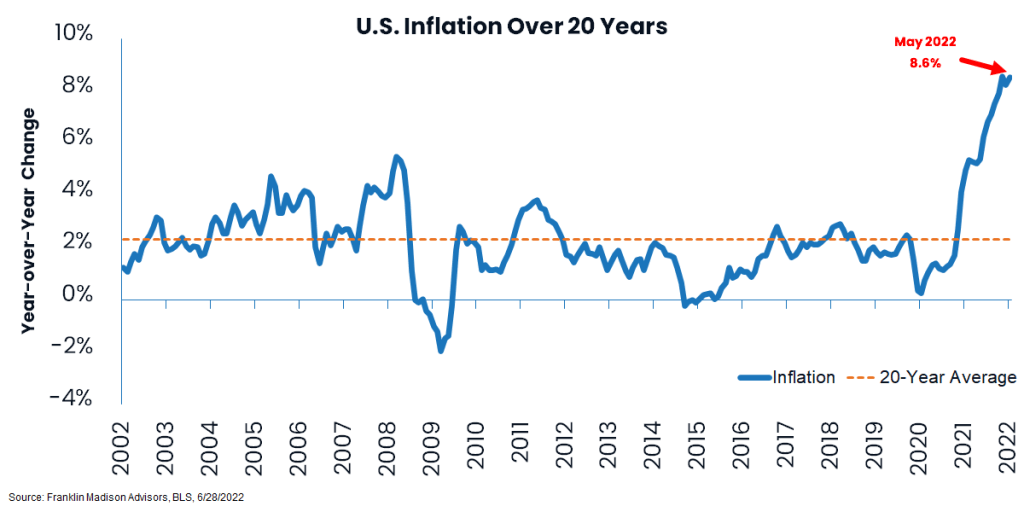
While we tend to hear about inflation in terms of percent changes in government reports, chances are, you've likely experienced its natural effects in everything from higher prices at the grocery store, gas pump, restaurants, and utility bills.
Prices change constantly, so why should you care about inflation now?
Well, other than the fact that inflation is at a 40-year high, it's crucial to understand that when inflation stays high for a long time, it can potentially erode your ability to secure your future financial independence goals if you do nothing to prepare for it today.
What is inflation?
So, what is inflation? Simply put, inflation measures the rate at which prices change for goods and services you spend money on.
For example, if a pound of apples costs $1.05 today, when it was $1.00 twelve months ago, we can say that inflation has caused the price of apples to change by 5% over the past year.
Inflation is the rate of change, or speed, at which prices rise over time.
Whether you're aware of it or not, inflation is always around. The price you pay for the things you need or want is constantly in flux. It can rise and fall daily, weekly, or monthly.
It's like a car traveling down a highway.
Sometimes, inflation moves along steadily for months or years, like it's on cruise control traveling at the highway speed limit. It can also suddenly speed up over days and weeks when something causes the gas pedal to hammer down.
What truly makes it a matter of concern now is how quickly inflation has sped up and how long it has remained in high gear.
How does inflation affect purchasing power?
Inflation matters because the longer it remains in high gear, the fewer goods or services your money will buy tomorrow.
Economists call this declining purchasing power.
For example, a dollar in the late 1990's purchased one gallon of gasoline. Today, with gas prices around $5.00 per gallon, a dollar today has a fifth of the purchasing power it did over two decades ago!
A dollar is still a dollar, but it doesn't go as far as it used to. At least for gasoline.
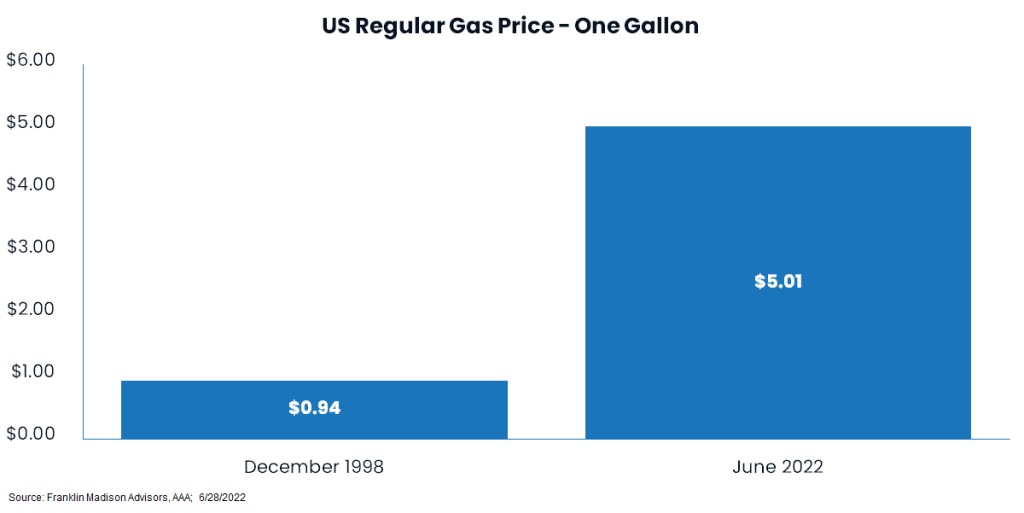
And when inflation takes off, you need more dollars to buy the same product compared to a month or year ago.
That's why if you're setting money aside for a big-ticket purchase or plan to live off your savings sometime in the future, you need to be able to anticipate rising prices.
Indeed, understanding purchasing power is essential whether you're socking money away in a 401k to retire later in life or dependent on your savings now to cover retirement living expenses.
When inflation goes up, and purchasing power goes down, you'll likely need to either save more money today, spend less in the future or do a bit of both. Otherwise, you could find your financial independence plans falling short.
What causes inflation to speed up?
Just like a car needs gas to power its engine and a driver to raise or lower their foot on the gas pedal, no one factor causes inflation to accelerate or decelerate.
Inflation is an interplay between supply (amount of gas in the tank) and demand (driver's willingness to push down on the accelerator).
A full gas tank (supply) won't make a car go fast with a cautious driver (demand) at the wheel.
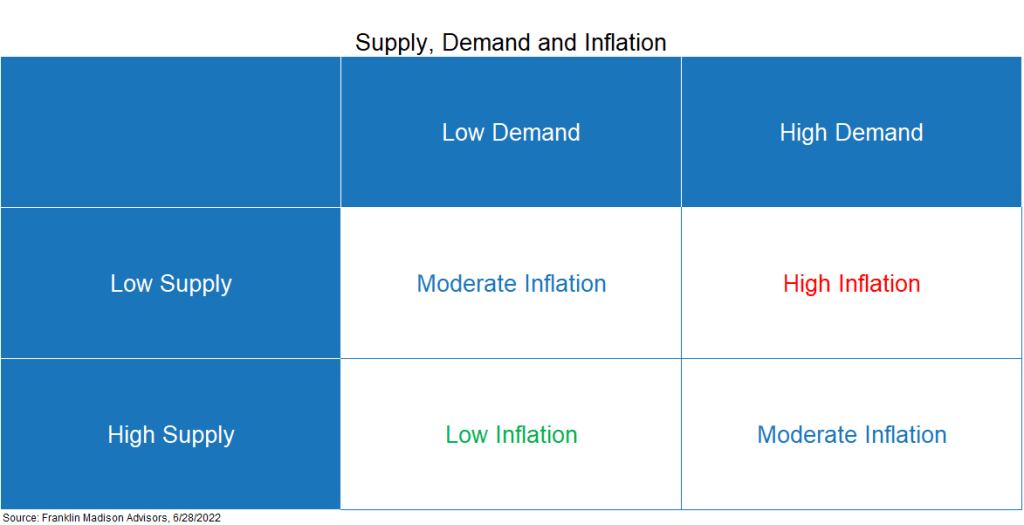
Likewise, an aggressive driver can only go so far with fumes in the tank.
Let's look at gasoline prices as an example. While some may argue that high prices at the pump are related to oil company profits, there's more at play than pure greed.
From a supply perspective, the fact is that economic sanctions on Russia has led to oil shortages in the West.
At the same time, key oil refiners have shut down because of fires, needed repairs, or maintenance.
From a demand perspective, summer is the travel season. And as more cars get out on the road and air travel picks up, so does oil usage.
When supply is limited, and demand is high, prices tend to go up.
Buying a house is another example. Demand for new homes increased nationally during the pandemic as individuals moved to the suburbs to work from home.
It typically takes about a year or so to build a new home, making supply an issue when thousands of individuals are looking to buy a home simultaneously.
Again, when demand is high, and supply is limited, prices tend to go up.
What role does government money play in inflation?
Now, some people will blame the government for today's high prices.
They'll argue that if the Federal Reserve (Fed) hadn't increased the money supply by printing trillions of dollars, or if it had raised rates sooner and the Treasury didn't send out stimulus checks, we wouldn't be dealing with high rates of inflation today.
To a certain extent, this is a valid argument.
Easy central bank policies arguably made it easier for banks to lend money, thus increasing demand from individuals willing and able to make large expenditures, like a new home or car.
Stimulus checks also made it easier for people to purchase goods or services they otherwise may not have needed during the pandemic, thus increasing demand at a time when economic lockdowns constrained global supply chains.
While this argument makes for a simple explanation, the truth is that the story is much more nuanced than can be explained by any one government policy.
That's because the rise in food and energy prices today arguably has less to do with interest rates or government stimulus than it has to do with supply. While government policies have added to the demand side of the equation, the supply of raw materials and finished goods sourced from around the world is still in short supply.
It's not just the government's fault. To be sure, today, we're dealing with a perfect storm of artificially too much money chasing artificially too few goods.
What can be done about inflation?
So, if inflation is seemingly speeding out of control, can't someone stop it? The truth is, there's only so much the government can do to halt inflation.
The Federal Reserve has raised its policy rate in a bid to slow down demand by making money more expensive to borrow and thus slowing the economy. But with war raging in Ukraine, ongoing Covid lockdowns in China, and other challenges, supply-side challenges likely will keep inflation elevated until those issues are resolved.
Fortunately, some businesses have raised wages to help workers offset higher living costs. However, most firms are not entirely altruistic, making up for higher wages by raising the price of their goods and services. This behavior could introduce an entirely new complexity to the inflation discussion. But, that's a topic for another day.
Three things you can do about inflation
For now, inflation matters because it can affect your ability to maintain your standard of living now and into the future.
There's not a lot we can do to affect the declining purchasing power of a dollar. However, you can mitigate its effects by:
1) holding just enough cash to help you sleep well at night,
2) putting excess cash to work in assets that move with inflation and
3) ensuring that you're saving and growing enough money today to make up for a declining purchasing power in the future.
Hold just enough cash to sleep well at night
Setting cash aside during this time of economic uncertainty is essential to weathering a financial setback.
However, keeping too much cash on hand could leave you with a reduced purchasing power of your savings.
For example, let's assume that you have $10,000 in a savings account that pays you interest of 1.00% per year. We'll also assume that inflation averages 5.00% over the year.
How much purchasing power do you have at the end of the year? If you said $10,100 you'd be wrong.
While you earned $100 in interest, inflation reduced your purchasing power by $500, with inflation running at 5% during the year.
That's why if you want to preserve the inflation-adjusted value of your savings, you'll need to put it to work in assets that can protect your purchasing power.

Put your money to work in productive assets
Where else can you put your money if a savings account alone won't protect against inflation? Consider your investments.
A diversified investment portfolio has historically been shown to be a hedge against inflation. Why?
Well, a key reason being is that the price paid for a stock today is often in anticipation of the underlying company's future earnings potential. And with firms increasingly passing rising costs on to consumers, corporate earnings have the potential to rise with inflation over the long term.
At the same time, bondholders demand a return on their investment that will compensate them for their time, investment risk, and inflation.
While stocks and bonds offer a degree of inflation protection, consider holding a mix of these assets in a diversified portfolio to reduce investment risk.
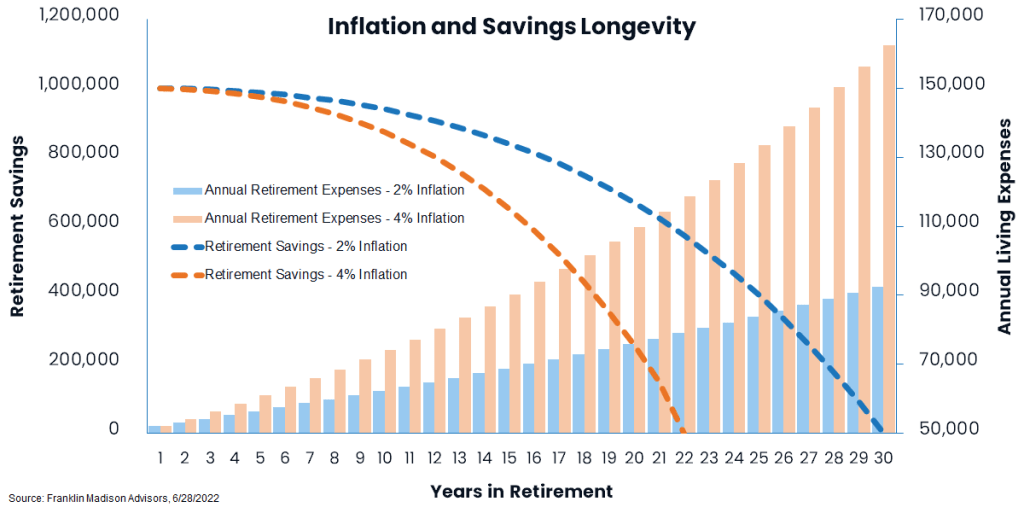
Ensure that you're saving enough to account for inflation
Finally, to our earlier point, inflation could leave your retirement savings goals falling short if not adequately accounted for. Indeed, if you want to secure your future financial independence when inflation is on the rise, you'll likely need to evaluate whether you need to save more money, reduce your spending or do a little of both.
Let's look at an example of how higher than expected inflation could alter the size of your retirement savings nest egg:
We'll start with a base set of assumptions that at retirement, you'll need roughly $50,000 per year to cover living expenses for the next 30 years. We further assume 2.0% average inflation and 5.5% average portfolio returns throughout retirement. At this rate, you'll likely need to have saved one million dollars to cover your costs.
What happens if inflation comes in faster than 2.0%? Well, if inflation turned out to average 4.0% instead of 2.0% over your 30 years in retirement, your million-dollar nest egg could go to zero in just over twenty years instead of thirty years.
To overcome this shortfall, you'd likely need to save an extra $280,000 before retiring, reduce your retirement spending by $10,000 annually or delay retiring by six years.
That's why periodically revisiting your financial plan and clearly understanding the effects of inflation on your expected future income need is essential to maintaining your standard of living and not running out of money in retirement.
Make no mistake, inflation can be a serious threat to your financial independence plans as it reduces the purchasing power of your savings.
Understanding the effects of rising inflation, putting your money to work in productive investments, and formulating a game plan to address declining purchasing power is essential to securing financial independence.
If you do nothing to mitigate this inflation threat, you could find your savings falling short of your desired standard of living later in life.

Worried About Ukraine and Your Money? Consider these Six Things.
Words seem to fail when attempting to describe the horrors of war currently faced by the people of Ukraine. Since last Thursday, millions of innocent Ukrainians have been displaced and hundreds killed following Russia's invasion of an Eastern European democracy.
Indeed, world leaders have since responded by providing Ukraine with financial and military support while imposing heavy economic and financial sanctions on Russian President Vladimir Putin and his cronies. Today, much of the world looks on with bated breath, hoping for a quick and triumphant victory for the Ukrainian people.

How and when this war ends remains largely unknown. It could end tomorrow or persist for weeks to come. Indeed, we're hopeful that delegates from Ukraine and Russia can find a way to end this war diplomatically. Even so, as we pointed out in last week's note, a seismic shift in the geopolitical status quo could lead to economic spillover effects that likely will impact US households for months or even years to come.
So, this leaves many asking, what do these developments mean for my finances, and is there anything I should do right now to protect my wealth? Well, here are six points you may want to consider when it comes to guarding your money during periods of uncertainty:
#1 Expedite big-ticket purchases
Inflation is likely to stay elevated for months to come as a result of this conflict. If your emergency fund is already topped up (see point #3 below) and you have adequate means to buy a new car, house, or anticipate any other big-ticket cash expenditures later this year, you may want to consider purchasing those items now before they become more expensive later.
While a military confrontation currently is limited to Russian and Ukrainian, globally imposed sanctions could, directly and indirectly, affect imported goods and compound supply chain issues that have recently contributed to inflation's rise to multi-decade highs. That's why front-loading spending within your means today may help you avoid potentially higher prices tomorrow.
#2 Revisit your lifestyle spending and savings plan
While inflation's rise likely will mean higher costs for big-ticket spending, you can also expect to pay more on everyday living expenditures not only over the coming months but also potentially for years. Not accounting for these rising costs could leave your retirement nest egg falling short. Indeed, uncertainty surrounding the implications of sanctions and global supply chain efficiency could broadly affect the cost of keeping the lights on at home, filling up your gas tank, eating out, or even buying everyday staples.
In isolation, these higher expenditures may seem manageable in the near term. However, not accounting how these expenses could remain at elevated levels over the long-term could potentially derail your overall financial independence journey when not considered within the context of your broader lifestyle spending goals. That's why now's a good time to reset future cost of living expectations in the face of higher inflation, recalculate your traditional/early retirement total savings need, and make necessary adjustments today to your lifestyle spending or savings contributions to ensure that your everyday financial decisions keep you aligned with your path to financial independence.
#3 Top up your emergency savings fund
The US labor market remains favorable for workers and job seekers alike by many measures. Indeed, while jobs in specific sectors of the economy are plentiful and wages continue to rise, the fact is that US economic growth is slowing and faces headwinds from ambiguous central bank policy, systemic financial instability, and global military conflict.
While an economic recession is not baked into economists' GDP forecast of 3.5% this year, a policy misstep by the Federal Reserve, a shock to the global financial system or a global military escalation could put downward pressure on US economic activity. That's why if you don't have 6-9 months-worth of cash to cover living expenditures, now may be the time to reconsider big-ticket spending decisions along with how much you spend on non-essential goods and services, so that you can increase your monthly savings or reduce needed distributions from your retirement savings.
#4 Prepare for a smaller employer bonus or limited equity award payout
Even if you feel like your job is secure and your emergency savings are topped off, relying on an employer bonus or equity award payout to cover living expenses may lead to financial disappointment later this year. Generally speaking, firm bonuses are tied to corporate earnings. As evidenced during the Covid-induced recession, when economic conditions soften and earnings decline, employers tend to cut back on incentive compensation in a given year.
Present expectations of weaker economic conditions, combined with many of the risks we’ve already mentioned, likely could weigh on risk asset prices this year. That's why if you're the recipient of equity awards and dependent on ISOs or RSUs to cover a portion of your lifestyle spending needs, you may be in for a disappointment should stock prices decline in the months ahead. Put simply, you may want to reevaluate how much of your household outlays are funded by once-per-year windfalls and consider adjusting your lifestyle spending today.
#5 Avoid timing the markets & increase your home country bias
When it comes to your investments, how markets respond to Russia's war with Ukraine likely will depend on day-to-day developments. As such, we expect market volatility to ebb and flow with the news cycle. Indeed, there are times when you may be tempted to make changes in your investment portfolio when it appears that the news is about to get bad.
Nevertheless, during these times of uncertainty, astute investors stick to their disciplined investment process. Rather than trying to identify an inflection point in stock prices or trying to time the next move in the markets, you'll likely be best served by ensuring that your portfolio is aligned with your long-term goals over the coming years, rather than responding to near-term uncertainties by trying to pick the right securities to buy or sell over the coming days and weeks.
#6 Rebalance international risk exposure
Finally, the Russia-Ukraine war coupled with the potential for further confrontations with China has some investors concerned about holding securities tied to these countries in their investment portfolios. While we continue to advocate for investing internationally, we also believe that now may be a good time to reevaluate your investment exposure to countries where the rule of law or the potential for escalating military conflict may lead to downside investment risks.
We're evaluating the current situation more opportunistically, particularly as it relates to international vs. domestic exposure. Indeed, while Russian securities make up a small portion of emerging market stock and bond benchmarks, China's dominance in traditional EM indices likely may argue for a tactical rebalance from traditional asset class benchmark guidelines. We'll provide further guidance and clarification to our active clients in the coming weeks.
For now, only time will tell whether the current situation will escalate to a broader conflict or settle more amicably. Our hope is that substantial financial and economic sanctions coupled with a solid political resolve from Western leaders will convince Putin to end his military incursion in Ukraine. Until then, we anticipate market volatility to ebb and flow with the news cycle. For now, avoiding the noise, evaluating the six items we covered today and committing to your long-term financial plan will not only give you peace of mind during this time of uncertainly, it may also enable you to continue your journey toward financial independence mastery.
Hold Tight in this Financial Meltdown
US equity markets have officially erased their summer gains. The Dow Jones Industrial Average is back in bear market territory, and the S&P 500 is on pace for its worst year-to-date start in recent history. Adding insult to injury, rising US Treasury yields have pushed borrowing costs to seemingly unsustainable levels as mortgage rates in some markets are now above 7% from around 3% just months ago.
It feels like the financial system is about to break.
The fact is that we’ve been here before. In many ways, today’s financial environment is similar to the one that played out during the height of the Global Financial Crisis in 2008.
And I’m taken back to the early years of my career when our Chief Investment Officer held weekly calls for our advisors to help them navigate the market volatility.
If you’ll recall, at the time, Countrywide was handed over to Bank of America months earlier, while Lehman Brothers and Washington Mutual had just gone under. Money markets had just “broken the buck”, AIG was getting bailed out, and Wachovia was pushed into the arms of its competitor for pennies on the dollar.
Fourteen years ago this week, the financial system was melting down in front of my very own eyes.
Understandably, our clients (and team of advisors), were panicking. The floor was falling out from under many individuals’ retirement plans and overall financial well-being. At the time, market participants and households alike were looking for simple answers to a challenging situation.
Now, our weekly calls involved hundreds of investment professionals, and many of them felt like they needed to do something. Some advisors wanted to implement exotic derivative strategies to stem the losses in client portfolios. Others suggested buying specific stocks or sectors amidst the selloff. And other advisors were doing everything they could to stop themselves from simply getting out of the markets altogether.
So, what was the advice from our Chief Investment Officer?
Hold tight.
The advice offered then still holds merit today, and here’s why.
Why You Should Hold Tight
As the financial system was coming unglued in fall of 2008, few individuals knew what the path forward would look like. Investors were desperately looking for a catalyst to drive financial assets higher, but a positive market narrative was nowhere to be found.
The old rules of how the financial system should function in many ways no longer applied during that time.
Even so, policymakers stepped in with creative approaches to undergird the financial system. As you’ll recall, in October 2008, the US government introduced the Troubled Asset Relief Program (TARP) to prevent other financial institutions from failing.
In November of the same year, the Federal Reserve launched a historic quantitative easing program aimed at buying up bad debt and restoring confidence in the financial system by showing that policymakers had “tools in the toolbox” to address the market dysfunction. The central bank also introduced a number of measures to support global central banks that had been experiencing stresses in international markets.
By March 9, 2009, market participants were finally convinced that the right set of tools were in place to avoid any further catastrophic collapse in the financial system, and risk assets susbequently rallied.
In the year that followed the March 2009 lows, the S&P 500 index would nearly double in value and then rise by around 600% through December of last year.
Now, there are some individuals whose investment experience was far worse than the broader market. It was those individuals who got out of the markets in January 2009, waiting on the sidelines for an “all-clear” signal before putting their money back to work.
Keep Moving Forward
The point here is that when it seems like the world is crumbling around you and the path forward appears ambiguous, the best course of action may be to simply hold tight and keep moving forward.
Indeed, three fundamental principles apply here when it comes to managing your finances in times of uncertainty:
What You Should Focus On
To the first point, there is only so much that we can control when it comes to managing our lives or our money. During times like today, I’m often reminded of an illustration from Carl Richards over at the Behavior Gap. It’s a Venn Diagram with two circles.
In the left circle are the “things that matter.” And in the right circle are the “things you can control.”
When you bring the things that matter, and things you can control together, what you find is that there are only a few items in life that you should be focused on when the economy or markets are in decline.
These areas should include reminding yourself of the long-term financial purpose that you’ve defined for your wealth, and the plan you’ve put in place to address times like these when the markets go south.
These actions could include reevaluating your investment strategy to ensure that your holdings are aligned with your long-term goals. It can also mean ensuring that you have a cash management strategy in place to avoid having to sell investments at an inopportune time.
Stay Objective
The next component to holding steady in times of uncertainty is to remain objective and avoid getting caught up in emotions when the markets are gyrating up and down.
Now, it’s been said that watching the stock market every day is like watching someone play with a yo-yo while riding up a moving escalator.
You’re likely to feel a high degree of stress if you focus on the yo-yo rather than where the escalator is headed.
If you find yourself worried about the markets and glued to financial media desperately seeking out answers, now may be a good time to turn off the TV and go for a walk.
There’s no better time than the present to remind yourself that over the long-term, financial markets have historically rallied after periods of extreme volatility. Remember, the role of financial media often is to sell emotion and rarely to provide any meaningful advice.
And if you find yourself stressed and still looking for answers, now may also be a great time to reach out to your trusted advisor to get an objective opinion on your options.
Stay in the Present
Finally, it’s vital to stay present in uncertain times like these. John Kabat-Zinn had a saying that “wherever you go, there you are.” What this means is that the one constant we have throughout our experience with money (or life in general) is how we deal with the present moment.
There’s nothing we can do about the past and very little we can do about future events outside of our control.
That’s why during these times of economic and market uncertainty, it’s essential to focus on what you need to do right now. Not sure what to do? Then go back to your financial plan and remind yourself what you need to do now to make your goals a reality.
Don’t have a plan?
Well, there’s no better time than the present moment to put one together. Either way, avoiding rumination on past or upcoming financial decisions begins with staying focused on what needs to be done right now in the present.
Where to from Here?
Make no mistake, the events unfolding in financial markets today feel ominously similar to the events that took place fourteen years ago this week. Equity markets at home and abroad seem to feel like they’re in some sort of freefall. The US dollar’s strength is squeezing international financial markets while bond yields are heading relentlessly higher and stocks are moving lower.
And the key reason that markets are behaving the way they are today is mainly due to uncertainty around what appears to be a self-inflicted wound from policymakers: a desire to inflict pain in order to tame inflation expectations.
It’s scary out there, and it feels like things can only get much worse.
But here’s what’s key: we’re going to get through this market dislocation just like we did during the Global Financial Crisis, Savings and Loan Crisis, Energy Crisis of the ’70s, and so many other crises from the past.
The solution to today’s high government debt and experiment in money printing likely will require a solution that hasn’t been presented yet.
For now, policymakers appear to be out of tools that address historically high inflation while avoiding a crash in the economy and financial markets.
What history has shown, however, is that when it seems like it can’t get any worse and there’s seemingly no way out, a solution eventually finds a way, allowing risk assets to breathe a sigh of relief and rally higher.
Until then, hold tight.