

Set Financial Boundaries and Gain Peace of Mind
Are you good at setting boundaries? If you’re not, then rest assured that many individuals struggle with setting and enforcing boundaries.
And what kind of boundaries are we talking about here?
Well, imagine for a moment that a school’s playground is situated so close to a highway that you could reach out and touch the passing cars. In fact, there are no fences surrounding the playground and cars zip right by at 80 miles per hour, unimpeded.
Now, understandably, when it’s time for recess, both the teachers and children face an overwhelming amount of stress and anxiety as they head out to play. For the kids, their concern is getting too close to the edge of the highway, so they play in the center of the yard for fear of the vehicles passing by at high speeds.
And for the teachers, their anxiety comes from the constant worry about a rogue child leaving the playground and wandering onto the highway, which could ultimately lead to a tragic outcome. It then goes without saying that in this situation, recess is not an enjoyable experience for either the children or the teachers. That’s because they spend their free time huddled up in the center of the schoolyard, each vigilant for their own reasons, instead of enjoying the present moment.
Now, let’s say that the city puts up a reinforced concrete wall to separate the highway from the playground. How do you think this outcome would change the recess experience? Certainly, with a solid fence in place, the children can utilize the entire playground, and run right up to the wall, without worrying about all of the high-speed traffic on the other side of the barrier.
At the same time, the teachers would likely be less anxious because they can rest assured that the newly constructed barrier will prevent a wayward child from wandering on to the highway.
Now, if you’re a parent out there, how would you feel knowing that your child was playing near a busy highway with nothing standing between them and the cars? Well, too often, that’s what happens when we set about managing our money without setting prudent financial boundaries.
Like a protective wall separating a school playground, boundaries tell others where they end and you begin. While on the surface setting boundaries seems to look like a form of restriction or control, this practice involves setting limits on how much emotional energy and time we give to others and ourselves and has the benefit of clarifying expectations, demonstrating self-esteem, fostering trust and encouraging mutual respect.
And when it comes to money, financial boundaries are intended to set a wall around how you use your life energy to manage your finances.
To be sure, financial boundaries are essential for maintaining a healthy relationship with not only our money, but also with your friends and family. And by embracing financial boundaries, you can likely experience increased financial stability and harmony in both personal and relationship contexts, and more importantly, make essential financial decisions while protecting your emotional and mental well-being.
Understand How Boundaries Can Help You
So, how can setting financial boundaries improve the money relationships you have with yourself and others?
Clarifying Expectations
Well, let’s look at it from the perspective of clarifying expectations.
By outlining the limits of acceptable behavior and communicating these limits effectively, you help others understand what you expect from them.
For instance, in the book, Boundaries, by Henry Cloud and John Townsend, they describe scenarios where someone like Bob, for example, frequently shows up unannounced at Tom’s home, expecting to be welcomed in at any time, without regard for Tom's schedule or needs.
By setting a boundary, Tom would communicate to Bob that while he values their friendship and wants to spend time together, Bob needs to call or schedule a visit in advance, so that Tom can prepare and make time for him. This act of setting boundaries helps to clarify expectations and set mutual respect for each other's time and space.
And without a boundary in place, Bob may continue to show up unannounced, causing stress and resentment in the relationship. That’s why by setting a clear boundary, both parties know what is expected and therefore they can maintain a healthier, more respectful relationship going forward.
Self-Respect
Another benefit of establishing boundaries is that it demonstrates self-respect to ourself and others. That’s because when we communicate our needs and expectations, it signals that we value ourselves and our well-being.
In Nancy Levin’s book, “Setting Boundaries will Set You Free,” the author gives us an example of someone like Michelle, who has a pattern of always saying "yes" to her boss's requests, even if it means sacrificing her own needs and personal time.
And by setting a boundary and saying "no" to certain requests, Michelle demonstrates that she values her own time and energy, and that her needs are important too. And this act of self-respect can lead to a greater sense of empowerment and self-worth.
What’s more, Levin argues that when we establish healthy boundaries, we show ourselves and others that we are worthy of respect and consideration. And by setting limits on what we are willing to tolerate, we communicate that our needs and feelings matter, and we create a foundation for healthy relationships built on mutual respect and understanding.
Fostering Trust
Now, setting clear boundaries can also fosters trust because when we’re open about our needs and expectations, we show our reliability and trustworthiness.
For example, in her book "Daring Greatly," Brene Brown shares a story about a woman like Gretchen, who was struggling the relationship she had with her mother-in-law. Now, Gretchen felt like her mother-in-law was constantly criticizing and interfering in her life, and she was having trouble setting boundaries.
With time, Gretchen learned to set clear boundaries with her mother-in-law, telling her that she could not tolerate the constant criticism and interference in her life. As a result, this specific relationship improved and Gretchen felt more respected and valued.
Now, Brene suggests that setting boundaries in this way fosters trust because it establishes clear communication and mutual respect. And when we’re able to communicate our needs and expectations effectively, we show that we are reliable and trustworthy, which builds stronger relationships and fosters a sense of trust in our personal lives as well as our professional ones.
Mutual Respect
Finally, establishing our limits while also honoring other people’s boundaries leads to more rewarding and mutually beneficial relationships through mutual respect.
For example, in the Boundaries book, Cloud and Townsend share a story about a woman like Sarah who was constantly being taken advantage of by her friends. That’s because Sarah was always available to listen to their problems and offer support, but when she needed help, Sarah’s friends were nowhere to be found.
Over time, Sarah learned to set clear boundaries with her friends and communicate her needs and limitations. In fact, Sarah stopped being the "go-to" person for everyone's problems and started focusing on her own needs and goals.
As a result, Sarah’s relationships with her friends improved, and they learned to respect her boundaries and limitations. What’s more, Sarah was able to establish a more balanced and mutually beneficial relationship with herself and her friends.
Indeed, Townsend and Cloud suggest that when we are able to communicate our needs and limitations effectively, we create a space for others to do the same, which leads to a healthier and more balanced relationship for everyone involved.
To be sure, setting boundaries is crucial for fostering healthy, fulfilling, and respectful relationships. And by clarifying expectations, showing self-respect, building trust and fostering mutual respect, we can create a strong foundation for effective communication and more importantly, financial and emotional well-being.
Set Financial Boundaries with Yourself
Alright, so now that we have a baseline for what healthy boundaries are, let’s look at this approach from the context of how you deal with your own money.
Indeed, while boundaries often tell others where they end and you begin, when it comes to setting financial boundaries, we often need to start with focusing on ourselves.
And what does this mean?
Well, psychologist Anne Katherine in her book "Boundaries: Where You End and I Begin," explains that setting boundaries with yourself involves recognizing your limits, being aware of your emotional and physical needs, and asserting those needs to maintain a healthy balance in your life.
That’s because setting boundaries with yourself can help you avoid burnout, manage stress, and cultivate a sense of self-worth. And without this healthy baseline in place, you can’t expect others to support or respect the boundaries you plan to set with them.
Indeed, when it comes to financial boundaries, Anne Katherine's insights can be applied in a similar fashion. Based on her book, Anne likely would emphasize the importance of understanding your financial needs and limits, setting clear guidelines for spending, saving, and investing, and practicing self-discipline to adhere to those guidelines.
Boundaries and Giving Your Money Purpose
So, then, how do you go about doing the work of setting financial boundaries with yourself?
Well, to start, setting financial boundaries with yourself involves identifying a purpose for your money, and then aligning your own spending, saving, and investing habits with your broader values and purpose. This approach can help you establish a sense of control over your finances and financial future and ultimately help reduce your financial anxiety.
Indeed, creating a financial plan that includes a solid cash management process, allocating a certain percentage of your income towards savings and investments, and avoiding unnecessary expenses are all forms of setting clear boundaries about your money.
For example, consider Samantha’s story. Now, Samantha is a 38-year-old software engineer, who recently received a significant salary increase after her promotion. Now, despite her newfound financial success, she found herself feeling out of control and anxious about her financial future, as she struggled to maintain healthy financial boundaries.
Without a purpose for her money, Samantha was unsure how to allocate her income wisely. She had no idea how much of her salary should be set aside for savings and investments, and her spending habits had become increasingly impulsive. Now, this lack of control over her personal finances also affected her financial boundaries with others. That’s because she often found herself lending money to friends and family without considering the impact on her own financial stability.
And Samantha’s anxiety intensified when she realized that her lack of a solid cash management process left her with minimal emergency funds, making her vulnerable to unexpected expenses. What’s more, her inability to track her spending meant she was often surprised by her credit card bills at the end of each month.
So what did Samantha do? Well, to regain control, Samantha put in the work to identify her personal values and what she ultimately wanted to get out of her life, and created a financial plan that would finally give her money purpose.
And by doing this work, Samantha was able to establish a monthly budget that included allocating a certain percentage of her income towards savings and investments, as well as setting limits on discretionary spending. What’s more, Samantha started using her cash management process to track her expenses, which helped her avoid unnecessary costs and gain more financial confidence.
Boundaries to Reduce Emotional Spending
Another way to set financial boundaries with yourself is to become more aware of your propensity to spend impulsively or emotionally. And doing so can help prevent purchases outside of your budget or not aligned with your values or the purpose that you’ve defined for your money.
Remember, a boundary is a decision about how and where you give your emotional energy. And from this perspective, Bari Tessler, the author of "The Art of Money," emphasizes the importance of establishing emotional boundaries as a tool for overcoming impulsive spending.
Indeed, Tessler believes that impulsive spending is often a response to emotional triggers such as stress, anxiety, or a desire for instant gratification. And by setting financial boundaries, you can learn to identify and manage your emotions in healthier ways, which can reduce the urge to engage in impulsive spending.
So, how do you establish boundaries in this arena? Well, Tessler suggests several ways to establish emotional boundaries to overcome impulsive spending, and the first of which is to develop awareness of your emotional triggers.
From this perspective, if you have trouble with setting boundaries on emotionally driven or impulsive spending, Tessler recommends keeping a journal to track your emotional responses and subsequent spending habits. Doing so can help you identify patterns and triggers that lead to impulsive spending, and potential ways to address them.
Then, once you have identified your emotional triggers, Tessler suggests setting limits on your emotional responses. For example, if you find that stress triggers impulsive spending, you can set a boundary to take a break or engage in a stress-reducing activity before you pull the trigger on that next regretful purchase.
Tessler also emphasizes the importance of practicing self-compassion when establishing financial boundaries to curtail emotional spending. This means being kind and understanding with yourself, even when you make mistakes or struggle to avoid impulsive spending. Indeed, self-compassion can help you stay motivated and avoid feeling discouraged or overwhelmed.
Boundaries to Foster Healthy Financial Habits
Lastly, setting clear financial boundaries can help you develop sustainable money habits. Remember, the act of setting boundaries with yourself is about deciding where you will (and won’t) devote your time and energy.
Indeed, Mark Manson the author of, "The Subtle Art of Not Giving a F*ck," argues that people often have a limited amount of time, energy, and attention to devote to different areas of their life. And, so, when it comes to your money, three areas where you give your energy are founded in your values, responsibilities, and control.
So, then, from this perspective, the first thing you’ll want to focus on to develop sustainable financial habits is to set boundaries on your values and priorities.
What does this mean?
Well, let's say that one of your core values is to be financially independent. When your choices are driven by this value, you’ll likely prioritize saving money each month and avoid overspending on non-essential items, such as eating out or buying expensive clothes. And, by aligning your spending habits with your values, you can create a sense of purpose and motivation for sticking to your financial habits.
And, so, how do you go about doing this?
Well, take some time to reflect on your beliefs, attitudes, and behaviors around money and evaluate whose money script you’re living.
Remember, a money script is a set of thoughts, beliefs and attitudes you have about money that, more often than not, are influenced by the people around you. If you’re not sure whose script you’re living, then be sure to check out our recent posts on Money Scripts so that you can get some much needed guidance in this area.
Next, set boundaries to be more responsible. Now, responsibility refers to your obligation to take care of yourself and your finances. And so, setting financial boundaries involves taking responsibility for your financial rituals. For example, let's say that you have a habit of ignoring your bills and not keeping track of when they are due because you’re dealing with financial procrastination.
Naturally, this can lead to missed payments, late fees, and damage to your credit score. Therefore, taking self-responsibility in this situation, would involve identifying emotional triggers that are leading to your willingness to procrastinate.
At the same time, it may also involve taking the time to review your bills each month and checking your bank statements for errors or discrepancies to ensure that you’re not leaving money on the table. Either way, setting responsibility boundaries can help you stay focused on what needs to be done, and help develop sustainable habits.
Finally, set boundaries around what you do and don’t have control over. Remember, you can’t control where the markets are headed, but you can control your investment strategy. You can’t always control when you or a loved one will pass away, but you can control how you’ll prepare financially for just such an event. You can’t control whether you’ll lose your job, but you can be prepared if it happens.
Indeed, Franklin Covey, in his book, “Seven Habits of Highly Effective People,” suggests that if you want to use your life energy wisely, you’ll need to have a clear understanding of what you can and can’t control. Covey refers to this as the circle of influence.
And what does this mean?
Well, according to Franklin Covey, there are three areas of the circle of influence:
- Circle of Concern: This includes all the things that an individual is concerned about, but has little or no control over, such as the weather, political events, or other people's behavior.
- Circle of Influence: This includes all the things that an individual can impact including their own behavior, thoughts, and emotions, as well as their relationships and work.
- Circle of Control: This includes all the things that an individual has complete control over, such as their own actions, choices, and attitudes.
Now, when it comes to choosing where to give your energy, Covey emphasizes the importance of focusing on the circle of influence and circle of control, rather than expending energy on things in the circle of concern that cannot be changed. That’s because by focusing on what can be controlled, you can create sustainable habits and make progress towards your financial independence goals.
The big takeaway here is that personal financial boundaries are about deciding who and what gets your emotional energy when it comes to your money. And by creating boundaries around your money’s purpose, emotional spending, and habits, you can create mental and emotional space to concentrate on pursuing your long-term life and financial goals.
Setting Financial Boundaries with Others
And now, the final point that we’ll discuss when it comes to financial boundaries is those we set with other people. Now it's crucial to set boundaries around money when dealing with other people, and here’s why.
First and foremost, if you don't set boundaries, you might end up giving away, lending or spending more money than you can afford, which could put you in a tough spot. Now, imagine if money issues started causing problems in your relationships with friends or family. That wouldn't be great, would it? Well, setting boundaries helps avoid misunderstandings and keeps things from getting awkward or causing conflicts.
You might wonder, how can setting financial boundaries help others? Well, by setting effective financial boundaries with others, you encourage them to be responsible with their own money. This way, they learn how to manage their finances and become more independent, rather than relying on you when they fall short in their own financial habits.
Indeed, when you set appropriate financial boundaries, you can help reduce your own stress and guilt because you won't constantly feel like you have to help others financially.
Let me explain what I mean here by telling you a story about, Lisa.
Now, Lisa is a successful marketing executive who's really smart about her money. But there was a time, however, when she found herself in a bit of a financial predicament, all because of social pressures.
You see, Lisa's friends loved going out for fancy dinners, taking expensive vacations, and basically, just living the high life. And Lisa, not wanting to feel left out or seem stingy, would simply go with the flow, even though she knew it wasn't the best choice for her finances.
What was the result?
She was constantly stressed about money and struggling to save for her future.
Then, one day, Lisa decided she'd had enough. She knew she needed to set some financial boundaries and be more open about her money matters with her friends and family.
So, what did she do?
Well, the next time her friends invited her on a luxury weekend getaway, Lisa took a deep breath and said, "Guys, I appreciate the invite, but I've got to be honest with you—I'm trying to be more responsible with my money, and this trip is out of my budget right now."
Now, to her surprise, a few of her friends admitted they were feeling the same way! They'd been silently struggling with keeping up with their own social pressures, but were too embarrassed to say anything.
In fact, Lisa's honesty sparked a conversation about finances among her friends, and they started brainstorming ways to have fun without blowing their budgets.
Now, Lisa and her friends have a new tradition: once a month, they get together for a potluck dinner at someone's house instead of going out to an expensive restaurant. They still have a great time, and the best part? Everyone's a lot less stressed about money.
So, what's the big takeaway? Don't be afraid to assert your financial boundaries and talk openly about money with your friends and family. That’s because you might just find that others are in the same boat, and you'll all be better off for it.
By this point you might be thinking to yourself, “the approach sounds simple, but how do you actually make this happen?”
How to Set Boundaries with Friends and Family
Well, in the book "Set Boundaries, Find Peace," author Nedra Tawwab discusses the importance of setting financial boundaries with friends and family. She emphasizes that money can be a sensitive and emotionally charged topic, so setting boundaries around finances is crucial for maintaining healthy relationships.
But how do you set these boundaries with friends and family?
First things first, know your own financial goals and limits. This understanding comes from the work you did in setting your own personal financial boundaries and can help you more clearly articulate your own financial expectations and goals before engaging in conversations with friends and family about money. Then, use what you’ve learned about your own financial boundaries to communicate to others what you’re willing and unwilling to do when it comes to your money.
For example, let’s say that you’re considering co-signing on a loan with a friend or family member. In this case, take the time to review your own financial goals and the purpose that you’ve defined for your money. This will help you determine whether co-signing is a good fit for your own financial situation and whether you can afford the risk.
Next, be clear and consistent in your communication. More specifically, when discussing money with loved ones, it's important to be clear about your boundaries and consistent in enforcing them so that you can avoid blame or miscommunications.
For example, if you've established a boundary with a family member, and they’re still hassling you to lend them money, then you might need to remind them of the boundary, and learn to use "I" statements to express your own needs and concerns.
And what if you have to say "no"? Well, truth be told, setting financial boundaries often involves saying "no" to requests for money or financial assistance. But remember that saying "no" is not a rejection of your loved ones, but rather a way to prioritize your own financial well-being.
For example, if a friend asks to borrow money and you're not comfortable with the request, say "no" in a firm but respectful manner. Here, you can explain that you're not in a position to provide financial support, but you're happy to help in other ways if possible.
Also, if you’re unwilling to say “no” outright, try thinking through some alternatives, such as helping your loved ones find other sources of financial support or offering to provide non-financial assistance.
For example, if a family member asks for a loan that you're not comfortable providing, you can offer to help them find other sources of financial support, like connecting them with local financial resources or recommending job opportunities. Alternatively, you can provide non-financial assistance, like helping them move or offering emotional support.
Finally, take care of your emotional well-being. Setting financial boundaries can be emotionally challenging, so prioritize your own well-being throughout this process is essential. And what does this look like? Well, taking care of your emotional well-being might involve seeking support from a professional, practicing self-care, and being patient with yourself as you navigate this process.
For example, if setting financial boundaries with loved ones is causing you emotional stress, seek support from a therapist or trusted friend. You can also practice self-care activities, like meditation or exercise, to help manage stress and maintain a sense of well-being. Overall, be patient with yourself as you navigate this process and prioritize your own emotional needs.
Remember, social pressures can heavily influence your own financial decisions, making it crucial to assert financial boundaries with friends and family. And by establishing clear guidelines and openly discussing money matters, you can navigate social expectations and emotional pressures while maintaining your financial well-being.
Set Financial Boundaries and Gain Peace of Mind
When it comes down to it, financial boundaries play a pivotal role in achieving your long-term life and financial goals by enabling you to stay emotionally disciplined when you’re tempted to do otherwise.
Indeed, by taking the time to assess and tweak your boundaries, you're giving yourself the opportunity to respond to life's inevitable ups and downs with flexibility and resilience.
But what's the ultimate outcome of embracing financial boundaries? The answer is simple: increased harmony, stability, and overall well-being in both your personal life and your relationships. Indeed, when you actively engage with your finances in a thoughtful, proactive manner, you're not only setting yourself up for success but also fostering healthier, more fulfilling connections with those around you. But most importantly, doing the work of setting healthy financial boundaries ultimately takes you one step closer to becoming the master of your own financial independence journey.


What's the Cost of Too Many Financial Accounts?
Did you know that having too many financial accounts can actually be more counterproductive than being useful? To be sure, while some individuals view having multiple financial accounts as making them better stewards of their finances, the truth is that being overbanked can lead to serious financial problems.
And that's what happened to Brian. Now, Brian is an ambitious entrepreneur with a passion for personal finance. And Brian believed that the more accounts he had, the better he could manage his finances and grow his wealth.
Even so, little did Brian know that his obsession with opening and managing various financial accounts would take a toll on his mental health and cost him dearly.
And, that's not because Brian didn't know how to manage his money. In fact, Brian had always been a high achiever. He graduated at the top of his class from a prestigious business school and quickly climbed the corporate ladder, earning a six-figure salary enabling him to make the leap and start his own business.
As his wealth grew, so did his appetite for diversification. So much so that Brian believed that opening multiple bank accounts, credit cards, and investment accounts would provide him with better financial security and opportunities for growth.
And, over the years, Brian accumulated several dozen bank accounts, credit cards, and investment accounts. Even so, Brian meticulously tracked the balance, interest rates, and fees for each account, ensuring that he maximized his returns. In fact, he spent countless hours poring over spreadsheets and statements, monitoring his cash flows, and making complex transactions between accounts.
Now, at first, Brian's strategy seemed to work. His wealth grew, and he felt a sense of accomplishment from his financial prowess. But as Brian brought on new clients and his business grew, so did the complexity of his financial situation.
And as his finances became more complex, Brian's stress level started to rise. Indeed, whenever a statement arrived in the mail, or an email notification popped up on his phone from a financial institution, Brian felt a wave of anxiety wash over him. The truth is that the sheer volume of information related to his finances was so overwhelming that he struggled to keep track of all the financial details.
The turning point came when Brian missed a credit card payment deadline. He had always prided himself on his financial responsibility, but the oversight led to a hefty late fee and a hit to his credit score. And it was that incident that shook Brian to his core, forcing him to question whether his financial strategy was really working.
Nevertheless, despite the warning signs, Brian stubbornly refused to simplify his finances. He believed that his system, while complex, was still the best way to manage his money, and this decision came at a steep cost. That's because the stress from managing so many accounts at once led to more oversights and errors, resulting in additional fees and penalties. As this happened, his stress levels skyrocketed, which affected his work performance and personal relationships.
So, what happened?
Well, Brian's once-pristine credit score plummeted, making it difficult for him to secure cheap funding to keep his business afloat. What's more, his investment accounts suffered, as he was unable to give each account the attention it required. Eventually, Brian's professional and personal life began to suffer as a result of his financial struggles.
And, only when Brian hit rock bottom did he finally recognize that something needed to change. At that point, he realized that his finances had become unmanageable, leading him to admit that he needed to simplify his financial life.
Now, as Brian began working to simplify his financial life, he noticed a significant decrease in his stress levels. In fact, he no longer spent countless hours poring over financial statements or worrying about missing important details. And as a result, his professional performance improved, and he gradually repaired his relationships with friends and family.
The Mental and Financial Costs of Too Many Financial Accounts
In the end, Brian learned a valuable lesson: sometimes, less is more. His pursuit of financial complexity had limited his ability to remain financially flexible, ultimately costing him far more than it had earned. By embracing simplicity, however, Brian was able to regain control of his finances and, more importantly, his life.
Can you relate to Brian?
The truth is that many individuals today are overbanked or have too many financial accounts spread across various financial institutions, and it's costing them their ability to manage everyday stresses and to remain resilient to one-time shock events.
The Mental Costs of Being Overbanked
In turn, these complex processes for managing their finances quickly spiral out of control, leading to unnecessary financial costs and setbacks.
Indeed, there are many costs associated with being overbanked, and it all starts with cognitive overload.
So, what is cognitive overload?
Well, cognitive overload is when you become so stressed that you don't know what to do next. And this typically happens when your brain cannot process and handle the overwhelming amount of information it's receiving because there are so many things coming at you at one time.
Now, Eldar Shafir has a lot to say about cognitive overload. That's because Shafir is a cognitive psychologist whose work focuses on how cognitive limitations, such as cognitive overload, can affect decision-making and behavior in various life domains. And Shafir, along with other behavioral economists studied how your mental resources can become scarce when you're faced with income challenges, time pressures, or other demanding situations.
According to Shafir, when you experience cognitive overload due to resource scarcity, it can lead to a phenomenon called "tunneling." Tunneling occurs when you focus your attention on the immediate problem at hand, forcing you to neglect other important aspects of your life. And, as a result, you may struggle to make sound decisions or engage in effective problem-solving when it comes to your money.
Indeed, in a study conducted by Shafir and his colleagues, participants were given a challenging financial decision to make, with some participants facing a high-pressure situation that simulated financial scarcity while others faced a low-pressure situation. Those in the high-pressure condition experienced cognitive overload, leading them to make suboptimal financial decisions compared to those in the low-pressure condition.
What this study illustrates is that when you're overbanked, and your financial management process becomes so complex that it takes up too much of your attention, it leaves little room for other essential professional and personal life obligations, especially when sudden life changes take place.
When this happens, you may feel mentally exhausted, find it difficult to focus on tasks, and struggle to make critical decisions. In turn, "tunneling" can affect your productivity, creativity, and overall well-being because your mental resources are committed to solving one complex problem. And more often than not, that's worrying about your finances. It can also cause additional stress and anxiety, leading to burnout and decreased life satisfaction.
Moreover, when your brain is preoccupied with one domain of your life, like staying on top of managing your various financial accounts, it may be less able to switch gears and focus on other tasks. This situation can lead to reduced creativity and problem-solving ability, as well as increased risk of errors or oversights in other parts of your life, like staying on top of your workload or managing essential relationships.
Now, maybe you're in a situation where you have various deposit, credit, and investment accounts spread across various financial institutions and are doing just fine managing all of them.
The Financial Costs of Being Overbanked
The trouble is that while you may have a well-oiled process right now to manage all of the complexity, all it takes is one overwhelming life event to put a kink in your complex financial process, ultimately leading to cognitive overload and potentially costly financial mistakes down the road.
And what are these costs?
Well, having multiple deposit accounts, like checking and savings accounts, can lead to increased fees and expenses if you become distracted by other pressing personal or professional matters in your life.
That's because when you're managing several accounts spread across different institutions, it's easy to overlook minimum balance requirements, which might result in monthly maintenance fees. And if you're using three, four or five deposit accounts to pay various expenses, chances are that you might encounter the occasional overdraft charge if you forget to make a transfer from one account to the other as expenses come through.
Now, at this point, you may be tempted to believe that, when times get tough, you can just put your expenses on your credit cards to avoid those potential bank charges. But, when it comes to your credit cards, managing multiple cards can make it more challenging to track your spending and pay off your balances on time, leading to interest charges and potential late payment fees when the inevitable road bump or pothole comes along in your journey to financial independence.
What's more, having too many accounts can not only affect your propensity to spend wisely, it can also negatively impact your credit score. For example, each time you apply for a new card, there is a hard inquiry on your credit report, which can lower your overall score and make it more expensive to borrow money in the future.
And finally, when it comes to your investment accounts, there is such a thing as having too much of a good thing. Indeed, when it comes to investment accounts, managing multiple accounts can lead to inefficiencies, including a suboptimal asset allocation and paying too much in performance fees.
That's because when you have too many investment accounts, tracking each account's performance and combined allocations can become time-consuming, making it harder to maintain a well-diversified portfolio. What's more, with so many accounts to manage, you'll likely be less inclined to evaluate the fees that you're paying for various investment products, leading to overall lower returns over the long-term.
So, when it comes down to it, being overbanked or having too many financial accounts can be mentally and emotionally taxing and lead to unnecessary fees and expenses that can delay or even derail your journey to financial independence. That's why it may not always be beneficial to have many accounts spread across various institutions when it comes to your financial accounts.
The Benefits of Financial Simplicity
So, what can you do if you find yourself in Brian's position where you're overbanked, and it's beginning to tax your time and cost you money?
The short answer is to simplify.
Why simplify? Well, other than the obvious reason that it can reduce the complexities in your life, simplifying your financial account management can have many near- and long-term benefits.
For example, in the book, "Your Money or Your Life," authors Vicki Robin and Joe Dominguez emphasize the importance of simplicity and intentionality when it comes to managing your finances. In fact, the authors drive home the point that being overbanked can often lead to confusion and unnecessary complexity in your financial life.
What's more, Robin and Dominguez emphasize the importance of understanding the true value of money in terms of life energy. By simplifying your finances, you are more likely to gain a clearer perspective on your spending habits and the amount of time and energy you invest in acquiring material possessions. This awareness can lead to more intentional and meaningful use of your financial resources, ultimately improving your overall quality of life.
Indeed, embracing simplicity can allow you to cultivate a more fulfilling and purpose-driven life. That's because by reducing physical and financial clutter, you can focus on the activities, relationships, and experiences that truly bring you joy and satisfaction.
Sure, managing a complex financial framework can, at times, make you feel empowered and like you're a good steward of your money. At the same time, however, simplifying your life can help you identify and prioritize your values and help you align your spending habits with your life goals, ultimately leading to a more content and purposeful existence.
Another take on the idea of simplicity comes from the world of home organization. Marie Kondo, known for her KonMari method of tidying and organizing, offers valuable insights on how you may want to consider decluttering the number of financial accounts you have, which can help simplify your financial life.
Now, Kondo believes that decluttering and simplifying your surroundings can profoundly impact your mental and emotional well-being. That's because by only keeping items that "spark joy" in your life, you cultivate an environment filled with positivity and happiness. When you do, you'll likely experience less stress and anxiety, and as a result, your mind will be clearer and more focused.
How does this work? Well, the KonMari method encourages you to be more mindful of your possessions and their value. By focusing on simplicity, you develop a deeper understanding of what truly matters to you. As you carefully consider each of your financial accounts and determine whether or not its management sparks joy, you become more conscious of your consumption habits and learn to appreciate how you spend your life energy.
How to Simplify by Aligning Account Management with Your Money's Purpose
So, now that we've discussed the emotional and financial costs of being overbanked, and how simplifying your life and finances can help you cut stress and achieve peace of mind, how do you actually go about the process of reducing the number of accounts you manage?
One approach to simplifying your financial management is to align your financial accounts with your money's purpose.
And what exactly does this mean?
Well, you'll likely recall that in recent articles, we discussed how essential it is to identify your values, crystallize your life purpose and align your money with these priorities. So then, from this perspective, if your values and life purpose guide how you use your money, then how you manage your financial accounts is an extension of making your life goals a reality.
Indeed, when you take the time to examine your financial accounts, you may discover that some of them no longer serve a clear purpose or align with your current financial goals. Remember, this clutter can lead to cognitive overload and stress, making maintaining a healthy relationship with money challenging.
Alright, so where do you begin once you're ready to simplify and declutter your financial house?
Well, you can start by reflecting on your near- and long-term financial goals and the values that drive them. Ask yourself: "What do I truly want to achieve over the next one, three, five, and ten years and how will my money help me get there?"
Then, review each of your financial accounts, including bank accounts, credit cards, and investment accounts. Consider whether each account serves a specific purpose that supports your defined financial goals. If you find an account that no longer aligns with your objectives or creates unnecessary complexity, consider closing or consolidating it.
Ultimately, the goal is to simplify your financial life and make it easier to manage your money. By reducing the number of bank accounts you have, you can streamline your finances and make it easier to keep track of your spending, savings, and investments. This, in turn, can help you achieve greater clarity and control over your financial future.
What's more, as you simplify your financial household, you may notice a positive shift in your mental state. The process of aligning your accounts with your money's purpose can bring clarity and focus to your financial decision-making, reducing anxiety and stress. That's because when you clearly understand the life goals you are working towards, and how your money supports your goals, it becomes easier to make intentional choices that promote financial well-being.
Moreover, this newfound sense of financial order can free up mental space and energy for other aspects of your life. To be sure, when you are no longer weighed down by financial clutter, you can devote more time and attention to nurturing your personal and professional relationships, pursuing your passions, and moving you one step closer to becoming the master of your financial independence journey.

Is Financial Procrastination Derailing Your Life Plans?
What do Willie Nelson, MC Hammer, and Allen Iverson have in common? Well, what their life situations have in common is that it doesn't matter how much you make, but how much you keep.
To be sure, these individuals came into vast fortunes, only to see their wealth dwindle in a short period of time. And certainly, it's hard to believe that these individuals didn't have trusted advisors who urged them to take actions that could help them preserve their fortunes.
But the truth is that there are likely many reasons why these individuals found themselves in their situations, and one reason likely has to do with financial procrastination.
Now, when you hear the word procrastination, you might immediately think of a pejorative, like a bad word or something with negative intent. But the truth is that procrastination simply reflects a subconscious (or sometimes conscious) decision to delay or postpone something you know you should be doing.
Indeed, you've likely experienced a moment where you've procrastinated on crucial financial work, like paying an important bill, balancing your checkbook, or taking care of some financial obligation, and these delays have likely cost you in lost time or money.
And the unfortunate truth is that in our society today, people who procrastinate are often viewed as lazy or unmotivated, which is why so few of us want to talk about this uncomfortable topic. But the fact is that there are many valid reasons why an individual may choose to put off doing an important task, especially when it comes to their money.
Do you or someone you know struggle with financial procrastination? Do you ever wonder why some people are really good at managing their finances while others get stuck in analysis paralysis and indecision or procrastination?
Well, even if you only occasionally struggle with putting off paying your bills, gaining some insight into this underlying behavior, understanding how to rebound after a setback, and doing the work to maintain your positive momentum can help you stay the course on your path to mastering your financial independence journey.
Some Common Causes of Financial Procrastination
So then, what causes procrastination when it comes to money?
Well, while there are many reasons why someone may be a financial procrastinator, generally speaking, this act could be related to 1) your thought processes, 2) a struggle for instant gratification, or 3) your body's signal that something is just not right.
So as we dive deeper, let’s start by taking a look at your mindset’s role in financial procrastination.
Procrastination and Self Efficacy
Now, when it comes to your mindset, Henry Ford was known to have said that, "whether you can, or you can't, you're right." That's because when it comes to finding the motivation to do what we know we're supposed to do, self-efficacy, or the internal belief we have about our ability to accomplish a task or goal, plays a significant role in our ability to get started on essential tasks.
Indeed, when we have high self-efficacy, we are more likely to take on challenging tasks and persist in the face of obstacles. Conversely, when we're dealing with low self-efficacy, we may be more likely to avoid or delay tasks, particularly those that we perceive as challenging or complex.
That's why in her book, "Mindset: The New Psychology of Success," Carol Dweck discusses how self-efficacy and mindset can influence procrastination.
Dweck explains that individuals with a growth mindset tend to have higher levels of self-efficacy. Indeed, these individuals are more likely to view setbacks and failures as opportunities to learn and grow rather than as a reflection of their own innate abilities. As a result, they are less likely to procrastinate, as they have confidence in their ability to succeed.
On the other hand, individuals with a fixed mindset tend to have lower levels of self-efficacy and are more likely to procrastinate. These individuals may avoid tasks or challenges they perceive as difficult or beyond their abilities because they fear failure and negative feedback.
Therefore, if you find yourself procrastinating, ask yourself if your mindset is holding you back from taking the next steps toward what you know you should be doing next.
The Struggle for Instant Gratification
Another factor to consider when you're trying to identify the underlying factor causing your procrastination is time inconsistency.
So, what is time inconsistency?
Well, have you ever made plans to get up early in the morning, only to find yourself struggling to get out of bed when your alarm goes off? Or how about the last time you made plans to get to the gym on the regular, only to find yourself with other obligations coming up when it's time to go?
If you've found yourself in this situation, then you're likely already familiar with the concept of time inconsistency and how it can influence procrastination.
Now, time inconsistency is a psychological concept that describes people's tendency to make present decisions that conflict with their long-term goals. This means that people often make more favorable choices in the short-term, but that can be detrimental to their long-term interests.
For example, imagine an individual who has a long-term goal of improving their credit score but struggles with time inconsistency when it comes to paying bills on time. They may have the intention to pay their bills when they're due and understand the importance of doing so for their long-term financial goals, but when the time comes to complete their task, they may simply put off the payment in exchange for a short-term reward such as spending money on leisure activities or delaying the discomfort of paying their bills.
Indeed, when it comes to procrastination, time inconsistency can cause people to delay tasks or critical decisions vital to achieving their long-term goals, even if they know that delaying the task will have negative consequences. This likely happens because the immediate rewards of avoiding the task (such as short-term pleasure or relief from anxiety) can be more compelling than the potential long-term benefits of completing the task.
Either way, time inconsistency is just a fancy way of saying that we prefer the immediate benefit of instant gratification over long-term rewards. And when it comes down to it, procrastination can be a coping mechanism for time inconsistency, as an individual delays essential tasks to avoid the immediate discomfort of starting important work. Even so, while it may seem harmless at first, when left unchecked, this behavior can negatively affect their long-term goals and financial well-being.
The Body Relation
One last potential cause for procrastination that we'll explore is looking at what's going on in the body. That's because, in some situations, procrastination, or the act of putting off what we know we should be doing, is often the body's way of telling us that something bigger is going on behind the scenes.
Indeed, psychologist Dr. Stephen Porges, in his Polyvagal Theory, suggests that procrastination is a form of self-protection when viewed in the context of the body's nervous system. Now, what this theory suggests is that inside our bodies, we have a special nerve called the vagus nerve that helps us respond to stress and danger. It has three parts, and each part helps our body react in different ways.
The first part, the ventral vagal, or "rest" state, helps us feel safe and calm. When we feel safe, our bodies can “rest and digest” and give us the confidence to take on challenges and meet new people.
The second part, the sympathetic nervous system, or "fight/flight" state, helps us prepare to fight or run away when we feel threatened. This part of the nerve helps us become more alert and ready to act quickly to protect ourselves. When our minds are in this state, we are more likely to take care of our finances from a place of panic, fear, and anxiety as we realize that a bill is past due.
The third part of the nerve, the "freeze" state, is like a last resort. That’s because when we feel like we can't fight or run away from danger, our bodies can shut down and become very still and quiet. In this state, we're more likely to feel shame, a sense of helplessness, hopelessness, or utterly trapped. In this state, we have an inability to focus and actually get work done.
Indeed, when the nervous system is dysregulated or underactive, we may experience difficulties in social interactions and have a reduced ability to cope with stressors, leading our bodies to physically shut down and produce what looks like procrastination.
Therefore, if you typically have a growth mindset and rank low in terms of impulsive behaviors but still occasionally struggle with financial procrastination, then take a moment to listen to your body and evaluate what's going on in your life.
If there are other things going on, like problems at work, challenges in your personal relationships, health issues, or other situations that are increasing your levels of anxiety, then these factors likely will inhibit your ability to take care of money issues until these matters are addressed.
Steps to Move Past Procrastination
So, now that you understand what might be driving your inclination towards procrastination, the next step to actually moving out of this state and towards your desired financial outcomes involves identifying ways to adapt whether your mindset, instant gratification, or your nervous system are causing you to procrastinate.
Shifting Your Mindset
And what can you do when you find yourself procrastinating on managing your finances and paying your bills because you are dealing with self-doubt? Well, recall that self-efficacy is the belief in one's ability to achieve a specific goal or outcome. When someone experiences self-doubt, they question their ability to succeed or feel uncertain about their competence in a particular area, but there are some things you can do to improve your self-belief and get your finances back on track.
First, you can start by educating yourself about the particular financial matter where you might be struggling. This could involve reading books, articles or taking online courses on topics such as budgeting, investing, and debt management. By learning more about the financial topics that give you anxiety, you can better understand how to manage your money effectively and improve your self-confidence in areas where you might be struggling.
Next, consider whether you're approaching your situation from a growth or fixed mindset. Remember, individuals with a fixed mindset believe that there’s little they can do to change their present circumstances, and are more inclined towards procrastination. And, what can you do if you find yourself in this situation? Well, to develop a growth mindset, you can take several steps based on Carol Dweck's book.
Well, to start, embrace challenges and view them as opportunities for growth and learning. Rather than shying away from complex tasks or new experiences, welcome them as chances to develop your skills and abilities. At the same time, recognize that setbacks and failures are a natural part of the learning process and can provide valuable feedback for future efforts.
Then, cultivate a love of learning and approach challenges with a sense of curiosity and a desire to gain new knowledge and skills. Indeed, take the time to focus on the effort and hard work you put into achieving your goals rather than attributing success or failure to innate abilities or talent.
As you go about this work, you'll also want to be kind and supportive to yourself, even when you encounter setbacks or failures. Dweck points out that developing a growth mindset can be a challenging process, and it's essential to be kind and compassionate to oneself during this journey. That's why she suggests you practice self-compassion by treating yourself with the same kindness and support you would offer a close friend or, if you're a parent, your own child.
Indeed, Dweck goes on to point out that self-criticism and negative self-talk can be detrimental to one's self-esteem and motivation, and can ultimately hinder growth and progress and undermine a growth mindset. That's why replacing negative thoughts with more positive and realistic ones that emphasize your strengths and potential is essential to building a growth mindset. At the same time, be open to constructive criticism, and actively seek out feedback from a trusted advisor and use it as an opportunity to learn and grow so you can improve your ability to prudently manage your finances.
Finally, surround yourself with individuals who encourage and support your growth mindset. This approach could include seeking out mentors and role models who exemplify a growth mindset and can provide guidance and support as you work to develop this mindset for yourself.
Dealing with Instant Gratification
Now, let’s take a moment to talk about dealing with instant gratification.
Earlier, we discussed the trouble with time inconsistency and how it can lead individuals to favor a present bias over difficult long-term decisions.
So then, what can you do if you find that you identify with instant gratification as a leading cause of your procrastination? Well, take a page from James Clear.
In his book "Atomic Habits," Clear provides proven methods for developing healthy habits and overcoming a present bias. And in his book, Clear focuses on creating a system for building habits that are sustainable and effective.
One key takeaway from Atomic Habits is that it's not about making big changes all at once but about making small, consistent improvements over time. This approach means focusing on small changes to your daily routines that will help you gradually move toward your goals.
For example, if you have a hard time getting started with paying your bills or even reviewing your finances on the regular, then set aside a thirty-minute block of time and do as much as you can within that window. Then, take a break and return to your task if you still have work that needs to be done. This approach can help you tackle a big task that might otherwise seem overwhelming in small, bite-sized pieces.
Another point emphasized by Clear is the importance of focusing on the habit-building process rather than just making the outcome the end-all-be-all. Clear emphasizes that building a habit is not just about achieving a goal but creating a system of actions that will help you consistently achieve your goals over time. That's why if you procrastinate when it comes to paying your bills, you may want to reframe this task as a ritual that is performed rather than a task that's marked off a to-do list.
Clear also emphasizes the importance of creating a supportive environment for building habits. This means surrounding yourself with people who will support your goals and help create an environment that makes it easier to stick to your habits.
For example, if you're trying to be more prudent with your finances, then spending time with individuals who like to talk about how much money they make or spend could tempt you to make poor choices and set you back from your financial goals. While you may not need to find new friends (or maybe you do), at the very least, be mindful of how others can affect your own decision-making process.
Lastly, Clear emphasizes that habits are not just about what you do but about who you become. By building habits that align with your values and goals, you can transform yourself into the person you want to be. To be sure, overcoming a present bias, or desire for instant gratification, means consistently evaluating the long-term benefits of achieving your financial goals and why it’s essential to keep your house in order at all times.
So then, from this perspective, ask yourself, “who do I want to become?” How will your life change if you commit to making this new habit of being disciplined with your money and doing what needs to be done at the right time? More importantly, how will people's perceptions of you change, and how would that make you feel?
Support Your Nervous System
Finally, if your financial procrastination is tied to life stressors that are putting your body into a freeze state, then you can take a few suggestions from Stephen Porges to get you moving forward.
Now, you'll recall that according to the Polyvagal Theory, our nervous system exists in three states, 1) rest and digest, 2) fight or flight, and 3) freeze. When we experience trauma or stress, our body's natural response is to activate the sympathetic nervous system, which can result in feelings of fear or anxiety to act or eventually activate the parasympathetic system, leading to a freeze or shutdown when the situation becomes untenable.
This state of dorsal shutdown can feel overwhelming and paralyzing, but there are ways to help our body transition to a more regulated parasympathetic, or "rest and digest" state.
So then, to move out of a frozen state, what you'll need to do is activate your fight/flight system, which is responsible for mobilizing your body to respond to stress and danger. Now, at this point you might be asking, why are we going to a stress response if we're trying to get to the "rest and digest" state?
Well, recall that the nervous system has a primal function to keep us safe. It's like those moments in a National Geographic episode when a gazelle trapped in the mouth of a lion. With nowhere to go, the gazelle goes into freeze mode as a way to cope with the trauma that it’s about to face. But the moment that the lion gets distracted and lets go, the gazelle can snap back into fight mode in its bid to break free and get to safety.
In other words, the gazelle goes into freeze mode to stay safe, but then it first snaps into fight/flight to get away from the lion before it can eventually return to life as normal in the rest and digest phase.
And, so, how do we move between these states?
Well, one way to activate this system is through physical activity or exercise, which can increase your heart rate and respiration, release adrenaline and other stress hormones, and promote feelings of alertness and energy. For example, going for a brisk walk, heading to the gym, or dancing to music can help stimulate the sympathetic nervous system and promote a sense of activation and help move you out of shutdown mode.
Another way to move out of a dorsal vagal state is through social engagement and connection. Polyvagal theory suggests that social engagement, such as eye contact, facial expressions, vocal tone, and touch, can help regulate the autonomic nervous system and promote feelings of safety and connection.
For example, calling a friend, joining a group activity, or participating in a social event can help stimulate the ventral vagal system, which is responsible for social engagement and connection, and promote a sense of safety and belonging. And if you're in a place where you'd rather not engage with others, getting out into the public to people-watch can be a safe way to reset your nervous system as well.
Finally, breathing exercises and meditation can also help move out of a dorsal vagal state by promoting relaxation and reducing stress. Slow, deep breathing can stimulate the vagus nerve and promote feelings of relaxation and calm.
Keep the Momentum Going
Alright, so now that we've identified potential factors that could be causing your financial procrastination and have offered some suggestions for overcoming them, let's talk about a few things you can do to build momentum to avoid going off the tracks again.
Create a Conducive Environment
So, what can you do to keep the positive momentum of prudently managing your finances going for the long-term?
Well, to start, consider your environment and how it might affect how you deal with your finances. Marie Kondo, an expert in the art of tidying up and creating a joyful home, believes that your physical environment has a powerful impact on your habits and behaviors. So then, from a financial perspective, here are a few tips from Marie on ideally designing your physical environment to establish new financial habits, such as consistently paying your bills and prudently managing your finances.
First, create a dedicated financial management space in your home. You can do this by designating a specific area in your home for managing your money like a desk or a corner of your living room. And this space should be clean and organized, with all the tools and documents you need to manage your money easily accessible.
Next, use visual cues to remind yourself to pay bills, review financial statements, rebalance investments or take care of other essential financial tasks. You can do this by placing a brightly colored sticky note or a decorative object in your financial management space to remind you of when it’s time to take care of the essentials, and make these habits more automatic.
Also be sure to make it a pleasant experience by playing music, lighting a candle, or sipping a cup of your favorite drink while you take care of your finances. This way, paying bills doesn't have to be a chore, and you may even come to look forward to the experience.
Create New Habits, But Start Small
Now, earlier, we discussed James Clear's take on how habits can help overcome procrastination. Another take on habits comes from Charles Duhigg, who emphasizes the importance of starting small in his book "The Power of Habit." And Duhigg suggests that the key to forming new habits is to focus on small wins that give you a sense of progress and accomplishment.
For example, if you're trying to build a habit of going to the gym regularly, start by committing to just 10 minutes of exercise each day. In a similar way, if you have trouble with paying your bills or staying on top of your financial accounts, try paying one bill or reviewing one financial account per day.
The idea here is that once you've established the habit, you can gradually increase the amount of time you spend on it. This way, you're starting small, but you're building towards a larger goal.
Another key principle of habit formation is the habit loop, which consists of three parts: the cue, the routine, and the reward. The cue is the trigger that sets off the habit, the routine is the behavior or action that follows, and the reward is the positive outcome that reinforces the habit.
To establish a new habit of paying your bills on time, for example, you may want to consider creating a new habit loop. To accomplish this outcome, start by identifying a cue that will trigger you to pay your bills. This could be something as simple as setting a reminder on your phone or marking your calendar with the due date of your bills.
Then, once you have a cue in place, establish a routine for paying your bills. This could involve setting aside a specific time each week to pay your bills or automating your bill payments to automatically deduct them from your account.
Finally, make sure you reward yourself for paying your bills on time. This reward system could be something as simple as treating yourself to a favorite snack or taking a few minutes to relax and enjoy a cup of your favorite drink after you've paid your bills.
By creating a new habit loop for paying your bills, you can establish a new habit that will help you stay on top of your finances and avoid late fees and other financial penalties. With practice and persistence, you can make this new habit a permanent part of your life and enjoy the benefits of better financial management.
Treat Yourself
Finally, make sure you don't miss out on the earlier point about rewarding yourself for the progress you're making. Indeed, in "18 Minutes: Find Your Focus, Master Distraction, and Get the Right Things Done," Peter Bregman emphasizes the importance of incorporating rewards into the habit-creation process as a way to reinforce positive behavior.
According to Bregman, when we engage in a behavior that we find rewarding, we are more likely to repeat that behavior in the future. Therefore, he suggests that we identify specific rewards that we can give ourselves for completing a desired behavior or task.
For example, if your goal is to review your bank account transactions once a week, you might reward yourself with a pizza delivery or takeout from your favorite restaurant. Alternatively, if your goal is to balance your checkbook by a specific deadline, you might reward yourself with a night on the town or a big-ticket purchase once you've finished your work.
Bregman also emphasizes the importance of making the rewards tangible and immediate. Indeed, rather than waiting for a long-term goal to be achieved, he suggests that we reward ourselves for making progress along the way. Again, it's the small wins on a daily and weekly basis that move us closer to our long-term financial goals.
By incorporating rewards into the habit-creation process, Bregman believes that we can create positive habits that are sustainable and enjoyable rather than feeling like a chore. Additionally, he suggests that we track our progress and celebrate our successes, which can also serve as a form of reward and motivation to continue positive behaviors.
Is Financial Procrastination Putting Your Life Plans Off Track?
Make no mistake, financial procrastination can significantly impact your money and relationships if left unchecked. It can lead to missed payments, late fees, and even ruin relationships. And while there are many reasons why people procrastinate, understanding the underlying causes can help you take steps to overcome this behavior.
These approaches include addressing mindset, working to avoid instant gratification, and by listening to your body, you can start to break free from the cycle of financial procrastination and take control of your finances. Remember, it's never too late to start taking action and making positive changes in your financial life.
Indeed, by shifting towards a growth mindset, developing sustainable habits, and supporting your nervous system, you can overcome the barriers that are preventing you from taking action and moving towards your desired financial outcomes.
Remember, sometimes all it takes is small, consistent steps and being kind and compassionate towards yourself during this process to make sustainable gains. And, with a little patience and persistence, you can take one step closer to becoming the master of your financial independence journey.

Is Credit Your Superpower or Kryptonite?
Is credit a good thing or bad thing?
Well, it all depends on your perspective.
When used correctly, credit can supercharge your life and help you level up financially in a shorter time than you would have if you relied on savings alone. That's why Dale Carnegie, in his book, "The Gospel of Wealth," wrote that debt could be a powerful force for good if used productively.
Now, the trouble with debt is that, just like any other financial tool out there, it has been misused by lenders and borrowers alike, leading its use to be largely villainized by society. Make no mistake, in the wrong applications, debt can be a form of bondage. That's why in some cultures, its use is forbidden and why some individuals have mortgage payoff parties instead of retirement savings celebrations.
Make no mistake, however, when used prudently, credit can boost your earnings ability, enable you to acquire appreciable or income-producing assets, and help keep you from going broke when life throws you a curveball bigger than your savings account.
Even so, a Scottish historian and author, Niall Ferguson, wrote, "credit is like a looking glass. Once cracked, it can never be the same again, and the more we use it, the more fragile it becomes…"
Indeed, these perspectives from Carnegie and Ferguson show how on the one hand, the wise use of credit can dramatically enhance your current financial situation. On the other hand, debt can leave your finances in a precarious position when not managed properly.
Certainly, much has been written about the trouble with credit and how too much debt can be a trap. Before we discuss the drawbacks of credit, let's take a look at why you would want to use debt to lever up your current financial situation.
Why Credit Can Be a Force for Good
Credit as a Force Multiplier
When used the right way, credit can be a force multiplier. It can help you accomplish things in your life that you otherwise may not have been able to do on your own financially.
Now, the term force multiplier is often used in the military to describe a factor, such as better positioning or equipment, that can increase a unit's combat potential, allowing it to fight on a par with a more significant fighting force.
For instance, in World War II the development and use of radar technology arguably changed the course of the war in favor of the Allies. As you'll recall, radar is a detection system that uses radio waves to determine the location, speed, and direction of objects.
Now, radar served as a force multiplier for the Allies by providing them with a significant advantage in air and naval combat. With radar, the Allies could detect incoming enemy aircraft and ships at a much greater distance than the enemy could detect them. This tool allowed the Allies to prepare their defenses and launch counterattacks more efficiently and accurately.
For example, radar played a critical role in the Battle of Britain, in which the Royal Air Force (RAF) used radar to detect incoming German aircraft and direct their own fighters to intercept them. Using radar allowed the RAF to defend against the German bombing campaign more effectively and played a crucial role in their eventual victory.
So, from this perspective, credit can act as a force multiplier by taking the financial resources you have today and amplifying them to achieve a broader victory in your life.
How so?
Well, the first way it can benefit you is by enhancing your future earnings ability by allowing you to borrow money in the present so that you can improve your skills and get credentials that can help you break into a new field or raise you to a higher earnings level in your current role. And while the topic of college education, and more specifically college debt, is hotly debated today, the statistics still argue in favor of a college degree.
Now, according to data from the Bureau of Labor Statistics' most recent Occupational Outlook Handbook, the data show that those jobs with the fastest industry growth rates and median pay of at least $100,000 all require a college degree. Indeed, according to the same government data, there is a growing earnings gap between individuals holding a college degree and those without.
For example, government data show that the average 25-year-old full-time worker with a bachelor's degree made a median annual wage of around $55,000, compared with $30,000 for full-time workers of the same age group with just a high school diploma. And when we look at the earnings gap over a lifetime, it continues to increase. Here again a study from the Department of Education shows that an individual with a high school diploma is likely to earn a median income of around $1.9 million over their lifetime.
However, an individual with a bachelor's degree could earn $3.4 million over their lifetime, while a top-earning professional degree could bring in nearly $6.5 million. So, then, even if we assume that it costs an individual $160,000 to obtain and pay off their debt over ten years, the costs associated with the college debt would still net an extra $1.3 million or a multiplier of eight times of what a non-college graduate could earn over their lifetime.
So, then, from this perspective, we can say that credit can act as a force multiplier to enhance an individual's inherent knowledge and increase their earnings power.
A Lever for Wealth Building
Another way that credit can dramatically change your financial situation is by giving you leverage to use a little bit of money to create a lot of wealth. Now, for many individuals, purchasing a home is one way to create wealth. Certainly, arguments have been and continue to be made for and against the wealth-building attributes of home ownership. Even so, the long-term benefits become evident once you look past the short-term costs of home ownership versus renting.
Now, one way homeownership builds wealth is through the appreciation of the value of your home over time. Historically, home values have tended to appreciate over the long term, sometimes resulting in significant wealth gains to homeowners. And while you may be only putting down five- ten-, or twenty-percent towards the purchase of a home, you gain access to the full value of the appreciated equity in your home over time when you borrow against or sell it.
What's more, homeownership can help you build wealth through the process of forced savings. That's because the longer you make mortgage payments, the more principal you pay down, which is essentially putting money into a savings account each month, assuming home values remain stable. And this approach can help you build wealth over time, even if the cost of homeownership is slightly higher in the short term than that of renting.
Another way that credit can help turn a little bit of money into a lot of money is by starting a business. Now, the internet is filled with stories of individuals who borrowed money to achieve wildly successful outcomes. And one rags-to-riches entrepreneur who used debt to start their business is John Paul DeJoria, the co-founder of John Paul Mitchell Systems, the haircare company.
Now, DeJoria was raised in a low-income family and faced financial difficulties throughout his life. In fact, in 1980, when he decided to start John Paul Mitchell Systems with his partner, Paul Mitchell, DeJoria was homeless and living out of his car. Even so, he borrowed $700 to launch the company and personally went door-to-door selling their first hair care products. And through perseverance and hard work, DeJoria managed to grow the business into a multi-billion dollar empire, making him one of the most successful entrepreneurs in the world.
Help You Stay Solvent
A final way that credit can be a valuable tool in your financial toolbox is that it can help you stay solvent even when you're short on cash. This point is especially salient should you have an unexpected home or auto emergency, an unforeseen medical expense, or suddenly find yourself without a job.
Now, make no mistake, when it comes down to it, an emergency fund or a solid cash management strategy is a prudent way to help mitigate these financial risks.
Even so, a time likely will come when using credit can help you stay solvent enough to keep your priorities straight and stay on track to your journey to financial independence. That's because if you're facing an unexpected one-time big-ticket expense, such as a large medical bill or a significant home repair, instead of drawing down on your savings or liquidating your investments, you can use credit to cover the expense to preserve your financial security.
Indeed, by using credit responsibly, you can, over time, spread out the cost of a large one-time expense. And why not just use cash savings to pay down the debt? Well, if you draw down your cash reserves too much, you risk putting yourself in a position where you'd be unable to handle uneven cash flow situations or potentially limit your optionality when other unforeseen expenses come your way as they inevitably do.
What's more, using credit to cover unexpected expenses can also help you achieve financial freedom in the long term. Now, while this may sound counterintuitive, this works because by avoiding the need to liquidate your investments or tap into your savings, you can preserve your wealth and allow your money to compound over time.
So, when it comes down to it, credit can be a force for good when it's used the right way. Indeed, credit can act as a force multiplier when it comes to your earnings ability, and it can serve as a lever to help acquire assets that might build long-term wealth and a means to help buy time and stay solvent so you can keep fighting in the game.
Give Your Credit a Good Purpose
Now, when it comes to the prudent use of credit, what trips up a lot of individuals is not necessarily gaining access to credit but needing a clearly defined purpose for how they'll use the credit itself. At that point, credit becomes a problem because, without a clearly defined purpose for your money, you may end up relying on credit to live someone else's money script., or, as Will Rogers puts it, spending money you haven't earned, to buy things you don't need, to impress people you don't like.
Indeed, this topic is essential and one we spent time on in a broader discussion about giving your money purpose in past articles. And as you'll likely recall, giving your money purpose means knowing…
- why you work in a chosen profession
- where you are spending and what you are spending my money on
- why you are saving money for the future
- how you will feel when you can use your money to make critical life change
- that your kids won't have debt burdens when they go to school
- that you are leaving something behind for future generations to enjoy
- that you can spend money without feeling guilty
- that no matter what happens in the economy or markets that, your financial situation is secure
- that you can help out a friend or family member when the financial need arises
- that you have the resources you need to pursue your hobbies and passions
- that you have the time to do what you want when you want
- that you have options to make life changes
- that no job or relationship will ever control your ability to live a fulfilling life
- that you can give your family life experiences that they can treasure
So, what purpose does your money have?
Take a moment to consider the values and purpose that you defined for your life. Then, think about the near- and long-term life priorities that you've defined for your life journey.
Now, ask yourself, "how can I use my credit as a force multiplier, leverage to acquire productive assets, or to ensure that I have an adequate last-resort backstop?"
Put differently, if you plan to use credit to amplify your future earnings potential, ask yourself if your chosen profession on vocation and the credential you're planning to borrow for is genuinely something that aligns with your values and the purpose that you've defined for your life. If not, then carefully consider whether borrowing for this education goal is something you might regret if it's not moving you closer to your intended life.
Tim Kasser, a psychologist who has written extensively on the psychological consequences of materialism and the pursuit of wealth, emphasizes the importance of aligning one's chosen vocation with their values and life purpose. And Kasser argues that people who pursue careers solely for the sake of money and status are more likely to experience adverse psychological outcomes, such as anxiety, depression, and a lack of fulfillment.
That's why Kasser suggests that individuals who choose a career that aligns with their values and life purpose are more likely to experience a sense of meaning and purpose in their work. This, in turn, can lead to greater intrinsic motivation, satisfaction, and overall well-being, but more importantly, a genuinely prudent use of credit.
As it relates to borrowing to acquire an asset like a home or car, here again, the question you want to ask yourself is whether the purchase you make will move you further down your path to financial independence or whether it's simply serving as a means to satisfy someone else's money script.
To be sure, Horstein Veblen, a prominent economist and social theorist, believed that people often engage in conspicuous consumption, or the spending of money on items solely to display wealth and social status, in order to signal their social status and impress others. In his book "The Theory of the Leisure Class," Veblen argued that people engage in this behavior as a way of demonstrating their superiority over others in their social circles.
So before you go out and borrow to buy a new house or car, ask yourself if your motivation is based on moving you closer to your intended life purpose or simply to live someone else's money script.
And when it comes to relying on credit as a stop-gap for emergencies, remember that cash should be your primary means for addressing one-time big-ticket spending needs.
An emergency savings fund can serve as your financial safety net, ensuring that you stay on track with your financial goals and avoid setbacks when unforeseen expenses arise. When you have this reserve in place, you're able to cope with unexpected events, such as medical emergencies, car repairs, or job loss, without dipping into your long-term savings or incurring debt.
Either way, giving your money purpose is the first step in getting off the hedonic treadmill of mindlessly borrowing more money simply to chase after outcomes or spend it to impress others. Alternatively, it can give you the push you need to begin spending more intentionally if you're a natural saver and worry too much about overspending.
How Much is Too Much of a Good Thing?
Now that we've talked about how credit can fast-track your path to financial independence and how aligning its use with your money's purpose can help you make wise borrowing decisions, let's take a moment to discuss why too much credit can be too much of a good thing.
Now, it's common sense that we all need to borrow money within reason. Most, if not all, financial professionals out there argue against accessing credit, and the truth is, you likely know individuals in your own life who have had their financial plans derailed because of unmitigated borrowing and spending choices.
In fact, Suze Orman, the well-known personal finance expert, struggled with debt early in her life, which impeded her ability to achieve her financial goals. That's because Suze grew up in a middle-class family in Chicago, and while she was always interested in finance, she didn't have the best financial habits.
As a young adult, Suze worked as a waitress and later as a financial advisor, but she was living beyond her means and accumulating debt. At one point, she had over $20,000 in credit card debt and owed money to the IRS. Despite making a decent income, Suze struggled to make ends meet and could not save for her future.
It wasn't until Suze hit rock bottom that she realized she needed to take control of her finances. That's when she made a plan to pay off her debt, cut back on her spending, and start saving for her future. She even took a job as a financial advisor in California to learn more about managing money and building wealth.
Over time, Suze's financial situation improved, and she was eventually able to achieve her financial goals. Despite her early struggles with debt, however, Suze's experiences taught her valuable lessons about the importance of managing money wisely and avoiding the pitfalls of debt. She has since become an advocate for financial education and empowerment, helping others take control of their finances and achieve their financial goals.
Now, as you think about the possibilities that borrowed money can open up in your life, it's easy to forget that your debt will need to be serviced. That's why when you're not paying attention to how much you're borrowing or who you're borrowing from, you could find yourself in a position where you're earning an income simply to pay off your creditors. And when you do, it becomes a form of bondage.
This is because you could find yourself in a position where a large portion of your income is going towards paying off your debts, leaving you with little money to spend on the things you want or need. You may also find yourself needing help to make ends meet, unable to save for the future, or even struggling to pay for unexpected expenses.
Additionally, having excess debt can also limit your options and control over your life. For example, you may be unable to change jobs or start a business because you need a steady income to service your high debt load. You may also have to put off major life milestones, like buying a house or starting a f amily, because you simply cannot afford it.
The stress and anxiety that come with being in debt can also take a toll on your mental and emotional well-being. You may feel trapped and hopeless, constantly worrying about how you will make ends meet or how you will ever pay off your debts.
And, when taken together, servicing too much debt can be a form of bondage because it limits your options, control, and ability to live the life you want. It can be a constant source of stress and anxiety, leaving you feeling trapped and unable to break free.
Setting the Right Levels
So, what is an ideal amount of debt to carry? Let's take a look at some ideal borrowing limits for key consumer debt categories, starting with your home.
Mortgage
Now, when it comes to borrowing to purchase a home, Clark Howard, author of the book," Living Large in Lean Times," believes that limiting your monthly mortgage payments to no more than 28% of your gross monthly income is important because it can help you avoid taking on more debt than you can comfortably afford to repay. That's because when you take on too much mortgage debt, you risk becoming "house poor" and not having enough money to meet other financial obligations or save for the future.
In his book, Clark further explains that your mortgage payment should consider the principal and interest on your loan as well as the property taxes, insurance, and any homeowners association fees. That's why he recommends that you calculate the total cost of owning a home before making a purchase, taking into account all of these expenses as well as any maintenance or repair costs that may arise.
For example, Howard suggests that if you earn $5,000 per month before taxes, your total monthly mortgage payment should not exceed $1,400 (28% of $5,000). If your mortgage payment is higher than this amount, he recommends that you consider finding a less expensive home or waiting until you have saved up a larger down payment to reduce your monthly payment.
Auto Loans
And when it comes to buying a new car, what's a reasonable amount to borrow? Well, in "Your Money: The Missing Manual," J.D. Roth recommends that you should keep your auto loan debt to a minimum and aim to pay cash for your vehicles whenever possible. However, if you need to take out an auto loan, he suggests limiting your monthly car payments to no more than 10% of your take-home pay.
Roth believes that taking on too much auto loan debt can be a financial burden and limit your ability to achieve other financial goals, such as saving for retirement or emergencies. He suggests that you should choose a used car instead of a new car, as they are often more affordable and can provide good value for your money.
Roth also recommends that you shop around for the best auto loan rates and terms before making a purchase and suggests that you should avoid dealer financing and consider getting pre-approved for an auto loan from a credit union or bank before shopping for a car.
Credit Cards
According to government data, many Americans carry a balance of at least $1,000 on their credit cards. That's why in her best-selling personal finance book "The Money Class: How to Stand in Your Truth and Create the Future You Deserve," Suze Orman recommends that you aim to keep your credit card debt to no more than 30% of your available credit limit.
What's more, Suze argues that you should aim to pay off your credit card balances in full each month to avoid high-interest charges and long-term debt. In her book, Orman goes on to explain that carrying a balance on your credit card can be costly, as interest charges can quickly add up over time.
Student Loans
And finally, when it comes to student loan debt, how much should you aim to borrow for yourself or for your children? Well, in "Making the Most of Your Money Now," Jane Bryant Quinn recommends that you should limit your total student loan debt to no more than your expected annual salary after graduation. This means that if you expect to earn $40,000 per year after graduation, you should aim to limit your total student loan debt to $40,000 or less.
Quinn emphasizes the importance of minimizing student loan debt as much as possible by exploring alternatives such as grants, scholarships, work-study programs, and part-time jobs. She also suggests that you should choose a less expensive college or university, attend community college before transferring to a four-year institution, and take advantage of programs that allow you to earn college credit while still in high school.
The Costs of Poor Debt Management
Now, as we mentioned earlier, being able to stick to a disciplined use of credit can help you avoid running afoul of common borrowing issues. That's because when your borrowing gets out of hand, it can lead to unfavorable situations that 1) limit your optionality and creates missed opportunities and 2) creates more emotional stress and anxiety in your life.
Make no mistake, when managed wisely, credit can help you fast-track your path to financial independence by acting as a force multiplier for your earnings ability, providing you with the leverage you need to acquire appreciable assets and keeping you solvent in times of emergency.
Too Much Debt: Missed Opportunities
Even so, taking on too much debt can limit your ability to jump on financial opportunities that may come your way.
How so? Well, let me tell you about Frank.
Frank is an entrepreneur who used his stellar credit to borrow money to start a business. However, one afternoon, Frank found himself sitting at the kitchen table, sifting through a pile of bills he had accumulated from his startup. Now, Frank had always been a responsible person, but a series of unexpected events with his startup had left him struggling to keep up with his financial obligations.
And, a few weeks ago, a close friend approached Frank with a promising business opportunity. They needed a partner to help expand their thriving local storefront into a chain of stores, and they believed Frank had the skills and experience to make it a success. The potential for lucrative returns was undeniable, but the required initial investment was substantial.
Frank spent countless nights analyzing the opportunity and dreaming of the financial freedom it could bring him and his family. This opportunity could be his ticket out of debt, a way to secure a comfortable future. But as he sat down to create a detailed plan, he realized that his current debt situation made it impossible to take on the additional financial risk.
His mortgage, car loans, and credit card balances had snowballed into a mountain of debt that was suffocating his finances. The monthly payments were barely manageable, and he knew that adding another significant obligation could easily push him into a downward spiral.
Frank hesitated for days, trying to figure out a way to make it work. He considered taking on a second job, selling some assets, or even asking for a loan from family members. But deep down, he knew that none of these options would be enough to keep his head above water if the venture didn't go as planned.
With a heavy heart, Frank picked up the phone to tell his friend that he couldn't join them in the business venture. He could hear the disappointment in their voice, but they understood his situation and wished him well.
Now, as he sat at the kitchen table, he knew that it was time to face his financial reality head-on. He would need to develop a plan to tackle his debt, cut back on expenses, and work towards a more secure financial future. The missed opportunity served as a reminder of the importance of managing his finances responsibly and staying on top of his obligations.
Though the thought of what could have been stung, Frank understood that he must focus on overcoming his current challenges before he could chase after new opportunities. He was determined to learn from this experience and ensure that the next time an incredible opportunity came knocking, he would be ready to answer the door.
Too Much Debt: Financially Fragile
Certainly, taking on too much debt may limit your choices when lucrative financial opportunities come your way. What's more, while credit can act as a lifeline for one-off, big-ticket purchases, borrowing too much money can leave you financially fragile and unable to bounce back if you get hit with another unexpected life event.
And that's what happened to Maria.
Now, Maria had always been prudent with her money, living frugally and saving for the future. However, she couldn't have anticipated the series of events that would unfold and leave her in a financially fragile position.
A few years ago, however, she decided to take the plunge and purchase her dream home, with a picturesque view and a spacious backyard for her growing family. She took out a sizable mortgage that was at the top end of her budget, but with her steady income and careful budgeting, she felt confident that she could manage the monthly payments.
Life carried on smoothly for a while, and Maria made consistent progress towards paying down her mortgage. However, unforeseen challenges began to arise. Her partner lost their job due to company downsizing, and although they actively searched for a new position, it took months for them to secure another job, leading them to burn through their emergency savings because her partner's unemployment benefits weren't enough to cover their share of the household expenses, leaving Maria to shoulder the burden alone.
To make matters worse, she was hit with an unexpected medical emergency that required surgery and a lengthy recovery. While her insurance covered most of the costs, she was still left with significant out-of-pocket expenses. This event also forced her to take extended leave from her job, which impacted her income further as her long-term disability only covered a portion of her regular income.
To stay afloat, Maria reluctantly turned to credit cards to cover the mounting expenses. Soon, however, the minimum payments on her credit card balances began to pile up, adding to her already strained budget.
Just when she thought things couldn't get any worse, a leak in her home's roof led to water damage and costly repairs. Desperate to address the issue before it worsened, she took out a home equity line of credit, hoping to pay it off once her financial situation improved.
Unfortunately, the combined weight of the mortgage, credit card debt, and the home equity line of credit left Maria struggling to keep her head above water. With each passing month, she found it harder to make ends meet, and the stress began to take a toll on her physical and mental well-being.
Maria never imagined that her pursuit of a dream home could lead to such a financially fragile position, but the combination of unforeseen challenges and mounting debt became an overwhelming burden. Nevertheless, this was her “rock bottom” moment, and now she's focused on finding a way to overcome this difficult situation and regain control of her financial future.
The takeaway here is that while credit can be helpful, too much of a good thing can act as kryptonite, holding you back from potential opportunities or leave you financially fragile if you overstretch your borrowing budget.
That's why it's crucial to understand that debt isn't always the enemy when you're working towards financial independence. Indeed, if used wisely, credit can be a superpower, amplifying your future earning potential, providing leverage for purchasing valuable assets, and offering a safety net during tough times.
However, it's vital to remain true to your core values and the purpose you've assigned to your money. Be introspective and ask yourself whether a debt-related purchase aligns with your financial goals or if it's merely catering to someone else's expectations. This mindfulness will help you avoid overconsumption and ensure your credit works for you, not against you.
And finally, think of managing your credit as an essential skill, much like spending and saving judiciously. Overwhelming debt can lead to lost opportunities and financial fragility in the face of life's unpredictable events. Nevertheless, by adopting a balanced approach, you're well on your way to crafting a stable, prosperous future—one in which you're moving one step closer to mastering your path to financial independence.

Your Playbook: A Healthier Money Relationship
Money alone will not buy you lasting joy. Money alone will not solve many of your most profound relational problems. Money alone will not help you discover who you are or what you should do in life. More often than not, however, many individuals deceive themselves, believing that their pursuit of money can help them solve these and other life problems.
Don't believe me?
You can ask the well-paid executive who spends too much time at the office and is about to lose his family. You can ask the professional athlete who worked their whole life to make it to the big time, only to find their successes wanting. You can ask the lottery winners who report little change in their overall happiness after winning a million dollars.
Make no mistake, money is essential to getting the things we want out of life, but acquiring money is only one component in building your ideal life.
And a common misbelief that some individuals hold is that the act of acquiring wealth will somehow bestow all sorts of gifts upon their lives. The often sad reality is that many individuals who pursue this end, often spend their time chasing more money in hopes that they one day will somehow find what's missing in their lives.
It's called the hedonic treadmill: without a purpose, the more you make, the more you want to spend and, therefore, the more you want to earn so that you can spend even more.
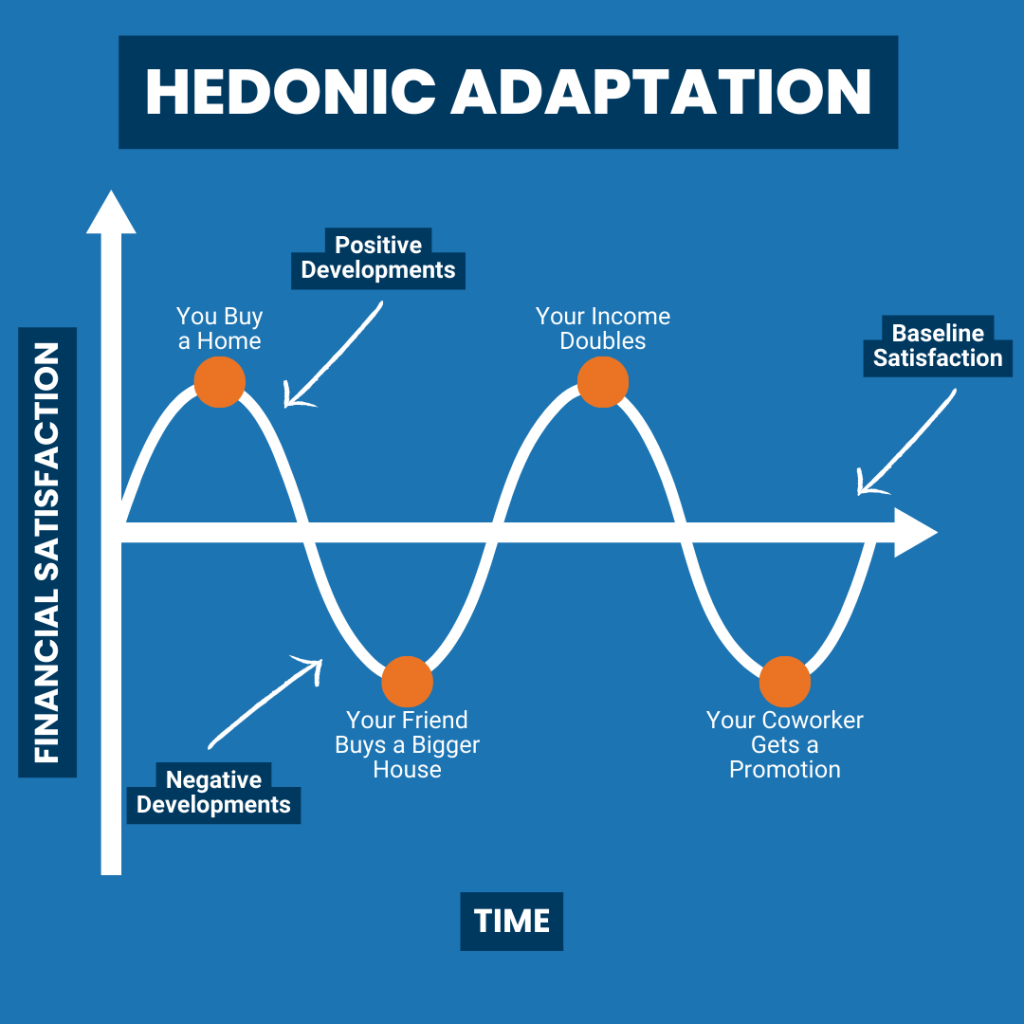
The fact is that money, in itself, is simply a tool. The acquisition and possession of money does not bestow magical powers to the individual holding it. Certainly, money can change a person's current life satisfaction to a certain extent. This recognition is described in the book, "Your Money or Your Life," and illustrates the relationship between money spent and personal satisfaction called the fulfillment curve.
What the authors show in their work is that there is a diminishing return between the amount of money spent and the fulfillment one receives from spending that money.
For example, a needy individual's life satisfaction can change overnight when they can earn $2,000 per month to meet their daily survival needs. Their fulfillment level continues to go up if they earn an extra $500 per month to pay for creature comforts, and it continues rising as their ability to spend on luxuries increases – up to a point.
Once an individual hits the level of luxury spending, it takes an increasingly higher amount of money spent to move the dial higher in terms of life satisfaction. From an economic perspective, we call this the law of diminishing returns. Once our spending exceeds the point of "enough", the consumption can produce a negative effect.
Indeed, one study from a couple of researchers at Georgetown University and the University of Birmingham analyzed measures of happiness and income levels using data from 2010 to 2015. Their study found that measures of happiness rose with income up to a certain point before falling. Indeed, in their study, the researchers found that individuals with higher reported incomes often reported lower happiness compared to those with lower incomes.
So then, can we say that to be happy means that we need to spend less money and live like a hermit?
Not at all.
The point here is that money does not give your life purpose. It's a tool that helps meet essential needs and wants.
That's why once your essential needs and wants are met, it's time to give your money purpose by identifying your personal values and creating a life purpose that answers big questions like, "what is life asking of me." If you still need to identify your values and define your life purpose, be sure to check out our resources from the January and February FI|Mastery Journey action items.
Give Your Money Purpose
For now, however, the next leg of the journey for giving your money purpose should begin by assessing whether you're using your money to create your ideal life. That is, an ideal life that is aligned with your values and purpose.
So, what does it look like when you have your money purpose? Here are some examples:
Giving money purpose means knowing…
- why you work in a chosen profession
- where you are spending and what you are spending my money on
- why you are saving money for the future
- how you will feel when you can use your money to make critical life change
- that your kids won't have debt burdens when they go to school
- that you are leaving something behind for future generations to enjoy
- that you can spend money without feeling guilty
- that no matter what happens in the economy or markets that, your financial situation is secure
- that you can help out a friend or family member when the financial need arises
- that you have the resources you need to pursue your hobbies and passions
- that you have the time to do what you want when you want
- that you have options to make life changes
- that no job or relationship will ever control your ability to live a fulfilling life
- that you can give your family life experiences that they can treasure
What purpose does your money have?
Take a moment to consider the values and purpose that you defined for your life. Then, think about the near- and long-term life goals that you've defined for your life journey.
Now, ask yourself, "how can I use my income and savings now and into the future to achieve my life goals?"
Do you need to increase your earning power, save more money or reduce your spending to achieve your goals? Maybe a combination of all three?
Your values and life purpose are the Northstar for where you're heading in life directionally. The life goals you defined over the past couple of months set the milestones to tell you that you're moving in the right direction. Your money decisions, thereafter, is the fulcrum for moving you closer to the overall purpose that you've defined for your life.
Either way, giving your money purpose is the first step in getting off the hedonic treadmill of mindlessly acquiring more money simply to spend it. Alternatively, it can give you the push you need to begin spending more intentionally if you're a natural saver and worry too much about overspending.
Save and Spend with Confidence
A key benefit of knowing your money's purpose is the ease of spending and savings decisions.
Why?
Because always knowing your money's purpose reduces your need to overanalyze each and every spending or savings decision that you make from one moment to the next. That's because when you have a base from which you make spending and savings decisions, making money choices becomes easier. And there's an added benefit: it reduces overall cognitive load.
Now, in psychology, the term cognitive load refers to the amount of work that your brain has to go through to think through a complex task. Or, put a different way, it's the amount of mental energy used to process information.
For instance, tasks that impose a heavy load on short-term memory, such as calculating, planning, and quick decision-making, result in less-than-ideal outcomes when time is a factor in the face of new or changing information.
So then, the two critical factors here are 1) how familiar you are with the information and 2) the amount of time you have to make a decision. When you don't have enough time or information to make a decision, you typically revert to more common or familiar behaviors. And when it comes to your finances, these situations can lead to making decisions based on old money scripts.
Nevertheless, when you define a new purpose for your money that aligns with your values, making money decisions becomes easier because you have one less criteria against which to evaluate your decision.
For example, let's assume that a friend asks you to join them on a trip, and it will cost you $10,000. You consider this person a good friend and don't want to disappoint them. The request is short notice, but it could be a great experience. You need to make a decision in the next few days and know that you can just put the purchase on a credit card and deal with it at some future point in time.
So, what do you do in this situation?
Well, you have a couple of options. Your initial instinct may be to evaluate the pros and cons, including what the trip may cost you in terms of time and financial resources. But if you worry too much about this approach, you could end up forgoing the trip to avoid making a bad financial decision.
Your next option is to evaluate this potential spending decision within the context of your life values as the guiding light and the new money script that you've defined to guide your spending decisions. You'll recall from previous topics we discussed that money scripts are internal beliefs you hold about money.
For instance, you can begin by asking yourself, "does this spending decision reflect the purpose that I've defined for my money?" If you've been working on amending your money script as we've described in previous articles, then this process will act as a prompt to queue up how you might want to respond to the money situation in front of you.
If one of your values includes nurturing important relationships, then the decision to spend money on the trip might be rather straight forward so long as the spending does not take away from your other financial priorities.
Dealing with Analysis Paralysis
Giving your money purpose means being intentional with your spending and savings decisions. This process begins with a firm grasp of your life values, understanding what life is asking of you, and amending your money scripts to align with your values and purpose.
Then, as you develop a new awareness of your money scripts, begin using them actively in your everyday financial decisions so you can reduce the friction involved in making wise money choices.
These can include times when you're about to make a purchase but feel guilty about the spending.
For instance, do you spend too much time analyzing the utility of a spending decision and struggling to make a choice? This is a common experience known as analysis paralysis, which is the inability to make a decision due to overthinking and overanalyzing. While taking time to consider your options can be helpful, it's important to recognize when it's time to decide and move forward.
Here are a few steps you can consider to reduce analysis paralysis:
Identify Your Values
Identifying your values is an essential first step to spending money with confidence. Values are the principles and beliefs that guide your behavior and decision-making. They are unique to each individual and can include anything from family, community, career, and personal growth. When considering a spending decision, take a moment to reflect on how it aligns with your values. Ask yourself, "Is this purchase in line with my values? Does it support my long-term goals?"
Prioritize Your Goals
Prioritizing your goals is another crucial step to spending money with confidence. Your goals should be aligned with your values and help you to achieve your desired outcomes. Take time to identify your short-term and long-term goals, and then rank them in order of priority. When considering a spending decision, ask yourself, "Does this purchase help me achieve my goals?"
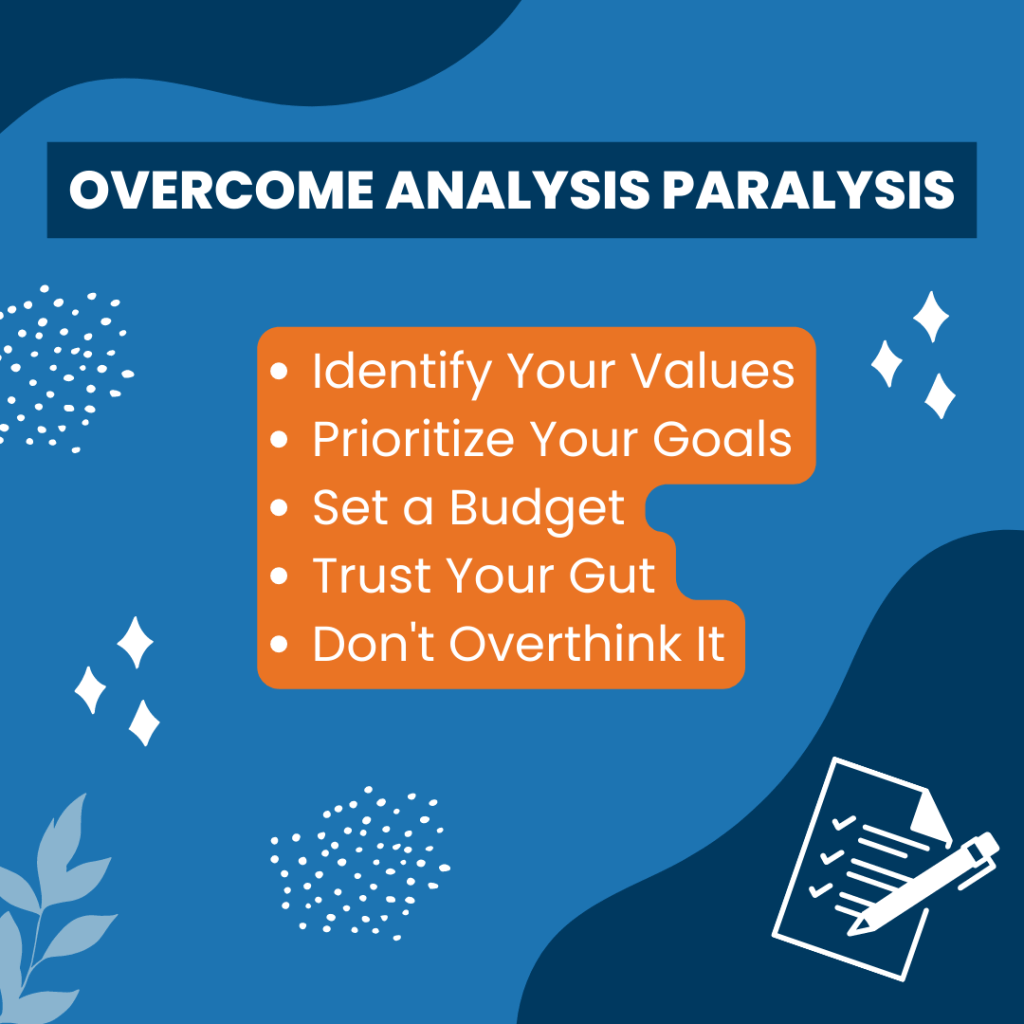
Set a Budget
Setting a budget can help you make more confident spending decisions. A budget is a plan for allocating your income, expenses, and savings. Setting a budget allows you to make a spending decision aligned with your values and goals without worrying about overspending. When considering a spending decision, ask yourself, "Does this purchase fit my budget?"
Trust Your Gut
Sometimes, our instincts can be a valuable guide when making decisions. If you're struggling with analysis paralysis, taking a step back and listening to your gut can be helpful. Your intuition can help you identify what is most important to you and guide you toward making a confident decision.
Don't Overthink It
Finally, it's important not to overthink a spending decision. While it's essential to consider how a purchase aligns with your values and goals, it's also important to spend only a little time analyzing the decision. Remember that perfection is not always possible, and sometimes it's better to make a decision and learn from the outcome.
Saving and spending with confidence often involves overcoming analysis paralysis. By identifying your values, prioritizing your goals, setting a budget, trusting your gut, and avoiding overthinking, you can make spending decisions that align with your values and goals.
Remember that spending money is not just about logic but also about what is important to you as an individual. So, the next time you struggle to make a spending decision, take a step back, consider your values and goals, and trust your instincts.
Spending and Saving Intentionally
Money is a powerful tool that can help you achieve your life goals. However, too often, we pursue money as an end goal rather than as a means to an end. This approach can lead to a never-ending cycle of chasing more money and can lead to feelings of dissatisfaction and unfulfillment.
And adding to these feelings of guilt and dissatisfaction are times when spending and savings decisions go sideways because of unexpected life events.
So what can you do to finally give your money purpose, save and spend with confidence, create your ideal life, and get back up when you have a financial setback?
To start, make a plan to avoid having a financial setback in the first place. Here are a few points you may want to consider to get ahead of financial setbacks.
Understanding Money as a Tool
First, understand that money is a tool. Indeed, money is a tool that you can use to accomplish your desired life outcomes. Whether it's purchasing a home, traveling, starting a business, or supporting a cause, money can provide the means to achieve these goals. However, it's essential to recognize that money is not an end goal in itself. It's a tool that can be used to achieve the life outcomes that are important to us as individuals.
Identifying Life Outcomes
In order to effectively use money to achieve what's essential in your life, you'll need to identify tangible goals. This work goes back to our initial work involved in identifying your values and planning your life purpose. And the work often involves figuring out what you want to achieve in your life by first identifying what life may be asking of you. This work can involve sorting through your passions and interests and the kinds of experiences you want to have. When you identify these outcomes, you can then determine how money can be used to achieve them.
Creating a Financial Plan
Creating a financial plan is essential in effectively using money to achieve life goals. A financial plan is a roadmap for allocating your income, expenses, and savings to achieve your desired outcomes. It should include a cash management strategy, a savings plan, an investment strategy to grow your wealth and a set of action items that need to be accomplished in the near- and long-term. Indeed, a financial plan provides clarity and direction and can help you make decisions that are in line with your life goals.
Prioritizing Spending
Once you have identified your life outcomes and created a financial plan, the next step is to prioritize your spending. When you prioritize your spending, you ensure that your money is being used to achieve your most important goals. Prioritizing spending can involve making choices such as saving for a down payment on a home instead of eating out or putting money towards a travel fund instead of buying a new car.
Living Below Your Means
Living below your means is another critical component of effectively using money to achieve life goals. This means spending less than you earn and avoiding the cycle of debt. Living below your means can involve making choices such as downsizing your home, driving an older car, or cutting back on unnecessary expenses. Ultimately, living below your means gives you more financial freedom to pursue your life goals.
Track Progress Regularly
Regularly tracking progress is critical to holding yourself accountable for achieving financial goals. Monitoring spending and savings regularly and adjusting the plan as needed is crucial because it provides an opportunity to celebrate progress toward goals and make changes to the plan to ensure continued progress.
Share Goals with an Accountability Partner
Sharing financial goals with an accountability partner is an excellent way to hold oneself accountable. An accountability partner can offer support, motivation, and guidance in achieving financial objectives. Additionally, sharing goals with an accountability partner can help you stay focused on your goals and maintain momentum toward achieving them.
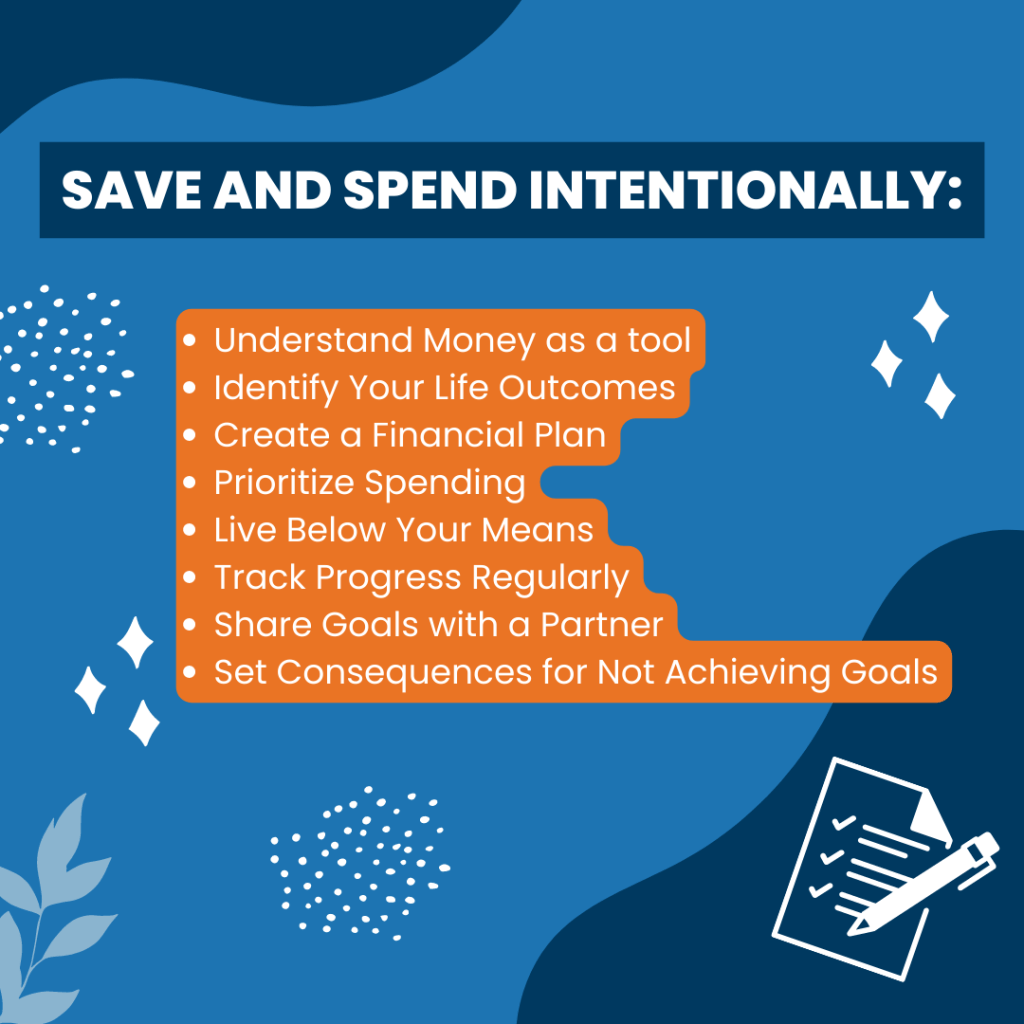
Set Consequences for Not Achieving Goals
Setting consequences for not achieving financial goals is another way to hold oneself accountable. This could involve setting a consequence such as donating money to a charity or performing a challenging task. The consequence, however, should be significant enough to provide motivation to achieve the goal and be tied directly to the goal being pursued.
Holding oneself accountable for achieving spending and savings goals is essential for building a stable financial future. Creating a clear and measurable plan, using automated savings tools, tracking progress regularly, sharing goals with an accountability partner, and setting consequences for not achieving goals are all effective ways to hold oneself accountable.
By implementing these strategies, you can develop a sense of ownership and commitment to your financial goals, ultimately leading to greater financial stability and success.
Signs that Your Savings and Spending are Out of Alignment
Now, making financial choices that align with personal values is essential for creating a fulfilling and satisfying life. Indeed, it can be challenging to ensure that financial choices are in alignment with one's values.
However, once you figure out how to use your money to create your ideal life, what can you do if you still do not feel good about your financial choices or experience a setback in your plan?
Well, feeling anxious, stressed, or guilty about your financial decisions can indicate that you're not making choices that are in alignment with your values. That's why it's essential to pay attention to these feelings and reflect on how your choices may be misaligned with your values.
The fact is that life does not move in a linear fashion. Indeed, we all have setbacks occasionally that threaten our best-laid financial plans. But with a little foresight, you can get ahead of those setbacks and quickly get your savings and spending plans back on track when the inevitable roadblock pops up.
Here are some things you may want to consider when you face inevitable challenges with your financial goals:
Don't Lose Hope When Plans Go Sideways
Holding oneself accountable for achieving spending and savings goals can be challenging, especially for individuals who struggle with seeing their plans through. However, accountability is crucial for achieving financial goals and building a stable financial future.
Evaluate Whether You're Prioritizing Instant Gratification Over Long-Term Goals
Prioritizing instant gratification over long-term goals is another sign that your financial choices may be misaligned with your values. If you consistently choose short-term pleasure over long-term satisfaction, it's a sign that you may not be making choices that align with your values. Pay attention to your choices and reflect on whether they align with your long-term goals.
Your Spending is Not Supporting Your Priorities
If your spending is not supporting your priorities, it's a sign that your financial choices may not reflect your values. If you prioritize spending time with family and friends, but your spending habits are preventing you from doing so, it's a sign that you're not making choices that are in alignment with your values. Pay attention to how your spending aligns with your priorities, and make adjustments as needed.
You're Not Saving Enough for Your Future
Not saving enough for your future is another sign that your financial choices may be misaligned with your values. If you prioritize financial stability and independence, but you're not saving enough for retirement or emergencies, it's a sign that you're not making choices that are in alignment with your values.
Your Financial Choices are Compromising Your Health or Relationships
Another sign that your spending might be out of alignment with your values is if your financial choices compromise your health or relationships. For example, if you prioritize physical health but are overspending on food and dining out, it's likely a sign that you need to make choices that align with your values.
Bouncing Back from Financial Setbacks
Make no mistake, falling back on old financial habits can be discouraging, especially if you've tried sticking to a savings and spending plan in the past but have come up short. Finding the motivation to get back on track and work towards a recovery plan can be difficult in times like these.
So what can you do if you find yourself in this situation?
Practice Self-Compassion
Practicing self-compassion is essential in motivating oneself toward a recovery plan. Self-compassion involves treating oneself with kindness, care, and understanding. It means acknowledging that financial setbacks are a part of the recovery process and reframing the situation with self-compassion rather than self-criticism. By practicing self-compassion, you can shift your mindset towards a positive and constructive perspective, which can provide motivation for moving forward.
Refocus on Your Life Goal
Refocusing on your life goals is essential in motivating oneself after a financial setback. This work involves reevaluating the goals you've set for the year, breaking them down into smaller, achievable steps, and identifying what led to your financial setback. Once these steps are established, you can shift your focus towards the process of achieving your goals, rather than the setback. By shifting focus towards the goal and the positive steps that can be taken, you can create a sense of momentum and motivation for moving forward.
Use Positive Self-Talk
Using positive self-talk can also be a powerful motivator when recovering from a financial setback. Positive self-talk involves speaking to oneself in a kind, compassionate, and encouraging manner. This can include affirmations such as "I am capable of achieving my goals" or "I am making progress, even if it's slow." By using positive self-talk, you can create a sense of self-motivation and self-confidence that can help you overcome setbacks.
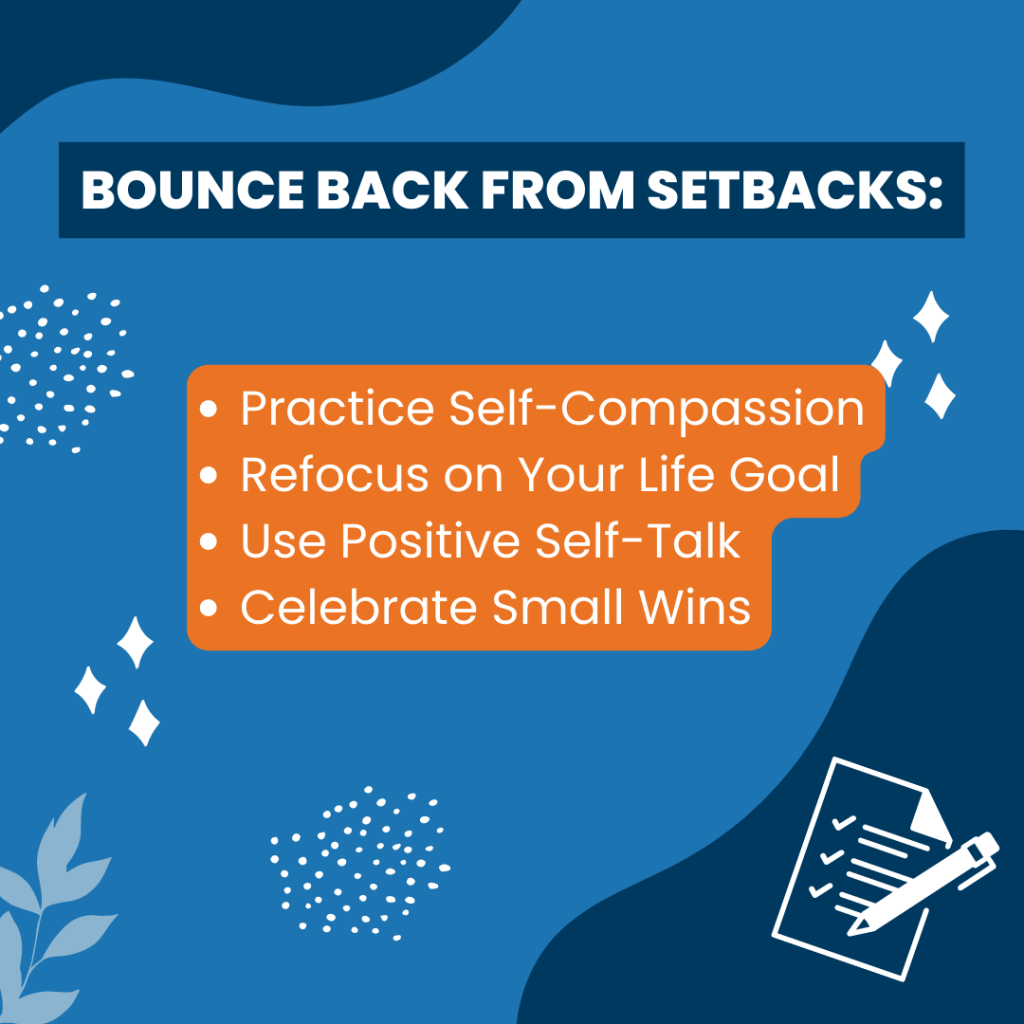
Celebrate Small Wins
Finally, celebrating small wins is an effective way to motivate oneself after a financial setback. Small wins can include achieving a smaller goal, completing a step towards a larger goal, or making progress towards a habit change. By celebrating small wins, you can create a sense of achievement and momentum, which can motivate you to continue making progress towards your long-term financial plan.
Money is a tool that can be used to achieve life outcomes. However, it's essential to recognize that money is not an end goal in itself. By identifying life outcomes, creating a financial plan, prioritizing spending, and living below your means, you can effectively use money to achieve your desired outcomes. When money is used as a tool rather than pursued as an end goal, you're more likely to achieve a sense of fulfillment and satisfaction in your life.
And aligning financial choices with personal values is essential for creating a fulfilling and satisfying life. If you're not feeling good about your financial choices, prioritizing instant gratification over long-term goals, spending in ways that do not support your priorities, not saving enough for your future, or compromising your health or relationships with your financial choices, it's a sign that your financial choices may be misaligned with your values. Paying attention to these signs and reflecting on how your financial choices align with your personal values can help you make more fulfilling and satisfying financial choices.
And finally, recovering from a financial setback can be challenging, especially if you've tried to make financial progress in the past and seem to be repeating the same mistakes over and over again. However, you can motivate yourself toward a stable savings and spending plan by practicing self-compassion, refocusing on the goal, using positive self-talk, seeking support from others, and celebrating small wins. Indeed, by staying focused on the process of achieving your goals and reframing setbacks as opportunities for growth and progress, you can create a sense of momentum and motivation towards becoming the master of your financial independence journey.

Time for a Refresher: Don’t Leave Restricted Stock on the Table
Imagine receiving an award from your employer for the value that you bring to the table, but the payout doesn't come for months or even years down the road. If you work in the tech industry, or otherwise receive a stock award from one year to the next, then you'll likely understand how exciting and at the same time, how bewildering it can be to receive what can be a significant portion of your income doled out over an extended period of time.
That's why understanding this often complex form of incentive compensation is essential to making wise choices with your income and to avoid leaving money on the table.
Now, when it comes to incentive compensation, restricted stock is one of the most commonly granted forms of income issued to individuals employed by publicly traded tech companies. And, if you're one of these fortunate individuals, chances are that you're likely in line for a new stock award or refresh grant as we roll into this year's performance evaluation and bonus season.
And because these awards can make up a sizable portion of your overall income, it's essential to understand what you should be aware of when you receive your grant, what happens when your grants vest, and your options for preserving your wealth and income.
Before we dive in on these critical points, let's take a step back and talk through some definitions regarding restricted stock that you should be familiar with.
What is Restricted Stock?
At its basic level, restricted stock is the ability to own equity in the company you work for without your need to pay for the stock itself. And restricted stock is a form of compensation because when you satisfy the conditions imposed by your company, you often receive the shares free and clear.
When it comes to terminology, you'll want to understand the difference between restricted stock units and restricted stock awards.
So what are Restricted stock units? Well, a restricted stock unit (or RSU) is a right to receive company shares after you've satisfied some conditions imposed by your employer. These criteria might include hitting a certain sales quota, department performance goal, or, what's most common for many of you out there, is simply continuing to work for your employer for an agreed amount of time. The key takeaway here is that you only own the shares once you've met specific criteria defined in your grant. It's like an unfunded promise by your employer that you'll receive company stock at some point in the future once you achieve certain milestones.
And so, how are RSUs different from restricted stock awards? Well, a restricted stock award (sometimes called a restricted stock grant) provides essentially the same benefit as an RSU. However, the key difference is that with a restricted stock award, shares are transferred to you at the time of the grant but are subject to forfeiture if you don't meet specific performance criteria. This could include, for example, leaving your company before your shares vest. What's more, these shares are typically held in a third-party escrow account and are released to you as conditions for vesting (or ownership) are met.
Now, there's one more definition of restricted stock out there, and that's GSUs.
Now, GSU stands for "Google Stock Units," a form of equity compensation that Google offers its employees. GSUs represent a promise to receive a specified number of shares of Google stock at a future date, typically after a vesting period. A Google employee's typical GSU vesting schedule is four years, with 25% of the total grant vesting each year. This means that after the first year, an employee would have 25% of their GSUs vested, after the second year, 50% would be vested, and so on until all of the GSUs are vested after four years.
The main difference between Google's GSU vesting schedule and traditional restricted stock vesting schedules is that Google offers a "graduated vesting" schedule, which means that GSUs vest on a quarterly (and sometimes monthly) basis after the first year of employment. This means that if you stay with Google for at least one year, you would receive the first 25% of the total grant, and then the remaining 75% would vest on a quarterly (or again monthly) basis over the next three years.
It's worth noting that specific vesting schedules for restricted stock can vary depending on the company and the individual grant. What this means, plain and simple, is that until your stocks vest, you don't have full ownership of it yet. Indeed, it's essential to carefully review the terms of any restricted stock grant to understand the specific vesting schedule and other conditions that may apply. Either way, whether you receive a new award or refresh grant this bonus season, be sure to familiarize yourself with the type of restricted stock you received and the vesting schedule so that you can make the most of your equity awards.
Restricted Stock and Taxes
Another topic related to your restricted stock that you'll likely want to familiarize yourself with is taxes.
To our earlier point, restricted stock is the ability to own equity in the company you work for without your need to pay for the stock. Even so, the tax man will want to get his fair share once you get paid.
Now, when it comes to paying Uncle Sam, the tax consequences of RSUs (and GSUs) are relatively straightforward. For example, when the shares are granted, you typically do not have to pay taxes on them. That's because, in many cases, there is a substantial risk of forfeiture for not meeting the vesting criteria. Therefore, you're typically not taxed on the grant itself, but rather when your awards actually vest.
At the point when your restricted stock vests, the value of the shares received is considered income, and you'll likely pay tax on the vested shares at an ordinary income tax rate. How much you will pay all depends on your individual tax bracket. And the more of your income that comes from restricted stock, the higher you'll likely move in marginal tax brackets.
When it comes to paying taxes, some employers may offer to withhold a certain percentage of your vested stock to pay what's due to state and federal authorities. While this approach is helpful, in many cases, withholdings can often be too low, which can lead to a surprise tax bill at the end of the year. That's why it's essential to understand your current income and tax situation, especially if you're a single or a high earner, to understand whether to increase your tax withholdings as shares vest or to prepare to make estimated quarterly tax payments.
One benefit of restricted stock is that you can defer the distribution of shares until a later date. This allows you to benefit from the potential growth in the stock while you're waiting to receive the shares. Deferring the distribution of shares can also help reduce the amount of taxes you must pay when the shares are distributed, as you could be taxed at a lower rate.
A situation like this may apply if you anticipate your earnings in your retirement years to be substantially lower than in your current working years. Either way, consider whether it would be advantageous to choose a future payment date to coordinate the timing of tax recognition with your overall exercise plan.
What to Do with Vested Stock
So, once your restricted stock vests, what happens next?
Well, when your restricted stock vest, you'll either receive a cash settlement or stock settlement. That's why reviewing your equity grant is essential to getting a good handle on how your stock award will be paid out.
If you receive a stock settlement, then for all intents and purposes, that restricted stock is now company stock you own free and clear. Once it's transferred to a brokerage account, you can hold onto it, sell it, or borrow against the stock. One option many individuals choose is to sell their shares immediately as they vest to lock in gains and avoid future market volatility or unwanted tax liabilities from the appreciation of their company shares.
Now, if you plan to hold onto your stock or trade your recently received shares, you'll want to be aware of any blackout periods, trading windows, or other limitations on your ability to sell shares. For example, your company may enter blackout periods during earnings season and ask employees not to sell company stock. That's why it's essential to review your stock grant and check with your benefits administration team for clarification on blackout periods.
Now, if you want to sell your restricted stock without the hassle of keeping track of blackout periods and trading windows, consider a 10b5-1 plan.
A 10b5-1 plan is a pre-established trading plan that allows insiders, such as corporate officers or employees who hold restricted stock, to sell a predetermined number of shares at predetermined times. The plan is designed to ensure that the sale of shares is conducted in an orderly and transparent manner and that the individual selling the shares is not privileged to any material, nonpublic information at the time of the sale.
The key advantage of a 10b5-1 plan is that it allows insiders to sell shares on a regular basis without raising concerns about insider trading or other ethical issues. The plan is set up in advance and based on a predetermined formula that considers various factors, such as the employee's financial needs and the performance of the company's stock. Once the plan is in place, you cannot alter it or decide when to sell shares unless you voluntarily decide to end your participation in the plan itself.
How does a 10b5-1 plan work for selling restricted stock?
To establish a 10b5-1 plan for selling restricted stock, you'll want to work with your employer's HR department to get details on participating in the plan. The plan will specify the number of shares to be sold, the timing of the sales, and the price at which the shares will be sold. The plan will also include provisions to ensure that you do not have access to any material, nonpublic information at the time of the sales.
A plan administrator, typically in cooperation with your broker, executes the trades according to the established plan. The trades, more often than not, are conducted on a predetermined schedule, and you'll have no ability to make decisions about when to sell the shares. Again, this approach helps to ensure that the sales are conducted in an orderly and transparent manner and that there is no appearance of impropriety.
Finally, if a 10b5-1 seems too complicated and doing nothing with your shares seems like a good enough plan, you may want to think again.
That's because while we hope that the price of your company stock will rise over the long run, you'll likely receive little financial benefit from shares that fall in value after vesting in the short run.
How so? Well, let's look at an example:
Let's assume that you have an effective tax rate of 25%, you're the recipient of a restricted stock award that settles in stock, it's the end of the year, $100,000 worth of your award has just vested, and your employer withholds enough stock to cover all of the tax related to this award.
At this rate, your $100,000 award nets you $75,000 worth of company stock after-tax.
So far, so good, right?
Well, if you do nothing with the stock, its value will either rise or fall with the markets.
So, let's assume for a moment that current market conditions today are similar to what we experienced in 2022 and the value of your company stock falls by 25%.
Where does that put you?
Well, if you decided to hold onto your company shares in the down market, the value of this holding could be worth $56,250. The downside here is that if you were planning to use that money for the downpayment on a new home, to pay for childcare expenses, or otherwise supplement your living expenses for the year, then you'd likely be down nearly $20,000 for the year.
While selling your restricted stock outright is one option to avoid this outcome, so is diversifying your holdings into a basket of low-correlation assets to avoid some of the risks of holding a concentrated stock position. And if your plan was to hold your company stock for the long term, then having an appropriate cash management plan in place would also have helped avoid unnecessary shortfalls for your big-ticket spending needs.
Either way, having an appropriate action plan in place after your restricted stock vests can help you preserve your wealth and avoid unnecessary headaches down the road.
Make the Most of Your Restricted Stock this Bonus Season
Make no mistake, restricted stock is likely to be a valuable component of the total compensation that many employees at publicly traded tech companies receive. By providing you with an opportunity to benefit from the growth of the company, offering some tax benefits, and serving as a retention tool, restricted stock can serve as a significant portion of your overall compensation package if you work at one of these companies.
Even so, the devil is in the details when it comes to your awards. That's why you'll want to evaluate your stock plan to understand the terms of your grant agreement when you receive your award. More specifically, you'll want to pay particular attention to the vesting schedule and the conditions that need to be met for the restricted stock to vest.
At the same time, you'll want to be aware of any tax implications associated with your restricted stock, as they will be subject to taxation when they vest. It's also vital to understand any restrictions that may be placed on the restricted stock, such as the inability to sell or transfer the shares until certain conditions are met.
When it comes down to it, however, taking these steps will help you make the most of your restricted stock this bonus season, but most importantly, it will bring you one step closer to mastering your journey to financial independence.

Money Mindset Makeover: Re-writing Limiting Money Scripts
Have you ever made an impulsive big-ticket purchase that you later regretted? Or, maybe you have found yourself making choices with your money that seem out of alignment with your overall life or financial goals? If so, then you're likely familiar with the effects of your money script.
So, what is a money script?
Well, a money script is often unconscious beliefs about money, rooted in early childhood experiences and guided by family or societal expectations, that influence the way we think about and handle money. In many ways, the "script" is subconscious conditioning that tells us how to respond to money choices as we're presented with one spending or savings decision to the next.
Having awareness and greater insights into what's happening mechanically, under the surface, is the first step to setting sustainable goals and money management strategies that will endure no matter what curveballs life throws at you.
Now, it's important to note that the concept of psychological scripts has been around for a while. But more recently, this concept has been popularized, at least in the context of financial planning, by Psychologist Bradley Klontz and Sonya Britt.
In their work, Klontz and Britt divide money scripts into four categories: 1) Money Avoidance, 2) Money Worship, 3) Money Status, and 4) Money Vigilance. These first three categories are associated with lower overall financial outcomes. The last category, Money Vigilance, is often associated with a lower quality of life.
Let's take a look at the descriptions of these four categories according to Klontz and Britt's research:
Money Avoidance
Individuals who score high on money avoidance believe that money is bad or that they do not deserve money. For the money avoider, money is seen as a source of fear, anxiety, and disgust. Money avoiders have a negative association with money, believe that people of wealth are greedy and corrupt, and believe there is virtue in living with less money.
At the same time, money avoiders are likely to hold conflicting beliefs that having more money could end their problems and improve their self-worth and social status. As such, they may fluctuate between the extremes of holding great contempt for money and people of wealth and placing too much value on the role of money in their own life satisfaction.
Money avoiders may sabotage their financial success or give money away in an unconscious effort to have as little as possible, but at the same time, they may be working excessive hours in an effort to make money. Not surprisingly, money avoidance is associated with poor financial health. Money avoiders tend to have less money and lower net worth.
Money avoidance is associated with an increased risk of overspending and compulsive buying, sacrificing one's financial well-being for the sake of others, financial dependence on others, hoarding, avoiding looking at one's bank statements, trying to forget about one's financial situation and having trouble sticking to a budget.
Money Worship
At their core, money worshipers are convinced that the key to happiness and the solution of all of their problems is to have more money. At the same time, they believe that one can never have enough money and that one will never really be able to afford the things one wants in life.
The tension between believing that more money and things will make one happier and the sense that one will never have enough can result in chronic overspending in an attempt to buy happiness. Money worshipers are more likely to have lower income and lower net worth and be trapped in a cycle of revolving credit card debt.
Money worshipers are also more likely to spend compulsively, hoard possessions, put work ahead of their family relationships, try to ignore or forget about their financial situation, give money to others even though they can't afford it, and be financially dependent on others.
Money Status
People who hold money status scripts see net-worth and self-worth as being synonymous. They may pretend to have more money than they do and, as a result, are at risk of overspending in an effort to give people the impression that they are financially successful.
They believe that if they live a virtuous life, the universe will take care of their financial needs and that people are only as successful as the amount of money they earn. They have lower net worth and income and tend to grow up in families with a lower socioeconomic status.
People with money status beliefs are more likely to be compulsive spenders, depend financially on others, and lie to their spouses about spending. Holding the money status scripts is also predictive of pathological gambling, indicating individuals may gamble in an attempt to win large sums of money to prove their worth to themselves and others.
Money Vigilance
The money vigilant are alert, watchful, and concerned about their financial welfare. They believe it is crucial to save, for people to work for their money and not be given financial handouts. If they can't pay cash for something, they won't buy it and are less likely to buy on credit.
As a result, the money vigilant have higher income and higher net worth. They also tend to be anxious and secretive about their financial status with people outside of those closest to them but are less likely to lie to their spouse about spending behavior.
Money vigilance appears to be a protective factor in that the money vigilant are significantly less likely to spend compulsively, gamble excessively, enable other financial, and ignore their finances. While such an approach encourages savings and frugality, excessive wariness or anxiety could keep someone from enjoying the benefits and sense of security that money can provide.
Acknowledge Your Money Script
Do any of these money scripts resonate with you? If so, what can you do to rewrite or amend them to better align with your values and purpose for your money?
Well, the first step to setting financial goals that stick is to understand the money scripts that influence your decisions.
One approach to identifying the money script that could be sabotaging your financial goals is completing a Klontz Money Script Inventory (or KMSI).
The inventory, or survey, is a set of 51 questions designed to identify your propensity towards one script, whether that's money avoidance, money worship, money status, or money vigilance versus another.
A score above a specific threshold developed by Klontz suggests less likelihood of being influenced by a particular type of script. And a score above that threshold suggests that a particular money script may influence your financial choices.
You can complete a KMSI by visiting Klontz’s website or downloading our version of the KMSI from the FI|Mastery Journey under the February action items.
Now, it's essential to note that survey results should be taken with a grain of salt. Indeed, I believe surveys and questionnaires are useful tools for guiding further insight rather than typifying an individual into a particular bucket.
So, if you complete the survey and find yourself in disagreement with the result, don’t take it to heart. Rather, use the output as a starting place to reflect on potential subconscious influences that may be affecting your relationship with money.
If surveys aren't for you, another approach you can take to identify your money script is to spend some time in reflection.
You can start by asking yourself the following questions:
- What was the first big purchase you ever made?
- What was your first job like?
- How did money play a part in your childhood?
- If you could change one thing about what you were taught as a child about money, what would it be?
- What did you learn from your parents or grandparents about money? As you think about these questions, jot down a few sentences describing the situation.
Next, write down the feeling you recall from the memory.
Was it positive or negative? Did the event give you hope or leave you feeling regretful?
Then, identify a value that represents this memory. Try not to read into the intention of others, but rather, how you personally observe the outcome yourself.
Finally, evaluate whether the value of these influential memories aligns with the values that you defined in your own value ladder. Do the values related to these money memories reflect what's essential to you in your life today?
Again, the purpose of this exercise is to gain information about what may be influencing your money decisions, and more importantly, the beliefs that could be throwing you off of your financial independence goals.
Make no mistake, evaluating your money script is the first part of setting SMART goals. Doing so will allow you to better understand how to think about money and the way they affect your decision-making. Getting this out into the open now can later reduce your odds of goal sabotage and improve your chances of achieving your life success.
feelings play a significant role in changing subconscious behaviors because they serve as an emotional feedback mechanism
Use Dissatisfaction as Your Catalyst for Change
So now that have better insight in your potential money script, or the subconscious beliefs driving your money decisions, what can you do to start making more constructive financial choices and reduce your chances of goal derailment?
Well, one approach to challenging defeating beliefs and their unwanted behavior is to use your feelings to guide your next steps.
And I know, at this point, you may be asking yourself, “in a world primarily driven by logic, data, and analysis, what role do feelings have in setting financial goals?
Well, feelings play a significant role in changing subconscious behaviors because they serve as an emotional feedback mechanism.
For example, when a person experiences strong emotions, such as guilt, shame, or anxiety, it can influence their subconscious behaviors by creating a drive to change them. This emotional feedback can make lasting changes by forming new neural connections in the brain that reinforce desired behaviors and weaken connections to old habits.
At the same time, positive emotions like joy and pride can also increase motivation to continue healthy behaviors. Thus, feelings can be a powerful tool in changing subconscious behaviors.
More specifically, what we're trying to do is elicit an emotion, or rather that feeling of dissatisfaction, that comes from a keen awareness that some financial choices we made were less than ideal compared with our current values and life purpose.
So, the first step in amending your money script so that you can avoid making the same choices that once derailed your past financial goals, is to identify the gap between your current money script and the outcomes that you want to see from a life lived according to your values and desired life purpose.
Like it or not, we are creatures driven primarily by our feelings first, then logic.
And so, this step of eliciting emotions is essential to prompting change because thoughts, beliefs, and actions that are hardcoded in our subconscious mind are rarely changed simply by logic or pure will.
It's like the individual who makes a new year's resolution in January to lose ten pounds. They get the gym membership, they buy new running shoes, and work out 3-4 times per week. But, as the motivation wanes, old habits, or life scripts, kick in and the commitment to the new year's resolution eventually fades.
That's why we need a catalyst for sustained improvement, and often the feeling of dissatisfaction is one of the biggest motivators we can use to stimulate that change.
So, why focus on a negative emotion like dissatisfaction instead of positive emotions like achievement or success?
Well, dissatisfaction is a crucial emotion to explore because it helps us get to our "why."
You know – it's that "why" that often starts off a question like, "why did I make that purchase" or "why didn't I save more money" that is often accompanied by a feeling of dissatisfaction with our past choices.
Now, you've likely heard the stories of individuals who, due to unfortunate lifestyle choices, found themselves in the doctor's office diagnosed with a terminal illness.
The prognosis is poor, and they're given only months to live. For some individuals, they immediately begin to contemplate their past life choices as the sense of dissatisfaction reflects their current life situation.
And for some of those individuals, the doctor's news acts like a wake-up call, or a realization that their story isn't finished. The idea of not being around for friends or family or loss of life experience itself is dissatisfying to say the least. And for these individuals, their values and life purpose immediately become clear.
And so, they use their dissatisfaction with their current situation, held in contrast to their values and desired life purpose, as a catalyst to begin making changes that allow them to turn around their situation and avoid a terminal fate.
Maybe you're asking yourself, what does any of this have to do with money? Certainly, the dissatisfaction you're experiencing with money today isn't going to lead you to the poor house.
And no doubt, we all tend to make poor financial choices from time to time.
So, what's the point of going through all of this work?
Well, the point here is to use our feelings of dissatisfaction with the patterns of unproductive financial choices to identify the behaviors that better reflect our values and the purpose that we've defined for our money.
How to Do the Work
So to get started, what you want to do is gain an awareness of your current money script. Then, take time to think about specific situations where you made financial choices that elicited a feeling of dissatisfaction and how they differed from your values and purpose.
One way to do this is to take out a piece of paper and divide it into the following five columns:
- Event
- Why
- Script
- Value and Purpose and
- Desired Outcome
You can also download and fill out the Money Catalyst worksheet from the FI|Mastery Journey in the February Action items.
Then, in the first column, jot down a past event that elicited a feeling of dissatisfaction. Maybe one example is buying an expensive car that you didn't need.
In the next column, write down one sentence describing your why for that financial decision. In our illustration, it could be that you made the purchase to validate your self-worth by showing off your net worth.
Then, in the next column, identify in just a few words what script this decision was playing out. You can look back to the Klontz example we mentioned earlier for ideas here.
Then, in the fourth column, write down your current value and purpose related to this event in a few words.
And then in the final column, make a quick note of what choice you would have liked to have made in the past that would have better reflected your current value and purpose.
We'll use your answers here as steps for amending your money script. But for now, use this approach to gain awareness of where you're at and where you'd like to go.
Again, one of the first steps to rewriting or amending your money script is to use your sense of dissatisfaction with past financial choices to identify the gap between your current money script and your values and money's purpose.
To accomplish this outcome, take some time to think through past financial choices that have elicited feelings of dissatisfaction and identify why you made that particular choice, the script playing out, the values and purpose related to that event, and the desired outcome you would like to have seen.
Reframe Your Money Script by Creating Desirable Life Experiences
Thus far, we’ve discussed what money scripts are and what they look like, and how to elicit emotions to spark change towards your desired money script.
So, how exactly do we go about making the changes we discussed here? Well, think about the next step of change in the context of broader human behavior.
For example, have you ever wondered why do some individuals from war-torn countries decide to migrate while others choose to stay behind?
Certainly, while family ties and financial resources may be one consideration for those choosing not to immigrate, for those seeking out new destinations, the conflict experienced in their homeland might push them to consider leaving, with the prospect of a better life being the pull to draw them to their target country.
Ernest Ravenstein, who is widely regarded as the earliest migration theorist, put forth a push-pull theory that described why individuals choose to leave one country for another. For instance, these individuals may be "pushed" by unfavorable laws, taxes, or conflict in their home country and "pulled" by the prospect of greater freedoms or economic stability in their destination country.
This push-pull behavior is relevant not just to migration but genuinely applicable to all aspects of our lives where we want to see change take place. And with respect to changing our relationship with money, dissatisfaction might be the push that we need to move us out of unproductive money scripts.
"Every action you take is a vote for the type of person you wish to become. No single instance will transform your beliefs, but as the votes build up, so does the evidence of your new identity. This is why habits are crucial. They cast repeated votes for being a certain type of person."
James Clear
Where does the pull come from?
Well, that pull that we need likely comes from creating the conditions that bring our desired values and life purpose into reality.
So, to bridge the divide, we need to find ways to create a new belief system that help pull us toward amending or rewriting our money script.
This change process involves more than creating positive affirmations or good intentions. Indeed, simply knowing what you should do differently in the future with your money fails to lead to durable change when your current belief system does not back it, is not supported by your current actions and ultimately does not address the underlying subconscious biases running around the clock.
Indeed, when you engage in behaviors that do not align with your subconscious value systems, it leads to self-correcting behaviors that bring you back to where you want to be today.
Psychologists refer to this behavior as cognitive dissonance.
It arises when a person's beliefs or behaviors are inconsistent with each other, and the individual is forced to choose between them. This inconsistency can result in feelings of discomfort, anxiety, and tension, which can motivate the person to resort to old beliefs or behaviors to restore balance and reduce the discomfort.
So, how do you change your belief systems? Well, rather than starting with positive affirmations, choose to begin with identifying and completing experiences that align with the desired values and purpose you've defined for your life and money.
In his book, "Atomic Habits," James Clear describes how "Every action you take is a vote for the type of person you wish to become. No single instance will transform your beliefs, but as the votes build up, so does the evidence of your new identity. This is why habits are crucial. They cast repeated votes for being a certain type of person."
Therefore, thinking about the change in our behavior with money is only the first step. Affecting that change is challenging because there are a variety of processes taking place in our brains that affect our belief systems.
And a common aphorism used in neuroscience that explains this process is that "neurons that fire together, wire together."
This means that our sense of experience results from complex interactions between various brain regions and systems that process sensory information from the environment and create subjective experiences.
The process begins with sensory receptors in the body (such as the eyes, ears, skin, etc.) that sends signals to the brain that are then transformed into electrical and chemical signals. These signals are processed and integrated in various brain regions, including the thalamus, the sensory cortex, and the limbic system. The final product is the conscious perception of the experience, which is stored in memory and can influence future behavior and decision-making.
That's why experiences are essential to reframing and amending your money script. The more areas within our brain that we can activate as we're engaging in our desired money script, the more connections we make. This increases the likelihood of creating durable change in our money habits.
Reframe Your Money Script by Creating Desirable Life Experiences
So how do you go about making lasting changes and finally rewrite your money script?
Well, to amend your money script you need to create experiences that help you cast repeated votes for being your desired person.
How can you do this?
Let's look at this from the perspective of an individual with the money avoidance script.
For example, suppose you find it difficult to review your bank statements and keep track of your spending from one month to the next. Maybe the fear of knowing that you may have over spent has you laden with guilt underpinning your avoidance.
And so, if your values and purpose of your money are centered around achieving financial freedom, then you know how vital it is to keep track of your spending.
And reviewing your bank statements is an essential first start to this end.
So, how can you amend your avoidant money script so that you get past the fear of reviewing your bank statements?
Well, to begin, use your feeling of dissatisfaction as your catalyst for change.
Before diving in, create a whole sensory experience that aligns with the positive money script you're trying to create. Remember, we experience the world around us with all of our senses: sight, hearing, touch, taste, smell, body position, and sense of space, to name a few.
Therefore, if you're going to rewrite the script, do it at a time and in a place where you can be calm, centered, free of distractions or worries about work and family, and otherwise safe as you dive into your bank statements.
Why?
Well, while this approach may seem superficial, ultimately, the message that we're trying to give your body is that reviewing your bank statements is safe.
Remember, the neurons that fire together wire together.
Now, when you’re in a calm, safe place, pull up your financial institution's website on your phone, laptop, or computer. Then, review your last month's bank transactions, and organize the transactions by category.
As you go through the work, avoid assigning judgment to any of your spending decisions. Simply use your time in this calm, safe space to bring awareness to your current habits. Then, bring awareness to any unwanted pattern of spending and acknowledge that your feelings of dissatisfaction are coming from a place of old money scripts and that you're committed to positive changes.
Next, pick out one spending categories where you'd like to see improvement and write them down. Do you want to spend less money using Uber eats? If so, what's the alternative? Jot down a few other options and create an immediate action plan for how you will avoid the use of takeout for the week and what reward you'll give yourself for taking this step.
Inevitably, you'll find yourself pressed for time at some point in the coming week. When this happens, refer back to your action plan.
Finally, assign yourself a reward for following through on your action plan. Operant conditioning, as described by B.F. Skinner states that behavior is shaped and maintained by its consequences. When a behavior is followed by a reinforcing consequence, such as a reward, the behavior is more likely to be repeated in the future.
So be sure to treat yourself when you engage in behaviors that reflect the new money script that you’re trying to create, and ultimately the values and purpose that you’ve defined for your money.
Now, in this example we referenced the Avoidant type money script. You can repeat this same process if you find yourself dealing with a different one of the other scripts here as well.
Either way, remember that by bringing awareness to your current money script and using dissatisfaction with it can be the "push" you need to move towards a more desirable money outcome. Your values and money purpose are the "pull" to draw you towards your money goals. And to create lasting behavioral change, you'll need to create new, positive experiences that enable you to bridge the gap.
While it may be tempting to set ambitious goals to spark this change, start small. Remember Clear's advice: Every action you take is a vote for the type of person you wish to become. No single instance will transform your beliefs, but as the votes build up, so does the evidence of your new identity. This is why habits are crucial. They cast repeated votes for being a particular type of person.
In upcoming posts, we’ll dive deeper into bringing together your SMART financial goals and setting habits for achieving them throughout the course of the year. For now, taking these few steps will not only help make over your money mindset, they’ll bring you closer to becoming the master of your financial independence journey.

Crush Your Financial Resolutions by Becoming Rather than Doing
Who doesn’t like a fresh start? The beauty of New Year’s Resolutions is that we all have an opportunity to fully commit to losing weight, getting organized, or finally saving more money at the turn of the calendar year.
In fact, resolving to change one’s life for the better is a tradition that goes back millennia, starting with the ancient Babylonian 12-day New Year’s celebration. During the Akitu festival, Babylonians promised the gods to return borrowed items and pay down their debts. In more recent developments, some historians note clippings from an 1813 Boston newspaper documenting what could be considered the first contemporary use of the “New Year’s Resolution”:
“And yet, I believe there are multitudes of people, accustomed to receive injunctions of new year resolutions, who will sin all the month of December, with a serious determination of beginning the new year with new resolutions and new behavior, and with the full belief that they shall thus expiate and wipe away all their former faults.”
Whatever the origin of this tradition, the fact is that many of us will create financial resolutions in the coming days only to find those well-intentioned goals falling short soon after they’re conceived. One study from sports company Strava, using over 800 million user-logged activities in 2019, found that individuals are likely to give up on their fitness goals by January 19 – less than three weeks into the start of the New Year.
Another study from Scranton University found that only roughly 19% of individuals keep their resolutions for the year. The data go on to show that the majority of New Year’s resolutions are abandoned by mid-January, confirming findings from many different studies.
Whether you want to admit it or not, the chances are that the work you’re about to put into one or more of your financial resolutions this year likely will soon end in frustration and disappointment. So, what can you do to ensure that your financial resolutions stay on the right track heading into the New Year? Well, one way is to focus your goals on “becoming” rather than “doing.”
Becoming Rather than Doing
Let’s face it: the past two years have derailed many of our New Year’s resolutions and life goals as we’ve rightfully focused on doing everything necessary to keep ourselves and our loved ones safe. Even so, heading into year three of this healthcare crisis, many of us have a choice to set our sights on a bigger goal of thriving financially rather than surviving in day-to-day uncertainty.
While external circumstances can be a reason for goal failure, they can also be an excuse for not getting to the heart of what’s preventing long-term success with your financial plans. And quite often, that roadblock is being focused on “doing” the work necessary to achieve a goal, rather than first taking the time to understand who you need to “become” to make your New Year’s Resolution a reality.
Indeed, some individuals will suggest that the way to improve your odds of achieving your resolution is to ensure that you’re defining SMART goals (Specific, Measurable, Achievable, Relevant, and Time-Bound). While SMART goals are important, more often than not, what many well-intentioned individuals miss is what needs to happen before specific goal setting begins. And that is asking yourself: “who do I need to become this year to make my financial resolutions a reality?”
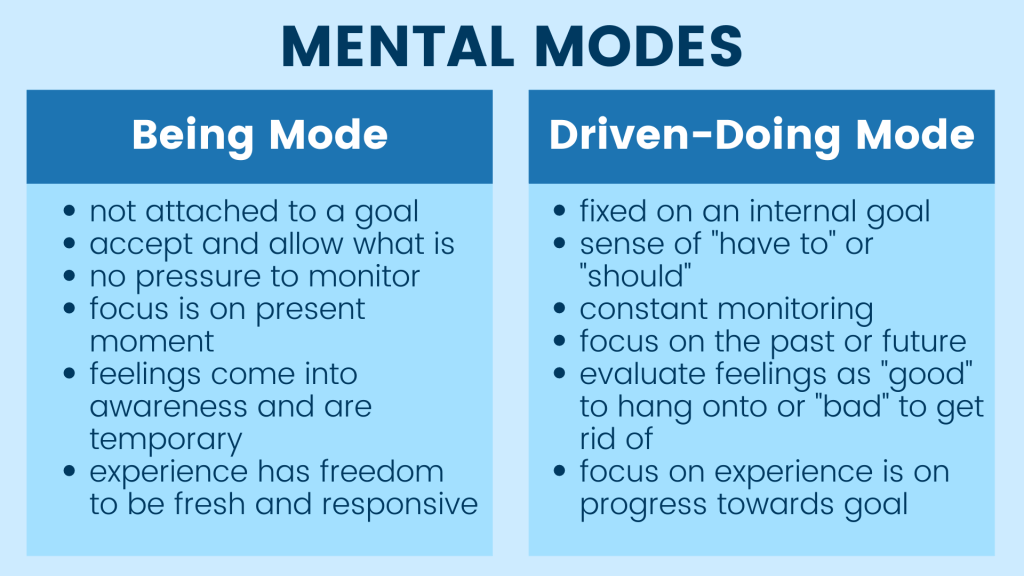
One school of thought suggests that individuals operate in two modes: “Doing” and “Being”. The Doing Mode individual is focused on explicitly defining a goal, then developing a system to monitor their progress and striving for the future outcome they’re attempting to achieve. Whether it’s a reward that you plan to give yourself for accomplishing the goal – or a threat, like the potential shame experienced from friends and family – quite often, this carrot and stick approach sets the stage for a possible resolution failure.
When you shift your approach to accomplishing resolutions from Doing Mode to Being Mode, there’s a broader sense of aligning your daily actions, choices, and behaviors with who you are as an individual. When you approach your goals from a Being Mode, saving more money or investing in a disciplined manner isn’t a task, it’s a way of life – you’re simply doing what’s natural for who you are as an individual. When positive developments or setbacks occur, they’re viewed as part of the natural process of being rather than a good or bad outcome.
This approach to Being is essential because when your New Year’s resolution is at odds with who you believe yourself to be, you’re more likely to experience self-sabotage and reject the “new” habits you’ve identified for yourself. Such a disconnect often leads to what psychologists call cognitive dissonance or the mental anguish of holding two competing thoughts simultaneously. Fortunately, becoming the person who does the desired behaviors is one way to overcome this resistance.
Dealing with Resistance
At first glance, many individuals will dismiss the notion of “becoming” and state that what’s needed is focus, discipline, and a firm commitment to accomplishing goals. While there’s some truth to this notion, again, the reality is that your subconscious mind does not like to engage in habits or behaviors that conflict with your identity.
...once you’ve identified who you want to become, achieving your New Year’s Resolution continues to progress by aligning your daily habits with the outcomes necessary to become the person you need to be.
For example, a New Year’s resolution to become more disciplined with your household spending could quickly become derailed if you don’t intrinsically believe that you’re a good steward of your finances. Indeed, your first misstep after setting a financially prudent resolution likely could prompt negative internal dialogue like, “I’m not good with money” or “I’ll never be good with money, so what’s the point of trying to save.” When this disconnect arises, it potentially could lead you to abandon a worthwhile goal for the coming year.
So, how can you overcome this negative self-talk and self-sabotaging behavior? Well, one way to overcome cognitive dissonance is to either 1) change your thoughts, 2) change your behavior, or 3) justify your behavior by adding new thoughts. In his book, Atomic Habits, James Clear points out how we are likely to meet resistance when we start new habits inconsistent with our self-image.
For example, a couch potato could have an ambitious goal of completing a marathon in the coming year. Certainly, willpower and self-discipline likely will lead to some progress initially, that is, until that individual begins to experience setbacks, like an injury or scheduling conflict, naturally leading them to give up on their goal to run a marathon.
Cast differently, if your goal is to become a runner (rather than accomplishing a running feat, like a marathon), then the daily one-percent improvements that Clear outlines in his book naturally will lead you to get in the kind of shape you need to compete in a marathon.
From this perspective, once you’ve identified who you want to become, achieving your New Year’s Resolution continues to progress by aligning your daily habits with the outcomes necessary to become the person you need to be. How is this accomplished?
Well, Clear refers to the work necessary as the Four Laws of Behavior Change:
- Make it Obvious – list all the steps that need to happen to make your new habit a reality
- Make it Attractive – link your new routine with behaviors that you already enjoy doing
- Make it Easy – simplify your environment to make your new habit easy to accomplish
- Make it Satisfying – create intrinsic rewards when you complete behaviors that align with your identity
Starting with this approach could help you overcome resistance as you put in the work to become the person you want to be this year and accomplish essential life goals. Now it’s easy to say that an individual who wants to run a marathon should focus on becoming a runner first.
So, who does an individual need to become to save more money or become a more disciplined investor? From this perspective, consider becoming the master of your financial independence journey.
Becoming the Master of Your Financial Independence Journey
In the simplest terms, financial independence represents a state of financial well-being where you have enough money to pursue experiences of utmost value. Unless you’re already retired or anticipating a financial windfall, becoming financially independent requires a daily discipline of creating, growing, and preserving financial wealth.
...a deliberate lack of understanding of what intrinsically motivates you might leave you feeling stuck in a perpetual cycle of earning and spending more but making little headway towards long-term financial goals.
Considering the journey itself, the path to mastery (financial independence) forces you to think outside of the constraints of the money scripts presented to you by other people. Indeed, pursuing those experiences that satisfy feelings core your value system can activate higher levels of intrinsic motivation and potentially reduce the yo-yo effect of unconscious savings and spending decisions.
What’s more, the journey itself becomes transformative. For example, each step in the wealth-building process (creating, growing, and preserving wealth) serves an explicit role in helping you move toward financial independence.
Each of these steps requires you to learn disciplines that enable you to build wealth for the long term. And because the knowledge you’re gaining serves an intrinsically defined purpose, its application likely will have a more profound impact on your achieving financial independence than learning money management techniques simply for the sake of knowledge or to mark off a completed resolution for the year.
Many individuals see their financial choices as discrete win/lose outcomes when it comes down to it. They think of their behaviors as things that need to be done. And more often than not, people play the game of life not to lose: settling for comfort rather than striving for a goal for which they may fail. They’re looking for quick fixes, temporary relief to get them through their day.
While this approach may work initially, a deliberate lack of understanding of what intrinsically motivates you might leave you feeling stuck in a perpetual cycle of earning and spending more but making little headway towards long-term financial goals.
Whether you’re earning six figures and broke, or simply trying to take control of your finances, doing the work of learning a new financial management technique, determining your “retirement number” or achieving some material outcome may not be the approach you need.
What might better suit your situation and help you stay committed to and crush your New Year’s resolution is reframing your relationship with money, rewriting your money scripts, and becoming the master of your financial independence journey.

The Executive Way: Treat Your Career Like a Sport
When thinking about your career, it might seem odd to make comparisons to a sport. But when you zoom out and look at the similarities, they’re more closely related than you may think. For example, a common problem many people face as they end their careers and enter retirement is a loss of purpose and a feeling of emptiness because the thing that consumed eight hours a day for the past 40 years is now gone.
Athletes face these same struggles, but a lot sooner in life. However, some athletes find themselves thriving in life after sports because they’ve learned many valuable lessons and picked up traits from their sport that can translate into many other areas of life.
Derek Jeter, former Yankees shortstop and first-ballot Hall of Famer, is now CEO and part-owner of the Miami Marlins and co-founded the media company, The Players’ Tribune. Hall of Fame defensive end Michael Strahan took his talents and football knowledge to live TV and has co-hosted Fox NFL Sunday, $100,000 Pyramid, and even Good Morning America.
While your career may not lead to headlines and TV gigs, there are a few ways that you can treat your career like a sport to set yourself up for long-term success.

The 10,000 Hour Rule
In his book, The Outliers, Malcolm Gladwell claims that it takes roughly 10,000 hours of work to master a skill. While the specific number of hours has been challenged by many, the principle will always make sense: to be great at something, you must put in the work.
Athletes dedicate years, sometimes decades, to their craft to be the best that they can be, and we shouldn’t treat our own careers too different. Over the course of your working career, you’re most likely going to put 10,000 hours of work in by just showing up. However, if you’re intentional about the work that’s being put in, you can begin to propel your career.
For example, this may be getting additional certifications or a graduate degree that allows you to move up in the ranks of your profession. Also, putting in the work of connecting with like-minded people on the same path as you or growing your skillset to make a career change that provides higher potential income.
When you put in the work, it’s hard not to make progress.
Be Prepared for Uncertainty
Just like athletes devote time to be mentally and physically prepared for competition, an effective way to level up in your career is by being prepared. Whether you’re interviewing for a new job or giving a presentation to your team, preparation is critical and impacts how you perform the given task.
When you’re prepared, you’re more confident. The stress that comes with uncertainty disappears when you’ve prepared appropriately, and with that, the likelihood of achieving the desired result is increased.

Be Accountable in Your Work
Being accountable is a trait that impacts many areas of life, even outside of your career. When things don’t go right, which is bound to happen many times over your career, it’s easy to blame other people or external factors. However, by taking ownership of your work, you’ll stand out from other workers, and you begin to build trust with the people around you.
While being accountable to others is excellent, it doesn’t stop there. It’s also important to be responsible for yourself and your goals. For example, if you want to get promoted over the next year and you’ve laid out the steps needed to make it happen, stick to them. Too often, we set goals for ourselves, like New Year’s Resolutions, and end up leaving them behind when life gets in the way.

Embrace Your Team
In both the workplace and sports, being successful almost always requires good teamwork.
The backbone of a championship team usually consists of two essential factors: cohesion and communication. But one doesn’t come without the other. Cohesion is formed through effective and consistent communication. These two traits then begin to form a solid foundation of trust, leading to better, more efficient work.
Having a good relationship with a team or coworkers can create healthy competition, and a great example of this is the sales profession.
Imagine being a salesperson who works alone, didn’t have a team to fall back on, and didn’t know how the rest of the team was performing. They might get discouraged or lose sight of the end goal. So, there’s a reason that most sales teams operate together - it can create a healthy competitive atmosphere, increases engagement, and keeps everybody’s motives and goals aligned.
Aside from the performance aspect, embracing your team and having an enjoyable workplace makes work that much easier, and the foundation is built through being reliable, offering help to others, and being a good teammate.
The Takeaway
In our careers, it’s easy to lose sight of an end goal and feel like we’re not making progress. But when you treat your career like a sport and strive to get better, it starts to feel like a natural part of your life, not just another task to check off the list each weekday.

From Six Figures and Broke to Financial Independence Master
When Frank began practicing bankruptcy law, his average client earned between $8 to $9 an hour. A decade later, his clients increasingly earn six-figure incomes. And Dave and Beth were one of Frank's high-earning clients. At one point, the couple had amassed over $100,000 in credit card debt and were tapping their home equity line of credit to pay for a lifestyle their family simply couldn't afford. Dave's six-figure annual bonus was enough to cover a large part of his outstanding credit card balances, but the debt kept piling up, and they had little choice but to seek out Frank's services. But it wasn't always like this for the couple.
Dave and Beth had once lived a frugal lifestyle. Beth came from a working-class family that valued making a dollar go as far as it could. One night, Dave offered to take Beth out to Olive Garden for dinner, but Beth insisted that she stop by the grocery store and prepare a meal for the couple instead. Early on in their relationship, Beth drove a car she received in high school and refused to buy herself a new one until Dave paid off his car. So, what changed over the years? Well, their financial issues began shortly after Dave was transferred to Florida after receiving a big promotion.
Following their move, the couple purchased a four-bedroom home in an affluent, gated Orlando community. Their purchase was more significant than anticipated, yet their house was one of the smallest in the neighborhood. Soon enough, Dave and Beth found themselves surrounded by highly educated, ambitious professionals and entrepreneurs who lived in larger homes, drove nicer cars, were members of the local country club, and sent their kids to private schools.
The couple's desire to fit into their new community, coupled with an anticipation of rising future income, led to a spending spiral to keep up with their neighbors. Dave had hoped that by using his annually granted stock options and bonuses, he would maintain his family's spending habits. However, after a short while, Dave and Beth realized that their consumption habits weren't sustainable, and the couple found themselves stuck in a cycle of spending that led them to Frank's office.

When Financial Literacy isn't Enough
By the time Dave and Beth met with their attorney, Frank, they barely made the minimum payments on their credit cards and were facing the courts taking control of their family's spending. How did this educated, high-earning couple go from humble means and sound financial stewardship to earning six figures and broke?
A lack of financial literacy wasn't necessarily their problem. Recall that Beth had once embodied the value of stretching a dollar and minimizing unnecessary debt. Even so, she and Dave ended up charging $2,000 per month on clothes their family didn't need.
Dave and Beth's situation is an extreme example of a condition plaguing many high-earning households. You might know someone in a similar situation or maybe have found yourself in the same spot. Either way, this phenomenon is not new. Call it keeping up with the Joneses or hedonic adaptation. Addressing such challenges related to money management and wealth-building has been covered in volumes of books and seminars and are the frequent talking points of tv and radio financial gurus.
Quick fixes like cutting back on that five-dollar cup of coffee, avoiding debt altogether, or putting your savings on autopilot are often cited, no-brainer remedies to such spend-thrift behavior. Create a budget, develop a financial plan, and stick to it. Simple, right?
Well, many individuals, especially those well-versed in essential financial literacy topics, continue to find their financial wellbeing rising from a level of financial security up to financial freedom and then back down again to living paycheck to paycheck. Something must be missing from the equation for Dave and Beth and millions of other families just like theirs struggling to take back control of their financial situation. But what's missing?
Living Some Else's Money Script
Often, individuals trying to break free of this vicious financial cycle spend too much time trying to master their money without having a conscious understanding of whose life they're living and how they want their money to make them feel. Indeed, many individuals unconsciously make financial decisions based on money scripts handed down to them by family, friends, or society at large.
Go to college, get a high-paying job, buy a house, earn more money, join this club, upgrade your car, live in this neighborhood (not that one) and then buy a bigger house. These outcomes, or milestones, represent expectations about how we might feel once specific experiences materialize due to our earning and spending decisions.
In Dave and Beth's case, their financial choices were dictated by their newly chosen community members' money scripts. Their seemingly fleeting unconscious desire for feelings of love, peace, aliveness, and freedom led them to pour money down a black hole because they were living someone else's money script.
There's nothing wrong with wanting to live in a big house, driving a nice car, or joining a prestigious club. More to the point, what Dave and Beth's story illustrates is that trying to feel emotionally satisfied by chasing someone else's expectations can prove to be a goal as elusive as trying to rid yourself of the pernicious gopher encountered by Bill Murray's character in Caddyshack.
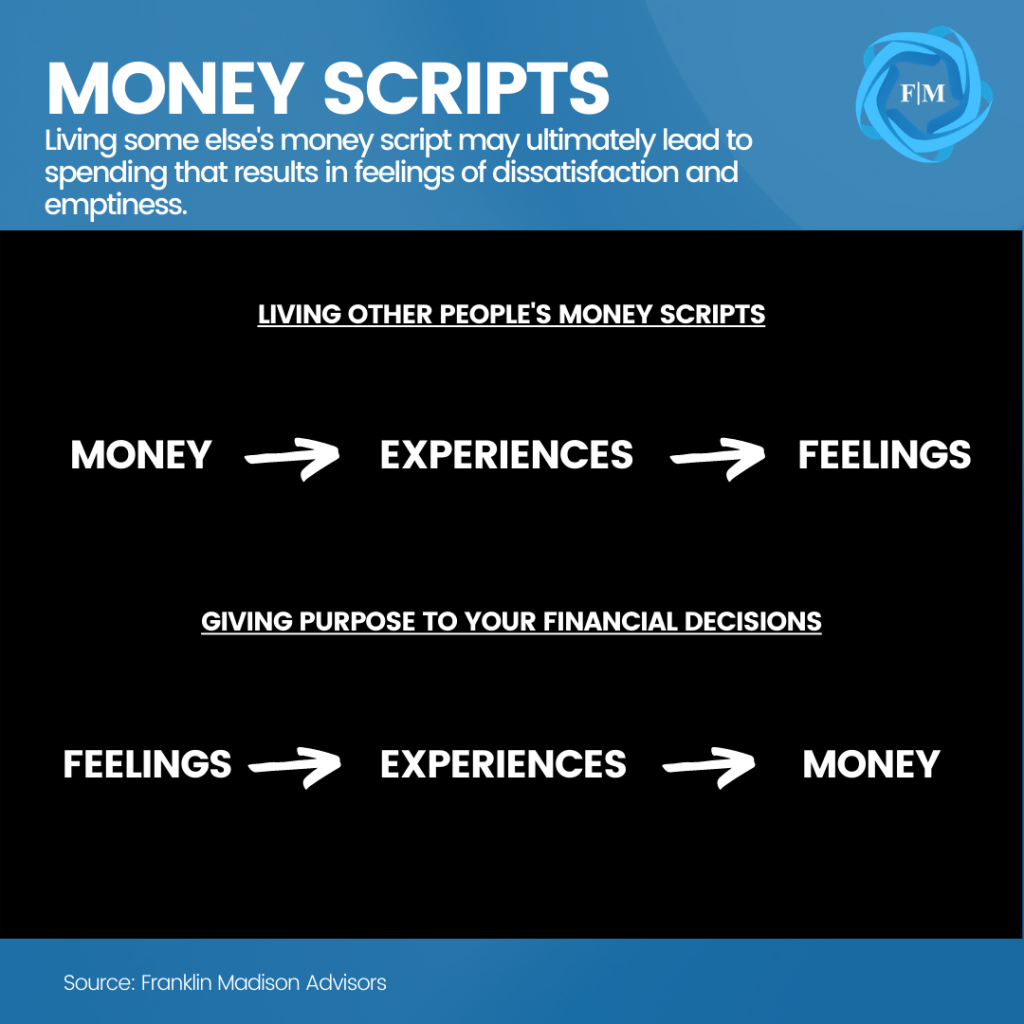
Feelings Give Purpose to Your Financial Decisions
Here again, Dave and Beth's issues didn't revolve around knowing the proper money management techniques. Instead, their challenges came down to finding the right set of experiences that satiated deeply held emotional cravings. By this point, you're probably asking yourself, "why are we talking about feelings?" Well, the truth is that nearly every financial decision we make is based on a desire to satisfy a complex set of feelings.
There's no doubt that money can make you feel secure when you use it to pay your rent or mortgage. You likely feel comfortable when you stock your refrigerator and pantry with groceries. Buying your friends a round of drinks at the local pub likely makes you feel accepted. At its core, money represents stored potential to elicit certain feelings through the experiences afforded.
In the book "Your Money or Your Life," author Joe Dominguez writes how "money… is life energy, or something you trade the hours of your life for… and …is like a mirror that allows [you] to see [yourself]." This truth about money is why many high-earning individuals struggle with growing their wealth for the long-term. Why?
When financial problems crop up, these individuals are focused on trying to solve the wrong set of problems. Often, the solution to their money problems focuses on learning about new money management techniques. On the contrary, in Dave and Beth's situation, developing a conscious awareness of the kinds of experiences that align with their desired feelings, then crafting a money script around those set of experiences could have helped them master their money.
The reality is that few individuals are inclined to think or talk about their feelings. It's easier to look at what's worked for other individuals and try to emulate their lives. While some successful people may appear content from the outside, they may be struggling with as much financial discontentment as Dave and Beth. That's why it's essential to start with the end in mind: understand how you want your money to make you feel and identify the kinds of experiences that will get you there. So how do you determine the fitting types of experiences to pursue?
Which Experiences Matter Most to You?
The first step is understanding what matters most in your life. To this end, George Kinder built his life planning program around answering three vital questions:
- If you had enough money to take care of your needs now and into the future, how would you live your life?
- If you had five years to live, what would you do with your time?
- If you only had 24 hours to live, what did you miss in life, who did you not get to be, what did you not get to do?
Answering questions like these have helped many individuals identify vital life experiences worth pursuing, and at the same time, gain control over their finances and live more rewarding lives.
Why does this approach work? Science has shown that intrinsically oriented goals, or those that come from within, are more likely to be achieved and produce long-lasting emotional satisfaction. On the other hand, extrinsic pursuits focus on goals like getting a promotion, buying a new car, or losing ten pounds. Studies have shown that while such reward-pursuing behavior can produce results in the near-term, their value tends to diminish over time and turns up the speed on the hedonic treadmill.
Indeed, pursuing experiences with the intent of eliciting a specific set of feelings that matter most to you is, by its very nature, an intrinsic goal. So, how can you make an experiences-oriented approach applicable to your life? Spending time with Kinder's three questions is one way to start. What's more helpful, however, is developing a framework in which to put your thoughts, actions, and choices into a broader context. One approach to consider is becoming the master of your financial independence journey.
Become the Master of Your Financial Independence Journey
In the simplest terms, financial independence represents a state of financial wellbeing where you have enough money to pursue experiences that are of utmost value to you. Unless you're already retired or anticipating a financial windfall, becoming financially independent requires a daily discipline of creating, growing, and preserving financial wealth.
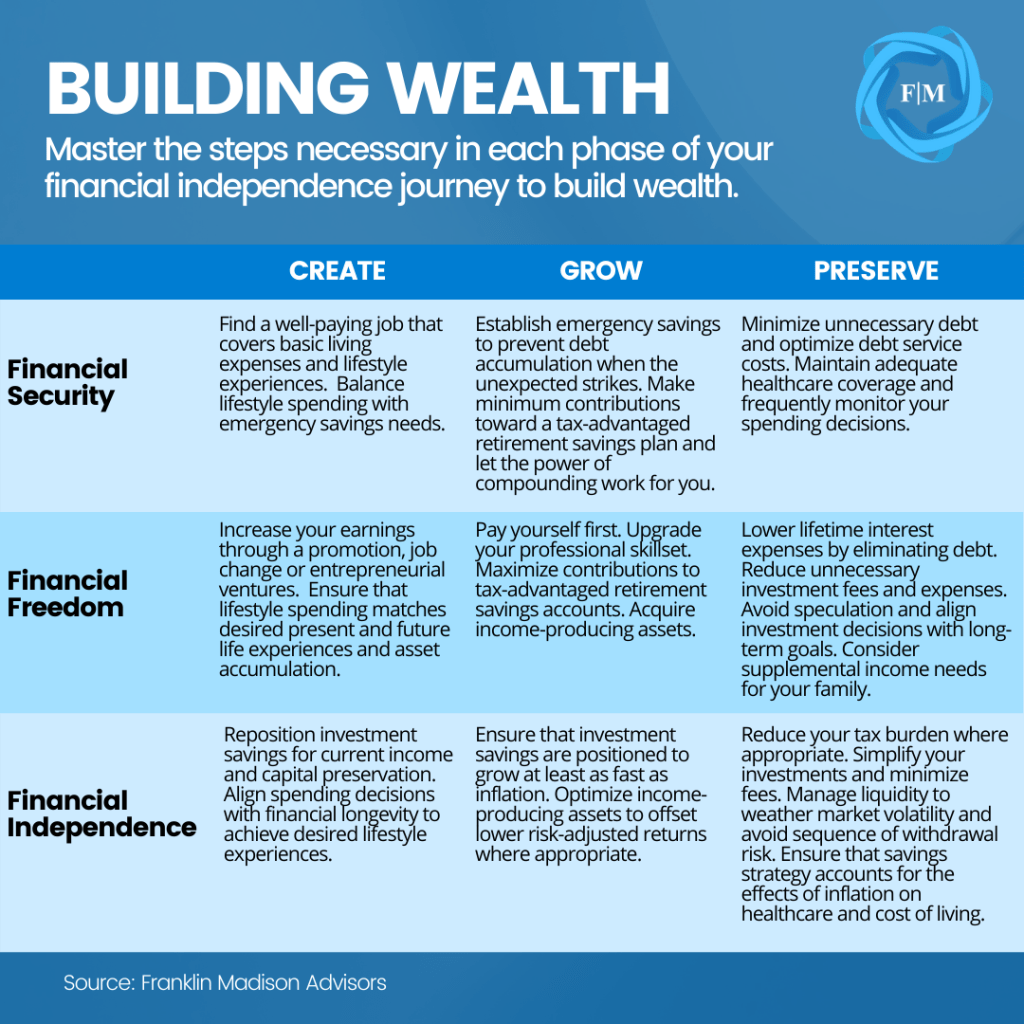
Considering the journey itself, the path to mastery (financial independence) forces you to think outside of the constraints of the money scripts presented to you by other people. Indeed, pursuing those experiences that satisfy feelings core your value system can activate higher levels of intrinsic motivation and potentially reduce the yo-yo effect of unconscious spending.
What's more, the journey itself becomes transformative. For example, each step in the wealth-building process (creating, growing, and preserving wealth) serves an explicit role in helping you move toward financial independence.
Each of these steps requires you to learn disciplines that enable you to build wealth for the long-term. And because the knowledge your gaining serves an intrinsically defined purpose, its application likely will have a more profound impact on your achieving financial independence than learning money management techniques simply for the sake of knowledge.
When it comes down to it, many individuals see their financial choices as discrete win/lose outcomes. And more often than not, people play the game of life simply not to lose: settling for comfort rather than striving for a goal they may fail. They're looking for quick fixes, temporary relief to get them through their day.
While this approach may work initially, a deliberate lack of understanding of what intrinsically motivates you might leave you feeling stuck in a perpetual cycle of earning and spending more but making little headway towards long-term financial goals.
Whether you’re earning six figures and broke like Dave and Beth, or simply trying to take control of your finances, learning a new financial management technique, determining your "retirement number" or some material outcome may not be the approach you need. What might suit your situation better is reframing your relationship with money, rewriting your money scripts and becoming the master of your financial independence journey.
Indeed, endeavoring to master your financial independence journey sets the stage for defining the kinds of essential experiences in your life. Better yet, the journey might ultimately transform you into a fitter financial steward with less stress than you had imagined.