

A Playbook for the Prudent Speculator
Being a prudent speculator is like trying to "act natural", or being "clearly confused", or listening to the "deafening silence".
They're all things that typically don't go together.
Even so, it is possible to become a prudent speculator if you approach it the right way.
And why would you want to be a speculative investor?
Certainly, don't we all know that disciplined investing is the surefire way to achieving and maintaining financial independence?
Well, let's face it: For many of you out there, taking big bets is what's allowed you to achieve the level of success in your career or business that you're living today.
Indeed, you know all too well what it feels like to go all-in on yourself, and to see those efforts rewarded in many multiples of your initial time and financial outlay.
Now, while it's true that you've likely experienced some big professional wins in the past, a common mistake that many high achievers make is to extrapolate expertise in one domain by trying their hand at beating the markets.
And you know, all too often, this move rarely works.
That's because, all it takes is one wrong move in the markets, and you could see your years of hard work wiped out in short order, which is why a disciplined investment strategy works for the long-term.
Even so, if you're going to try your hand at speculative investing, there is a way to have your cake and eat it too, so long as you approach this act from a place of self-knowledge, order, and prudence.
Do You Have What it Takes?
So then, before we go into talking about how to get into speculative investing, the first thing we’ll need evaluate is whether you have what it takes to get started.
And what are we talking about here?
Well, image that you've got an extra $100,000 lying around, and you want to put it to work in the markets.
And by now, you've likely come across various so-called experts promising different ways to turn just a little bit of money into your ticket to financial independence.
So now, the big question here is, "do you have what it takes to put that money on the line?"
The Emotional Journey of Speculative Investing
Well, while the answer to that question might seem like an obvious "yes", given your professional success, the truth is that speculative investing introduces a different kind of emotional situation that you likely haven’t faced in your professional circumstances.
You see, while a disciplined investor puts their money to work by allowing time, a reasonable rate of return from their investments, and the power of compounding to produce gains, speculators tend to take big bets hoping that the price of an asset will rise AND that there will be a buyer at the other side of the table when it's time to sell.
Make no mistake, just as you might feel a rush when a new product takes off or a project succeeds, the potential gains in speculative investing can be exhilarating.
On the other hand, the lows can be profound, as has been the case for many "meme" stock and NFT speculators in recent years, because, unlike a product that can be tweaked or a business strategy that can be adjusted, investments can sometimes plummet with little warning.
So then, the question here is, are you emotionally equipped to handle this high level of volatility and uncertainty?
And why is this question relevant?
Well, as much as you might think you're ready to take speculative bets, it's essential to gauge your emotional resilience and ensure that you're not just chasing the highs associated with following the crowd but are indeed making informed decisions.
The Role of Self-awareness in Investment Decisions
To be sure, in your professional journey, you've likely honed your instincts and now trust them to guide you through complex decisions.
However, in the world of speculative investing, instincts can sometimes be clouded by personal biases. Now, these biases might stem from past experiences, current market trends, or even societal pressures.
And what are we talking about here?
Well, for example, you might be inclined towards a particular tech stock because you're familiar with its products or have an affinity for its CEO.
But you’ve got to ask yourself, “is this fact alone a sound reason to invest?”
The point here is that recognizing such biases is the first step in assessing your readiness for speculative investing.
Then, the next step is to actively challenge your biases to ensure that every investment decision is rooted in research and reason and not just personal preference or emotion.
Indeed, Michael Mauboussin, who is a financial strategist and author known for his work on decision-making, valuation, and behavioral finance, is frequently cited for his insights into the intersection of psychology and finance.
And in his work, he's described this concept known as the "outside view."
And what is the "outside view?"
Well, simply put, holding an outside view means stepping back from the specifics of a situation and instead looking at the broader set of similar situations to make a more informed prediction or decision.
In other words, instead of relying solely on your specific experience or the details of the current problem, you should consider how things generally turned out in comparable situations.
And why is this important?
Well, by taking this approach, you're likely to make more accurate assessments of your investments and avoid common biases that come from being too narrowly focused on the present situation.
The Ever-evolving Landscape of Speculative Investing
Now, another thing to consider as you evaluate whether you've got what it takes to be a speculative investor is that, just like the rapid changes we see in the tech industry, the speculative investment world is also in constant flux.
That's because new trends and opportunities arise, and old ones fade as market dynamics shift. So then, to successfully navigate this everchanging landscape, you need to be constantly in the know.
Now, this doesn't just mean staying up-to-date with the latest market news. Rather, it involves having a deeper understanding of market mechanics, global economic factors, and even behavioral finance.
Here again, it means taking a step back and looking at all of the factors that could influence the price movement, one way or another, of your speculative position.
That's why you'll have to put in the additional time and effort so that every investment decision you make is backed by a robust dataset, ensuring that you're not just reacting to market movements but getting ahead of them.
The Importance of the Right Tools and Resources
Finally, if you're going to engage in speculation, you've got to have the right tools at your disposal. Now, in your professional life, you already know the value of having the right tools, like the latest apps for product development or analytics for market research.
In a similar way, in speculative investing, the right tools can make all the difference. This might mean leveraging advanced analytics software for evaluating market trends or having access to high-quality research from financial experts who can provide insights beyond raw data.
And while having all of these tools at your disposal is a good start, the real magic is in your ability to use them effectively. To be sure, just as you wouldn't rely solely on one data point to make a business decision, you shouldn't base an investment decision on a single piece of analysis before pulling the trigger.
Indeed, as a tech professional or business owner, you likely possess a unique skill set in identifying value opportunities that can be invaluable in speculative investing.
But the real question here is, "do you have what it takes to be a prudent speculator?"
Make no mistake, it's crucial to approach this practice with the same diligence, self-awareness, and thirst for knowledge that has driven your professional success.
And why is this important?
Well, by recognizing and challenging biases, continuously learning, and leveraging the right tools, you can have a better chance at successfully navigating speculative investing without losing your shirt.
Is Your Financial House in Order
Alright, so now that you've done the work to determine whether you have the intestinal fortitude to engage in speculative behavior, the next thing you'll want to do before getting started is to ensure that your financial house is in order.
Now, this might sound like basic work, but listen up, because this step is essential for ensuring that you have the ability to stay in the game.
The Importance of a Financial Foundation
Now, throughout your career, you've likely built products, services, or entire companies from the ground up. So then, you likely understand the importance of a strong foundation.
In a similar way, when it comes to money, before you can explore the volatile world of speculative investing, it's crucial to have a solid financial base in place so you can bounce back from setbacks.
To be sure, as you know, speculative investments are high-risk by nature, and while they offer the potential for high returns, they also come with a greater likelihood of loss.
So then, if your basic financial needs, like emergency savings, debt management, and retirement funding, are not yet secure, then you risk jeopardizing your long-term financial health by engaging in speculative activities.
Indeed, having a solid financial foundation gives you the freedom to take calculated risks without endangering your or your family's overall financial well-being.
Now, this point is essential because, without this foundation, a single bad bet could have disastrous consequences, potentially setting you and your family back years and adding a host of various stresses to your life.
So, then, before you venture into the world of high-risk, high-rewards, make sure you've secured your basic financial needs so that you can weather potential losses without derailing your long-term goals or lifestyle.
Strategic Use of Windfalls
Now, in your professional life, sudden successes like a product going viral, a business deal exceeding expectations, or your company going public are events that bring along big windfalls that you might want to immediately put back to work and double or even triple your windfall.
But before you speculate with such a big gain, it's crucial first to consider your strategic opportunities.
And what do we mean here?
Well, when you experience a sudden windfall, it's tempting to see it as a ticket to the high-risk, high-reward pace of speculative investing. You've got to double your money, right?
Well, before you do, take a pause and consider the bigger picture.
In many ways, a windfall is a chance to solidify your financial position. Indeed, it's an opportunity to address areas in your life you might have previously neglected or as a way to accelerate your financial goals.
This could involve reducing or eliminating debt, which can save you significant interest costs over time. Or, your windfall could help bolster your savings and provide greater financial security and flexibility.
Either way, by addressing these financial needs first, what you're doing is ensuring that any venture into speculative investing is done from a position of prudence and strength, rather than on a hope and a prayer.
The Role of an Emergency Fund in Risk Management
And finally, think about your emergency fund.
Now, you're likely familiar with the importance of backups and redundancies or even understand the value of contingency plans in the business world. Now, these same concepts translate to your financial life, and underscore the importance of having a solid cash reserve in place before you engage in speculative activity.
Now, what we're talking about here isn't just about having money set aside for a rainy day.
Indeed, what we're talking about here is risk management.
And so, why is this important?
Well, can you imagine having all of your liquid cash tied up in a speculative position, and then having a sudden financial need come up in your life, like a healthcare emergency or job loss, and now you can't tap into your money?
That’s why with a robust emergency fund, or cash management strategy, you're free to explore speculative investing with the knowledge that, even if things don't go as planned, you still have a safety net when you need it.
Now, here again, it's crucial to note that this fund should be separate from your speculative investments, and contain enough liquid assets to cover living expenses from between 3 to 9 months, depending on your income and asset levels.
This way, you can ensure that market volatility doesn't directly impact your immediate financial security because, ultimately, it's about having the freedom to take calculated risks, knowing that you've mitigated the impacts from potentially disastrous events.
Become a Risk Manager
Alright, so now that you understand the emotional costs of engaging in speculative behavior and have taken the steps necessary to ensure that your finances are in order, let's take some time to talk about risk management.
Now, while speculative investing is about hoping that an opportunity will provide you with a high return in the future, risk management is a process that ensures you can stay in the game long enough to see that outcome come to pass.
And why is this approach important?
Well, speculative investments, by definition, are more volatile and uncertain than traditional investments. That's because they often involve assets or strategies that have a higher chance of rapid price fluctuation in short periods of time.
And these price moves could be due to various reasons, such as limited historical data, external macro or market factors, or the speculative nature of the asset itself.
Put differently, there are many more unknowns to account for when it comes to speculation. And even in situations where you might know everything about the market you're betting on, there might be outside events that you just can't control.
For example, a new tech startup's stock might be considered speculative because it doesn't have a long track record, and its success might hinge on factors like long-term market adoption of a product.
Or, in the case of real estate speculation, there's no guarantee that, when interest rates continue to creep higher, that the next buyer will want to pay a higher price than their neighbor.
Indeed, while risk management is essential for all forms of investing, its importance is magnified in when it comes to speculative behavior.
Alright, so now that we understand the importance of risk management, how does one actually go about becoming a risk manager?
Understanding Position Sizing
Well, when it comes to becoming a risk manager as it concerns speculative investing, the first thing you'll want to think about is sizing.
Now, from a risk management perspective, market traders (who are often known for their short-term speculative bets) talk about position sizing. And what they're referring to here is the amount of capital you allocate to a specific trade relative to your overall portfolio.
And why is this important?
Well, sizing is crucial because it's a way for you to effectively manage risk.
How so? Well, by determining the right position size, what you're doing is ensuring that even if a trade doesn't go in your favor, the loss won't be devastating to your overall finances.
At it's core, it's about deciding how much to invest in a particular trade or asset, so you can both maximize potential returns and limit potential losses in a manner consistent with your risk tolerance.
Either way, when you consider position sizing, just know that it's more than just a numerical decision. It's a reflection of your understanding of your financial situation and your comfort with risk.
The Imperative of a Clear Exit Strategy
Alright, so now that we've talked about one prudent way to enter a speculative position, let's talk about using a prudent risk management technique and setting your exit strategy.
Now, as you might well already know, venturing into speculative investments without a clear exit strategy is like sailing into stormy seas without a compass. That's because no matter how enticing the potential rewards are, without a plan to navigate the challenges, you risk being swept away and having your ship sunk.
Indeed, an exit strategy outlines the conditions under which you'll sell or otherwise exit your position, either to lock in profits or to your cut losses.
And so, by setting these parameters ahead of time, what you're doing is not leaving your decision to the heat of the moment, where emotions like fear or greed can cloud your judgment.
Ultimately, having an exit strategy allows you to enter speculative positions with a clearer sense of what you're aiming to achieve and what you're willing to risk.
At the same time, it helps you maintain discipline and helps ensure that you'll make decisions based on logic and strategy rather than purely on emotion.
Adopting a Gambler's Mindset
And finally, when it comes to risk management, the last thing you'll want to consider is adopting a gambler's mindset.
And what exactly are we talking about here?
Well, adopting a gambler's mindset can help you make better investment decisions by emphasizing risk management and probabilistic thinking in your approach.
And how's that possible?
Well, that's because in gambling, just like in speculative investing, the outcomes are uncertain, but the odds can often be quantified.
And so, by thinking like a gambler, what you're doing is becoming more attuned to assessing the probabilities of different outcomes, which allows you to better weigh potential risks against potential rewards.
Another reason to adopt this mindset is that gamblers who succeed in the long run know the importance of sticking to a strategy, setting limits on losses, and not chasing after bad bets.
In a similar way, a prudent approach to speculative investing, like knowing when to enter and exit positions and adhering to your risk management plan, can increase your likelihood of success over the long term.
A Playbook for the Prudent Speculator
You know, when it comes down to it, navigating the tumultuous waters of speculative investing is not for the faint of heart.
That’s because it demands a blend of courage, strategy, and self-awareness because, when not approached prudently, it can quickly wipe you out financially.
With that said, by understanding when to push forward, when to hold back, and most importantly, when to exit, you ensure that you're not just participating in the race, but that you have the chance to actually finish it.
In the end, the prudent speculator's voyage is not just about financial gains, it's about growth, learning, and resilience so you can take one step closer to becoming the master of your own financial independence journey.


Don't Keep All Your Eggs in One Basket
All it takes is just one stock to go to the moon, and that's it, you're set for life, right? Well, if it were only that simple. You see, concentrated investing, or keeping your eggs in one basket, seems to work until it doesn't.
Now, make no mistake, concentrated investing isn't all that bad. In fact, notable investor Warren Buffett is known to have made lots of money decade after decade because he takes big bets.
Even so, concentrated investing isn't for everyone.
In fact, if you were to personally ask the Oracle of Omaha for investment advice, he'd likely tell you to buy a diversified basket of stocks that tracks the S&P 500 index and simply hold on to your investments for the long haul!
And why would a sage investor give such seemingly conflicted advice?
Well, that's because Buffett knows that concentrated investing cuts both ways. You see, on the one hand, you could score big under the right circumstances or find yourself desperately holding onto a failing position that wipes away your life savings when fate turns against you.
Indeed, whether you've intentionally placed all your eggs in one basket or are simply trying to figure out what to do with your restricted stock or stock options, then having a plan is essential to preventing unfavorable outcomes.
And this approach starts with checking for concentrated holdings, assessing your risk tolerance to manage such a position, and then understanding how to rebalance away or hedge risk when necessary.
Understanding Concentrated Investment Positions
So then, how can you tell if you're holding on to a concentrated position in your portfolio or otherwise? Well, there are several straightforward methods to figure this out.
The first approach involves evaluating your portfolio's asset allocation. And, as you'll likely recall, your asset allocation refers to the mix of stocks and bonds, US and International holdings you might hold in your investment portfolio.
Now, a portfolio heavily weighted towards a single investment or a given sector or industry is typically indicative of a concentrated position. For example, a general rule of thumb is that if more than 20% of your portfolio is allocated to one stock or sector, then that's likely considered a concentrated investment.
Now, this sort of concentration typically happens when you have restricted stock units (RSUs) that vest, and you haven't decided what to do with your equity, so you just let it sit in your employer's stock plan account. Or, it can happen when you decide to exercise and hold your stock options but don't have a strategy in place for your equity now that you own it.
Now, another method for evaluating whether or not you have a concentrated investment position involves reviewing your exposure to a single asset or sector relative to a benchmark index.
And, what are we talking about here?
Well, let's say your portfolio has 30% invested in the tech sector while your equity benchmark has a 20% weighting in the sector itself. In this situation, you're likely to find yourself with a concentrated position from the perspective of owning more of a sector than you would otherwise like.
And finally, when it comes to determining whether you have a concentrated investment position, you should look at your holdings from the perspective of a worst-case scenario. For example, heading into the Global Financial Crisis, many employees of Wachovia Bank had their retirement savings stored up in company stock, which ultimately led to an unfortunate outcome.
That's because, when the bank failed, the value of their holdings was effectively wiped out, which canceled the retirement plans of many of the bank's former employees. So then, the moral of the story here is that if the failure of a single investment would lead to a significant loss that would severely affect your future financial plans, then you likely have a concentrated position.
Evaluating Your Risk Tolerance for Concentrated Investments
Alright, so now that you understand what it means to have a concentrated investment holding, the big question now is, "do you have what it takes to hold on to that concentrated position for the long-haul?"
And this question is so essential because, as you likely very well know, the road of investing is long and winding, with pitfalls and windfalls alike. It's like a journey where your risk appetite can significantly influence the trajectory and the destination of your investment returns.
And so, what do we mean here by risk tolerance?
Well, to be clear, risk tolerance refers to your ability and willingness to bear losses in exchange for potential gains, especially when a large portion of your net worth is potentially ebbing and flowing with the whims of the markets.
So then, for those of you out there considering or already maintaining concentrated positions, it's essential to have a deep understanding of not only your concentrated holdings, but also of how these investments are affected by market trends, narratives, and principles alike.
And why's that?
Well, it's one thing to know everything about your company stock. But to understand what Mr. Market might also think is a powerful money management skill. Indeed, financial acumen, paired with a disciplined approach, is often what separates successful investors from those who experience significant losses.
To be sure, for those of you out there who have studied market cycles or have simply lived through them, you likely already understand that downturns are inevitable and, more often than not, unpredictable.
Now, if you're a seasoned investor with a high tolerance for risk, then you're likely to remain steadfast in your investment strategy during periods of heightened market volatility because you understand the broader economic and market factors at work and anticipate the longer-term investment play at hand.
With all of that said, holding onto a concentrated position in market ups and downs isn't always as simple as understanding the technical of market or economic factors.
And why's that?
Well, that's because investing can, and often is, an emotional journey. To be sure, when market volatility picks up, and your net worth starts swinging to and fro, it can bring about strong emotional responses, like fear during downturns and euphoria during market rallies.
So then, within the context of investment risk tolerance, your emotional fortitude is a crucial trait to consider in these scenarios. Indeed, in these situations, you have to be able to resist reactive decision-making and stick to your long-term investment plan no matter what's ahead of you.
This approach is especially true when a large portion of your wealth is tied up in your company's stock, and so you'll need to be able to hold on without panicking during periods of negative news or poor earnings performance.
So then, how can you tell if you're fit for holding concentrated investment positions? Well, the first thing you'll want to do is to evaluate your inclination towards maintaining your financial acumen in your given investment holding.
More specifically, you'll need to ask yourself not only whether you're well-versed in the intricacies of a given sector of the market or your company's financials but also whether you have the mental bandwidth and time to stay on top of all the changes in both.
Remember, more often than not, all it takes is one lousy report to send an investment plummeting, so you'll need to stay on top of key developments so you can make wise decisions.
Next, you'll want to assess whether you have the intestinal fortitude to deal with a single large holding and its potential impact on your wealth. More specifically, you'll need to determine whether you can endure periods of market turbulence without making rash decisions. For example, if you're tempted to sell investments or simply move to the sidelines entirely during periods of heightened market volatility, then managing a concentrated position may not be the right fit for you.
And, when it comes to evaluating your risk tolerance within the context of managing a concentrated investment holding, you'll want to consider your broader financial position. More specifically, you'll want to look beyond your investments and evaluate your entire balance sheet.
That's why it's essential to take some time to ask yourself whether you have the ability to absorb potential losses when markets go against your holdings without it impacting your lifestyle or financial goals. And, if you don't have the financial flexibility to weather market downturns, then managing a concentrated position may not be for you.
Strategies for Managing Concentrated Investment Risk
Alright, so now that you understand what a concentrated position looks like, and have evaluated your own risk tolerance, what else can you do if you have concentrated investment risk that you can’t just walk away from, but you need to address in the present?
Well, managing concentrated investment risk often requires a strategic, multi-faceted approach that draws on a range of financial tools and principles to grow your wealth in a mindful way.
Indeed, when it comes to managing a concentrated position, you'll need to consider several factors, from complex things like tax consequences to finding the right trade-off between risk and reward to make prudent choices with your holdings.
Diversification, Asset Allocation and Rebalancing to Manage Risks
And so, how do you go about managing these risks?
Well, to start, let's come back to the first principles of diversification. Indeed, history has shown that, over the long term, you can reduce the overall risk in an investment portfolio when you spread your money across multiple holdings. To be sure, by investing in a broad range of assets, you reduce the risk associated with the poor performance of any one single investment.
And so, how do you achieve this outcome? Well, that's where a solid asset allocation strategy comes into play.
Remember, diversification is achieved by adding different asset classes (like stocks and bonds) to your portfolio, by investing in different sectors or countries, or by utilizing mutual funds or exchange-traded funds (ETFs) that offer instant diversification.
Now, asset allocation, on the other hand, involves determining how much to allocate to these various investments, and more often than not, will be determined by your investment goals, risk preferences, and time horizon.
Alright, with all that said, a common question that typically comes up with respect to diversifying a concentrated position is whether you should sell all of your holdings at once and just be done with it or whether to do so over an extended period of time?
Well, you could sell everything today, but there's a host of factors at play, including tax consequences and the potential for missing out on investment gains to consider as well.
And so, depending on your situation, this is where portfolio rebalancing comes into play.
Now, portfolio rebalancing is a proactive risk mitigation strategy that involves periodically buying or selling assets in your portfolio to maintain your desired asset allocation.
And, in your situation, this could mean reducing a concentrated position by selling some of your investment holdings and then using the proceeds to invest in other underrepresented sectors or asset types.
So then, by taking this approach, what you’re doing is preventing your portfolio from becoming overly concentrated in a single investment while ensuring it aligns with your investment goals and risk tolerance.
Okay, so now that you understand that to reduce concentration risk, you'll need to spread it out across various assets, the next question is, "over what time period?"
Well, if you have a long enough investment horizon, meaning that you don't need to tap into the proceeds from your concentrated position for quite some time, then you might be able to bear the short-term volatility associated with a concentrated position with the expectation of higher returns in the long run as you begin diversifying away this position.
With that said, however, if your investment horizon is short, meaning that you'll need to tap into those investments sooner rather than later for, let's say, a home purchase or for your early retirement, then an extended diversification strategy might be too risky since you likely won't have sufficient time to recover from a potential market downturn when unexpected volatility hits.
Hedging as a Way to Manage Risks
Now, outside of rebalancing as a way to mitigate the risk of a single investment holding, another way to deal with a concentrated position involves hedging.
And what do we mean here?
Well, hedging involves a rather deliberate process of making intricate investment decisions to transfer the risk of adverse price movements in a concentrated asset.
You're still with me, right?
Well, to put this process more simply, to achieve your desired outcome, what you're going to do more often than not is use financial derivatives like options and futures to transfer risk (or hedge against) a potential decline in the value of your concentrated position.
Now, this concept can get pretty technical rather quickly, so let me give you an example to explain here.
Let's assume that you anticipate that the value of your company stock is likely to decline in the months ahead for any number of reasons. Well, in this situation, you could enter into a contract to buy put options, which gives you the right (but not the obligation) to sell a portion of your concentrated position at a locked-in price in the future.
It's like an insurance policy if the value of your concentrated position falls significantly, but it comes with its own set of costs and trade-offs and is helpful in specific situations.
Either way, when it comes to managing a concentrated investment position, you have several options to consider. And so, what's critical to take away here is that if you do decide to hold onto a large position for the long-term, it's essential to find a strategy that works for you and ultimately stay committed to it.
Don't Keep All Your Eggs in One Basket
You know, when it comes down to it, the road to successful investing, especially when it involves concentrated positions, requires a mix of self-awareness, emotional resilience, and strategic execution. Indeed, managing a concentrated investment position is like trying to balance on a high wire where the rewards may be as significant as the risks.
Make no mistake, however, managing a concentrated investment position is often a full-time job, and likely one reason why Warren Buffett encourages individual investors to buy a diversified basket of investments early and often.
Even so, the risks are far from impossible, so long as you're armed with the right tools and strategies, like knowing when you're in a concentrated investment position and appreciating the risks and potential rewards of such positions.
And when it comes to successfully managing your concentrated investment position, understanding your investment horizon, portfolio rebalancing, and hedging strategies can help guide you through the often turbulent seas of investing.
To be sure, with these tools in hand, you'll not only be better equipped to navigate the often stressful but many times rewarding path of investing, you'll also be able to take one step closer to becoming the master of your own financial independence journey.

Train Your Brain, Build Your Fortune: The Power of Mental Rehearsal
When was the last time you mentally rehearsed how you're going to make your financial goals a reality?
Well, whether you're a skeptic or a die-hard proponent of mental rehearsal, you can take a lesson from Craig, who used this approach to fast-track his financial progress toward his essential life goals.
Now, Craig had a decent job as a middle manager in a tech company and was making good money, but not the kind of money where he could call himself rich. Even so, Craig had big dreams. And his goal was to hit a net worth of $10 million before the age of 50.
Sounds like a tall order, right?
Well, this was especially the case given that he was already halfway through his thirties and only had a fraction of that amount saved.
That's when Craig realized that he needed a financial game changer, something totally different from what he was currently doing to reach his lofty goal.
Now, you know how sometimes the craziest ideas come from the most unlikely places? Well, a friend told Craig about a book that he was reading and it was all about the power of mental rehearsal.
More specifically, it described how one's mind often can't tell the difference between the mental world and the physical world, and so developing a practice of mental rehearsal could help him better realize his dreams.
Now, it's essential to note here that this approach wasn't some sort of pie-in-the-sky wishful thinking.
In fact, the book discussed three concrete steps that Craig needed to focus on to realize his dreams, and these included: 1) clarifying his goals, 2) developing a mental rehearsal routine, and 3) overcoming limiting beliefs.
Sounds too good to be true, right?
Well, Craig thought so at first, but he ultimately decided to give it a shot.
And, so, how did he do it?
Well, he started with the basics and got clear about what he wanted and that was: a $10 million net worth by age 50. Then, he wrote his goal down, big and bold, and stuck it to his kitchen wall.
Now, you might wonder, does this approach really help? But think about it this way: seeing that number daily reminded Craig of his dream and kept him motivated regardless of what was going on that day.
Next, Craig got real about his expectations. He knew that just seeing a number wouldn't cut it. That's because he had to make this dream feel as real as possible. So, what did he do?
Well, Craig made a list of what his $10 million goal would look like to him.
For Craig, this meant a house in Hawaii, being able to travel the world, and funding scholarships for underprivileged children. And so, to make the list more real, he attached pictures representing his goals to each one of the items.
Now, stay with me here because this is more than simple daydreaming. That's because the pictures of his goals made the outcome real and tangible to Craig so that he knew exactly what his financial decisions would help him accomplish.
Finally, Craig got serious about his visualization practice, and that's where the magic started to happen. That's because Craig started visualizing his desired outcomes every single day. Now, can you imagine how powerful it would be to be so focused on what you want from your life that you don't lose focus of it regardless of what’s going on in your life?
Well, by doing so, Craig could almost taste the life he was dreaming of, and it drove him to push even harder toward his financial goals.
And, so, what happened?
Well, as he spent more time mentally rehearsing the life he wanted, Craig noticed he was more willing to take more risks.
He asked for that promotion he'd been eyeing, he got serious about his disciplined investment strategy, and even began exploring side hustles to diversify his income. And wouldn't you know it, his net worth started to climb faster than he ever thought was possible.
And here's the kicker: just after his 48th birthday, Craig hit his goal a full two years earlier than planned. And at that point, he was standing in his beachfront home, traveling the world and giving scholarships to needy kids. But the best part? It wasn't just about the money. Craig found that the real magic was in the journey and the incredible power of mental rehearsal that got him there.
The Power of Mental Rehearsal
Now, while Craig's story may sound too good to be true, the fact is that our mindset and how we view our life goals have a lot of sway on whether or not we achieve our desired life goals.
And at this point, it's critical to note here that the kind of visualization we're talking about is not necessarily one associated with the Law of Attraction, or the "Name it and Claim It" prosperity gospel.
To be sure, while the jury is out on whether thinking good thoughts about what we want from life will actually manifest them, what we're talking about here is the proven method of priming our brains for a desired life outcome so that we can better do the work, rather than simply wishing our desires into existence.
Indeed, looking at mental rehearsal from the perspective of sports, psychologist Aidan Moran has been known to say that "sports are played with the body and won in the mind."
And, so what does this mean?
Well, the saying suggests that winning in sports goes beyond mere physical dominance. That's because athletes who can harness the power of their minds by channeling their mental strength, visualizing success, setting goals, and employing effective strategies are more likely to achieve ultimate victory.
And so, what does sports have to do with money? Well, the truth is that top-performing athletes often acknowledge that their opponent isn't the person staring at them from the other side of the court, but rather, it's often the person staring at them from the other side of the mirror.
That's why when it comes to mental rehearsal in performance training, Jim Afremow, the author of "The Champion's Mind," has some valuable insights for upping your game when it comes to mastering your journey to financial independence.
Goal Setting
To start, you need to consider the fact that mental rehearsal plays a vital role in goal setting. And why's that? Well, that's because visualization helps you take obscure or ethereal desires and turn them into something you can touch, taste and smell.
For example, have you ever visualized yourself living in a new house while touring homes with your real estate agent? Or how about imagining your child's experience at a new school during an open house? Could you recall how you felt in those moments?
Well, if you can, then you've likely already experienced the power of visualization when it comes to setting your goals. To be sure, to make the practice successful for you, Afremow suggests frequently visualizing yourself accomplishing your desired outcomes, whether it's winning a competition, attaining personal financial milestones, or achieving financial freedom through your savings goals.
Indeed, by consistently envisioning your success, you enhance your focus, motivation, and belief in your ability to achieve those objectives. To be sure, when engaging in vivid mental imagery or visualization, the brain can activate similar neural networks and pathways as it does during actual experiences. This activation can lead to physiological and psychological responses similar to those experienced in real-life situations.
What's more, visualizing yourself in your desired financial state will not only help you set goals, it can also boost your motivation and focus your energy towards achieving those highly desired life goals. Now, these outcomes typically happen because you're using the power of your imagination to generate positive emotions and feelings of accomplishment to get a taste of what achieving that goal might feel like.
Again, this mental rehearsal process will help keep you motivated during challenging times, help you remain focused on your objectives, help you avoid distractions, and, most importantly, help you avoid making impulsive financial decisions that could derail your financial independence journey.
Develop a Mental Rehearsal Practice
Alright, so once you have a clear idea of which objectives you want to pursue, the next step in using visualization to fast-track your financial goals is to mentally rehearse your desired life outcomes.
And, so, how do you do this?
Well, start by visualizing the satisfaction and joy you'll experience once you achieve your goals. As in Craig's case, this could include tapping into the feeling of cruising up the driveway of your house in Hawaii, experiencing the awe and wonder of visiting a new country or seeing the joy in a child's face when they realize that you've helped them pay for college.
Now, naturally, on the surface, constantly thinking about your desired financial goals might seem a little like daydreaming.
But, the truth is that mental rehearsal is much more than daydreaming because it's a way to prime your brain for the outcome that you want to achieve. In fact, mental rehearsal is an approach used by the soccer great Pele, Olympic swimmer Michael Phelps, Muhammad Ali, Tiger Woods, and many other well-known athletes to prime their minds for the outcomes they desire before actually doing the work.
Now, when it comes to applying this concept to your finances, you'll likely want to make the outcome more than just about achieving your life goals but also about the actions you need to take to achieve those outcomes. For example, take the time to visualize what your typical week or month looks like when it comes to how you're handling your finances.
For example, imagine your ideal financial situation and visualize specific milestones, such as paying off debts, saving a targeted amount of money, or acquiring assets that can produce income later on in life. And by creating a clear mental image of what you need to do to hit your life goals, you can develop a long-term roadmap along with short-term actionable steps that you can touch, taste and feel to reach them more efficiently.
To be sure, can you vividly imagine how you would feel checking your bank statements to see how your spending and savings are aligned with your overall life goals? And how do you want to feel knowing that your savings balances are growing consistently or that they're solid enough to cover your lifestyle goals until you die, thanks to the choices that you're currently making?
That's the power of mental rehearsal and visualization.
Again, it's essential to note here that we're not talking about wishful thinking. To be sure, the field of neuroscience has a lot to say about how neurons that fire together wire together, and that's a discussion for another time. But when it comes down to it, what you should know is that mental rehearsal helps improve connections in your brain that link effort to outcome.
Remember, the mind is, for the most part, a lazy member of our physiological system. It prefers habits and novelty and tends to focus on things you're good at or generally enjoy doing. So then, from this perspective, mental rehearsal allows you to prime your brain and body for future habits and desired outcomes by pairing images and scenarios of success with a physiological outcome that links potential achievement with positive emotions.
Indeed, through visualization, you can mentally rehearse the daily choices you'll need to make with your money with utmost clarity. And by creating detailed mental images, you are effectively training your brain to simulate the actual physical experience associated with that work.
Overcome Limiting Beliefs
The last point we'll cover when it comes to mental rehearsal is how it's a great way to overcome limiting money beliefs and how it can help you build confidence in your financial abilities. Now, if you're having trouble being consistent with doing the work to hit your financial goals, like sticking to your budget, it may have something to do with your belief in your ability to achieve these goals.
And that's where mental rehearsal can help out.
That's because visualization allows you to rehearse those behaviors necessary to achieve your life goals while helping you identify blindspots and potential derailers to create potential solutions.
And, so, how do you go about doing this work?
Well, to start, identify any negative beliefs or doubts you may have about your financial potential and replace them with empowering imagery. This could include imagining yourself finally overcoming those bad habits or derailers that have been holding you back, and what it would feel like to finally attain your measure of financial success.
To be sure, this visualization practice will not only help you challenge your limiting beliefs but also help you develop a confident mindset, enabling you to take bold actions such as investing, starting a business, or negotiating for better financial outcomes in your life.
Use Mental Rehearsal to Fast-track Your Financial Goals
Now, if you're still not sure where to begin with all this mental rehearsal work, consider this: what would your dream life look like, and how would achieving your financial goals bring this vision to life? Can you feel the excitement bubbling within as you step into your dream home, or experience the pride coursing through your veins as you fund your child's college education without any debt?
That's the power of mental rehearsal kicking in.
Now, drawing on Craig's story, reflect on the impact of visualization in your life. Picture the confidence you would feel asking for a deserved promotion or the thrill of discovering a new investment opportunity that aligns perfectly with your financial goals. At the same time, imagine the satisfaction of seeing your savings grow steadily or the relief in realizing that you're financially prepared for your post-employment years no matter what comes at you.
To be sure, your dreams aren't as far-fetched or unachievable as you might think. In fact, it's quite the contrary. Your financial dreams are within your grasp, and it starts with mentally rehearsing how your life will look when you achieve that outcome.
Indeed, just like in sports, the battlefield is in your mind, and victory starts there. And by frequently visualizing your desired financial state, you'll find an increase in your focus, motivation, and belief in your ability to reach your goals, but most importantly, you'll be taking one step closer to becoming the master of your own financial independence journey.

Why Linear Thinking Won't Get You Exponential Results
Have you ever wondered why some people seem to achieve enormous growth, whether in mastering new skills or building wealth, while others appear stuck in a state of static complacency?
Exponential growth might just be the hidden answer.
Now, before you write off this seemingly abstract concept, let's take a moment to think about this concept in simpler terms.
To do this, picture yourself standing at the foot of a towering mountain of opportunity. Now, the peak is barely visible because it's shrouded in the clouds of potential.
Even so, this mountain represents the concept of exponential growth, a potent yet often misunderstood principle that has the power to rapidly accelerate your life and financial goals.
So, where does exponential growth fit in?
Well, you can think of exponential growth as a small snowball at the top of the mountain. As it begins to roll down the mountain, it gathers more snow, growing in size and speed.
Now, imagine this snowball is your initial $10,000 savings investment. Initially, it might not seem substantial, but once you give it a bit of time and the right conditions, you'll likely be looking at an avalanche of progress and prosperity.
So, what can you do to tap into this power to fast-track your progress to financial independence?
Well, the first step is to get out of the trap of thinking about your money in a linear fashion. That's because once you truly grasp how exponential growth works, you can then take advantage of two critical financial concepts to 1) save less to reach your financial independence goals and 2) have more money set aside each month to enjoy your life instead of worrying about the future.
Now, outside of winning the lottery or coming into a sizeable windfall, there's no shortcut on your path to financial independence. It's a little like running a marathon. It requires patience, consistency, and the willingness to start even if the benefits aren't immediately apparent.
But you'll likely have the motivation you need once you have a firm grasp of how small actions today can influence your big financial goals tomorrow.
Beyond a Linear Mindset: Exponential Growth
Now, to fully grasp the concept of exponential growth you need to understand its essence.
And what is exponential growth?
Well, exponential growth or decay refers to a constant rate of increase or decrease. And one of the simplest ways to think about this phenomenon is compound interest.
How so?
Well, consider the growth of $10,000.
If you put that money to work today, earning a 5% growth rate, at the end of the first year, your investment will have grown to $10,500. In the second year, the 5% growth rate is not only applied to your initial $10,000 but also to the $500 you earned in interest, resulting in a total of $11,025. This pattern of accumulation continues, becoming increasingly dramatic over time.
In fact, if you took $10,000, invested it at a 5% growth rate and left it alone for 50 years, you’d have nearly $115,000!
So then, it’s this pattern of growth starting off small and slow, and then rapidly rising that characterizes exponential growth.
Now, it’s important to note that exponential growth is not confined to the realm of abstract concepts. That’s because it manifests in various facets of everyday life. A prime example is the evolution of technology, which adheres to the principle of exponential growth, as demonstrated by Moore's Law. According to this law, the number of transistors on a microchip doubles approximately every two years, propelling technological progress forward at an astonishing pace.
Nature, too, abounds with instances of exponential growth. Bacterial growth serves as a classic example, where under optimal conditions, a single bacterial cell can divide and multiply, giving rise to two, then four, eight, sixteen, and so forth, in an astonishingly short period.
Roadblocks to Exponential Thinking
Now, despite its ubiquity, many individuals struggle to comprehend the true nature of exponential growth.
And why’s that?
Linear Thinking
Well, to start, humans naturally tend to think linearly, perceiving relationships as straightforward and proportional. For instance, if I walk for an hour, I cover a certain distance, right?
And if I double the duration to two hours, I cover twice that distance. In this situation, linear thinking hinges on constant rates.
Even so, however, exponential growth operates differently, involving a rate of change that intensifies over time. And because this rate of change evolves over time, this non-linear nature can be counterintuitive and challenging for many to grasp.
Time Frame
Another reason many individuals struggle with understanding exponential growth is because it often starts slowly, only to suddenly surge forward.
And it’s this initial period of gradual growth that can lull people into a false sense of security, causing them to underestimate the profound long-term effects of the process.
And where is this applicable?
Well, we typically see this pattern of thinking observed in the context of epidemics, when reported infections are low, but transmission ability is high or financial investments, when an individual is just starting out their savings journey.
Mathematical Complexity
And when it comes to truly getting a grasp of exponential growth, some individuals may find the mathematical concept behind process simply daunting. That’s because it demands an understanding of multiplication and powers, which are concepts that may be unfamiliar or intimidating to some people.
Even so, by delving into the depths of exponential growth and unraveling its intricacies, we can unlock its immense potential. Indeed, from fostering personal growth to harnessing financial gains, the mastery of this concept opens doors to a world of possibilities.
Exponential Growth in Personal Development
Now, while exponential growth has the potential to transform your finances, it also has an incredible capacity to propel your personal growth. That's because daily habits, even small positive changes, when consistently practiced, can yield substantial progress over time.
It's like the compounding effect of interest. Let's say that you're interested in learning a new language and give it just 15 minutes each day worth of practice. While this approach may seem small and insignificant at first, over the span of a year, this modest commitment amounts to over 90 hours of practice which is an impressive investment that can foster considerable advancement.
Now, this concept extends beyond learning a new language. Indeed, learning new skills, enhancing your physical well-being, and nurturing personal relationships can all experience exponential growth through the accumulation of tiny, consistent adjustments. That's because every minuscule change, when compounded over time, possesses the potential to catalyze remarkable personal development.
Use Exponential Growth to Calculate Your Nest Egg Need
Alright, so now that you understand how essential exponential growth is for your personal and financial life, let's take a deeper dive and talk about how we can apply this concept from a financial perspective to determine how much you need to save to meet your essential life goals.
Now, when considering complex savings goals, like saving for post-employment living expenses, it's tempting to settle on a round number, say $1 million, as your financial independence savings target.
But how can you be certain this figure will support your lifestyle for the remainder of your life? That's where the concept of exponential growth enters the picture to help you calculate your financial independence number.
And how do we calculate this figure?
Well, to calculate how much you need to save for retirement or your post-employment living expenses, you must consider your savings journey in two distinct phases.
Two Phases for Financial Independence
The first phase, referred to as the accumulation phase, starts today and ends when you attain your definition of financial independence. This could be 10, 20, 30 years, or even more in the future.
The second phase, known as the distribution phase, covers the period between when you achieve financial independence and your eventual passing. In simpler terms, it represents the duration for which you plan to live off your savings.
Now, the big question you're probably asking is, "how much should I save today to meet my financial independence goals?" The answer is, "It depends." That's because, before you can accurately determine how much to save during your accumulation phase, you must understand how much you intend to spend during your distribution phase.
Consider this analogy. If you're planning a cross-country road trip, how much fuel will you need? The answer depends on a few factors, such as your vehicle's fuel efficiency and your chosen route. Are you planning a direct journey or do you anticipate detours to scenic spots?
The same principle applies to your journey toward financial independence. Just as you'd calculate your road trip's distance and fuel consumption, you need to estimate your retirement spending and income's saving potential to figure out how much to save today.
And how do you go about doing this work?
Well, let's illustrate these concepts with an example. Suppose your goal is to save enough money to supplement your lifestyle by $40,000 per year in today's dollars, and you plan to maintain this lifestyle throughout a 30-year retirement. Your goal is to save annually for the next 25 years before reaching your financial independence date.
So, how much do you need to save?
Exponential Growth of Inflation
Well, while it might be tempting to simply multiply $40,000 by 30 years to calculate your retirement nest egg need, you'd likely end up with a linear result that could jeopardize your financial independence goals. That's because, as you’ll recall from our discussion earlier, exponential growth works both ways.
Not only can it boost your savings, exponential growth in expenses, like inflation, can eat away at your future purchasing power. Indeed, history has shown that inflation tends to increase at an exponential rate as price growth compounds year over year.
Indeed, when we incorporate inflation into our hypothetical lifestyle expenses projection, assuming an average inflation rate of 3%, you'd need to spend $83,751 in 25 years to buy the same goods and services you can today with $40,000. What's more, that $40,000 lifestyle expense today will likely rise to over $200,000 by the time you pass away in 55 years.
So, given an annual inflation assumption of 3%, how much money would you need to have saved by your financial independence date in 25 years? Well, when taking inflation into consideration, you'd likely need just over $4.1 million to cover your rising lifestyle expenses!
Exponential Growth of Investment Returns
Now, before you get worried about the large savings figure, you can take comfort in knowing that you can use exponential growth during your distribution years to lower your overall savings need. That's because while inflation is an exponential factor that works against your savings, a compounding investment return can help mitigate your overall savings need.
How does this work?
Let's suppose that you decide to keep your savings invested throughout retirement, and your investments grow at about 5.5% annually. You might be thinking, "Isn't that small investment return barely offsetting my average inflation rate?"
Well, at first glance, it might seem that way, but let's examine how the numbers pan out over the long term.
Now, you'll recall that without any investment return and just saving enough to cover 30 years' worth of inflation-adjusted expenses, you'd need to have saved around $4.1 million. However, if your investments grow 5.5% per year in your post-employment years with inflation at 3%, you'd likely only need to save around $1.7 million, which is less than half the original figure!
Why?
Well, that modest growth rate applied to your retirement savings acts as a buffer or a cushion, that offers growth of your savings even as you're drawing down on the principal balance. And when your money has the opportunity to grow at a modest rate over a long period of time, it means that you need less money to start at retirement to fund your living goals.
From this perspective, you can think of exponential growth of your retirement savings like a fruitful orchard. Just as a tree steadily grows and bears fruits year after year, your savings, growing at a modest rate over time, acts as a resilient tree that continues to produce new fruit even as you pluck some of the ripe ones. And in our case, the growth of your savings serves as a cushion, ensuring that your retirement nest egg keeps expanding even as you withdraw from it.
Now, it’s crucial to bear in mind that these calculations are based on estimates and averages, and actual inflation rates and investment returns can vary. Therefore, it's vital to regularly review your financial plan, make necessary adjustments, and seek personalized advice from a financial planner who can guide you based on your specific situation and goals.
Use Exponential Growth to Figure Out Your Savings Need
Now, when it comes to planning for your financial independence, it's crucial to have a clear understanding of how much you need to save to achieve your goals. In our previous discussion, we explored the concept of exponential growth and its role in helping you understand your future savings needs. Now, let's shift our focus to determining the actual amount you should save today to meet your future financial goals.
And, as you’ll recall, we can break down your journey toward financial independence into two phases: the accumulation phase and the distribution phase. And, given our hypothetical example earlier, we've already discussed how to calculate your savings need for when you need it in the future.
So, now, let's tackle the fundamental question: "How much do I need to set aside today to reach my post-employment savings goal?"
Pitfalls of Linear Thinking to Fund Savings Goals
Well, to illustrate how to calculate your current savings plan, we'll continue with the same example and draw upon the concept of exponential growth. And you’ll recall that, assuming an inflation rate of 3% during your retirement and an average investment return of 5.5% over 30 years, you’d likely need to save $1.7 million over the next 25 years.
So far, so good, right?
Now, if we divide $1.7 million by 25, we find that you would need to set aside approximately $68,000 annually to reach your goal, assuming you're starting with no savings. It's understandable if this figure seems daunting, considering the various financial obligations and priorities you have in your life right now.
The Power of Exponential Growth and Your Savings
However, there's a way to use the power of exponential growth to your advantage, that can help reduce this annual savings need. And by doing so, you'll have more flexibility to enjoy your present while increasing your chances of achieving your financial independence goals.
So, how can you achieve this outcome?
Let's consider a scenario where you invest your annual savings and let it grow at an average rate of 6.5% until you need it in 25 years. Using a time value of money calculation, we find that you would only need to set aside around $29,000 annually to reach your savings target of $1.7 million, which is a lot lower than our earlier linear estimate of $68,000!
And how is this possible?
While your principal contributions would amount to approximately $750,000 at this rate, the power of compounding would contribute to the growth of your investments to the tune of around $950,000 by the end of 25 years.
The key takeaway here is that the power of compounding not only increases the amount of money you can save but, more importantly, it reduces the necessary savings over a given period of time. This enables you to strike a balance between enjoying your life today and preparing for a financially secure future.
Regular Review and Personalized Advice
Now, it's crucial to note that financial planning involves various uncertainties and variables. Factors like changing economic conditions, personal circumstances, and investment performance can impact your savings goals. Therefore, it's crucial to regularly review your plan and seek personalized advice to ensure it remains aligned with your evolving needs.
Either way, by understanding the concept of exponential growth and leveraging the power of compounding, you can gain a clearer perspective on your savings journey and work towards achieving your financial independence with confidence. Remember, financial planning is a dynamic process, and by staying informed and proactive, you can make the most of your financial resources both now and in the future.
Harnessing the Potential of Exponential Growth
Alright, so now that you have a grasp of the concept of exponential growth and its implications lets talk about strategies for leveraging its power to expedite our life and savings goals.
Laying the Foundations Early
Now, one of the most crucial things you can do to take advantage of exponential growth is to start early. To be sure, starting early is a golden rule when it comes to leveraging exponential growth.
It’s like setting out on an adventure, and the sooner you embark, the more time you have to explore and experience later on down the road. So, whether it's honing a new skill, establishing a fitness routine, or investing your hard-earned money, the trick is to dive in as early as possible.
You might not notice the benefits immediately, much like planting a seed doesn't yield a tree overnight. Yet, with the passage of time, these small steps start to pile up, multiply and just like that, you've made some significant strides towards your goals.
Consistency: Your Trusted Companion
Another crucial consideration when it comes to exponential growth is to think of consistency as your reliable travel buddy on this journey.
That’s because regular contributions, whether it's to your knowledge bank, health goals, or investment portfolio, lay the groundwork for considerable growth over time.
Indeed, just like a disciplined athlete achieves personal bests when they practice, your consistent efforts towards learning new skills or saving for the future can usher in an era of significant personal and financial growth.
Small Steps, Giant Leaps and Patience
A final point to consider when leveraging exponential growth to your advantage is to take small steps, giant leaps and leverage patience.
And what are we talking about here?
Well, let's consider the humble power of incremental improvements. Imagine improving just 1% each day for a year, that would lead to a whopping 37 times improvement due to the magical compounding effect! So, from this perspective, don't underestimate the impact of even the smallest positive changes because every bit counts.
And when you’re applying the concepts of exponential growth, it’s essential to remember to be patient! That’s because exponential growth is a bit like watching a pot boil, it may seem slow at first, but before you know it, it's bubbling away.
In a similar way, patience plays an instrumental role in this process. It's all about appreciating that growth isn't always instantly visible, but when compounding kicks in, it takes off like a rocket!
Linear Thinking Won't Get You Exponential Results
Make no mistake, having a firm grasp of the power of exponential growth can be a game-changer for your personal and financial journey. And by making a shift away from linear thinking and embracing exponential thinking, you can likely achieve incredible results over time.
It's just like a small snowball rolling down a mountain. Your initial investments and daily habits can gather momentum and lead to an avalanche of progress and prosperity. So then, the key is to start today and remain consistent in your efforts because even the smallest positive changes can have a significant impact when compounded over time.
Remember, when it comes to using exponential growth to calculate your savings needs, you'll need to be mindful of both the accumulation and distribution phases of your financial journey. And by using the principles of exponential growth and the power of compounding, you can determine how much you need to save today to meet your future goals.
In the end, you have the power to tap into the awe-inspiring force of exponential growth and to unlock limitless personal and financial changes in your life. So, get after it with confidence, and watch as your small steps transform into giant leaps on your path to mastering your financial independence journey.

Asset Location vs. Asset Allocation: The Winning Formula for Wealth
Have you ever wondered why your savings aren't growing even though you're contributing to an investment account? It may be because you haven't set your investment strategy.
That's what happened to Mariam.
Now, Mariam knew the importance of investing and that her bank account wouldn't cut it when it came to satisfying her long-term financial independence goals. But, like many uninitiated investors, Mariam misunderstood the concept of investing and believed that simply opening an investment account would guarantee high returns.
Sound familiar?
Well, in Mariam's case, she opened a Roth IRA, because that's what she's heard she's supposed to do. In fact, Mariam believed that her Roth IRA was all she needed, not realizing that the account itself was just a vessel for her investment strategy.
And how many of us have ever made that same mistake?
Well, everything changed when Mariam discovered that her Roth IRA wasn't performing as well as she had hoped. And it turns out that her account was all sitting in cash and not actually invested. That's when she realized that she had focused too much on the account itself and not enough on the underlying investment strategy.
So, what did she do?
Well, frustrated with her situation, Mariam took the time to track down resources and professional assistance that helped her discover that focusing solely on her Roth IRA may not have been a solid strategy from the start.
To be sure, Mariam discovered that the key to a solid investment strategy begins with putting her savings not only in suitable buckets, but also in choosing an ideal mix of stocks, bonds, and other assets that align with her near- and long-term life and savings goals.
Now, with a renewed sense of confidence, Mariam implemented her new investment strategy. And it was at that point that she knew she was making informed decisions and using all available savings vehicles, like her brokerage, employer retirement plan, and her IRA in an orderly manner.
So, what's the moral of the story here? Well, to build real wealth, it's essential to not just put money in an investment account, but also to understand the difference between asset location (that's the types of investment accounts) and asset allocation (or your investment strategy) and use them effectively within your overall financial plan.
Understand Your Investment Account Options
Indeed, understanding the difference between asset location and asset allocation is just as crucial as knowing which type of account to stash your cash in and how to make that money work for you once it's saved.
Account Asset Location
So, what is asset location? Well, this approach refers to placing your savings contributions into different savings buckets, or types of accounts based on their tax treatment. Now, these accounts might include taxable accounts, tax-deferred accounts (like a 401k and traditional IRA), and tax-free accounts (like a Roth IRA).
And, what's the whole point of asset location? Well, the point of asset location is to maximize the tax efficiency of your investment portfolio. And while you're likely aware of some of the immediate tax benefits of putting your money into these various accounts, the real focus should be on how your investments will be taxed when the money comes. That's because not being aware of your tax location could mean having less money to cover your living expenses when you need it the most.
So then, how does asset allocation differ from asset location? Well, asset allocation is the art of spreading your investments across various asset classes like stocks, bonds, cash, and other investments. The goal here is to build a balanced and diversified portfolio that vibes with your risk tolerance, time horizon, and financial goals.
Indeed, a well-diversified portfolio keeps your overall risk in check since your investments are spread across different assets, which react differently to market ups and downs. Now, before we talk about how to invest your savings, let's discuss the various savings buckets, or account types, and what they're typically used for.
Brokerage Accounts
Let's begin by taking a look at brokerage accounts. Now, a brokerage account is the most basic type of investment account that you'd open at a firm like Schwab, Fidelity, or Vanguard. And you can think of a brokerage account as your flexible platform for chasing various financial goals, like growing your wealth, saving for retirement, or funding major life expenses.
These accounts let you buy and sell various assets, like stocks, bonds, mutual funds, and ETFs, which promotes portfolio diversification and long-term growth.
Now, unlike retirement accounts such as 401ks and IRAs, brokerage accounts don't offer tax-deferral benefits. This means that you fund these accounts with after-tax dollars, and you'll likely have to pay taxes on your capital gains, dividends, and interest in the year they are earned. Now, it's possible to reduce these tax burdens through various investment strategies, but we'll save that discussion for a future report.
For now, what's essential to note here, though, is that while brokerage accounts don't have the same tax perks as other tax-advantaged accounts, they still allow you to put your savings to work for the long-term while giving you the flexibility to pull your money out penalty-free anytime you need it.
Retirement Accounts (401k, 403b, IRA)
Now, retirement accounts like 401ks, 403bs, and IRAs are tailor-made to help you save for your golden years. Now, when it comes to retirement accounts available through your employer, what’s essential to note is that in most cases these account types allow you to make contributions on a pre-tax basis, which means that you're putting more money to work before Uncle Sam gets his share of your earnings.
And in the case of Traditional IRAs, after-tax contributions can be tax deductible in certain circumstances. Either way, money in these accounts grow tax-free until you’re ready to take the money out.
Sounds good so far, right? What's the catch, you ask?
Well, the catch is that you typically can't access these accounts penalty-free until age 59 1/2, and when you do, you'll likely be taxed at ordinary income tax rates. Even so, because more money is going in on a pre-tax basis in the early years as far as your contributions are concerned, the more money you're putting to work and allowing to compound over time.
Now, one caveat to note here when it comes to retirement accounts is the Roth IRA. A Roth IRA is an account that you typically set up with a brokerage firm (or Roth 401k if your employer offers it), and is funded with after-tax dollars. While you generally can't access the funds penalty-free until age 59 1/2, the benefit of a Roth IRA is that the money grows tax free, and you typically pay no tax when you take the money out.
Education Savings Accounts (529 Plans)
Now, education savings accounts, like 529 Plans, are another kind of savings bucket designed to help families save for future education expenses. And they're useful because these accounts offer a tax-advantaged way to invest and grow funds for educational purposes.
That's because earnings in a 529 Plan grow tax-free, and withdrawals for qualified education expenses don't get hit with federal income tax. What's more, some states offer tax deductions for 529 Plan contributions, which make them a compelling savings vehicle in certain situations.
Health Savings Accounts (HSAs)
And finally, health savings accounts (or HSAs) allow you to save and pay for qualified medical expenses while offering some nice tax advantages.
In fact, HSAs offer a triple tax advantage and that's because 1) contributions are made on pre-tax basis and lower your taxable income; 2) earnings grow tax-free; and 3) withdrawals for qualified medical expenses are also tax-free. And these combined tax perks make HSAs an attractive option for healthcare expenses.
So, to sum it up, there are plenty of investment accounts designed to address specific savings goals, each with its own unique tax advantage. Brokerage accounts, for example, serve as a flexible platform for pursuing various financial goals, while retirement accounts, like IRAs and 401(k)s, are all about helping you save for your retirement, offering tax-deferred growth and, in some cases, tax-deductible contributions.
Asset Location in Action
And so, why is it important to understand the difference between taxable and tax-advantaged accounts?
Well, in the book, "The Bogleheads' Guide to Investing," the authors highlight the importance of asset location in maximizing after-tax investment returns. They point out that different investments are subject to different tax treatments, and placing them in the right types of accounts can significantly impact your overall tax bill.
The authors suggest prioritizing tax-advantaged accounts, like 401(k)s and IRAs, for tax-inefficient investments, such as actively managed mutual funds and real estate investment trusts (REITs). These investments generate more taxable income, so holding them in tax-advantaged accounts can potentially shrink your overall tax bill.
On the flip side, tax-efficient investments, like broad-based index funds and municipal bonds, might be best held in taxable accounts. These investments generate less taxable income, so holding them in taxable accounts can potentially reduce your overall tax liability.
Taken together, understanding these investment accounts and their respective tax benefits can empower you to make informed decisions that align with your unique financial goals and help optimize your savings strategies.
Understand How Asset Allocation Puts Your Money to Work
Okay, so now that you understand where your savings should go and why, let's discuss how you can actually put your money to work through asset allocation.
And, what is asset allocation?
Well, as we mentioned earlier, asset allocation refers to the process of dividing your savings among different asset classes in order to balance risk and return. Again, these assets include stocks and bonds, and US and international investments. And we take this approach because what we're trying to do is not only grow your savings, but reduce the chance for losses by diversifying risk across various assets.
The Power of Asset Allocation
So how much does asset allocation matter? Well, years ago a group of financial researchers led by Gary Brinson, Ralph Hood, and Gilbert Bebower wanted to figure out which factors influenced the returns investors earned from their portfolios.
So, to do this, they looked at the performance of a big group of pension funds. And what they found was that there are generally three main factors that determine the returns earned by the funds themselves, including security selection, market timing, and asset allocation.
Now, when it comes to security selection, this process refers to the act of choosing individual investments held in a portfolio, like which stocks or bonds to buy. And what the researchers wanted to understand was whether fund performance was driven by terrific stock picking, or some other factor.
And, so what did they find? Well, what the researchers found in their study was that stock picking was actually the least important factor in determining a portfolio's long-term returns.
In fact, the researchers found that the asset allocation decision was the most critical factor in determining a portfolio's returns. Indeed, the paper shows that even trying to time the market was less important than getting the asset allocation right.
And why's that?
Well, that's because different types of investments have different levels of risk and return. For example, stocks are generally riskier than bonds, but also have the potential for higher returns. Cash, on the other hand, is less risky but also has lower returns.
And the fact is that, over the long-term, markets typically don't move up, or down, in a straight line. Therefore, by choosing a mix of investments that matches your goals and risk tolerance, you can maximize your chances of earning solid returns over the long run. Indeed, trying to time the market or pick individual investments is less important in the grand scheme of things than holding a diversified basket of investments.
The Benefits of Diversification and Risk Management
So, what makes asset allocation the most important decision when it comes to long-term investors? Well, when it comes down to it, as the old adage goes, it doesn't matter how much you make but how much you keep.
Indeed, Benjamin Graham, once a professor at Columbia Business School and regarded as the father of value investing, says that "the essence of portfolio management is the management of risks, not the management of returns."
Indeed, if we were to boil down the purpose of asset allocation to its essence, it could be encompassed in that single quote from Graham. Now, I know what you're likely going to say at this point and that's, "doesn't a diversified portfolio produce returns that are less than those of a single stock, or highly concentrated investment position?"
And, well, the answer here is, "it depends…"
The fact is that asset allocation is not so much about optimizing returns as it is about managing risk so you can stay in the investing game when markets inevitably fall, allowing you to achieve your long-term savings goals.
What do we mean here? Well, let me give you an example from the perspective of workers who concentrated their retirement savings in employer stock.
Now, in 2008, Wachovia, one of the largest financial institutions here in the US, suffered significant losses due to its exposure to toxic mortgage assets which ultimately led to its failure. Now, at its peak, the company had over 3,400 retail banking branches and employed more than 120,000 people.
Even so, a few bad business decisions combined with a perfect storm that was the Global Financial Crisis, led to a steep decline in the value of Wachovia's stock, ultimately wiping out the retirement savings of many of its workers.
More recently, many tech investors who had jumped on board the tech stock rally that took place between 2020-2021 ultimately saw their savings diminished after inflation, war tensions and aggressive rate hikes led to a notable tech stock selloff in 2022. Indeed, remember all of the unicorn IPOs and SPACs that were supposed to make many millionaires? Well, there are likely many unfortunate souls out there who decided against diversification in exchange for diamond hands, and are now paying the price of holding onto their concentrated positions.
Make no mistake, diversification and risk management are essential elements of successful investing. That's because diversification helps investors spread their risk across different types of investments, while risk management helps minimize losses and maximize returns. And, by understanding the benefits of diversification and risk management, you can build an investment portfolio that is well-positioned to weather market volatility and help you achieve you long-term financial goals.
Risk Management's Role in Asset Allocation
Alright, now that we've covered the basics, let's talk about how asset allocation and asset location work together to put your money to work in a tax-efficient manner.
To this end, you'll recall that asset allocation is all about putting together your investment dream team. It's like picking players from all the different asset classes like stocks, bonds, and other risk assets. Then, by spreading your money across these various options, you're tapping into their unique strengths and making sure market ups and downs don't mess with your overall life and savings goals.
Sounds like a winning strategy, right?
Well, before you can put this money to work, you'll need to determine where your investments will hang out. More specifically, you'll need to determine how much of your investments are held in taxable accounts, tax-deferred retirement accounts, or tax-exempt places like Roth IRAs. Remember, each account type has its own set of tax advantages and distribution setbacks.
The trick here is to be savvy about which investments go where, so you get the biggest bang for your tax buck. That means putting tax-inefficient investments in tax-advantaged accounts and tax-efficient investments in taxable accounts. This way, you keep more of your hard-earned money and preserve it for the long-term.
For example, you can stash tax-inefficient investments, like high-yield bonds, in tax-deferred accounts, and tax-efficient investments, like index funds or municipal bonds, in taxable accounts.
How to Put Asset Allocation and Location to Work for You
So then, now that you know why asset location and asset allocation are essential investing decisions, the next big question that you likely have is, "where do I start?"
Saving in the Right Buckets
Well, the first decision in any disciplined investment strategy is to identify what you're saving for, and how much you need to have saved. Now, you'll likely recall that this is a topic that we've covered at length in previous reports, so we won't go into it here today. Even so, be sure to check out our previous posts if you need help on figuring out how to calculate your savings need.
Alright, so once you figure out how much you need to have saved, then the next thing we need to do is to determine which accounts need to be funded to meet your savings goals.
As you'll recall, you have three investment buckets to which you can contribute your savings, and these are taxable, tax-exempt and tax-free accounts. The key difference between these account types is the tax treatment of the investments held in each account and how gains are taxed when they occur.
Remember, in taxable accounts, for example, you could be subject to taxes on any income or capital gains generated by the investments, which can reduce your overall investment return. In tax-exempt and tax-free accounts, however, you're likely not subject to taxes on the income or gains generated by the investments, which can result in higher overall returns if you have a long enough savings horizon.
Now, to this point, when making asset location decisions, Larry Swedroe, in his book, "The Only Guide You'll Ever Need for the Right Financial Plan", recommends that you prioritize first making contributions to your tax-advantaged accounts, such as your 401(k)s, IRAs, and HSAs. That's because these accounts provide tax benefits, such as tax-deductible contributions, tax-free growth, and employer-matching contributions. Therefore, it makes sense to take advantage of these benefits as much as possible whenever you can.
Swedroe also suggests that you should consider holding tax-inefficient assets, like bonds or REITs, in your tax-advantaged accounts. By doing so, you can allow these investments to grow tax-free and reduce your tax burden on the income generated by them.
On the other hand, it may be better to hold tax-efficient assets, like stocks or ETFs, in your taxable accounts. Again, these types of investments generate less taxable income and therefore have a lower tax impact on your overall investment returns.
What's more, Swedroe believes that prioritizing tax efficiency in your asset location decisions is essential because taxes can significantly eat away at your investment returns over time. And by following a disciplined asset location strategy, you can maximize your after-tax returns and achieve your financial goals more efficiently.
Identify Your Risk Tolerance
Alright, so now that you've identified the ideal buckets to contribute money into, you're ready to invest, right?
Not so fast.
Before your money goes into your taxable, tax-exempt or tax-free account, the next decision in any disciplined investment strategy is to identify your risk tolerance.
And what is risk tolerance, you ask?
Simply put, risk tolerance reflects the amount of money you're willing to put at risk over a period of time for a given amount of gain. As the saying goes, the higher the risk, the higher the reward.
Now, in his book, "The Little Book of Common Sense Investing", Vanguard founder Jack Bogle talks about how you can identify your own investment risk tolerance by evaluating your time horizon, financial goals, comfort with volatility, and prior investment experience.
For example, when it comes to your time horizon, the longer you're willing to hold onto your investments before selling, the higher your risk tolerance. On a similar note, if you made it through the recent market selloffs without batting an eye and can handle taking short-term losses with the hope for longer-term gains, then that may be a sign that you're more risk-tolerant.
On the other hand, if your investment goal is to save for the down payment on a house, or retire in less than five years, then you may likely have a lower tolerance for risk than someone who otherwise has life goals that are years down the road. And if you're still not sure about your risk tolerance, you can complete a questionnaire to help provide you with a better gauge of where you stand.
And what is a risk tolerance questionnaire?
Well, a risk tolerance questionnaire typically consists of a series of questions about your financial situation, investment goals, time horizon, and comfort level with various investment risks. And based on your responses, the questionnaire generates a risk profile that suggests an appropriate asset allocation strategy for your investment portfolio.
Either way, Bogle believed that you should be honest with yourself about your risk tolerance, as it can be a crucial factor in determining your investment strategy. And by understanding your own risk tolerance, you can make more informed decisions about asset allocation and portfolio diversification.
Find Your Ideal Asset Allocation Framework
Now, once you have a better understanding of your risk tolerance, it's time to identify your ideal asset allocation framework. Now, you'll recall that asset allocation refers to the ideal mix of stocks and bonds held in a portfolio that reflects, in addition to your risk tolerance, your overall investment goals, income needs, and savings time horizon.
Now, generally speaking, securities like bonds have lower risk than stocks do. Therefore, if you have a low-risk tolerance, you'll likely have an investment portfolio with more bonds than stocks. Alternatively, if you have a higher risk tolerance or a longer savings horizon, you'll likely have a higher allocation to riskier assets like stocks in your portfolio.
So, how do we put these pieces together? Well, let me illustrate these two points about varying asset allocations by sharing Warren and Rebecca's story.
Now, Warren was a seasoned investor, who had spent decades building his wealth. Now on the verge of retirement, his focus was on preserving his capital and generating a steady income to support his golden years. He spent his days evaluating his portfolio, seeking out stable income-generating assets, and reminiscing about the financial lessons he had learned over the years.
Rebecca, on the other hand, still had years to go in her investment journey. To be sure, with many years ahead of her until retirement, she was keen to grow her wealth and embrace the power of compounding. That's why Rebecca spent her nights researching high-growth opportunities and learning from experienced investors like Warren.
Now, one day, Warren and Rebecca decided to learn from each other's investment strategies by sharing their insights and experiences.
That's when Warren, with his retirement just around the corner, explained to Rebecca how he crafted his own conservative asset allocation strategy. He emphasized that his strategy centered on the importance of low-risk assets such as government bonds, blue-chip stocks, and dividend-paying stocks. That's because he wanted to ensure that his investments were safe from market volatility and so his portfolio could provide a steady income stream.
Rebecca, on the other hand, shared her perspective on taking advantage of her long investment horizon. She explained to Warren that her strategy involved a more aggressive asset allocation, focusing on high-growth opportunities. She allocated a significant portion of her portfolio to emerging markets, small-cap stocks, and disruptive technology start-ups. And, she believed that the potential for outsized returns outweighed the risks, because she had plenty of time to recover from any short-term losses.
Now, as months passed, the two friends watched the markets move in different directions. Warren's portfolio, with its emphasis on stable investments, slowly but steadily gained in value. He knew that his primary goal was capital preservation and income generation, rather than chasing high returns.
Rebecca's portfolio, however, experienced substantial fluctuations, soaring to new heights one day, only to plummet the next. And throughout the year, they continued to share their experiences and insights, learning from each other's successes and failures. And by the end of the year, they discovered that both of their portfolios had performed quite well overall.
Indeed, Warren's cautious approach had provided the stability and income he needed for his impending retirement, while Rebecca's bold strategy had produced some impressive gains, setting her up for long-term wealth accumulation.
Overall, they each realized that their different investment horizons had led them to different asset allocations, and ultimately, different paths to success. Warren’s conservative approach was well-suited to his impending retirement, while Rebecca's growth-oriented strategy was ideal for her long investment horizon.
Don’t Forget About Your Investment Strategy
Warren and Rebecca’s story illustrates how different investment horizons and risk tolerances can lead to distinct asset allocation strategies, each tailored to an investor's unique circumstances and objectives. But more importantly, the big takeaway here is that by understanding the differences between various account types and their tax implications, you can avoid a common mistake of confusing account contributions with an investment strategy.
And this knowledge is essential because it can help you create personalized, effective financial plans that align with your unique goals and circumstances. And, when you understand the distinction between accounts and strategies, you can better allocate your financial resources, choose appropriate investments, and monitor their progress toward your financial goals. More importantly, having this understanding and actually doing the work can put you one step closer to becoming the master of your own financial independence journey.

Three Things You Can Do About Inflation
Inflation is on a lot of people's minds right now.
And for a good reason.
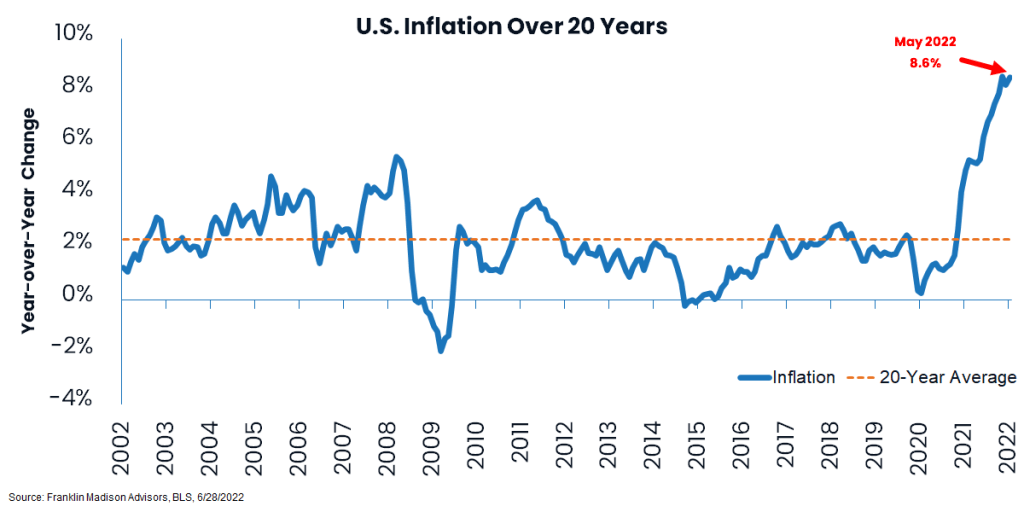
While we tend to hear about inflation in terms of percent changes in government reports, chances are, you've likely experienced its natural effects in everything from higher prices at the grocery store, gas pump, restaurants, and utility bills.
Prices change constantly, so why should you care about inflation now?
Well, other than the fact that inflation is at a 40-year high, it's crucial to understand that when inflation stays high for a long time, it can potentially erode your ability to secure your future financial independence goals if you do nothing to prepare for it today.
What is inflation?
So, what is inflation? Simply put, inflation measures the rate at which prices change for goods and services you spend money on.
For example, if a pound of apples costs $1.05 today, when it was $1.00 twelve months ago, we can say that inflation has caused the price of apples to change by 5% over the past year.
Inflation is the rate of change, or speed, at which prices rise over time.
Whether you're aware of it or not, inflation is always around. The price you pay for the things you need or want is constantly in flux. It can rise and fall daily, weekly, or monthly.
It's like a car traveling down a highway.
Sometimes, inflation moves along steadily for months or years, like it's on cruise control traveling at the highway speed limit. It can also suddenly speed up over days and weeks when something causes the gas pedal to hammer down.
What truly makes it a matter of concern now is how quickly inflation has sped up and how long it has remained in high gear.
How does inflation affect purchasing power?
Inflation matters because the longer it remains in high gear, the fewer goods or services your money will buy tomorrow.
Economists call this declining purchasing power.
For example, a dollar in the late 1990's purchased one gallon of gasoline. Today, with gas prices around $5.00 per gallon, a dollar today has a fifth of the purchasing power it did over two decades ago!
A dollar is still a dollar, but it doesn't go as far as it used to. At least for gasoline.
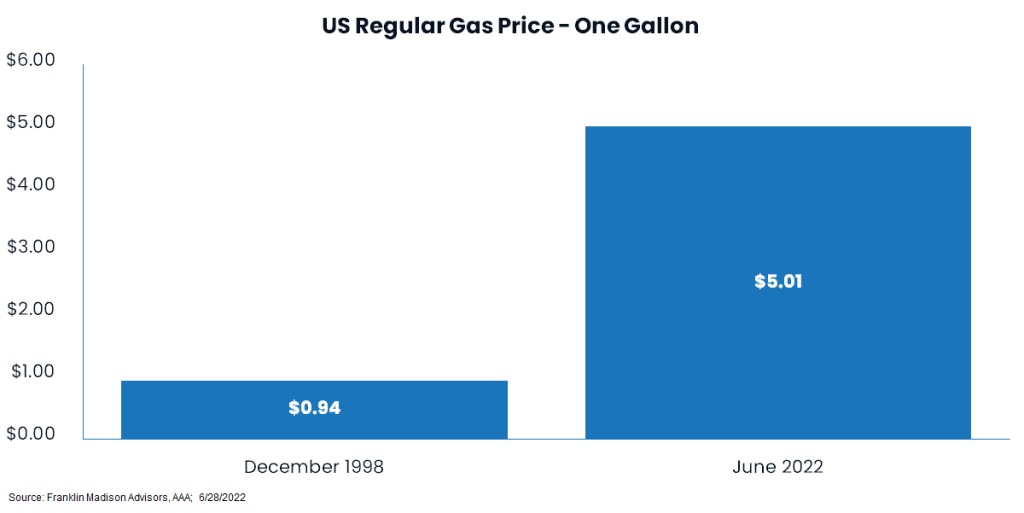
And when inflation takes off, you need more dollars to buy the same product compared to a month or year ago.
That's why if you're setting money aside for a big-ticket purchase or plan to live off your savings sometime in the future, you need to be able to anticipate rising prices.
Indeed, understanding purchasing power is essential whether you're socking money away in a 401k to retire later in life or dependent on your savings now to cover retirement living expenses.
When inflation goes up, and purchasing power goes down, you'll likely need to either save more money today, spend less in the future or do a bit of both. Otherwise, you could find your financial independence plans falling short.
What causes inflation to speed up?
Just like a car needs gas to power its engine and a driver to raise or lower their foot on the gas pedal, no one factor causes inflation to accelerate or decelerate.
Inflation is an interplay between supply (amount of gas in the tank) and demand (driver's willingness to push down on the accelerator).
A full gas tank (supply) won't make a car go fast with a cautious driver (demand) at the wheel.
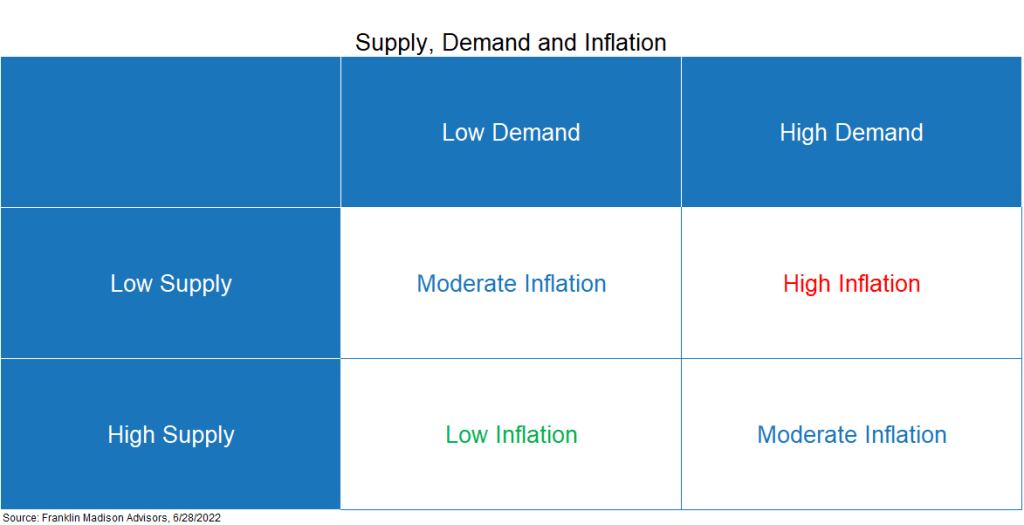
Likewise, an aggressive driver can only go so far with fumes in the tank.
Let's look at gasoline prices as an example. While some may argue that high prices at the pump are related to oil company profits, there's more at play than pure greed.
From a supply perspective, the fact is that economic sanctions on Russia has led to oil shortages in the West.
At the same time, key oil refiners have shut down because of fires, needed repairs, or maintenance.
From a demand perspective, summer is the travel season. And as more cars get out on the road and air travel picks up, so does oil usage.
When supply is limited, and demand is high, prices tend to go up.
Buying a house is another example. Demand for new homes increased nationally during the pandemic as individuals moved to the suburbs to work from home.
It typically takes about a year or so to build a new home, making supply an issue when thousands of individuals are looking to buy a home simultaneously.
Again, when demand is high, and supply is limited, prices tend to go up.
What role does government money play in inflation?
Now, some people will blame the government for today's high prices.
They'll argue that if the Federal Reserve (Fed) hadn't increased the money supply by printing trillions of dollars, or if it had raised rates sooner and the Treasury didn't send out stimulus checks, we wouldn't be dealing with high rates of inflation today.
To a certain extent, this is a valid argument.
Easy central bank policies arguably made it easier for banks to lend money, thus increasing demand from individuals willing and able to make large expenditures, like a new home or car.
Stimulus checks also made it easier for people to purchase goods or services they otherwise may not have needed during the pandemic, thus increasing demand at a time when economic lockdowns constrained global supply chains.
While this argument makes for a simple explanation, the truth is that the story is much more nuanced than can be explained by any one government policy.
That's because the rise in food and energy prices today arguably has less to do with interest rates or government stimulus than it has to do with supply. While government policies have added to the demand side of the equation, the supply of raw materials and finished goods sourced from around the world is still in short supply.
It's not just the government's fault. To be sure, today, we're dealing with a perfect storm of artificially too much money chasing artificially too few goods.
What can be done about inflation?
So, if inflation is seemingly speeding out of control, can't someone stop it? The truth is, there's only so much the government can do to halt inflation.
The Federal Reserve has raised its policy rate in a bid to slow down demand by making money more expensive to borrow and thus slowing the economy. But with war raging in Ukraine, ongoing Covid lockdowns in China, and other challenges, supply-side challenges likely will keep inflation elevated until those issues are resolved.
Fortunately, some businesses have raised wages to help workers offset higher living costs. However, most firms are not entirely altruistic, making up for higher wages by raising the price of their goods and services. This behavior could introduce an entirely new complexity to the inflation discussion. But, that's a topic for another day.
Three things you can do about inflation
For now, inflation matters because it can affect your ability to maintain your standard of living now and into the future.
There's not a lot we can do to affect the declining purchasing power of a dollar. However, you can mitigate its effects by:
1) holding just enough cash to help you sleep well at night,
2) putting excess cash to work in assets that move with inflation and
3) ensuring that you're saving and growing enough money today to make up for a declining purchasing power in the future.
Hold just enough cash to sleep well at night
Setting cash aside during this time of economic uncertainty is essential to weathering a financial setback.
However, keeping too much cash on hand could leave you with a reduced purchasing power of your savings.
For example, let's assume that you have $10,000 in a savings account that pays you interest of 1.00% per year. We'll also assume that inflation averages 5.00% over the year.
How much purchasing power do you have at the end of the year? If you said $10,100 you'd be wrong.
While you earned $100 in interest, inflation reduced your purchasing power by $500, with inflation running at 5% during the year.
That's why if you want to preserve the inflation-adjusted value of your savings, you'll need to put it to work in assets that can protect your purchasing power.

Put your money to work in productive assets
Where else can you put your money if a savings account alone won't protect against inflation? Consider your investments.
A diversified investment portfolio has historically been shown to be a hedge against inflation. Why?
Well, a key reason being is that the price paid for a stock today is often in anticipation of the underlying company's future earnings potential. And with firms increasingly passing rising costs on to consumers, corporate earnings have the potential to rise with inflation over the long term.
At the same time, bondholders demand a return on their investment that will compensate them for their time, investment risk, and inflation.
While stocks and bonds offer a degree of inflation protection, consider holding a mix of these assets in a diversified portfolio to reduce investment risk.
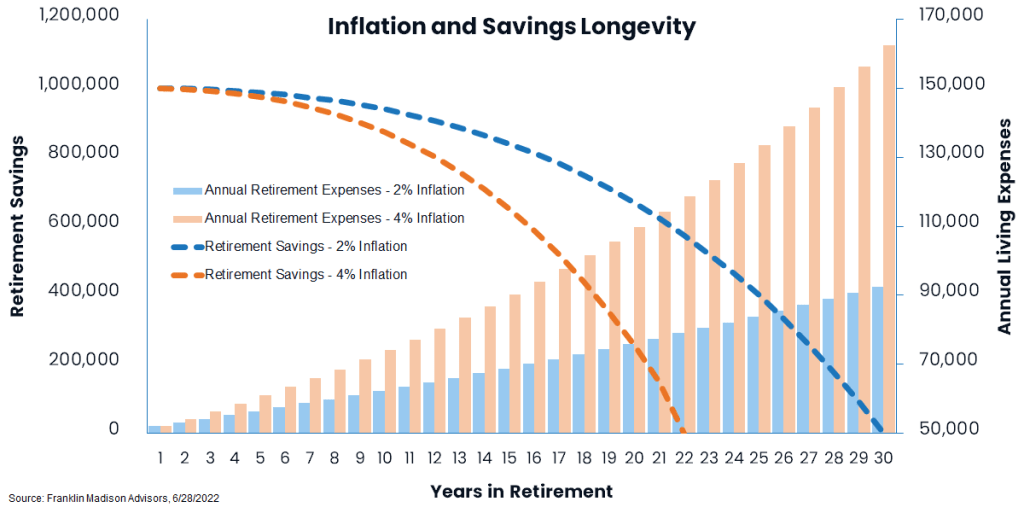
Ensure that you're saving enough to account for inflation
Finally, to our earlier point, inflation could leave your retirement savings goals falling short if not adequately accounted for. Indeed, if you want to secure your future financial independence when inflation is on the rise, you'll likely need to evaluate whether you need to save more money, reduce your spending or do a little of both.
Let's look at an example of how higher than expected inflation could alter the size of your retirement savings nest egg:
We'll start with a base set of assumptions that at retirement, you'll need roughly $50,000 per year to cover living expenses for the next 30 years. We further assume 2.0% average inflation and 5.5% average portfolio returns throughout retirement. At this rate, you'll likely need to have saved one million dollars to cover your costs.
What happens if inflation comes in faster than 2.0%? Well, if inflation turned out to average 4.0% instead of 2.0% over your 30 years in retirement, your million-dollar nest egg could go to zero in just over twenty years instead of thirty years.
To overcome this shortfall, you'd likely need to save an extra $280,000 before retiring, reduce your retirement spending by $10,000 annually or delay retiring by six years.
That's why periodically revisiting your financial plan and clearly understanding the effects of inflation on your expected future income need is essential to maintaining your standard of living and not running out of money in retirement.
Make no mistake, inflation can be a serious threat to your financial independence plans as it reduces the purchasing power of your savings.
Understanding the effects of rising inflation, putting your money to work in productive investments, and formulating a game plan to address declining purchasing power is essential to securing financial independence.
If you do nothing to mitigate this inflation threat, you could find your savings falling short of your desired standard of living later in life.

Are Your Financial Goals Meaningless?
Most driven individuals on their path to financial independence mastery know that you need goals to get to the next stage in life. And when it comes to money, many individuals have plans to increase their earnings ability, improve their lifestyle or save for long-term financial security. Nevertheless, even the most ambitious individuals quite often find that their goals fail within weeks or months into their endeavor. Why? Because they set meaningless goals.
So, what is a goal? A goal is a future or the desired result that you envision, plan for and commit to achieving. Many well-intentioned individuals set specific, measurable, actionable, realistic, and timebound (or SMART) goals. And goal-setting can be as simple as striving to wake up at 4 am each morning to exercise for 15 minutes so you can lose five pounds in a month or as ambitious as starting a business from the ground up.
When viewed in isolation, a well-defined financial goal may appear virtuous or valid on its surface. But, when it's out of context with what's essential to you, your goal likely will become meaningless and fail because it's not aligned with what matters most in your life. Certainly, determination to achieve an objective may initially propel you towards your aim, but soon enough, willpower fatigue likely will set in, and you'll probably end up reverting to old financial habits.
Alternatively, you could push toward your financial goals on willpower alone, mistaking effort and progress as measures of success as you propel forward only to find that the object of your intention is hollow or unappealing once you've attained it.
Goals in and of themselves are meaningless. They're simply a means to an end. What gives a goal meaning is its transformative power to shape and change who you are so that you can have the resources you need to experience a life worth living.

Why Do People Set Meaningless Goals?
So, why would someone set out to pursue a meaningless goal? Well, some individuals attain disappointing outcomes because they fail to take the time to understand what they want from life before creating and getting after their dreams. Thomas Merton, an American Trappist Monk, once said that "people may spend their whole lives climbing the ladder of success only to find, once they reach the top, that the ladder is leaning against the wrong wall." In a similar vein, Steven Covey was quoted to say that "if the ladder is not leaning against the right wall, every step we take just gets us closer to the wrong place faster."
In his book, The Second Mountain, David Brooks uses the analogy of climbing a mountain to pursue goal fulfillment. Some individuals start out in life intending to scale a mountain summit to reach some level of material wealth, comfort, or simply to be "happy". After speaking with hundreds of people from all walks of life and studying philosophy, religion, psychology and sociology, Brooks' findings show how even the most accomplished athletes, artists, business leaders and many others struggle with drugs, alcohol or other vices to make up for the hollowness of their lives even after acquiring status or wealth that many in society today would yearn for.
Whether you view goal setting as climbing a ladder or summiting a mountain, the fact is that if you haven't clearly defined why you're pursuing the goals you've set out for yourself, a time likely will come when you end up with frustration and regret. Indeed, a time could come where everything you have achieved will seem as though it were for nothing. And to be sure, society today is littered with broke lottery winners, miserable millionaires, and accomplished actors and musicians who have ended their lives in desperation.
The truth is that many well-intentioned individuals chase meaningless goals not because they're sadistically pursuing failure. More often than not, this outcome has to do with the fact that their goals were not their own. They're just doing what seemingly everyone around them is doing or wants them to do.
This behavior typically occurs when we live a financial script handed down from family or culture early on in life, like going to school, getting a good job, buying a house, getting married, having kids, and saving for retirement. It's keeping up with the Jonses or living the American Dream, right? Well, when you're setting goals to live someone else's financial scripts, there's a good chance that you could wake up lost, disappointed, or simply unfulfilled. So how can you set meaningful financial goals?
The Antidote for Meaningless Goals
First, start by understanding what's essential in your life, define a vision that aligns with your values, and then create goals that align with your vision. Isn't this all fluff when we should be talking about making money? The short answer is no.
Make no mistake, the word "vision" seems like another fancy buzzword because it's become so overused in today's culture. That's why when you hear the word "vision", you might think of business leaders who are intent on using ten-dollar words like "vision statements" to represent ten-cent ideas or self-help gurus who espouse having vision as a panacea for overcoming personal or professional underperformance.
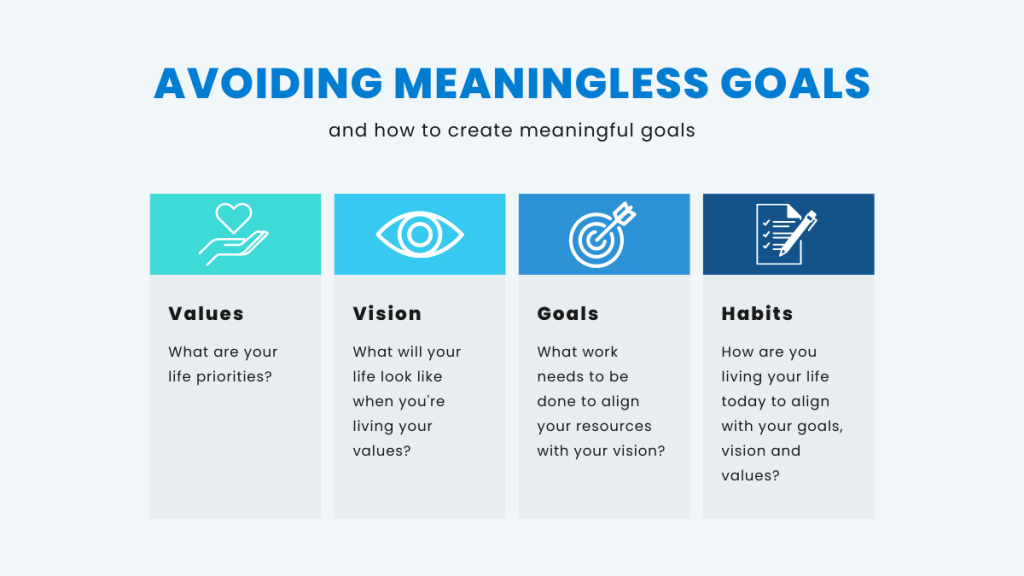
But the truth is that in its simplest form, the word vision represents a picture or a snapshot of your desired life destination. It's the creative process of developing a mental movie of your future potential life outcome. Vision is about being clear about where you're heading; goals are how you get there. That's why without vision, goals are meaningless.
Now, you may be asking: "Isn't vision and goal the same thing?" You might even ask, "I envision myself having saved more money in ten years than I have today; isn't that a vision." Well, vision is different from goals because it marks what happens after you've crossed the finish line. If your goal is to have more money in ten years, how would you use that money? What would change in your life as a result of having acquired more wealth? A goal, like saving more money in the coming ten years, sets out a specific set of tasks necessary to accomplish that outcome. The vision, on the other hand, is what you will do with that money and how your life will change once you have that money in your hands.
What Does Vision Look Like?
If you're still trying to wrap your head around the concept of vision as it relates to your finances, take an example from Pele. Now, Pele is arguably one of the greatest soccer players in the world. And he attributes his success to the practice of visualization. If creating a vision is imagining your future life outcome, then visualization is the active practice of rehearsing that story in your mind. That's why one hour before each game, Pele would go through his own mental movie, starting with when he was a child to his current moment right before a game, recalling how he felt playing soccer as a child and how he needed to play his next match as a way and to evoke positive emotions and mentally prepare himself for success on the field.
Thinking more long-term, some individuals find it helpful to create vision boards by physically laying out pictures of places, people, or destinations they'd like to see take place in their lives. Now, to be clear, we're not talking about the "law of attraction" or positive thinking type of board here. Simply put, it's a physical board filled with a collage of pictures representing how you'd like to see your career, family, health, travel, or social situation play out in the future. The collage itself is a physical representation of your intentions. It's there to remind you why you're getting up in the morning. You're still going to have to get at it and do the work to make that vision a reality!
At first glance, your initial response may be to say, "What's the point in all of this? I'm not looking for some path to enlightenment here. All I want is to save enough money to buy a house, put my kids through college and ensure that there's enough money to cover my needs for the rest of my life." Now, this is a valid point, but how much money is enough? Let's assume for a moment that you've accomplished these goals. Then what? Well, take a tip from Disney. No, not Walt Disney. We're talking about his brother Roy.
When we think of Disney, more often than not, we think of its founder, Walt Disney, the creative mind behind the media company. Few people know, however, that it was Roy who was the operations genius that turned the company into a profitable empire. And Roy once said that "when your values are clear to you, making decisions becomes easier." Put differently, when you're clear about where you're going and understand what the destination looks like, you instinctively know what goals need to be set and the resources you'll need to achieve that result.

Intention: It's What You Need to Create Your Vision
So, how do you create your life vision? To know what you want your life to look like, you'll first need to take the time to understand what's important to you and how you want to spend your time. This journey begins by identifying your top core values. In his book, Atomic Habits, author James Clear shares a list of values he prepared in collaboration with the LeaderShape Institute.
In his book, Clear describes how he identifies five core values to focus on and then prioritizes the short-list. After that, he aligns his daily practices to align his life with his values. Once you've identified which values you want to give your time to, then take the time to create a vision for how your life will change in the future as you begin to focus on your priorities.
Again, vision represents a picture, or a snapshot of your desired life destination. It's the creative process of developing a mental movie of your future potential life outcome. Vision is about being clear about where you're heading, goals are how you get there. This brings us to our final point: setting your goals.
Goal setting is the process of identifying what work needs to be done, the financial resources you need, and who you need to become to close the gap between where you are today and your ideal life vision. When approached correctly, this goal-setting process should withstand the ebbs and flows of near-term uncertainties when they're grounded in your vision and values.
When it comes down to it, spending the time to create your vision is an act of intentionally designing your life. The truth is that few individuals want to take the time to be introspective. They want a quick fix or rely on others to tell them how to do it. But if you want to avoid pursuing meaningless financial goals, you'll have to start by doing the work to understand who you are, what's essential to you and then creating a vision for how you want your life to unfold. Doing so will naturally lead to creating meaningful goals and move you further down the path to mastering your financial independence journey.

Inflation: An Insidious Threat Your Financial Independence Journey
Financial independence plans are coming under threat from inflation's insidious rise. According to a government report, prices paid for everyday household items rose by 4.9% in May compared to a year earlier. Even when stripping out volatile components, like food and energy, prices were up 3.9% over the same period – the fastest in over three decades.
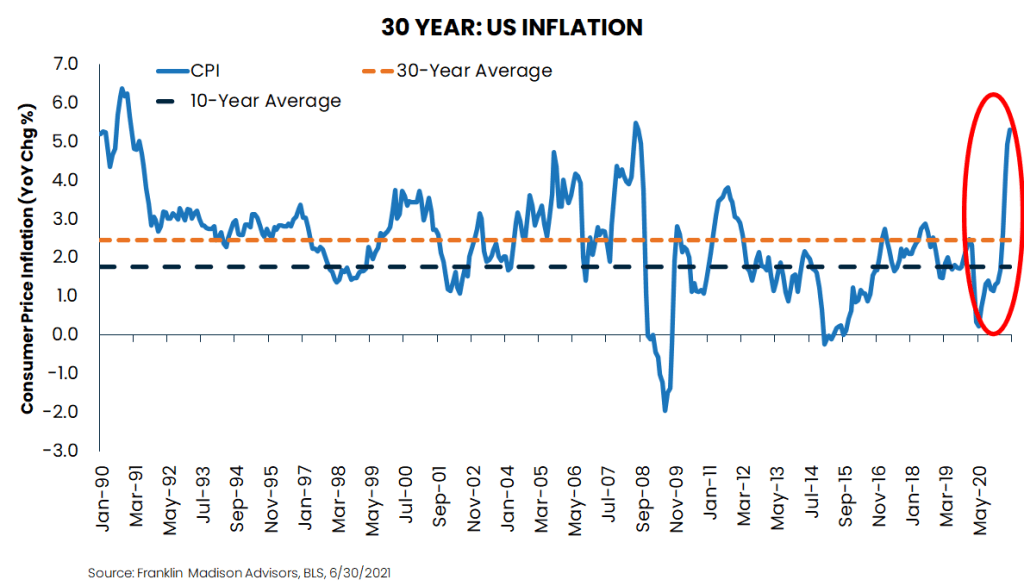
While these statistics might seem arbitrary at face value, it's essential to understand the context. For example, the latest inflation figure comes in stark contrast to its 2.5% average over the past 30 years. Indeed, the reality of rising prices is evident whether you're filling up the gas tank, shopping at the grocery store, getting ready to buy your next house, or decorating the home you just purchased.
Permanent or Transitory?
Today, many economists, market watchers, and to be sure, households look at the recent price spikes and ask, "Is today’s higher inflation a fluke or new reality?"
A Case for Lower Near-Term Inflation
Certainly, there's a case to be made that inflation is likely to ease in the coming months. How so? Well, households globally today are spending faster than expected, and global distributors are struggling to keep up with demand. Last year's global economic shutdown and ongoing COVID restrictions have created gridlock in the global supply chain. These bottlenecks have made it harder to ship certain goods from international producers to US warehouses, crimping supply on store shelves and naturally putting upward pressure on prices.
For example, according to one report, container ships responding to the post-COVID consumer spending surge found it challenging throughout June to unload their goods at the Port of Los Angeles (one of the busiest ports in North America). In fact, some ships were anchored in a holding pattern for five days outside of the port, given logistics backlogs. In normal circumstances, foreign cargo ships typically don't have to wait to enter the port and can unload their cargoes right away.
Why is this story significant? Well, what makes shipping into the Port of LA important is that these freighters carry household goods and manufacturing components that affect all aspects of the US economy. Now, this logistics gridlock story is not unique to the Port of LA as it's happening in ports all around the world. And these delivery slowdowns have led to a global supply chain crunch, giving way to higher near-term prices for a host of goods.
From this perspective, it could be argued that today's high inflation is only transitory. Once global logistics issues are fully resolved, near-term inflationary pressures might ease as the supply of goods finally meet the rising pressure from pent-up global consumer demand.

A Case for Higher Longer-Term Inflation
Now, while there's a case to be made for lower near-term inflation, it's also worth considering the potential factors that might lead to higher prices in the decades ahead. Indeed, the Federal Reserve has flooded the economy with $5 trillion from the start of last year. Combine this excess money printing with trillions in government stimulus, and there's a potential that excess household savings (coupled with a higher propensity to consume) might cause inflation to run hot for longer than what many economists anticipate.
To this point, researchers at Bank of America recently published a report noting that over the next four years, US inflation could average between 2-4%. If we look back through history, this estimate compares to average annual price gains, of around 3% over the past 100 years, 2% in the 2010s, and 1% in 2020. According to this report, analysts believe that a key contributor to faster inflation likely could come from Americans sitting on trillions of dollars in unspent savings. As COVID restrictions ease and the economy rebounds, this savings could make its way back into the economy in the form of higher consumption and wage growth.
Another long-term inflationary point to consider is China's evolving relationship with the rest of the world. Chinese factories have, until recently, been low-cost producers of the world's goods, arguably contributing to low inflation in developed market economies for the past two decades.
Nevertheless, geopolitical tensions remain elevated between Western nations (notably the US) and China. What's more, Beijing is pushing policies that would enable China's economy to become more domestically reliant while expanding its political influence globally. From this perspective, it's very well possible to see higher-priced goods here at home should Beijing's policy changes reduce China's export of deflation to the rest of the world.
Why Does Inflation Matter?
So, what's the big deal if prices rise faster than expected? In other words, what role might higher inflation play in your ability to navigate your financial independence journey? Well, at face value, persistently elevated inflation could result in your spending down retirement savings at a faster than expected rate. How so? Well, a simple example here might help.
Let's suppose that you're planning to retire in 20 years with a lifestyle need of $60,000 per year in today’s dollars. Assuming a modest Social Security benefit, you'll likely need to have saved about $1 million to cover inflation-adjusted living expenses over the next 30 years. This figure is based on a widely held industry assumption that inflation may average 1.5% over the long term.
So, what happens when the 1.5% average inflation assumption used in calculating your $1 million savings turns out to be 2.0%? Holding our earlier assumptions constant, a half-percentage point cost of living increase could lead to a savings shortfall of over $1 million throughout retirement. Put differently, $1 million of retirement savings might only cover about 20 years of living expenses should inflation average 2% instead of 1.5% in your original plan.
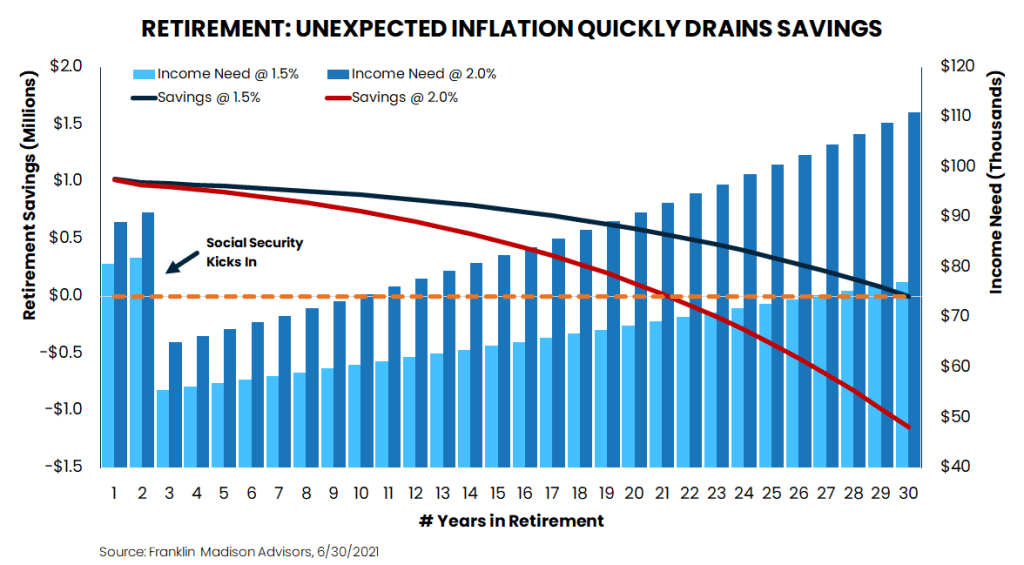
Inflation and Your Financial Independence Journey
So, are higher prices here to stay? And more importantly, is the 1.5% inflation assumption used by many in the financial industry overly optimistic? Well, some argue that once supply constraints ease and the low base effects pass, inflation could return to the low levels we've seen in the last 10-year.
The truth is that in the period following the Global Financial Crisis, economists have had a terrible track record of predicting inflation. Certainly, easing logistics bottlenecks likely will reduce inflationary pressures somewhat in the coming months, but long-term risks remain.
To be sure, many structural changes are afoot, which argue against a return to "normal" inflation. The effects of Trade War tensions and China's growing push for global political influence likely will have some impact on the country's willingness to remain a low-cost producer of the world's goods. Add to this the uncertainty surrounding trillions of dollars in US fiscal and monetary stimulus, and it's likely that inflation will not fall back to 1% over the long-term.
Make no mistake; inflation is so insidious that even a seemingly minor change can have an outsized impact on your achieving (and maintaining) financial independence. When not adequately accounted for, it will slowly and subtly erode the purchasing power of your retirement savings.
Certainly, while inflation is likely to ease in the near term, it would nevertheless be prudent to evaluate whether your long-term inflation assumptions are overly optimistic and if they are, to make adjustments accordingly. Doing otherwise may just end up cutting short your journey to financial independence.

Does Crypto Belong in Your Retirement Portfolio?
Life changing money. That's what happened to John Ratcliff. In 2013 the software developer from Colorado purchased 150 Bitcoin. Today, his $15,000 bet is worth millions as the price of cryptocurrencies (crypto) skyrocketed. Another individual who also came into life-changing money this year is Vitalik Buterin. The 27-year-old college dropout and co-founder of Ethereum is now the world's youngest crypto billionaire as Ether went from $130 in 2020 to over $4,000 in 2021.
Stories like Ratcliff's and Buterin's have led to a crush of demand for the popular new asset class. To be sure, rapid price appreciation in crypto over the past year has prompted heightened media attention and arguably is fueling frenzied behavior among some market participants in tokens like Bitcoin, Ethereum, and even Dogecoin for fear of missing out.
But what exactly are cryptocurrencies? And more importantly, do they belong in a retirement portfolio?
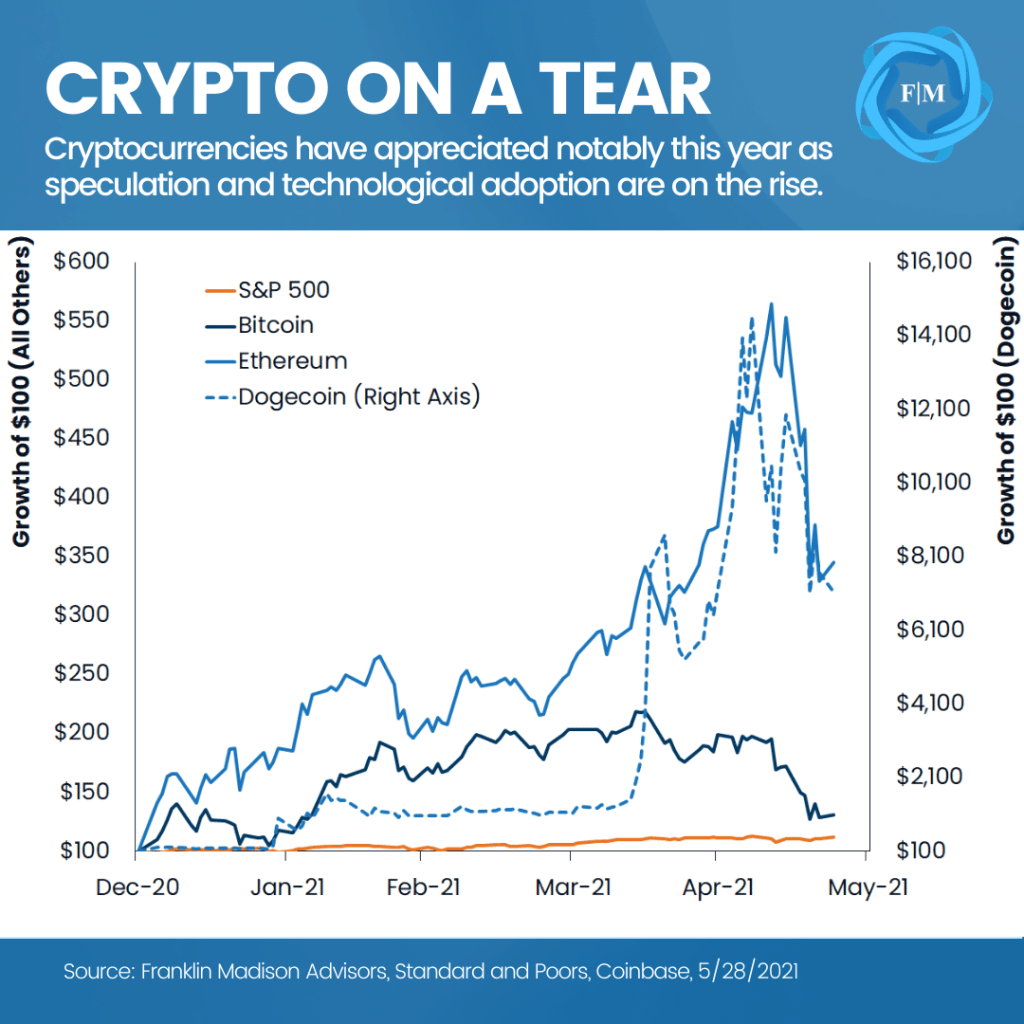
What is crypto?
Merriam-Webster defines crypto as "any form of currency that only exists digitally, that usually has no central issuing or regulating authority but instead uses a decentralized system to record transactions and manage the issuance of new units, and that relies on cryptography to prevent counterfeiting and fraudulent transactions." In other words, crypto is created by a collection of independent actors rather than a central government.
So, where does crypto come from?Well, in many cases, these virtual currencies are produced out of thin air by computers that solve cryptographic puzzles. This activity called is called mining. As more puzzles are solved, the more crypto an individual or collective earns as payment for their mining efforts on various blockchain networks.
Another essential point to understand about crypto is that they're unregulated and don't flow through traditional financial channels like the euro, yen, or U.S. dollar. Rather than being stored in a bank, these virtual assets are stored in digital wallets, currently limiting their use in the broader economy.
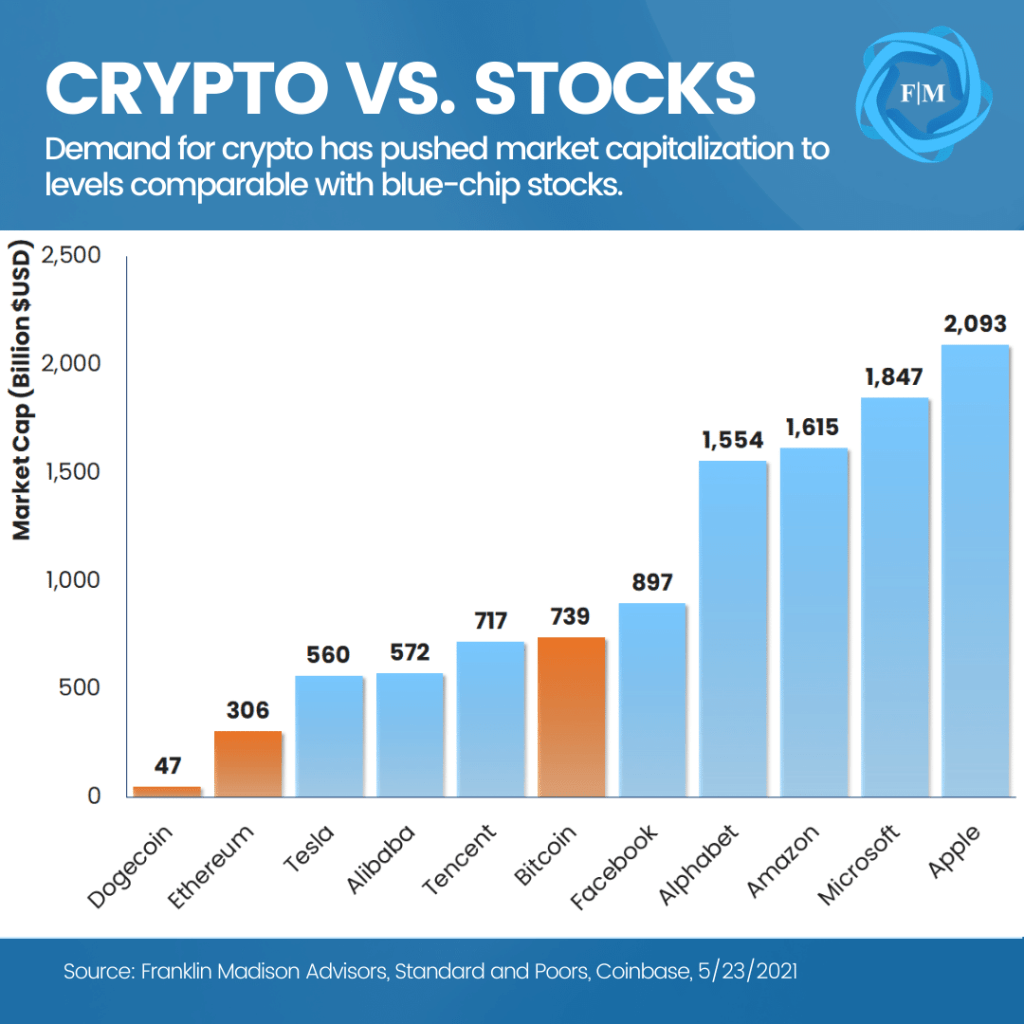
Is crypto just a lot of hype?
For many disciplined investors, it's hard not to see what's happening in the crypto space and ask whether another Tulip Mania, South Sea Bubble, Dot-Com Frenzy, or Housing Bubble is in the works. Even so, various indicators suggest this technology is more than a passing fad as blockchain technologies are increasingly seeing mainstream adoption in both public and private sector applications.
For example, the Federal Reserve announced in May that the central bank will publish a paper exploring the potential for its own Central Bank Digital Currency (CBDC). Meanwhile, the People's Bank of China is already testing a digital Yuan.
From the private sector perspective, Visa, Mastercard, Paypal, and Apple have recently expressed their intent to actively participate in the virtual currency space. So, it's safe to say that crypto, for the time being, may be more than simply a flash in the pan.
What's the outlook for cryptocurrencies?
While blockchain networks have been around for over a decade, the technology remains in its infancy. Even so, a key potential use for blockchain technology and crypto is in Decentralized Finance (DeFi). More specifically, crypto could be used to transform the way large transactions are settled between institutions and private individuals.
For example, a traditional high-dollar international wire can take several days to complete. Blockchain technologies supporting digital currency transfers, however, could offer a means to settle large transactions in minutes instead of days and at a substantially lower cost. For payment processors, this is big news and a key reason why Visa and Mastercard have entered the space.
To be sure, blockchain adoption might also find its way into widespread merchant payment processing services. Whereas banks and other intermediaries often charge around 2% to settle merchant card transactions, blockchain technologies might promote greater payment processing competition, leading to lower fees and higher profits for small and large businesses alike.
Does crypto belong in your retirement portfolio?
There's a case to be made for the blockchain technology but does crypto belong in your retirement portfolio? While rapidly appreciating tokens have led to life changing money for some individuals, we believe that disciplined investors should view crypto as a long-term speculative investment that could go to zero for two key reasons.
First, the jury is still out on long-term token adoption. While Bitcoin remains the largest network, Ethereum is gaining mainstream popularity. That’s because Ethereum’s network is about to dramatically lower its energy usage, increase processing capacity and potentially end Bitcoin’s blockchain dominance. Either way, leadership in the space is likely to change a number of times in the coming years, making it that much harder to pick a winning cryptocurrency in the short-term.
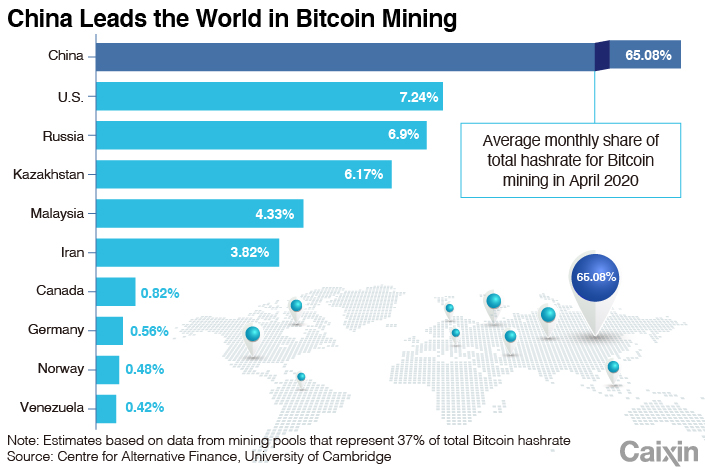
Regulatory risk is another reason we view crypto as speculative near-term investments. Recently, the Chinese government enacted measures to curb bitcoin mining. This is important because the country accounts for 65% of the world’s Bitcoin mining hashrate. Similarly in May, U.S. policymakers hinted at the need for more crypto regulation. What’s more, central banks globally are in the process of developing their own digital currencies.
To be sure, crypto token investor should be comfortable with the idea of their investments going to zero. Nevertheless, blockchain likely will play a transformative role in finance, presenting a long-term thematic investment opportunity. From this perspective, we view a diversified allocation to traditional companies that facilitate blockchain adoption as an attractive component of a retirement portfolio.
Hold Tight in this Financial Meltdown
US equity markets have officially erased their summer gains. The Dow Jones Industrial Average is back in bear market territory, and the S&P 500 is on pace for its worst year-to-date start in recent history. Adding insult to injury, rising US Treasury yields have pushed borrowing costs to seemingly unsustainable levels as mortgage rates in some markets are now above 7% from around 3% just months ago.
It feels like the financial system is about to break.
The fact is that we’ve been here before. In many ways, today’s financial environment is similar to the one that played out during the height of the Global Financial Crisis in 2008.
And I’m taken back to the early years of my career when our Chief Investment Officer held weekly calls for our advisors to help them navigate the market volatility.
If you’ll recall, at the time, Countrywide was handed over to Bank of America months earlier, while Lehman Brothers and Washington Mutual had just gone under. Money markets had just “broken the buck”, AIG was getting bailed out, and Wachovia was pushed into the arms of its competitor for pennies on the dollar.
Fourteen years ago this week, the financial system was melting down in front of my very own eyes.
Understandably, our clients (and team of advisors), were panicking. The floor was falling out from under many individuals’ retirement plans and overall financial well-being. At the time, market participants and households alike were looking for simple answers to a challenging situation.
Now, our weekly calls involved hundreds of investment professionals, and many of them felt like they needed to do something. Some advisors wanted to implement exotic derivative strategies to stem the losses in client portfolios. Others suggested buying specific stocks or sectors amidst the selloff. And other advisors were doing everything they could to stop themselves from simply getting out of the markets altogether.
So, what was the advice from our Chief Investment Officer?
Hold tight.
The advice offered then still holds merit today, and here’s why.
Why You Should Hold Tight
As the financial system was coming unglued in fall of 2008, few individuals knew what the path forward would look like. Investors were desperately looking for a catalyst to drive financial assets higher, but a positive market narrative was nowhere to be found.
The old rules of how the financial system should function in many ways no longer applied during that time.
Even so, policymakers stepped in with creative approaches to undergird the financial system. As you’ll recall, in October 2008, the US government introduced the Troubled Asset Relief Program (TARP) to prevent other financial institutions from failing.
In November of the same year, the Federal Reserve launched a historic quantitative easing program aimed at buying up bad debt and restoring confidence in the financial system by showing that policymakers had “tools in the toolbox” to address the market dysfunction. The central bank also introduced a number of measures to support global central banks that had been experiencing stresses in international markets.
By March 9, 2009, market participants were finally convinced that the right set of tools were in place to avoid any further catastrophic collapse in the financial system, and risk assets susbequently rallied.
In the year that followed the March 2009 lows, the S&P 500 index would nearly double in value and then rise by around 600% through December of last year.
Now, there are some individuals whose investment experience was far worse than the broader market. It was those individuals who got out of the markets in January 2009, waiting on the sidelines for an “all-clear” signal before putting their money back to work.
Keep Moving Forward
The point here is that when it seems like the world is crumbling around you and the path forward appears ambiguous, the best course of action may be to simply hold tight and keep moving forward.
Indeed, three fundamental principles apply here when it comes to managing your finances in times of uncertainty:
What You Should Focus On
To the first point, there is only so much that we can control when it comes to managing our lives or our money. During times like today, I’m often reminded of an illustration from Carl Richards over at the Behavior Gap. It’s a Venn Diagram with two circles.
In the left circle are the “things that matter.” And in the right circle are the “things you can control.”
When you bring the things that matter, and things you can control together, what you find is that there are only a few items in life that you should be focused on when the economy or markets are in decline.
These areas should include reminding yourself of the long-term financial purpose that you’ve defined for your wealth, and the plan you’ve put in place to address times like these when the markets go south.
These actions could include reevaluating your investment strategy to ensure that your holdings are aligned with your long-term goals. It can also mean ensuring that you have a cash management strategy in place to avoid having to sell investments at an inopportune time.
Stay Objective
The next component to holding steady in times of uncertainty is to remain objective and avoid getting caught up in emotions when the markets are gyrating up and down.
Now, it’s been said that watching the stock market every day is like watching someone play with a yo-yo while riding up a moving escalator.
You’re likely to feel a high degree of stress if you focus on the yo-yo rather than where the escalator is headed.
If you find yourself worried about the markets and glued to financial media desperately seeking out answers, now may be a good time to turn off the TV and go for a walk.
There’s no better time than the present to remind yourself that over the long-term, financial markets have historically rallied after periods of extreme volatility. Remember, the role of financial media often is to sell emotion and rarely to provide any meaningful advice.
And if you find yourself stressed and still looking for answers, now may also be a great time to reach out to your trusted advisor to get an objective opinion on your options.
Stay in the Present
Finally, it’s vital to stay present in uncertain times like these. John Kabat-Zinn had a saying that “wherever you go, there you are.” What this means is that the one constant we have throughout our experience with money (or life in general) is how we deal with the present moment.
There’s nothing we can do about the past and very little we can do about future events outside of our control.
That’s why during these times of economic and market uncertainty, it’s essential to focus on what you need to do right now. Not sure what to do? Then go back to your financial plan and remind yourself what you need to do now to make your goals a reality.
Don’t have a plan?
Well, there’s no better time than the present moment to put one together. Either way, avoiding rumination on past or upcoming financial decisions begins with staying focused on what needs to be done right now in the present.
Where to from Here?
Make no mistake, the events unfolding in financial markets today feel ominously similar to the events that took place fourteen years ago this week. Equity markets at home and abroad seem to feel like they’re in some sort of freefall. The US dollar’s strength is squeezing international financial markets while bond yields are heading relentlessly higher and stocks are moving lower.
And the key reason that markets are behaving the way they are today is mainly due to uncertainty around what appears to be a self-inflicted wound from policymakers: a desire to inflict pain in order to tame inflation expectations.
It’s scary out there, and it feels like things can only get much worse.
But here’s what’s key: we’re going to get through this market dislocation just like we did during the Global Financial Crisis, Savings and Loan Crisis, Energy Crisis of the ’70s, and so many other crises from the past.
The solution to today’s high government debt and experiment in money printing likely will require a solution that hasn’t been presented yet.
For now, policymakers appear to be out of tools that address historically high inflation while avoiding a crash in the economy and financial markets.
What history has shown, however, is that when it seems like it can’t get any worse and there’s seemingly no way out, a solution eventually finds a way, allowing risk assets to breathe a sigh of relief and rally higher.
Until then, hold tight.