

Are Your Financial Goals Meaningless?
Most driven individuals on their path to financial independence mastery know that you need goals to get to the next stage in life. And when it comes to money, many individuals have plans to increase their earnings ability, improve their lifestyle or save for long-term financial security. Nevertheless, even the most ambitious individuals quite often find that their goals fail within weeks or months into their endeavor. Why? Because they set meaningless goals.
So, what is a goal? A goal is a future or the desired result that you envision, plan for and commit to achieving. Many well-intentioned individuals set specific, measurable, actionable, realistic, and timebound (or SMART) goals. And goal-setting can be as simple as striving to wake up at 4 am each morning to exercise for 15 minutes so you can lose five pounds in a month or as ambitious as starting a business from the ground up.
When viewed in isolation, a well-defined financial goal may appear virtuous or valid on its surface. But, when it's out of context with what's essential to you, your goal likely will become meaningless and fail because it's not aligned with what matters most in your life. Certainly, determination to achieve an objective may initially propel you towards your aim, but soon enough, willpower fatigue likely will set in, and you'll probably end up reverting to old financial habits.
Alternatively, you could push toward your financial goals on willpower alone, mistaking effort and progress as measures of success as you propel forward only to find that the object of your intention is hollow or unappealing once you've attained it.
Goals in and of themselves are meaningless. They're simply a means to an end. What gives a goal meaning is its transformative power to shape and change who you are so that you can have the resources you need to experience a life worth living.

Why Do People Set Meaningless Goals?
So, why would someone set out to pursue a meaningless goal? Well, some individuals attain disappointing outcomes because they fail to take the time to understand what they want from life before creating and getting after their dreams. Thomas Merton, an American Trappist Monk, once said that "people may spend their whole lives climbing the ladder of success only to find, once they reach the top, that the ladder is leaning against the wrong wall." In a similar vein, Steven Covey was quoted to say that "if the ladder is not leaning against the right wall, every step we take just gets us closer to the wrong place faster."
In his book, The Second Mountain, David Brooks uses the analogy of climbing a mountain to pursue goal fulfillment. Some individuals start out in life intending to scale a mountain summit to reach some level of material wealth, comfort, or simply to be "happy". After speaking with hundreds of people from all walks of life and studying philosophy, religion, psychology and sociology, Brooks' findings show how even the most accomplished athletes, artists, business leaders and many others struggle with drugs, alcohol or other vices to make up for the hollowness of their lives even after acquiring status or wealth that many in society today would yearn for.
Whether you view goal setting as climbing a ladder or summiting a mountain, the fact is that if you haven't clearly defined why you're pursuing the goals you've set out for yourself, a time likely will come when you end up with frustration and regret. Indeed, a time could come where everything you have achieved will seem as though it were for nothing. And to be sure, society today is littered with broke lottery winners, miserable millionaires, and accomplished actors and musicians who have ended their lives in desperation.
The truth is that many well-intentioned individuals chase meaningless goals not because they're sadistically pursuing failure. More often than not, this outcome has to do with the fact that their goals were not their own. They're just doing what seemingly everyone around them is doing or wants them to do.
This behavior typically occurs when we live a financial script handed down from family or culture early on in life, like going to school, getting a good job, buying a house, getting married, having kids, and saving for retirement. It's keeping up with the Jonses or living the American Dream, right? Well, when you're setting goals to live someone else's financial scripts, there's a good chance that you could wake up lost, disappointed, or simply unfulfilled. So how can you set meaningful financial goals?
The Antidote for Meaningless Goals
First, start by understanding what's essential in your life, define a vision that aligns with your values, and then create goals that align with your vision. Isn't this all fluff when we should be talking about making money? The short answer is no.
Make no mistake, the word "vision" seems like another fancy buzzword because it's become so overused in today's culture. That's why when you hear the word "vision", you might think of business leaders who are intent on using ten-dollar words like "vision statements" to represent ten-cent ideas or self-help gurus who espouse having vision as a panacea for overcoming personal or professional underperformance.
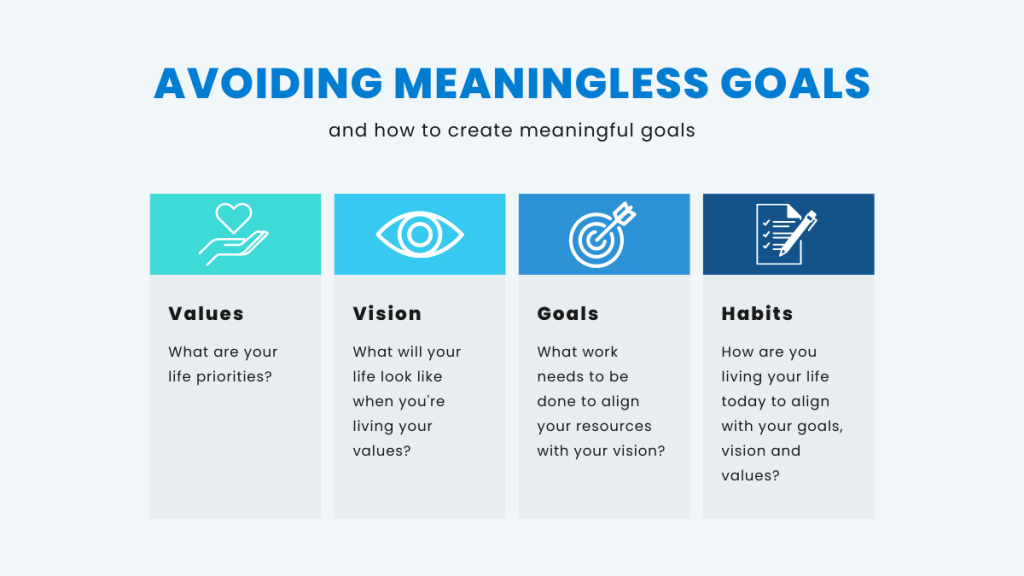
But the truth is that in its simplest form, the word vision represents a picture or a snapshot of your desired life destination. It's the creative process of developing a mental movie of your future potential life outcome. Vision is about being clear about where you're heading; goals are how you get there. That's why without vision, goals are meaningless.
Now, you may be asking: "Isn't vision and goal the same thing?" You might even ask, "I envision myself having saved more money in ten years than I have today; isn't that a vision." Well, vision is different from goals because it marks what happens after you've crossed the finish line. If your goal is to have more money in ten years, how would you use that money? What would change in your life as a result of having acquired more wealth? A goal, like saving more money in the coming ten years, sets out a specific set of tasks necessary to accomplish that outcome. The vision, on the other hand, is what you will do with that money and how your life will change once you have that money in your hands.
What Does Vision Look Like?
If you're still trying to wrap your head around the concept of vision as it relates to your finances, take an example from Pele. Now, Pele is arguably one of the greatest soccer players in the world. And he attributes his success to the practice of visualization. If creating a vision is imagining your future life outcome, then visualization is the active practice of rehearsing that story in your mind. That's why one hour before each game, Pele would go through his own mental movie, starting with when he was a child to his current moment right before a game, recalling how he felt playing soccer as a child and how he needed to play his next match as a way and to evoke positive emotions and mentally prepare himself for success on the field.
Thinking more long-term, some individuals find it helpful to create vision boards by physically laying out pictures of places, people, or destinations they'd like to see take place in their lives. Now, to be clear, we're not talking about the "law of attraction" or positive thinking type of board here. Simply put, it's a physical board filled with a collage of pictures representing how you'd like to see your career, family, health, travel, or social situation play out in the future. The collage itself is a physical representation of your intentions. It's there to remind you why you're getting up in the morning. You're still going to have to get at it and do the work to make that vision a reality!
At first glance, your initial response may be to say, "What's the point in all of this? I'm not looking for some path to enlightenment here. All I want is to save enough money to buy a house, put my kids through college and ensure that there's enough money to cover my needs for the rest of my life." Now, this is a valid point, but how much money is enough? Let's assume for a moment that you've accomplished these goals. Then what? Well, take a tip from Disney. No, not Walt Disney. We're talking about his brother Roy.
When we think of Disney, more often than not, we think of its founder, Walt Disney, the creative mind behind the media company. Few people know, however, that it was Roy who was the operations genius that turned the company into a profitable empire. And Roy once said that "when your values are clear to you, making decisions becomes easier." Put differently, when you're clear about where you're going and understand what the destination looks like, you instinctively know what goals need to be set and the resources you'll need to achieve that result.
Intention: It's What You Need to Create Your Vision
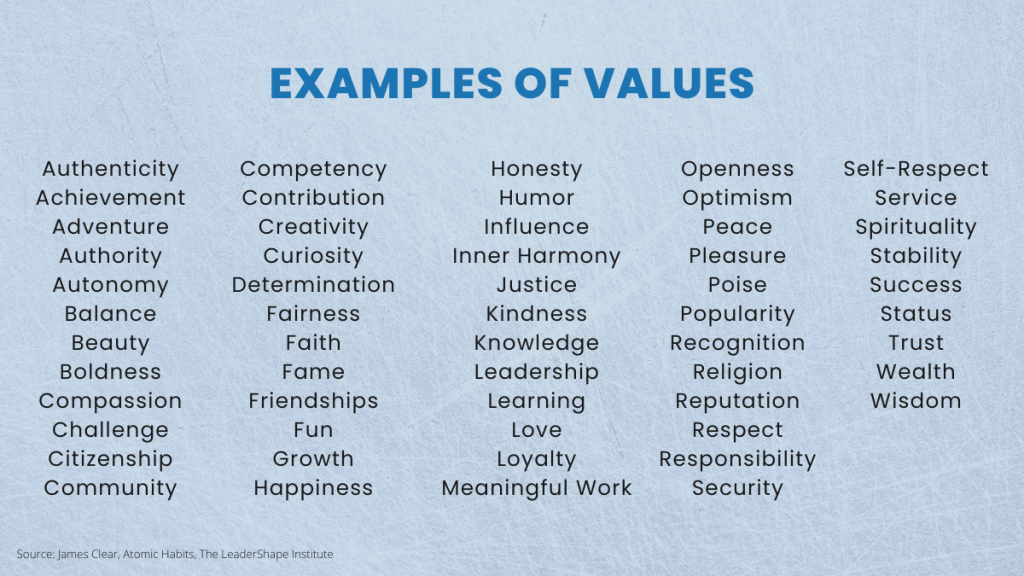
So, how do you create your life vision? To know what you want your life to look like, you'll first need to take the time to understand what's important to you and how you want to spend your time. This journey begins by identifying your top core values. In his book, Atomic Habits, author James Clear shares a list of values he prepared in collaboration with the LeaderShape Institute.
In his book, Clear describes how he identifies five core values to focus on and then prioritizes the short-list. After that, he aligns his daily practices to align his life with his values. Once you've identified which values you want to give your time to, then take the time to create a vision for how your life will change in the future as you begin to focus on your priorities.
Again, vision represents a picture, or a snapshot of your desired life destination. It's the creative process of developing a mental movie of your future potential life outcome. Vision is about being clear about where you're heading, goals are how you get there. This brings us to our final point: setting your goals.
Goal setting is the process of identifying what work needs to be done, the financial resources you need, and who you need to become to close the gap between where you are today and your ideal life vision. When approached correctly, this goal-setting process should withstand the ebbs and flows of near-term uncertainties when they're grounded in your vision and values.
When it comes down to it, spending the time to create your vision is an act of intentionally designing your life. The truth is that few individuals want to take the time to be introspective. They want a quick fix or rely on others to tell them how to do it. But if you want to avoid pursuing meaningless financial goals, you'll have to start by doing the work to understand who you are, what's essential to you and then creating a vision for how you want your life to unfold. Doing so will naturally lead to creating meaningful goals and move you further down the path to mastering your financial independence journey.


Crush Your Financial Resolutions by Becoming Rather than Doing
Who doesn’t like a fresh start? The beauty of New Year’s Resolutions is that we all have an opportunity to fully commit to losing weight, getting organized, or finally saving more money at the turn of the calendar year.
In fact, resolving to change one’s life for the better is a tradition that goes back millennia, starting with the ancient Babylonian 12-day New Year’s celebration. During the Akitu festival, Babylonians promised the gods to return borrowed items and pay down their debts. In more recent developments, some historians note clippings from an 1813 Boston newspaper documenting what could be considered the first contemporary use of the “New Year’s Resolution”:
“And yet, I believe there are multitudes of people, accustomed to receive injunctions of new year resolutions, who will sin all the month of December, with a serious determination of beginning the new year with new resolutions and new behavior, and with the full belief that they shall thus expiate and wipe away all their former faults.”
Whatever the origin of this tradition, the fact is that many of us will create financial resolutions in the coming days only to find those well-intentioned goals falling short soon after they’re conceived. One study from sports company Strava, using over 800 million user-logged activities in 2019, found that individuals are likely to give up on their fitness goals by January 19 – less than three weeks into the start of the New Year.
Another study from Scranton University found that only roughly 19% of individuals keep their resolutions for the year. The data go on to show that the majority of New Year’s resolutions are abandoned by mid-January, confirming findings from many different studies.
Whether you want to admit it or not, the chances are that the work you’re about to put into one or more of your financial resolutions this year likely will soon end in frustration and disappointment. So, what can you do to ensure that your financial resolutions stay on the right track heading into the New Year? Well, one way is to focus your goals on “becoming” rather than “doing.”
Becoming Rather than Doing
Let’s face it: the past two years have derailed many of our New Year’s resolutions and life goals as we’ve rightfully focused on doing everything necessary to keep ourselves and our loved ones safe. Even so, heading into year three of this healthcare crisis, many of us have a choice to set our sights on a bigger goal of thriving financially rather than surviving in day-to-day uncertainty.
While external circumstances can be a reason for goal failure, they can also be an excuse for not getting to the heart of what’s preventing long-term success with your financial plans. And quite often, that roadblock is being focused on “doing” the work necessary to achieve a goal, rather than first taking the time to understand who you need to “become” to make your New Year’s Resolution a reality.
Indeed, some individuals will suggest that the way to improve your odds of achieving your resolution is to ensure that you’re defining SMART goals (Specific, Measurable, Achievable, Relevant, and Time-Bound). While SMART goals are important, more often than not, what many well-intentioned individuals miss is what needs to happen before specific goal setting begins. And that is asking yourself: “who do I need to become this year to make my financial resolutions a reality?”
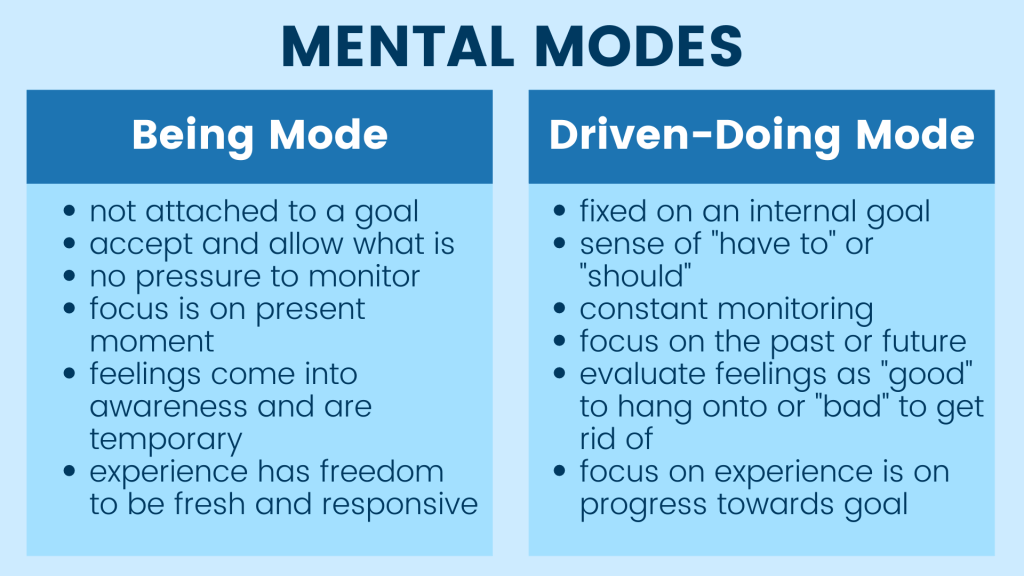
One school of thought suggests that individuals operate in two modes: “Doing” and “Being”. The Doing Mode individual is focused on explicitly defining a goal, then developing a system to monitor their progress and striving for the future outcome they’re attempting to achieve. Whether it’s a reward that you plan to give yourself for accomplishing the goal – or a threat, like the potential shame experienced from friends and family – quite often, this carrot and stick approach sets the stage for a possible resolution failure.
When you shift your approach to accomplishing resolutions from Doing Mode to Being Mode, there’s a broader sense of aligning your daily actions, choices, and behaviors with who you are as an individual. When you approach your goals from a Being Mode, saving more money or investing in a disciplined manner isn’t a task, it’s a way of life – you’re simply doing what’s natural for who you are as an individual. When positive developments or setbacks occur, they’re viewed as part of the natural process of being rather than a good or bad outcome.
This approach to Being is essential because when your New Year’s resolution is at odds with who you believe yourself to be, you’re more likely to experience self-sabotage and reject the “new” habits you’ve identified for yourself. Such a disconnect often leads to what psychologists call cognitive dissonance or the mental anguish of holding two competing thoughts simultaneously. Fortunately, becoming the person who does the desired behaviors is one way to overcome this resistance.
Dealing with Resistance
At first glance, many individuals will dismiss the notion of “becoming” and state that what’s needed is focus, discipline, and a firm commitment to accomplishing goals. While there’s some truth to this notion, again, the reality is that your subconscious mind does not like to engage in habits or behaviors that conflict with your identity.
...once you’ve identified who you want to become, achieving your New Year’s Resolution continues to progress by aligning your daily habits with the outcomes necessary to become the person you need to be.
For example, a New Year’s resolution to become more disciplined with your household spending could quickly become derailed if you don’t intrinsically believe that you’re a good steward of your finances. Indeed, your first misstep after setting a financially prudent resolution likely could prompt negative internal dialogue like, “I’m not good with money” or “I’ll never be good with money, so what’s the point of trying to save.” When this disconnect arises, it potentially could lead you to abandon a worthwhile goal for the coming year.
So, how can you overcome this negative self-talk and self-sabotaging behavior? Well, one way to overcome cognitive dissonance is to either 1) change your thoughts, 2) change your behavior, or 3) justify your behavior by adding new thoughts. In his book, Atomic Habits, James Clear points out how we are likely to meet resistance when we start new habits inconsistent with our self-image.
For example, a couch potato could have an ambitious goal of completing a marathon in the coming year. Certainly, willpower and self-discipline likely will lead to some progress initially, that is, until that individual begins to experience setbacks, like an injury or scheduling conflict, naturally leading them to give up on their goal to run a marathon.
Cast differently, if your goal is to become a runner (rather than accomplishing a running feat, like a marathon), then the daily one-percent improvements that Clear outlines in his book naturally will lead you to get in the kind of shape you need to compete in a marathon.
From this perspective, once you’ve identified who you want to become, achieving your New Year’s Resolution continues to progress by aligning your daily habits with the outcomes necessary to become the person you need to be. How is this accomplished?
Well, Clear refers to the work necessary as the Four Laws of Behavior Change:
- Make it Obvious – list all the steps that need to happen to make your new habit a reality
- Make it Attractive – link your new routine with behaviors that you already enjoy doing
- Make it Easy – simplify your environment to make your new habit easy to accomplish
- Make it Satisfying – create intrinsic rewards when you complete behaviors that align with your identity
Starting with this approach could help you overcome resistance as you put in the work to become the person you want to be this year and accomplish essential life goals. Now it’s easy to say that an individual who wants to run a marathon should focus on becoming a runner first.
So, who does an individual need to become to save more money or become a more disciplined investor? From this perspective, consider becoming the master of your financial independence journey.
Becoming the Master of Your Financial Independence Journey
In the simplest terms, financial independence represents a state of financial well-being where you have enough money to pursue experiences of utmost value. Unless you’re already retired or anticipating a financial windfall, becoming financially independent requires a daily discipline of creating, growing, and preserving financial wealth.
...a deliberate lack of understanding of what intrinsically motivates you might leave you feeling stuck in a perpetual cycle of earning and spending more but making little headway towards long-term financial goals.
Considering the journey itself, the path to mastery (financial independence) forces you to think outside of the constraints of the money scripts presented to you by other people. Indeed, pursuing those experiences that satisfy feelings core your value system can activate higher levels of intrinsic motivation and potentially reduce the yo-yo effect of unconscious savings and spending decisions.
What’s more, the journey itself becomes transformative. For example, each step in the wealth-building process (creating, growing, and preserving wealth) serves an explicit role in helping you move toward financial independence.
Each of these steps requires you to learn disciplines that enable you to build wealth for the long term. And because the knowledge you’re gaining serves an intrinsically defined purpose, its application likely will have a more profound impact on your achieving financial independence than learning money management techniques simply for the sake of knowledge or to mark off a completed resolution for the year.
Many individuals see their financial choices as discrete win/lose outcomes when it comes down to it. They think of their behaviors as things that need to be done. And more often than not, people play the game of life not to lose: settling for comfort rather than striving for a goal for which they may fail. They’re looking for quick fixes, temporary relief to get them through their day.
While this approach may work initially, a deliberate lack of understanding of what intrinsically motivates you might leave you feeling stuck in a perpetual cycle of earning and spending more but making little headway towards long-term financial goals.
Whether you’re earning six figures and broke, or simply trying to take control of your finances, doing the work of learning a new financial management technique, determining your “retirement number” or achieving some material outcome may not be the approach you need.
What might better suit your situation and help you stay committed to and crush your New Year’s resolution is reframing your relationship with money, rewriting your money scripts, and becoming the master of your financial independence journey.

How to Avoid Financial Stress During the Holidays
Depending on who you ask, the holidays are either a season full of celebration and connecting with family and friends, or they’re a seasonal burden that adds to the never-ending stresses of life. A recent survey found that 88% of people believe the holidays are the most stressful time of the year and 56% say that financial strain brought on by the holidays is their largest source of anxiety.1
We’ve identified a few ways to manage stress, keep your budget in line, and experience the joy of giving in a tax-advantageous way.
Sticking to a Budget
Everyone understands the past year has been tough, and while the economy is recovering, we’re not out of the woods yet. American balance sheets are in better shape, but it’s easy for the end-of-year festivities to blow a holiday-shaped hole in any budget. American Express reports that 86% of millennials spent more than they had planned to during the holidays last year.2 With ‘buy now, pay later’ services on the rise, it may be even more challenging to keep spending to a limit.
One way to keep holiday spending manageable is by setting a budget. It’s never been easier to compare prices online to figure out where the best deals are, so before hitting the mall or scrolling through Amazon, have an idea of what you’re able to spend. Take some time to list out your gift buying. Planning your purchases ahead of time will help you avoid impulse buying and overspending.
Another strategy is to use a separate card or account for holiday spending so you can easily see how much you’ve spent. It may even help to download a budgeting app, such as Mint or You Need a Budget, for the holidays so you can set limits on spending and get notified when you’re close to hitting them.
But remember, memories and experiences are worth more than the number at the bottom of a receipt. Don’t overextend yourself and add more stress to your plate when gifting this holiday season.
Practicing Gratitude & Prioritizing Mental Health
Practicing gratitude is a good habit no matter what season it is, but it feels more significant during the holidays. Oftentimes, the focus around this time of year is on gifts, but the holidays are more than spending money and exchanging presents. They can be a time of reflection and a chance to spend time with family. Many studies have shown a direct correlation between practicing gratitude and increased levels of happiness and reduced stress.
Overall, we tend to take little things for granted. It’s easy to get caught up in the day-to-day stresses of life, but don’t forget to take some time to be thankful and grateful for the positive aspects of life, the blessings you have, and the time you may get to spend with loved ones.
The past year has taken a toll and mental health conversations are at the forefront. In addition, many Americans struggle with seasonal depression as the holidays can trigger a variety of different feelings. One way to help reduce negative feelings is by being proactive and recognizing triggers and symptoms. This can allow you to plan ahead to avoid certain situations or at the very least, be aware that actions need to be taken to help cope.
During the holidays we may feel obligated to do certain things or act certain ways around family or friends and it’s not always healthy. Setting boundaries is important in any relationship. Without them, you may end up in uncomfortable or undesirable situations, leading to more stress and frustration. By setting boundaries, even with those you love, you’re laying out guidelines for yourself to determine what works for you and what doesn’t. This can be challenging to do but overall, but it can lead to healthier relationships.
The Season of Giving
Giving back is a great way to ground yourself and find purpose during the holiday season. It’s a time of giving and right now, the world needs more of it. Giving can come in many forms and also doesn’t have to be monetary. Spending time in your community and volunteering at a food kitchen or charity both have an impact and volunteers often report having higher personal satisfaction and gratitude than those who don’t. Additionally, you may also be able to deduct volunteer expenses if you purchased any supplies or had significant travel costs.
Don’t forget about the local businesses when you’re shopping. Small businesses keep money in the local economy, may not have the same supply chain issues as the big stores, and may participate in a lot of giving back to the community. They’re often the local sponsors for sports teams and arts clubs, and they often support food banks and sponsor charitable drives.
Tax-Advantaged Giving
Of course, there are direct donations to charities and other organizations as well. This may be easier to do and it can also come with tax benefits. Depending on the type of organization you donate to and how the donation is made, you may be able to deduct the full donation amount.
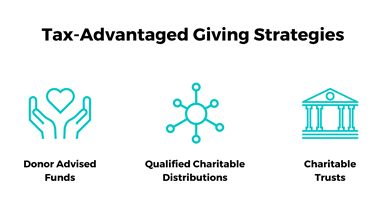
Setting up a trust is a classic option when it comes to charitable giving, but depending on your circumstances, a donor-advised fund may be simpler and achieve your goals. According to the National Philanthropic Trust, DAF contributions exceeded $38 billion in 2019, an 80% increase since 2015. DAFs allow you to donate highly appreciated stock and assets, receive an immediate tax deduction, but rather than select a charity immediately, the funds can be invested in the DAF, left to grow over time, and distributed at a later date.
Donating appreciated stock is advantageous because it can allow you to donate more than if you sold investments and donated cash. When charities receive appreciated stock, they’re not required to pay capital gains upon liquidation. As long as requirements are met, you receive a tax deduction for the full market value of the assets.
Those over age 70 1/2 can use a qualified charitable distribution strategy that allows donations of up to $100,000 directly to a charity from an IRA instead of taking RMDs. This can help reduce taxes because you avoid taking income, which could mean staying in a lower tax bracket, and potentially lowering the amount of RMDs in future years.
The Takeaway
The holidays bring out a variety of different emotions, and we often focus on others during this time, but don’t forget to take care of yourself. If you typically feel overwhelmed during the holidays, taking appropriate steps can help you spend more of the season enjoying the festivities. With a little planning, the holidays can be a time to unwind and spend much-needed time with loved ones.
1. Anderer, John. Jingle Bell Crock: 88% Of Americans Feel The Holiday Season Is Most Stressful Time Of Year. Study Finds. December 21, 2019.
2. White, Alexandria. 86% of Millennials Overspent on Holiday Gifts Last Year—Here’s How to Avoid the Same Mistakes. CNBC. August 17, 2021.

From Six Figures and Broke to Financial Independence Master
When Frank began practicing bankruptcy law, his average client earned between $8 to $9 an hour. A decade later, his clients increasingly earn six-figure incomes. And Dave and Beth were one of Frank's high-earning clients. At one point, the couple had amassed over $100,000 in credit card debt and were tapping their home equity line of credit to pay for a lifestyle their family simply couldn't afford. Dave's six-figure annual bonus was enough to cover a large part of his outstanding credit card balances, but the debt kept piling up, and they had little choice but to seek out Frank's services. But it wasn't always like this for the couple.
Dave and Beth had once lived a frugal lifestyle. Beth came from a working-class family that valued making a dollar go as far as it could. One night, Dave offered to take Beth out to Olive Garden for dinner, but Beth insisted that she stop by the grocery store and prepare a meal for the couple instead. Early on in their relationship, Beth drove a car she received in high school and refused to buy herself a new one until Dave paid off his car. So, what changed over the years? Well, their financial issues began shortly after Dave was transferred to Florida after receiving a big promotion.
Following their move, the couple purchased a four-bedroom home in an affluent, gated Orlando community. Their purchase was more significant than anticipated, yet their house was one of the smallest in the neighborhood. Soon enough, Dave and Beth found themselves surrounded by highly educated, ambitious professionals and entrepreneurs who lived in larger homes, drove nicer cars, were members of the local country club, and sent their kids to private schools.
The couple's desire to fit into their new community, coupled with an anticipation of rising future income, led to a spending spiral to keep up with their neighbors. Dave had hoped that by using his annually granted stock options and bonuses, he would maintain his family's spending habits. However, after a short while, Dave and Beth realized that their consumption habits weren't sustainable, and the couple found themselves stuck in a cycle of spending that led them to Frank's office.

When Financial Literacy isn't Enough
By the time Dave and Beth met with their attorney, Frank, they barely made the minimum payments on their credit cards and were facing the courts taking control of their family's spending. How did this educated, high-earning couple go from humble means and sound financial stewardship to earning six figures and broke?
A lack of financial literacy wasn't necessarily their problem. Recall that Beth had once embodied the value of stretching a dollar and minimizing unnecessary debt. Even so, she and Dave ended up charging $2,000 per month on clothes their family didn't need.
Dave and Beth's situation is an extreme example of a condition plaguing many high-earning households. You might know someone in a similar situation or maybe have found yourself in the same spot. Either way, this phenomenon is not new. Call it keeping up with the Joneses or hedonic adaptation. Addressing such challenges related to money management and wealth-building has been covered in volumes of books and seminars and are the frequent talking points of tv and radio financial gurus.
Quick fixes like cutting back on that five-dollar cup of coffee, avoiding debt altogether, or putting your savings on autopilot are often cited, no-brainer remedies to such spend-thrift behavior. Create a budget, develop a financial plan, and stick to it. Simple, right?
Well, many individuals, especially those well-versed in essential financial literacy topics, continue to find their financial wellbeing rising from a level of financial security up to financial freedom and then back down again to living paycheck to paycheck. Something must be missing from the equation for Dave and Beth and millions of other families just like theirs struggling to take back control of their financial situation. But what's missing?
Living Some Else's Money Script
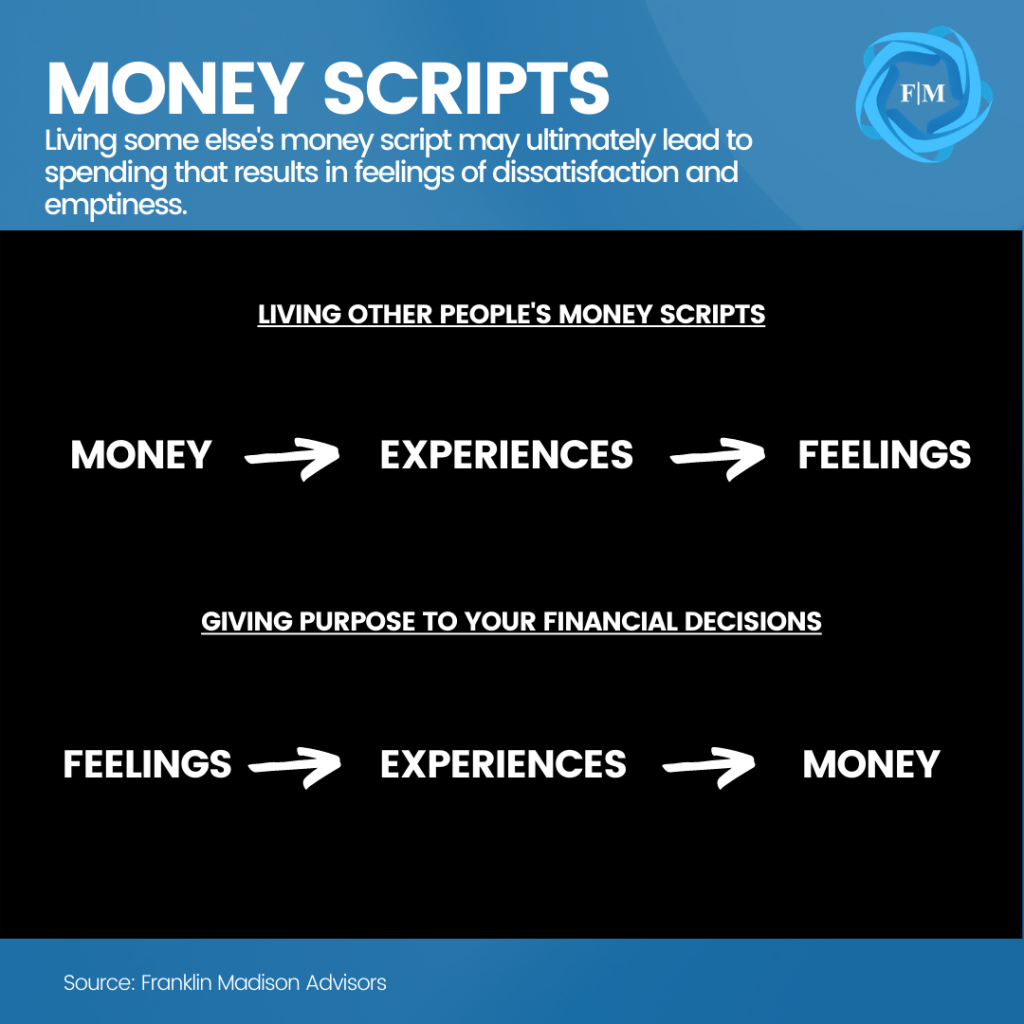
Often, individuals trying to break free of this vicious financial cycle spend too much time trying to master their money without having a conscious understanding of whose life they're living and how they want their money to make them feel. Indeed, many individuals unconsciously make financial decisions based on money scripts handed down to them by family, friends, or society at large.
Go to college, get a high-paying job, buy a house, earn more money, join this club, upgrade your car, live in this neighborhood (not that one) and then buy a bigger house. These outcomes, or milestones, represent expectations about how we might feel once specific experiences materialize due to our earning and spending decisions.
In Dave and Beth's case, their financial choices were dictated by their newly chosen community members' money scripts. Their seemingly fleeting unconscious desire for feelings of love, peace, aliveness, and freedom led them to pour money down a black hole because they were living someone else's money script.
There's nothing wrong with wanting to live in a big house, driving a nice car, or joining a prestigious club. More to the point, what Dave and Beth's story illustrates is that trying to feel emotionally satisfied by chasing someone else's expectations can prove to be a goal as elusive as trying to rid yourself of the pernicious gopher encountered by Bill Murray's character in Caddyshack.
Feelings Give Purpose to Your Financial Decisions
Here again, Dave and Beth's issues didn't revolve around knowing the proper money management techniques. Instead, their challenges came down to finding the right set of experiences that satiated deeply held emotional cravings. By this point, you're probably asking yourself, "why are we talking about feelings?" Well, the truth is that nearly every financial decision we make is based on a desire to satisfy a complex set of feelings.
There's no doubt that money can make you feel secure when you use it to pay your rent or mortgage. You likely feel comfortable when you stock your refrigerator and pantry with groceries. Buying your friends a round of drinks at the local pub likely makes you feel accepted. At its core, money represents stored potential to elicit certain feelings through the experiences afforded.
In the book "Your Money or Your Life," author Joe Dominguez writes how "money… is life energy, or something you trade the hours of your life for… and …is like a mirror that allows [you] to see [yourself]." This truth about money is why many high-earning individuals struggle with growing their wealth for the long-term. Why?
When financial problems crop up, these individuals are focused on trying to solve the wrong set of problems. Often, the solution to their money problems focuses on learning about new money management techniques. On the contrary, in Dave and Beth's situation, developing a conscious awareness of the kinds of experiences that align with their desired feelings, then crafting a money script around those set of experiences could have helped them master their money.
The reality is that few individuals are inclined to think or talk about their feelings. It's easier to look at what's worked for other individuals and try to emulate their lives. While some successful people may appear content from the outside, they may be struggling with as much financial discontentment as Dave and Beth. That's why it's essential to start with the end in mind: understand how you want your money to make you feel and identify the kinds of experiences that will get you there. So how do you determine the fitting types of experiences to pursue?
Which Experiences Matter Most to You?
The first step is understanding what matters most in your life. To this end, George Kinder built his life planning program around answering three vital questions:
- If you had enough money to take care of your needs now and into the future, how would you live your life?
- If you had five years to live, what would you do with your time?
- If you only had 24 hours to live, what did you miss in life, who did you not get to be, what did you not get to do?
Answering questions like these have helped many individuals identify vital life experiences worth pursuing, and at the same time, gain control over their finances and live more rewarding lives.
Why does this approach work? Science has shown that intrinsically oriented goals, or those that come from within, are more likely to be achieved and produce long-lasting emotional satisfaction. On the other hand, extrinsic pursuits focus on goals like getting a promotion, buying a new car, or losing ten pounds. Studies have shown that while such reward-pursuing behavior can produce results in the near-term, their value tends to diminish over time and turns up the speed on the hedonic treadmill.
Indeed, pursuing experiences with the intent of eliciting a specific set of feelings that matter most to you is, by its very nature, an intrinsic goal. So, how can you make an experiences-oriented approach applicable to your life? Spending time with Kinder's three questions is one way to start. What's more helpful, however, is developing a framework in which to put your thoughts, actions, and choices into a broader context. One approach to consider is becoming the master of your financial independence journey.
Become the Master of Your Financial Independence Journey
In the simplest terms, financial independence represents a state of financial wellbeing where you have enough money to pursue experiences that are of utmost value to you. Unless you're already retired or anticipating a financial windfall, becoming financially independent requires a daily discipline of creating, growing, and preserving financial wealth.
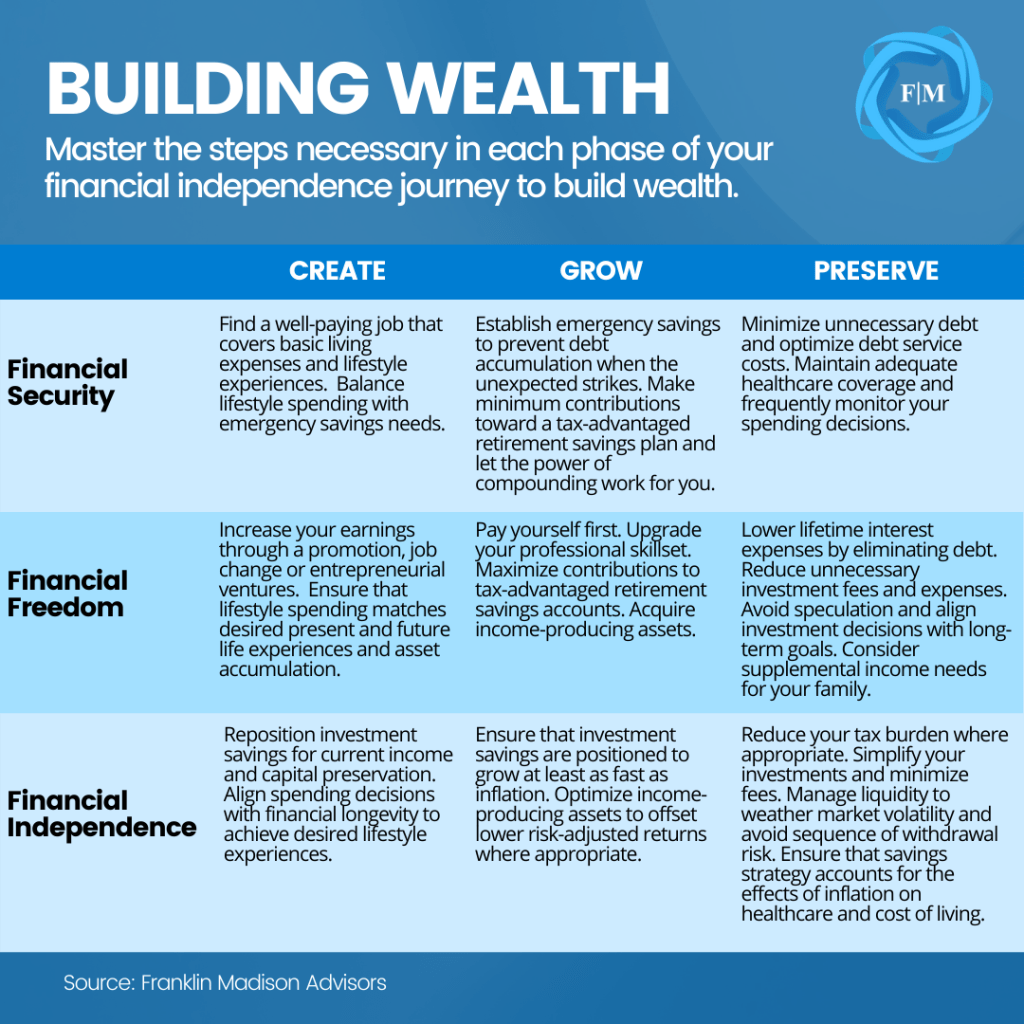
Considering the journey itself, the path to mastery (financial independence) forces you to think outside of the constraints of the money scripts presented to you by other people. Indeed, pursuing those experiences that satisfy feelings core your value system can activate higher levels of intrinsic motivation and potentially reduce the yo-yo effect of unconscious spending.
What's more, the journey itself becomes transformative. For example, each step in the wealth-building process (creating, growing, and preserving wealth) serves an explicit role in helping you move toward financial independence.
Each of these steps requires you to learn disciplines that enable you to build wealth for the long-term. And because the knowledge your gaining serves an intrinsically defined purpose, its application likely will have a more profound impact on your achieving financial independence than learning money management techniques simply for the sake of knowledge.
When it comes down to it, many individuals see their financial choices as discrete win/lose outcomes. And more often than not, people play the game of life simply not to lose: settling for comfort rather than striving for a goal they may fail. They're looking for quick fixes, temporary relief to get them through their day.
While this approach may work initially, a deliberate lack of understanding of what intrinsically motivates you might leave you feeling stuck in a perpetual cycle of earning and spending more but making little headway towards long-term financial goals.
Whether you’re earning six figures and broke like Dave and Beth, or simply trying to take control of your finances, learning a new financial management technique, determining your "retirement number" or some material outcome may not be the approach you need. What might suit your situation better is reframing your relationship with money, rewriting your money scripts and becoming the master of your financial independence journey.
Indeed, endeavoring to master your financial independence journey sets the stage for defining the kinds of essential experiences in your life. Better yet, the journey might ultimately transform you into a fitter financial steward with less stress than you had imagined.

Take these 5 Back-to-the-Basics Steps when Markets Move Against You
Market volatility can have a way of derailing your best-laid investment strategy. So, what can you do to reduce risk when markets move against you? Stay invested and get back to the basics. As with most life situations, when circumstances put up roadblocks to your goals, your first response may be to double down on your current approach instinctively. However, doing more of what you already have done may not only deplete your resources, it may also exacerbate an already untenable situation.
That's why when markets start moving against you, one of the best things you can do from an investment perspective is to focus on the essentials. While it may be tempting to get out of the markets altogether, fine-tuning some components of your investment strategy could otherwise set you up for long-term success. These steps include evaluating your exposure to market risk, focusing on higher-quality investments, reducing leverage, and diversifying your portfolio. To be sure, taking these actions may enable you to stay in the game for the long-run and improve your odds of achieving your financial goals.

Source: Broadview Macro Research
Step 1: Evaluate Your Market Risk Exposure
The first essential step you should take when markets start moving against you is to evaluate your exposure to market risk. Beta is one way to quantify this risk, and reducing exposure to it may help you better navigate sharp market swings. Why? Investments with high beta tend to experience outsized moves relative to the broader market when risk assets rally or decline. So, what is beta?
Well, beta is a statistical representation of the movements between a security and a broad measure of the financial markets, like the S&P 500 index. A positive value suggests that a security might move in tandem with the broader markets. Assets with a negative beta tend to move in the opposite direction of the broader markets, while a zero beta suggests little affect in its price relative to the broader markets. And which assets are more prone to move with sharp swings in the markets? Let's look at an example.
History tells us that cyclically oriented equity sectors, like financials, energy, and materials, tend to follow the broader market's moves higher (and lower). On the other hand, fixed income assets like Investment Grade and US Government bonds are less inclined to follow the direction of the broader markets and, in some cases, move in the opposite direction.
Beta is particularly useful when uncertainty rises, and your priority is to reduce the level of swings within your investment portfolio. Holding too many high-beta securities can leave your savings exposed to unnecessary risks and increases the likelihood that you'll fall short of your financial goals when risk assets suddenly decline in value. That's why when market volatility picks up, identifying an appropriate mix of high- and low-beta investments in your portfolio may be vital to reducing investment risk, particularly as you near your savings goals.

Source: Broadview Macro Research
Step 2: Move Up in Credit Quality
The next step you should take in getting back to investing basics is evaluating your bond exposure and consider moving up in credit quality. Assuming that merely having exposure to bonds in your investment portfolio is a way to hedge against volatility could be a recipe for disappointment. To be sure, not all bonds offer safety from market swings.
This point is evident in how yield spreads of low-quality bonds tend to rise during periods of heightened market volatility. Historical data show that when the VIX (a measure of market volatility) rises, the price of lower quality bonds falls, and yields move higher relative to higher-rated fixed-income assets, like government bonds.
In fact, history has shown that the spread between high yield and US government bonds can widen by as much as 20% during periods of heightened market volatility. For example, during the market selloff in early 2020, spreads went from less than 4% in January to 11% in March. Such price behavior not only reflects lower risk appetite among market participants, but it also represents a desire among some investors for higher compensation to take on additional risk. This is notably the case for assets that may have a higher degree of financial uncertainty when economic conditions underpinning the securities deteriorate.
As noted earlier, higher beta fixed income assets, like high yield bonds and emerging market debt, tend to move in the same direction as risk assets, like stocks. Indeed, while bonds might be perceived as a more conservative investment, the truth is that certain cash flow, industry, or country characteristics can make them higher-risk investments and susceptible to market ebbs and flows. That's why if you've been using bonds as a way to gain additional yield in your portfolio, you may want to consider higher quality and lower beta fixed-income assets as a way to reduce investment risk.

Source: Broadview Macro Research
Step 3: Consider Cheaper Stock Alternatives
After you've evaluated risk exposure and the credit quality of your bonds, the next thing you might want to think about during a market pullback is whether you're paying too much for stocks. It might go without saying that buying low and selling high is vital to long-term investing success. And while momentum, or recent price action can be an informative value indicator, you may want to consider valuation factors like price-to-earnings (P/E) ratios to determine whether you're paying too much for a given asset.
Why do valuations matter? While it's true that even some high P/E growth stocks can provide investors with positive returns, history suggests that lower P/Es are often associated with more favorable investment outcomes. To evaluate how well this relationship holds, we looked at the historical relationship between P/E ratios for the S&P 500 and subsequent returns over a one-year period. What did we find?
Well, with data going back to the 1930s, our work shows that if you held a portfolio tracking the S&P 500 index when its P/E ratio fell two standard deviations below its mean, you could have received an average annual return of 14%. And how does this compare with purchasing a similar basket of stocks when P/E's are excessively high? Well, buying stocks when they're expensive generated an average 8% returns in the following one-year period.
While our analysis shows that buying high P/E stocks also produced positive returns, the simple truth is that lower P/E stocks tend to outperform over time. The point here is that when the market begins to move against you, one way to set yourself up for a favorable investment outcome is to consider cheaper stock alternatives than what you may already be holding. This includes keeping an eye on high quality, low valuation opportunities.

Source: Broadview Macro Research
Step 4: Reduce Portfolio Leverage
For some investors, trending market behavior presents an opportunity to use borrowed money to boost investment returns. This strategy can work well when prices are moving higher but can amplify losses during a pullback. That's why when markets start moving against you, another critical factor to consider is reducing leverage in your portfolio. Let's take a closer look at how this works.
Leverage usually involves opening a margin account with your brokerage firm, depositing 50% of the value you wish to borrow (this is called initial margin), and hoping that the asset you purchased continues to appreciate. Simple enough, right?
Well, while the value of your portfolio may rise and fall with the markets, the loan you received typically stays fixed. What's more, your broker will also require that your levered investment maintain an equity-to-debt ratio above a certain threshold (maintenance margin). This approach might work well as markets head higher, but when they fall, a time might come when you'll need to raise cash to bring your equity position above the maintenance margin requirement or sell some of your stock to make your broker whole.
And it goes without saying that being forced to sell during a downturn to cover a margin call can amplify losses. That's why overseeing leveraged positions and avoiding a margin call is crucial to managing investment risk during uncertain times. To help illustrate the point, consider the performance of two portfolios that bought on margin heading into a market downturn.
Example: Margin and a Downturn
Let's say that you decide to invest $100,000 into ABC company using $70,000 cash, and $30,000 borrowed from your broker. In this situation, we'd say that your portfolio is 30% leveraged. After initially gaining in value, your portfolio experiences a 40% drawdown over two weeks. While your portfolio avoided a margin call, your net return after accounting for the loan is -48%. To put this number into context, the loss on an all-cash portfolio during this time could be -33%.
And how would this situation look if you had borrowed more money from the start? Well, let's assume that you use $100,000 to purchase the same security, this time with 50% of your broker's money. During the same market downturn, your net return after accounting for the margin loan declines -67%. This two-thirds decline is amplified by a broker's margin call, theoretically leaving you with a more significant hole to climb out of.
The key takeaway here is that if you're using leverage to gain an investing edge, then one of the first steps you should take when the markets are moving against you is to evaluate your use of margin. While this resource can undoubtedly help boost returns when markets are trending higher, it can also open you up for excessive losses during periods of heightened market volatility.

Step 5: Diversify Your Portfolio
A final but crucial step to reducing investment risk during times of uncertainty is to diversify. Diversification can help smooth out investment returns and, more importantly, lessen volatility when the markets begin to move against you. Why is diversification important?
Well, few individuals can predict with certainty which investments will perform well in any given year. In fact, history has shown that an outperforming sector or asset class one year often loses favor with market participants the following year.
For example, if you held one of the largest names in the S&P 500 index, what you're likely to have experienced over the past few decades is annualized volatility as high as 40%. Put differently, while your stock might have an average return of 10% in a given year, that value could swing between a 30% loss, a 50% gain from one year to the next.
This varying performance can be problematic if you're near a critical savings goal and is how diversification comes help. A simple analysis shows that combining just five stocks from the S&P 500 index could cut your portfolio volatility in half from 40% to 18%. In fact, adding 30 stocks to your portfolio might reduce volatility by two-thirds.
The point here is that diversifying your portfolio lets you gain exposure to market returns without having to pick a winner while taking excessive risk rather than trying guess which investment might do well from one year to the next. When paired up with assets of varying correlations, diversification has historically demonstrated its ability to reduce volatility and smooth out portfolio returns.
Get Back to Investing Basics When Markets Move Against You
As with most life situations, when circumstances put up roadblocks to accomplishing your goals, your first response may instinctively be to double down on your approach as a way to achieve success. Doing more of what you already have done, however, may not only deplete your resources, it may also even exacerbate an already untenable situation.
That's why when markets start moving against you, one of the best things you can do from an investment perspective is to focus on the essentials. While it may be tempting to get out of the markets altogether, shifting your investment strategy could be a better set up. These steps include evaluating your exposure to market risk, focusing on higher-quality investments, reducing leverage, and diversifying your portfolio. Taking these actions may enable you to weather a downturn, stay in the game for the long-run, and improve your odds of achieving financial success.

Five Ways to Free Up Cash When You Have Little in the Bank
Cash is king. During times of uncertainty, having cash on hand can make the difference between financial stability and the host of issues that come with insolvency. That's why regardless of your current financial situation, having cash options can not only help keep you solvent, they can also ensure that you stay on track right toward your crucial life goals. So, what can you do to raise cash if you have little money in the bank?
Without a doubt, there are many tools and techniques that you can utilize to generate cash and boost your emergency reserves. Today, we'll outline five practices that you can apply to come up with a few hundred or a few thousands of dollars when you need it. It's crucial to note that each option has its own set of benefits and tradeoffs. Even so, keeping track of the resources available to you before you need them can help ensure that your finances stay on track, no matter what issues life throws your way.

#1 Cut Back on Non-Essential Household Spending
One of the quickest ways to come up with cash is to cut back on non-essential household spending. For many, this suggestion seems like a no-brainer. Yet more often than not, this challenging yet straightforward approach is often one of the most underutilized ways to raise extra cash. Certainly, finding a tradeoff between consuming today and saving for tomorrow is hard. So, where should you begin?
To start, you'll want to get a sense of trends in your monthly household spending. To do this, begin by pulling up two months of your latest bank statements. Then go through your expenses, item by item, categorizing each as either essential (like housing, utilities, personal care) or non-essential (like takeout, app subscriptions, shopping). Then, tally up the non-essential items and decide what you can do without for a season while you come up with needed cash and make a plan for reducing these expenses.
Certainly, there are more streamlined methods for this approach. Apps like Mint and Quicken make it easy to link your bank accounts electronically, identify spending categories, and create a budget on the fly. However, the point here is to become accustomed to the way that money is entering and leaving your bank account each month to identify savings opportunities more clearly. To be sure, it's crucial to look at each individual expense to identify opportunities, rather than relying on generic spending categories offered by these apps.
Whichever method you choose, be sure that you're comfortable with how you go about cutting expenses. Dieting research has shown that sudden changes in eating habits often trigger a stress response that can lead to a crash diet. And that's why any changes to your financial spending should be done in a stepwise and systematic fashion. And while budgets are an essential part of a solid financial plan, the approach we're advocating here is short-term adjustments to address an immediate cash need, rather than a long-term lifestyle change.

#2 Reduce your Debt Service Costs
Another approach to coming up with extra cash is to reduce the number of debt accounts that you service every month. On average, Americans carry credit card balances of $6,200 and make minimum payments of $120 per month. Volumes have been written about the dangers of consumer debt and the cost of carrying credit card balances. Indeed, eliminating credit card debt is one way to free up extra cash for the long term.
And prioritizing debt repayment, paying down smaller accounts first, and refinancing are some ways to grow money in your bank account. Let's start by taking a look at paying down your debt.
Make a Budget, Prioritize Debt Repayment
What gets measured, get managed. As mentioned earlier, knowing where your money is going every month can help you identify ways to reduce or eliminate spending and free up cash. You can multiply this effect by using this freed up cash to eliminate credit card debt and thus giving your financial savings another boost.
How does it work? Well, this approach includes reallocating spending away from non-essential matters and toward making extra debt payments for a time. Again, like a diet, this method requires commitment. Yet, the short-term sacrifice of prioritizing debt repayment could lead to a lifetime of financial gain. Where should you start?
Pay Down Smaller Debts First
Consider focusing your efforts on paying off your smallest balances first if you have multiple credit cards. To be sure, prioritizing the elimination of your lowest balances can help free up cash from those payments to be used toward your next higher balances.
Here, the idea is to quickly pay off debts with low balances and then apply the extra monthly cash flow to pay down your next smallest account balance, repeating until your credit cards are completely paid off.
Consider a Personal Loan
Another thing to consider is that interest rates have fallen considerably over the past year. With personal loan rates well below 10%, refinancing higher interest credit card debt might help lower your monthly payments. You can then use the money saved on your monthly payments to pay down your loan faster. How so? Let's look at an example:
Assume you have an outstanding credit card balance of $10,000, for which you are charged an annual percentage rate of 21%. Making the minimum payment of $200 per month would take roughly ten years to pay off your debt. Now, if you refinanced into a fixed-rate 10-year personal loan at 7.5%, your payment could be as low as $118 per month. Applying the extra $82 per month toward your principal amount could lead to your account being paid off five years sooner.
While not necessarily a short-term fix to coming up with cash, the process of reducing credit card debt can help you identify ways to trim expenses, eliminate one more financial burden, and put you on track to building emergency reserves for the long-term.

#3 Judiciously Tap Your Home Equity
Now for many people, a home will be their largest lifetime purchase and source of wealth. A time will come when you have little choice but to borrow money. If you own a home and have a sufficient amount of equity, some lenders may allow you to borrow against your home. You'll have to choose between a home equity loan or a line of credit in this situation.
What's the difference between the two? Well, a home equity loan is a fixed-rate loan, paid off over a set time. On the other hand, home equity lines of credit are like a credit card whose rate and repayment period can fluctuate over time.
When should you borrow against your home? If you plan to sell your home soon and need a way to raise some extra cash, borrowing against your home equity might make sense, assuming stable price conditions in your local real estate market. While you should find ways to reduce non-essential expenses and raise cash first, borrowing against your home equity can be cheaper than using a credit card. Now, here's a word of caution against using home equity loans or lines of credit.
Borrowing against your home's value can help you meet near-term financial needs but should be done so judiciously. Borrowing against your home during a time of financial stress can put you and your home on the line. For example, a bank can force a foreclosure if you stop making regular payments on a home equity loan or line of credit. Therefore, taking on additional debt during a period of financial stress might lead to losing your home. This is one reason why borrowing against your home to come up with extra cash comes with its own set of risks.

#4 Relocate to Lower Your Housing Expense
If your cash need extends beyond addressing non-essential spending or borrowing prudently just won’t cut it, then it might be time to reassess your current living situation. For many people, housing can make up between 30-50% of their overall monthly expenses. And moving to a lower cost part of town or state to reduce this expense is one way to free up extra cash.
This trend is evident today in stories of Silicon Valley tech workers abandoning high cost rents of the San Francisco Bay Area, for more affordable options in places like Austin, Texas. So, what are the financial benefits of relocation?
Right off the bat, moving to lower your housing expense might enable you to finally accumulate savings that can later be used to pay for unexpected costs. At the same time, reducing a large part of your housing expense can give you more lifestyle flexibility compared to cutting back non-essential spending altogether.
In fact, while reducing non-essential expenses can work in the short term, like dieting, your spending is largely determined by your lifestyle priorities. That's why reducing housing expenses can set you up for a long-term gain without having to sacrifice the things that are important to you today. And if you own a home and have built up equity, then you can use that cash as a way to pay for significant one-time expenses if you decide to purchase a cheaper home in a more affordable part of town.
The downside of this approach means moving. Besides paying for boxes, packing supplies, and movers, there are other expenses to account for. If you're a homeowner, you probably know that there will be closing costs associated with selling your home and again when you buy your next home. That's why this option makes the most sense for individuals who have either 1) lived in their home for longer than five years or 2) have seen rapid home price appreciation. The bottom line here is to make sure that the savings benefits you anticipate outpaces moving costs.

#5 Access Retirement Savings Prudently
A final way to come up with extra cash is to tap your retirement savings. Now using your retirement savings to address a short-term need should always be a last resort. Fortunately, there are ways to access your retirement savings if you need cash in a pinch. While borrowing against your retirement savings is one option, let's talk about cash withdrawals.
The CARES Act passed earlier this year allows individuals affected by COVID-19 related conditions to draw down 401k and IRA savings and in many cases do so penalty-free. Under the old rules, penalty-free withdrawals from these accounts were limited to individuals over the age of 59 ½, those experiencing financial hardship or first-time home buyers.
What's more, prior laws applied a 10% penalty for withdrawals on individuals not meeting these criteria. In the case of the CARES Act, you can cash out your retirement plan in a more favorable way. Let's take a closer look.
According to the IRS's interpretation, the CARES Act allows individuals to withdraw up to $100,000 from their retirement accounts penalty-free. Because pre-tax money went into the accounts, money coming out will be considered ordinary income with taxes due. Fortunately, the CARES Act allows employers to forego the standard 20% estimated tax at withdrawals for 401ks and enables individuals to spread out tax payments over three years.
Just because you can take out the money doesn't mean you should. And that’s because taking money out of retirement savings can reduce your investments' future lifetime growth. And while doing so might help you meet a near-term need, the cost of foregoing your savings' future compounded growth should be carefully considered before choosing this option.
Coming Up with Cash When You Have Little in the Bank
A time likely will come where you need to raise cash to meet near- or long-term needs. Depending on your circumstance, finding extra cash may come down to simply cutting back on lifestyle expenses or tapping your retirement savings when a big emergency crops up.
Either way, knowing your options and having a plan in place might help you avoid costly mistakes when your need for cash arises. Even so, keeping track of the resources available to you right now before you need them can help ensure that your finances stay on track, no matter what issues life throws your way.

How Fast Can You Break Free from Student Loans?
Eliminating student loan debt can put you on the fast-track to achieving your essential life goals. If you’re one of the millions of Americans struggling with this vital issue, you know first-hand the challenges of student loan debt. As student loan balances continue to balloon from one year to the next, what can you do to conquer this overwhelming debt load? Well, many people are waiting for an act of congress to make their student loans disappear.
Yet, chances are that it will be on you to forge a path toward financial liberation. If you’re serious about freeing yourself from student loan debt, you’ll need to take steps that you might not have considered before. These actions include evaluating how much minimum payments on your student loans cost you, curbing unnecessary interest expenses, and finding simple ways to come up with extra cash to pay down loan principal. Making these steps a priority might enable you to eliminate debt sooner and give you the ability to focus your efforts on your most essential life goals.
The Burden of Student Loan Debt
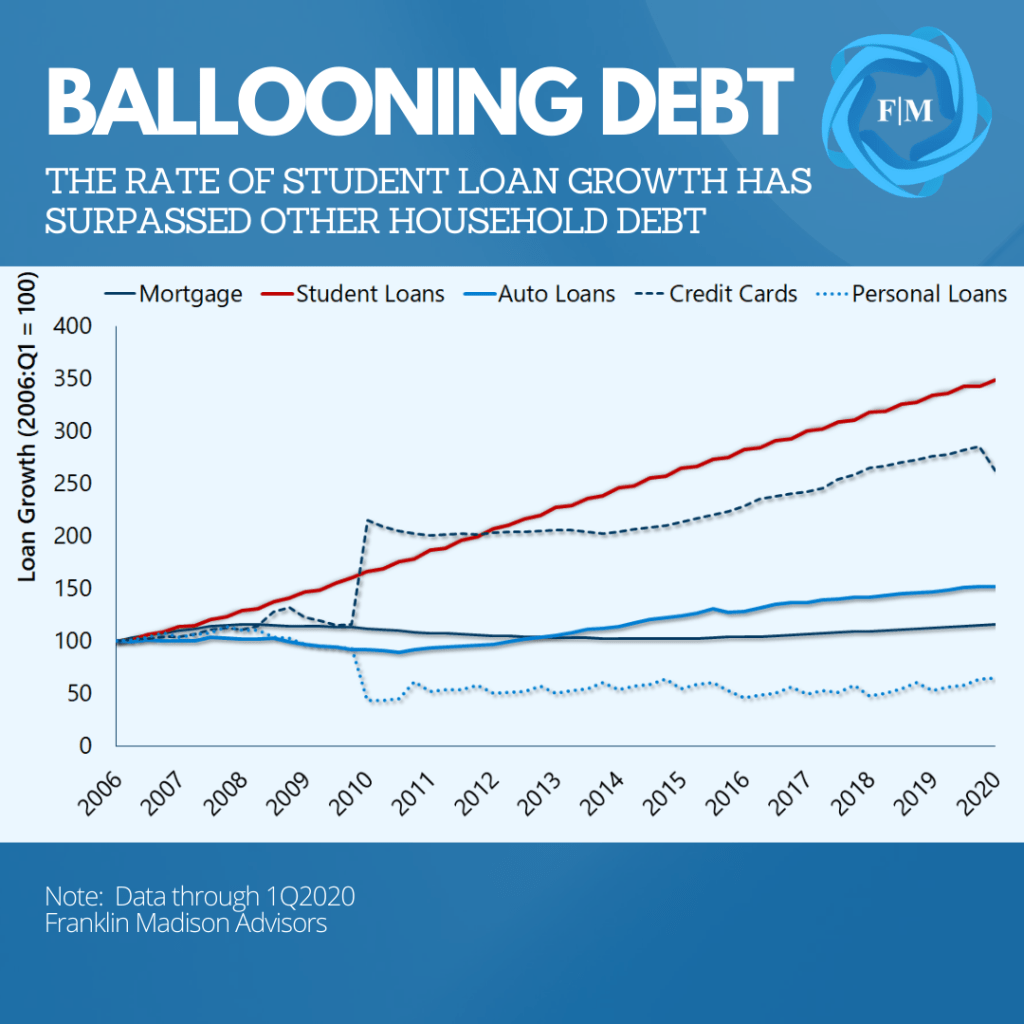
Student loan debt issuance has skyrocketed over the past decade. Government data out in the first quarter showed that total student loan debt outstanding reached $1.7 trillion. Of the amount outstanding, three-quarters were federal direct loans. This ownership share suggests that if you have a student loan, then there’s a good chance that Uncle Sam owns it. And if you feel like your debt burden is unreasonable today, you’re not alone.
Balances outstanding now average $35,000 for the nearly 40 million individuals who have federal student loans -- a figure that has doubled since 2007. And while the number of borrowers has increased by 40% over the past seven years, loan default rates have nearly tripled. If you want to pull yourself out of your student loan debt trap and forge a path to financial liberation, you’ll need to make decisions about your student loans that different than what most people are doing right now.
Relief in Times of Uncertainty
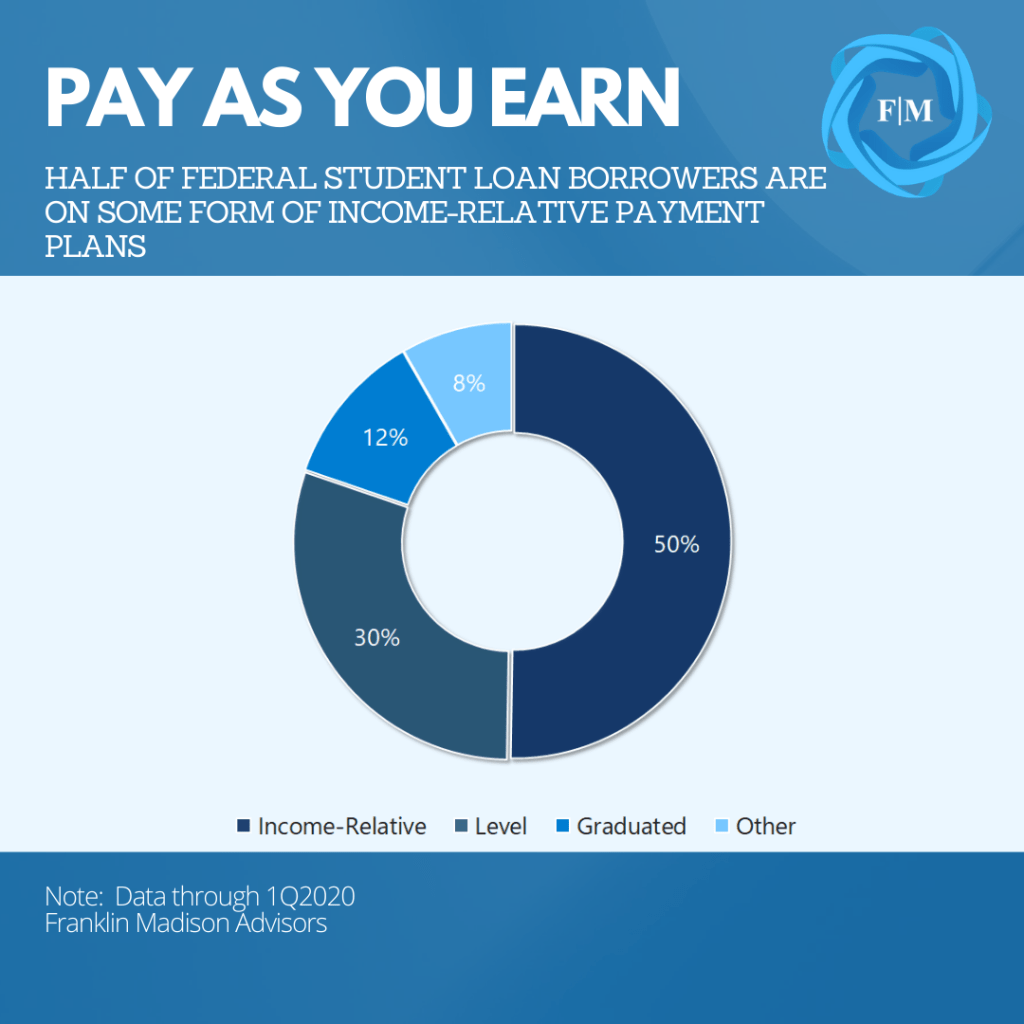
Many college students assume that money borrowed to finance education costs can be reasonably paid back over ten years. This seemingly short payback period is one reason some individuals choose to take on student loans in the first place. By the time they graduate, however, many students accumulate so much debt that they find it challenging to make their standard level payment. That’s when some borrowers choose to utilize income-relative repayment programs.
According to government data, over half of federal direct loans are in some form of an income-relative repayment as of the first quarter of 2020. These programs include Pay as You Earn (PAYE), Revised Pay as You Earn (REPAYE), Income-Based (IBR), and Income-Contingent (ICR) Repayment. The common thread running through these programs is that your monthly student loan payments are based on how much you take home per year rather than a level, amortized loan amount.
Income-Relative Plans: Not a Long-Term Fix
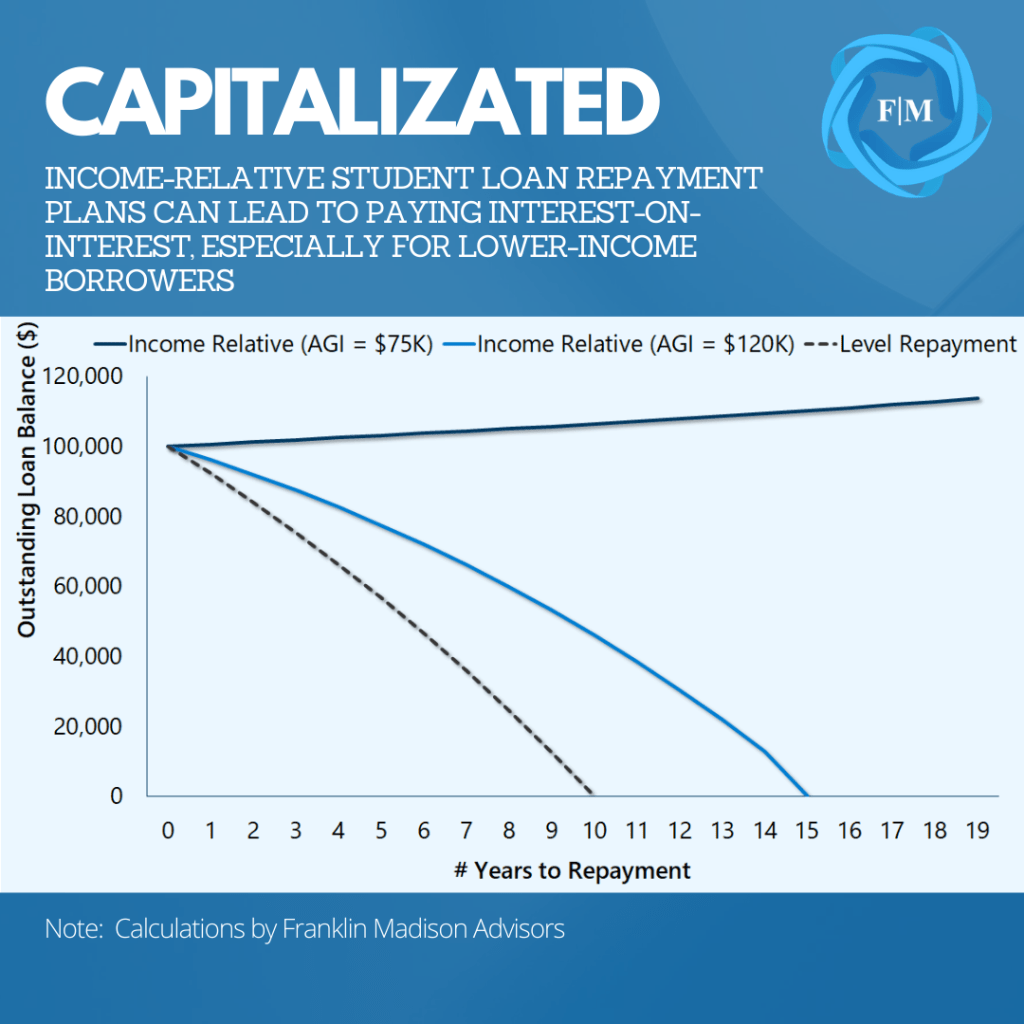
For example, consider a couple with an adjusted gross income (AGI) of $120,000 per year and $100,000 in student loan debt. Under an income-relative plan, the couple might pay an extra $18,000 in interest expense over the lifetime of their loan compared to level repayment. This difference is due to the fact that it would take 16 years to repay the debt compared to 10 years under a level repayment plan, therefore accumulating more interest.
The drawbacks of an income-relative plan become more evident as we move down the income scale. For a similar household with an AGI of $75,000 instead of $100,000, lifetime interest payments would be nearly $84,000 higher than compared to a level plan. What’s more, because monthly payments barely cover interest expenses in this scenario, the unpaid interest is capitalized or, in other words, added back to the principal amount of the loan.
The effect is that the borrower’s total loan outstanding rises over time rather than being paid down. While many income-relative plans allow for loan forgiveness after 20 or 25 years, these borrowers are not completely off the hook. Debt forgiven is, in some cases, considered taxable income. Therefore, the remaining balance might lead to a tax bill of $23,000 for this couple at the end of 20 years.
It is crucial to understand that income-relative repayment plans are an expensive way to pay down your student loan debt. While useful for addressing short-term challenges to your financial situation, these programs should not be relied upon as a long-term approach to paying down debt. If you’re participating in an income-relative repayment program, and are serious about conquering your student loan debt, it might be time to examine what this payment program is costing you.
Avoid Capitalizing Interest
If you’ve ever experienced hardship as a student loan borrower, you probably know how payment forbearance can help you manage obligations during times of financial uncertainty. Forbearance programs allow you to delay making payments on federal direct (and some other loans) for up to 12 months at a time. And today, there are approximately 3.8 million direct loan borrowers in forbearance with outstanding balances that are growing at a rapid rate.
While beneficial in the short-term, this program can undo the progress made on paying down your loans and, in some cases, leave you with a higher balance than with what you started. As noted earlier, capitalizing interest expenses is the quickest way to derail your student loan repayment plans. While income-relative programs might lead to higher debt levels for certain individuals, participating in a forbearance program will almost certainly cause your outstanding loan balance to rise. Let’s use an example to demonstrate this point.
The Cost of Forbearance
Recall the earlier illustration of a couple with a household AGI of $120,000 and $100,000 in student loan debt. Under an income-relative repayment plan, they might pay off their student loans in about 15 years, costing them about $152,000 over the lifetime of their loan. Now, what would happen if we introduced forbearance into the picture?
Assuming that this couple used forbearance to delay payments by 36 months, their student loan would cost over $191,000 by the time the debt is paid off and $40,000 more than had they avoided forbearance. Capitalized interest increases the outstanding loan balance and leads to paying interest on top of interest. What’s more, in this scenario, the payback period for the loan goes from 15 years to more than 20, leading to a hefty tax bill when the loan is forgiven.
And how does forbearance affect level repayment plans? Well, $100,000 in student loan debt amortized over ten years at 5.5% interest will accumulate about $33,000 in interest expense. Placing their loans into forbearance for 36 months, the couple would end up doubling interest expense. Because the borrowers are now making up for lost time when payments were postponed and paying interest on top of interest, it might take 15 years to repay their level loan versus the 10 years had the borrowers avoided forbearance.
The point here is that while forbearance is a useful tool that can help you navigate times of financial stress, when possible, it should be used only as a last resort. More to the point, if you do come upon tough financial times, prioritizing interest payments can help you avoid capitalization. Indeed, if your goal is to quickly conquer student loans and pay down your debt, then not paying interest on top of interest is crucial to this aim.

A Little Extra Goes a Long Way
Income-relative repayment plans can lengthen the time it takes to repay your student loans, while forbearance can lead you to pay interest on top of interest. If your aim is to eliminate student loan debt, consider alternatives to income-relative payment plans, and avoid forbearance. Then, create a strategy to make additional principal payments on your student loans.
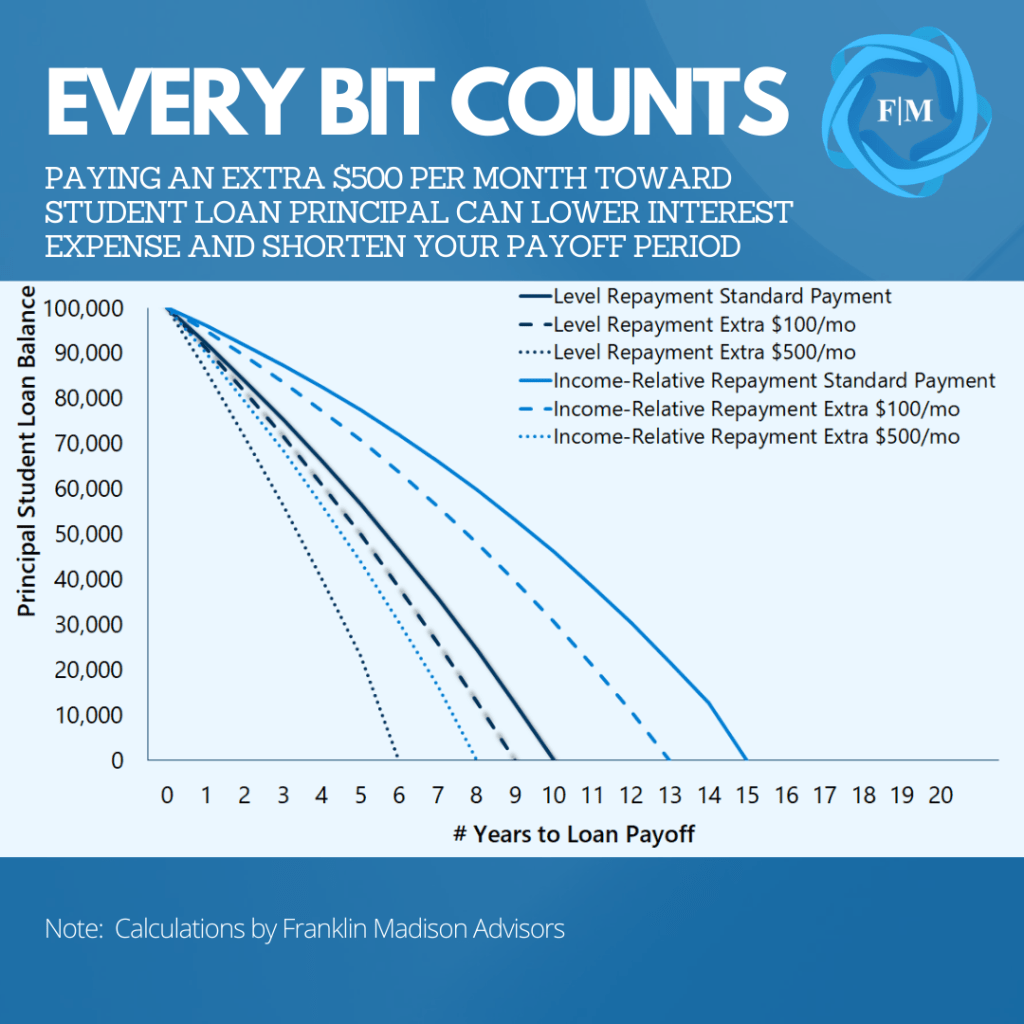
Indeed, whatever your chosen repayment program might be, every extra payment you can make on your loans can shorten the time it takes to pay off your debt and reduces interest expenses. For example, finding a way to pay an extra $100 per month on a $100,000, 10-year level repayment student loan can modestly reduce interest costs and cut your student loan payoff period by a full year.
How does this apply to income-relative payment plans? When using some of the same assumptions as before, making an extra $100 payment on your student loans can result in even more significant financial savings and shorten your payback period. Recall that for a couple with an AGI of $120,000 and $100,000 in debt, it might take them just over 15 years to pay down their student loans. By paying down an additional $100 in principal per month, they can eliminate debt in 13 years and save over $8,000 in interest expenses.
Taking this example one step further, let’s look at increasing principal payments from $100 to $500 per month. In our 10-year level payment scenario, committing $500 per month to principal reduction would reduce the repayment period to just over six years and lower interest expenses by a third. For the income-relative scenario, a similar contribution could cut lifetime interest costs and the repayment period in half. The point here is that every dollar that you can commit to paying down principal puts you one step closer to student loan debt liberation.
How to Eat an Elephant
Desmond Tutu was once quoted as saying that the only way to eat an elephant is a bite at a time. In the case of student loans, paying down your debt won’t happen overnight. However, as we just illustrated, finding ways to commit even a little extra money to pay down student debt principal can shorten your payback period and minimize interest expenses.
Even so, finding an extra $100 or $500 per month might seem like a daunting feat for some individuals. What can you do to come up with extra money to pay down your student loan debt faster? Here are a few suggestions:
- Make a Budget, Prioritize Debt Repayment– What gets measured, get managed. Knowing where your money is going every month can help you identify ways to reduce or eliminate spending and free up cash that can be applied to paying down student debt. The short-term sacrifice of prioritizing debt repayment by reallocating spending away from non-essential matters and toward paying down your debt for the next few years might lead to a lifetime of financial gain.
- Pay Down Smaller Debts First – If you have multiple student loans, prioritizing the payoff of your smallest balances can help free up cash to pay down your higher balances. The idea here is to quickly pay off debts with low balances and then apply the extra monthly cash flow to pay down your next smallest account balance, repeating until your student loans are paid off. Applying this same principle to credit card balances is another way to free up some extra cash. On average, Americans carry credit card balances of $6,200 and make minimum payments of $120 per month. Paying off your small credit card balance then applying those payments to your student loans is another way to reduce your student debt quickly.
- Consider Refinancing – Interest rates have fallen considerably over the past year. With student loan rates as low as 3.5%, refinancing higher interest student loan debt can lower your monthly payment. You can then use the money saved on your monthly payments to pay down principal . However, keep in mind that certain benefits afforded to federal student loans (like forgiveness) may not apply if refinanced with a private lender.
- Use Windfalls to Pay Down Debt – You’re likely to come into some financial windfalls during the year. For example, many people receive a bi-weekly paycheck yet pay expenses monthly. This means that twice a year, you’ll have “extra” checks coming your way. If your budget allows for it, consider using these additional paychecks to pay down student loan balances. Also, consider applying other windfalls, like a tax refund or your stimulus check toward your principal loan balance.
Student Loan Debt Liberation Begins with You
What could you do with an extra few hundred or thousand dollars per month right now? For some individuals, this additional cash might make the difference between buying a bigger house or a newer car. It could even mean getting closer to critical financial goals like funding a college savings plan for their children or shoring up retirement savings.
While many people are waiting on an act of congress to make their student loans disappear, you will likely need to forge your own path toward financial freedom. This includes limiting the use of costly income-relative repayment plans and avoiding capitalized interest. To be sure, taking a measured approach to paying off your student loans may liberate you from seemingly impossible debt and put you on the fast-track to achieving your essential life goals.

Keep Your Money Growing with Two Simple Steps
Growing financial wealth in today’s environment has been a struggle. Whether it’s the wide swings in asset prices that make it hard to decide whether to stay in or get out the markets to the dour economic conditions that have negatively affected business earnings. Finding the right strategy to grow your wealth in a world locked down truly has been a challenge.
So, what can households and investors do to make the right decisions to grow wealth given today’s challenges? Well, we believe that when individuals focus on a process and not an outcome they can create, grow and preserve financial wealth even in this difficult market and economic environment. More to the point, we believe that individuals can still grow their money today by utilizing and staying committed to a systematic wealth management process.
Figure 1: The Wealth Management Process
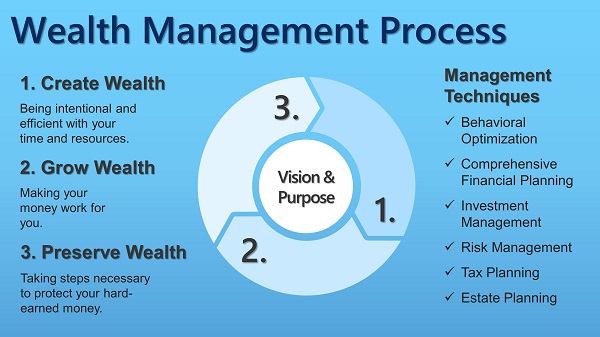
Growing Wealth Through a Systematic Process
In our report last week, we described how a wealth management process works and how it can help individuals build wealth that can endure the test of time. To recap, our wealth management process focuses on three key points to building enduring wealth:
- Being intentional and efficient with your time and resources
- Making your money work for you and
- Taking steps necessary to protect your hard-earned wealth.
In other words, a process focused on creating, growing, and preserving financial wealth. So why is the process important? Well, we believe it’s important because a process enables us to be consistent in the way that we align our wealth habits with our life’s passions and purpose. A process also provides discipline and being disciplined can help generate the productive assets that we need to pursue the more important things in our lives.
Create Before You Grow
Where to begin? Well, we recommend starting with creating wealth before trying to grow wealth. More specifically, we suggest beginning with the first step in our Wealth Management process. To us, Creating Wealth means:
- Being intentional with your money and identifying your life’s vision and purpose
- Maximizing your value to others to increase your earnings potential and
- Optimizing your net worth so that you have a base of money from which to grow wealth
To be sure, a key reason we stress the importance of the creation process is because it sets the base for generating productive assets that you can use to make money work for you. Crucially, this process enables you to pursue the more important things in your life and in a relatively shorter period of time than you could otherwise.
Figure 2: The Components of Creating Wealth
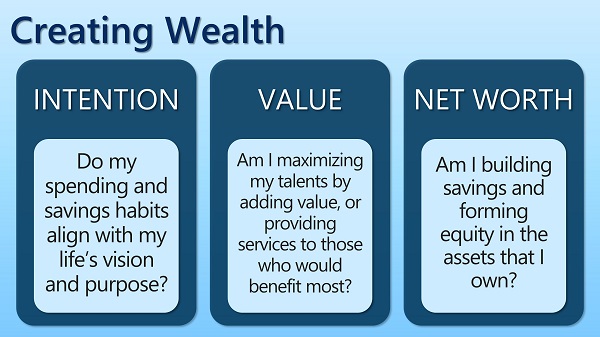
So, let’s quickly revisit some of the key components of creating wealth that we covered in our report last week, beginning with intention. When we talk about intention what we mean is the way that you align your financial resources with the vision and purpose that you have set out for your life. In other words, intention gives your money a reason for existence. It also means that you may be more inclined to create wealth when your savings and spending plans reflect what matters most to you now and into the future.
Maximizing value is the second wealth creation component that we wrote about last week. That is, using your innate talents to take your career or business to the next level. This means doing the kind of work that gets you up early in the morning, energized and puts you in a state of flow. This is important because, the world tends to exceedingly reward those individuals who are excellent in the things they do and the way they show up to help other.
The third way you can create wealth is by optimizing your net worth. This is done by allocating more of your attention to saving money and by reducing bad debt. Put differently, it means using debt to acquire assets that will appreciate over time or enable you to maximize the value that you provide to others.
Taken together, we believe that these three wealth creation components are key to setting the foundation to building enduring wealth. This is because when followed in a systematic fashion, the components can be used to help generate the crucial financial resources you need to make your money grow over time.
Figure 3: Three Key Components of Growing Wealth

Make Your Money Work for You
So, we’ve just talked about creation and how the first step in our wealth management process provides a base from which wealth can grow. Next, we’ll walk through how you can actually grow your wealth. To start, we’ll need three key components for growing wealth:
- Accumulated savings
- A rate of return
- Time
When taken together, you can use the Law of Compounding to grow your money in our current framework. More specifically, we mean earning a return on your savings, then investing that return back into your savings and repeating the process over a given period. Let’s take a closer look at the components necessary to grow wealth.
Figure 4: Law of Compounding
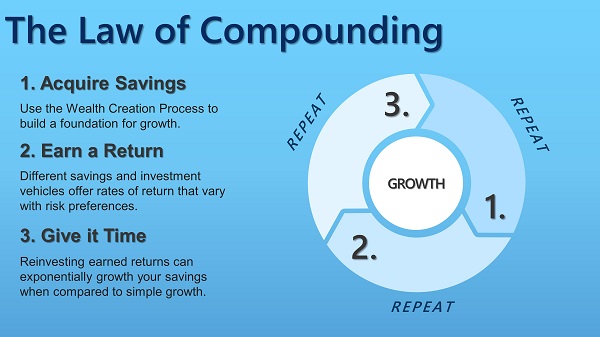
Savings is the first ingredient that you can use to grow wealth. To be sure, it’s primarily through the wealth creation process that we establish a solid foundation for growing financial resources. That is, without some form of savings developed during our creation process we have no base from which to grow money.
Our second growth ingredient focuses on a rate of return. For example, this would be a return that you could get from a savings account at a bank or the expected return from investing in the stock market. Whatever the case, the rate you receive will be either higher or lower depending on a number of factors, including time and the risk characteristics of your savings vehicle.
“…there are no shortcuts to building enduring wealth.”
Finally, to grow wealth you need to allow your returns to accumulate over time. While many of us wish we could grow our money in the quickest way possible, the fact is that there are no shortcuts to building enduring wealth. In fact, some research has shown that growing enduring wealth is typically accomplished through a consistent systematic process and done over an extended period of time. So now that we’ve talk about the three ingredients necessary for growing wealth let’s move on to looking at how this process works in practice.
A Practical Example
So how can you practically make your money work for you? Well, let’s look at an example. And we'll begin by going back to our three ingredients for growing wealth: accumulated savings, a required rate of return and time. In our example here we’ll assume that you’ve accumulated $100,000 in savings through the creation process. More specifically, you’ve done so by being intentional with your money, maximizing your value to others and optimizing your net worth.
Figure 5: Growth at 1% Over 10 Years
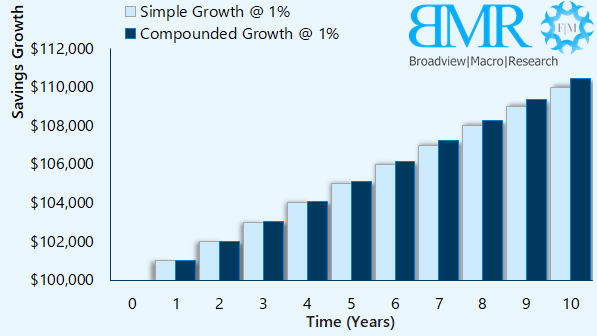
Let’s also assume that your savings is held at a bank and that bank offers you a 1% annual rate of return. So, where does this leave you? Well, in one year, your savings will theoretically grow by $1,000. Therefore, by the end of year one, you would have $101,000 in savings. If you were to repeat this process over a 10-year period, your savings would have grown at a compounded rate by about $10,500 and in excess of $500 more than a simple rate of return.
Now let’s assume that we increase your rate of return from 1% to 5%. How would this affect your savings? Well, with $100,000 earning 5% compounded annually the value of your savings would increase to $105,000 after year one and over $110,000 in year two. In fact, after 10 years, the difference between a compounded return and a simple return is nearly $13,000!
Figure 6: Growth at 5% Over 10 Years
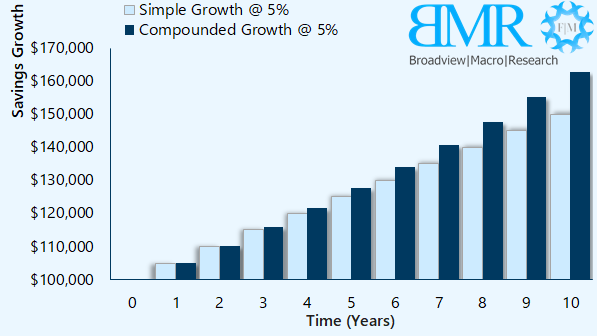
What’s more the compounded excess return at 5% is nearly 28x larger than the 1% return when measured over a 10-year period. So, the point here is that with a little time and a decent rate of return you can make your money work for you in a very meaningful way.
Keeping Your Money Growing During Uncertain Times
So, what can you do right now to keep money growing during these uncertain times? Let’s review the two key points we’ve already touched on. For starters, consider your process. It will be increasingly difficult for you to grow and build enduring wealth if you’re undisciplined in the way you create wealth during this time of economic volatility and uncertainty.
If you’re serious about growing wealth, we recommend that you start by taking the time today to gauge your wealth creation habits. You can start by going back and reading our last report. But generally speaking, this includes evaluating the alignment between your wealth habits and intentions, how you’re maximizing value for your employer or clients and the extent to which you are saving and using debt wisely.
“The stock market is a device to transfer money from the impatient to the patient.” –Warren Buffett
The other thing that you can do to grow wealth in today’s environment is to keep in mind that enduring wealth can grow meaningfully when given time and a reasonable rate of return. Financial markets have experienced wide swings in prices lately. And it’s also likely that non-financial assets (like real estate) could see downward pressure in the coming months as well.
Our point here is that there may be a temptation to chase swings in the markets in an attempt to catch an asset while it’s on sale. Well, rather than spending your time and energy trying to time the markets, or looking for a good market entry point we recommend looking for assets that can provide a generally consistent rate of return and that are in alignment with your long-term goals and risk tolerances. With a little time and a decent rate of return, you can make your money work for you in a very important way.
Figure 7: Time and A Reasonable Return Go a Long Way

In short, we believe it’s still possible to grow wealth even in this challenging economic and market environment. You can do this by sticking to a disciplined wealth management process. This begins by systematically creating wealth and then using the law of compounding to make your money work for you. No matter your current circumstances, we believe that people from all walks can start building enduring wealth today simply by following a few key steps to create, grow and preserve their financial wealth.

Three quick steps to help manage financial anxieties during uncertain times
If the coronavirus, recession angst or elections are keeping you up at night or have generally increased your level of anxiety, you can take comfort in knowing that what you’re feeling is natural. In fact, our brains are primed for an anxiety response during times of heightened uncertainty. At least that’s according to one research paper published in the journal Nature. And as the researchers point out, higher levels of uncertainty disrupt our ability to assign clear probabilities of success to our desired life plans and goals. When this happens, chemical messengers tend to activate the same centers that control the “fight or flight” response in our brains. The result?
When anxieties build to the point that a fight or flight response is activated, panic can ensue, leading to a set of decisions and actions that may appear irrational in hindsight, yet seeming rational in the moment. From a financial perspective, panicked behavior can include anything from hoarding resources or doubling down on losing bets to selling fundamentally sound investments during a bout of financial market and economic volatility. And while anxiety may build during periods of uncertainty, panic may not be a foregone conclusion during these times. To be sure, the solution may lie in the act of exposure, desensitization and acceptance. So what exactly do we mean here?

Who me, worry?
Well, the idea is that repeated exposure to the things that trouble us the most can, over time, desensitize our brain to our concerns, reduce anxiety and dull our innate panic response and generally increasing one’s ability to constructively deal with highly uncertain events. While this approach is more actively utilized in treating patients with certain phobias like fears of animals or insects, the process can be useful in reducing financial anxieties at a broad level. How so? Well, this can be accomplished by actively embracing the potential for a negative outcome, putting the possible consequence in context and developing tangible action steps to help mitigate their expected negative effects.
Let’s revisit what could go wrong from a financial perspective as a result of the coronavirus outbreak. In brief, we believe that the coronavirus has had both direct and indirect impacts on the global economy that are yet to be determined. Either way, in the most affected parts of the world, like China, the direct effects have been lower consumer spending and business activity resulting from mandatory quarantine and self-isolation on account of the coronavirus. One of the indirect effects of the outbreak has been supply chain disruptions that are making it harder for firms in less affected countries (like the U.S.) to get the products they need to do business.
What this means is that global economic growth is likely to suffer in the coming months as household spending and business activity fall (assuming that a solution to the outbreak is not found soon). While risk assets have in recent days bounced in response to global monetary and proposed fiscal support, the fact is that corporate earnings growth is likely to slow in the months ahead, making assets like stocks more expensive. And as the risk of a U.S. recession rises, we expect economic and financial market volatility to remain elevated for quite some time. So, what can households and investors do to prepare amidst increasing uncertainties?
Figure 1: U.S. recession risks remain elevated
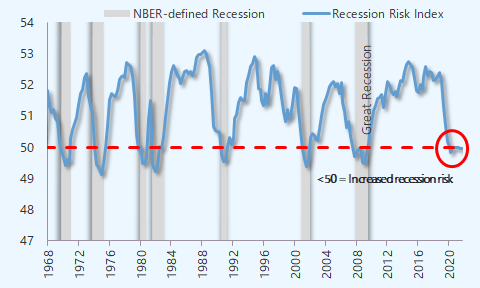
Gain some perspective
For starters, gain some historical perspective and keep an eye on the future. While the coronavirus has not yet been characterized as a pandemic by the World Health Organization (WHO), it could be on track to be more disruptive than the H1N1 virus of 2009. Even so, what’s important to note amidst today’s developments is that in some ways we’ve been here before.
In fact, as a civilization we dealt with a host of health epidemics in the 20th and 21st century, in the last 100 years the global economy has weathered 30 major military conflicts and six global recessions since 1970. During this time, we’ve also witnessed the rise and fall of various political and economic systems and yet, by some measures, global wealth has steadily risen, and poverty levels have fallen. What’s the point?
The point is that despite the concerns surrounding the coronavirus, state of the economy or potentially disruptive nature of elections this year, over the long term economic and financial market conditions are more likely than not to rise in the future. While market volatility and uncertainty can generate uncomfortable feelings in the near term, it is also helpful to remember is that similar events have come and gone over the years. Therefore, revisiting and staying committed to long term goals could help even the most anxious households and investors better navigate near-term uncertainties.

Take action today
Besides gaining some perspective and staying focused on long term goals, what are some tangible actions that households and investors can take to navigate short term economic and financial market volatility? First, build up your cash reserves to help prepare for the unexpected. This includes boosting cash flows by reducing non-essential household spending and lowering interest expenses by refinancing high cost debts. This is important because we expect employment conditions to become less solid should economic uncertainty increase in the months ahead. Therefore, having enough cash on hand to cover 6-12 months of living expenses will be key to bridging disruptive life events.
Next, we recommend investors avoid trying to time the market bottom or, alternatively, selling everything and going to cash. Rather, at this juncture our advice for investors is to keep an attitude toward investing that is rooted in fundamentals and maintaining broad exposure to the markets. This begins with ensuring that portfolio allocations are strategically aligned with long-term goals. And with the market poised to move lower in the near term, we believe that now is the time to look for investment opportunities in solid defensive names, like consumer staple companies, that are positioned to weather periods of sustained market volatility.
Finally, when the economic and market outlook begins to feel out of control, we recommend embracing radical acceptance. That is, accepting life as it is and not resisting what can’t be changed. To be sure, there are arguably more topics of great consequence today creating angst than there has been in years. And while it may be tempting to take a passive posture towards today’s uncertainties, we believe that now more than ever is the time to begin taking proactive steps to preserve long-term goals. This includes educating (exposing) yourself about the potential effects of today’s events, staying rooted in a historical perspective and taking proactive steps to ensure that you can weather near term economic volatility to achieve your long-term goals.
Feeling Stuck Financially? Hit the Reset Button.
You've been diligent with your money. You've amassed sizable savings. Then life knocks on your door – a once-in-a-lifetime opportunity falls through, work moves you to another state, a family emergency calls, or your primary source of income evaporates. Years of diligent financial progress comes undone in an instant, and now you feel stuck.
Or maybe you're in a position where you've struggled for years to get a handle on your finances, but one disruption after the next keeps you from moving forward. In either case, what can you do when your financial life is stuck? Hit the reset button. Indeed, you can often get your financial life back on track much sooner than you would otherwise by pausing, resetting expectations about your goals, and being methodical in your approach to rebuilding your finances.
Pause and Disconnect
Unplug it and wait a minute. Shutdown your computer. Power down your device. If you've ever encountered a problem with technology, then one of these phrases will likely be the first recommendation you'll receive to correct the problem. While such advice often comes after you've spent many frustrating hours trying to get your router, computer, or phone to do what they're supposed to do, the simple solution often does the trick.
But what do you do if your net worth or savings have declined in value recently? After years of building up your nest egg, what remains today is only a fraction of its once glorious worth after a down move in the markets, a family emergency, or loss of income. During such times it's quite common for feelings of discouragement and negative self-talk to emerge, and you may even feel the temptation to make a big-ticket purchase or have the desire to double down on a loss.
One of the quickest methods, however, to reduce money-related anxieties and regain a sense of financial empowerment in your life during a time of loss or transition is to stop what you are doing, pause and take a break. Doing so may enable you to postpone financial decisions that you may later regret while giving you the ability to assess events that may or may not have been within your control.
What's more, like a project post-mortem or military debrief, the initial act of disconnecting from your financial routine shifts your focus from trying to fix a problem to reviewing lessons learned that might enable you to see opportunities in your new setting. More importantly, pausing and disconnecting may prepare you to rebuild your financial life in a way that is authentic to the present while making room for future growth prospects.
Reset Your Financial Expectations
In his book, Marshall Goldsmith, "What got you here, won't get you there" writes how successful leaders who progress in their careers must let go of old thought processes and adopt a fresh set of beliefs that fit their higher leadership positions. During times of financial adversity, you may double down on your existing financial habits in a bid to restore what you've lost or to get yourself unstuck. You may even end up taking actions that move you away from your problems like avoiding money related matters or procrastinating on critical financial decisions. What can you do if you find yourself in this situation?
If you want to get your finances back on track after a significant loss, then one of the first things you'll likely need to do is pause, disconnect, and identify an ideal financial outcome to move towards. The trouble with repeating old habits or moving away from an unfavorable situation is that your focus remains hinged on the past. For example, an at-bat baseball player is unlikely to get a base hit by worrying about striking out rather than focusing on the pitch.
So, what can you do to shift your focus to the future? Reset your expectations. Start by getting crystal clear about how you want your financial future to play out, given everything that has led you to the present circumstance. If your current financial situation causes feelings of disappointment, start thinking about the kinds of outcomes that would lead to feelings of achievement. And while goals, in general, are an excellent place to start, be sure to create financial objectives that set out specific outcomes for your life’s aim.
To be sure, your chances of getting financially back on track will rise when you reset your expectations from past mistakes and shift your focus toward ideal future outcomes.
Get It All Out on the Table
Your new financial objectives focus on the future and tell you where you're heading. But how exactly will you get there? Now's the time to sort through bills, statements, and reports and get everything on the table to evaluate your available financial resources. Think about this process from the perspective of a professional home organizer.
An individual may hire a professional organizer because they have a vision for how they would like their home to look and feel, but not sure what to do with all of their clutter. In some cases, a professional organizer will clear all the belongings out a room and work with their client, item by item, to decide on which pieces fit (and do not fit) into the future vision set out for their home.
After you've had a chance to reset your expectations, gather financial documents that will help you understand your debts, assets, and cash flows better. Start by pulling a copy of your latest credit report. This information will help you learn more about your outstanding debt, credit availability, and minimum payments on your various loans. Also, review statements or call your lender to determine the interest rate on your accounts.
Then, gather a list of your assets. Start with the current balances on your checking, savings, brokerage, and defined contribution accounts like a 401(k) or 403(b). Be sure to include retirement accounts left behind at an old job and pay particular attention to the cash values of defined benefit pension plans available to you. Also include the equity in your home, value of your automobiles, motorcycles, and any other readily saleable non-financial assets.
Next, make a list of all the expenses you have and expect to address soon. A straightforward approach to this end is to pull up your bank or credit card statement and review your purchases from the past three months. Then, categorize your expenses as either essential, discretionary, or savings. Computer software and phone apps can help automate and simplify this process. Either way, your aim is to capture and understand trends in your spending patterns.
Keep in mind that this process is likely to evoke mixed emotions as you recount past financial decisions. That's why it's essential to pause, disconnect, reset your expectations, and focus on the future as you develop a broad picture of your finances. Remember, a professional organizer removes belongings from a room to decide what to keep and what to throw away. That's why getting all of your finances on the table is crucial to success because without knowing what you've got to work with, it's hard to know what sort of plans to make to achieve your goals.
Prepare for a Marathon, Not a Sprint
If you know someone who has participated in a marathon, you're likely aware of the incremental wins that may have led to that runner's overall victory. For example, going from being a couch potato to running a marathon does not happen overnight, even for some of the fittest individuals. A runner intent on successfully competing in the race will map out the steps they need to take, day to day, week to week to build the endurance necessary to compete in a competition they haven't run before.
The next step in getting your finances back on track is to bridge the divide between your desired financial objectives (future) and the financial resources at your disposal (present). This step can be one the most daunting and is one reason why getting unstuck financially is a marathon, not a sprint.
From this perspective, start mapping out how you will achieve your goals one financial objective at a time. For instance, if your goal is to rebuild your savings that have recently taken a hit, then efforts necessary to achieve this aim may include:
Each of these actions, incrementally, can help you move closer to your savings goal. It's important to note that all of these steps do not have to happen at once. Tackle one task in your plan at a time and go for the most comfortable wins first. In fact, starting with small, bite-sized actions as you take a new approach to your finances will make the task feel less daunting and less overwhelming. What's more, as you mark completed tasks off your list, you're likely to increase your feelings of achievement. And these positive feelings can help you build momentum as you look toward achieving other crucial financial goals.
Knowing When to Get Help
Many tools and resources are available to help you work out the items discussed here on your own. Such tools include websites, apps, books, videos, seminars, and blogs that outline steps to deal with uncertainty and lead to the creation of a solid financial plan.
A time may come, however, when you find that working with a financial advisor may help improve your odds of successfully getting your financial life back on track when compared to going it alone. To be sure, resetting expectations about your goals and thinking through financial objectives can be emotionally taxing, particularly after a significant life transition or financial event.
Maybe you've even done the work to assess your current financial situation but are still unsure how to create a bridge between your current financial situation and your ideal future financial objectives. A financial advisor can help by empathizing with your circumstance while bringing an objective perspective to your state of affairs and making recommendations that align your lifestyle with your desired financial outcome.
At the same time, a financial advisor, in many cases, has access to sophisticated tools and the requisite experience to help find balance in your lifestyle so that you can work toward important goals and still enjoy life today. To be sure, if you don't have the time or inclination to create a plan, but know you have important work to do, bringing in outside help can improve your chances of getting unstuck.
In either case, whether you decide to go it alone or bring in the help of a professional, one of the quickest ways to get your financial life moving in the right direction is to it the reset button. Getting unstuck and putting your financial life back on track begins by pausing, resetting expectations about your financial goals, and being methodical in your approach to rebuilding your finances.