
Ambition Pays: How Moving Roles Can Boost Your Bottom Line
What is the biggest career mistake that many high earning individuals make?
They stay in a job far past its expiration date.
And why is moving on from a bad job so hard to do?
Because leaving means change.
And let's face it, few of us like change.
Especially when it means giving up on all the time and effort you've poured into a situation or simply anticipating the uncomfortable feeling of the unknown.
But you know what?
The truth is that walking away to take a job with more attractive benefits is not only good for you, it can also help keep you out of trouble.
How so?
Well, there's the obvious fact that moving on can open the door to new possibilities and, as we discussed recently, can help you fast-track your way to financial independence.
More crucially, however, the truth is that moving on from an unproductive situation can help you avoid missed opportunities at best and disasters at worst.
But you know, when it comes down to it, walking away from an unfavorable work environment can help you avoid a potentially stalled or derailed career, a lifetime earnings shortfall, and even a long-term negative impact on your health and relationships.
Now, you might think, "this is all easier said than done," right?
Well, here's the thing.
It's one thing to know when to walk away from a bad situation and another to take that leap into the unknown.
That's why taking the time to assess the costs of staying comfortable, understanding what could be holding you back from exploring career opportunities, and knowing which next steps to take can help ease your transition into an unpredictable and yet likely rewarding future.
Understand Why You Haven't Left
Now, before we dive into a discussion about the costs of staying in an unhealthy work environment, let's spend a few minutes exploring why some individuals stay long past a job's expiration date.
And, so, why do we do it?
Why do so many of us well-qualified professionals stay in a work environment that values us for less than we're worth?
Well, the truth is that many of us don't have logical reasons for staying in unfulfilling jobs because our decision-making abilities, especially when it comes to a vocation or earning money, are emotionally driven.
And what are we talking about here?
When Our Emotions are in the Driver's Seat
Well, our decisions are largely based on our primal human instinct to either experience feelings like joy, love, and security or avoid feelings like anger, fear, or disgust from ourselves or the people around us.
And what do we mean here?
Well, when you decide to stay in an unhealthy environment, you might do so because of feelings like guilt of obligation, even when you know better options are out there waiting for you.
For example, if you're dealing with guilt, then you may feel that leaving would waste all the time and effort you've invested in your current job and work environment.
Or, you might feel guilt because you believe that you owe it to a boss or the company for past opportunities they may have given you. At the same time, you may also feel a sense of guilt and shame for wanting to leave behind other colleagues you might otherwise call friends, in a toxic environment.
Now, beyond guilt and shame, the feelings driving your desire to stay in a job may be driven by higher emotions, like holding onto hope that an otherwise bad situation will someday improve.
Now, make no mistake, feeling hope in this situation is essential because, without it, we wouldn't have a reason to get out of bed.
But even basing your career and income decisions on hope itself cuts both ways. That's because, as Viktor Frankl pointed out in his autobiography, the human psyche can take a big blow when it realizes that the thing it's anchored all of its hope on isn't going to happen.
Understanding How Emotions Drive Action
Now, while it may seem like fluff, there's science that backs up the notion that our decisions are driven first by emotions and then by logic.
Indeed, psychologist Daniel Kahneman, in his book, "Thinking Fast and Slow," describes a concept known as System 1 and System 2 thinking.
Now, System 1 is the fast, intuitive, automatic process responsible for quick reactions and gut feelings. System 2, on the other hand, is the slower, more deliberate, and analytical process that helps us solve complex problems.
So then, when you find yourself in an unhealthy work environment, your decision-making process regarding whether to stay or go is influenced by both System 1 and System 2 thinking.
How so?
Well, your System 1 thinking, being fast and intuitive, might immediately react to negative stimuli in your workplace. That's because if you're constantly feeling stressed, anxious, or undervalued, your initial gut reaction might be to flee the situation. And this response is your brain's autonomic nervous system kicking in to protect you from harm.
For example, if you overhear that you've been assigned to a toxic team even after several protests to your managers, then System 1 might trigger feelings of hurt or defensiveness without you consciously processing the context or intent behind the assignment.
On the other hand, your System 2 thinking, which is more deliberate and analytical, will weigh the pros and cons of leaving your job. Or, you might find ways to rationalize the stability of your current position or even criticize the prospects of finding a new job.
Ultimately, however, this slower, more methodical process might lead you to endure the unhealthy environment for a bit longer, especially if you believe there's a chance for improvement or if you deem the perceived costs of leaving to be too high.
Either way, if you've been struggling to get out of a bad job situation and can't understand why, then taking the time to evaluate "how" your body and mind might be processing the current situation could be the first step toward understanding your next move.
Evaluate the Costs of Standing Still
Alright, so now that we've talked about how your emotions and thinking processes can influence your decision to stay in a less-than-satisfactory work environment, let's talk about the costs of doing nothing.
And I get it, by now, some of you out there might be saying to yourselves, "My work environment is pleasant enough and, so I don't have a reason to leave, right?"
Well, your work environment might offer you sufficient pay and amenities to keep you satiated, but the big question here is, "is it the right job for you?"
More specifically, have you ever felt that your current role isn't pushing you forward as much as it used to? Or maybe you're now just going through the motions?
Well, the honest truth is that, more often than not, staying in one role for way too long, no matter how comfortable things may be now, might cost you significantly over the long term.
How so?
Well, let's first look at it from the perspective of professional growth.
Cost: Career Stagnation
Now, early in your career, you might recall that thrill of tackling a new project, or the satisfaction of mastering a complex task, or even the pride in leading a team to success. Indeed, these were the moments that not only defined your career but also helped propel your career to greater heights.
And while these past accomplishments may have landed you a cush assignment today, if you've been in the same role for too long, you might find those past moments of glory becoming few and far between.
And so, without new challenges and responsibilities, it's easy to fall into a staid routine, and that routine can become a roadblock to your professional development.
You know, when it comes down to it, you're capable of so much more, and sometimes, to realize that potential, you need to stop and take a moment to step out of your comfort zone or risk getting left behind.
And how's this possible?
Well, consider the rapid pace of development in the tech sector just this year alone should convince you not to sit on your laurels.
Indeed, everything that’s happened over the past 12 months should be evidence enough that a lack of innovation at large tech firms can become a very real threat to survival in very short order.
Remember the tools and approaches you mastered a couple of years ago?
With the advent of AI, they might already be on their way to becoming obsolete.
Indeed, this reality is especially true for jobs like yours because the tech sector thrives on change.
So then, from this perspective, you need to evolve with the changes to avoid being left behind.
Indeed, if you’re staying static, what you're doing is not only missing out on the latest trends and tools to enhance how you do your work, you're also likely missing out on the opportunity to be at the forefront of the next big thing in tech.
Remember, today's innovations are tomorrow's tablestakes in the tech world. So then, to stay ahead, avoid obsolescence, and keep your career moving forward, you need to place yourself in an environment that constantly challenges you to learn and adapt.
Cost: Financial Stagnation
Now, beyond the career mobility costs of staying in a bad fit job are financial costs that come along with it as well.
How so?
Well, imagine that you're standing at the base of a mountain, looking up at the peak. Now, that peak represents your financial potential, and every decision you make to focus on your professional development is a step you take is a move towards reaching the summit.
And what if you find yourself stuck mid-way up that summit?
Well, this is what can happen when you remain in a less-than-ideal work situation for too long.
To be sure, you're likely a high earner now who has enjoyed the fruits of your labor for quite some time. But have you ever considered that the annual raises you receive in your current static role might not be as lucrative as what you could earn elsewhere?
You know, there's a common misconception that loyalty always pays off.
And sure, while annual raises are a token of appreciation, they often don't match the potential earnings you could secure from a job change or promotion.
That's because in the tech world, where there’s rapid innovation and evolving skills are in high demand, the market rate for your expertise can rise or fall almost overnight.
That’s why if you decide to stay in a cush job for far too long, you might be inadvertently capping your income potential.
And beyond a higher salary, think about all the perks and benefits you could be leaving on the table.
For example, the tech industry is renowned for its competitive pay packages. And so, taking a new role can come with a host of benefits that go beyond just a base salary.
And what are we talking about here?
Well, more specifically, we're talking about better perks, lucrative bonuses, stock awards, and other financial incentives that can significantly boost your overall compensation.
And keep in mind that these aren't just numbers on a paycheck, they're tools for wealth accumulation, future security, and lifestyle enhancement.
Cost: The Emotional Toll
So, now that we've talked about the career and financial costs of staying in a role for far too long, there's one last critical cost that you'll likely want to consider, and that's the emotional toll that comes from staying in a job far too long.
Now, you'll likely recall the excitement you felt when you first started your role and the thrill of new challenges, or the satisfaction of problem-solving, and the joy of innovation early on in your career.
The big question now is, "do you have those same feelings about your current job today?"
You know, the truth is that, over time, doing the same tasks year after year can erode that initial enthusiasm.
Indeed, what was once a passion can slowly grind away into a chore. And you know, this isn't just about feeling bored at work, it's about the creeping sense of mental and physical exhaustion, and with it, a decline in your job satisfaction, which ultimately leads to burnout.
Now, it's critical to note here that burnout isn't just a buzzword. It's a genuine state of emotional, physical, and mental exhaustion brought on by dealing with stress for way too long. This is especially true when your job no longer ignites your passion, and sucks energy out of you, instead of enriching you, which can bring on burnout much faster than you think.
Alright, so, maybe your job isn't pushing you over the edge towards burnout, but there is the issue of mental stagnation that you should be aware of.
And why is mental stagnation important?
Well, the human mind thrives on novelty and challenge. In fact, it's how we grow, learn, and evolve. But feelings of monotony can set in when you're stuck in a role that no longer pushes your learning boundaries.
Now, it's critical to note here again that this isn't just about feeling bored, but rather, it's about the impact on your mental well-being.
Indeed, a stagnant mind can lead to lower motivation, lower creativity, and even feelings of depression. And even as someone at the top of your game, you deserve a role that challenges you, and excites and fulfills you mentally.
So then, when you're in a role that taxes you mentally, it can take a physical toll on your body.
How so?
Well, it's a well-documented fact that our mental state can manifest as physical symptoms in our bodies. Therefore, a lack of motivation or enthusiasm in a stagnant role could lead to tangible health issues.
For example, you might find yourself feeling constantly fatigued, battling frequent headaches, or even grappling with chronic conditions that are exacerbated by stress.
To be sure, your body has its way of signaling when something's amiss, and these symptoms can be its way of telling you that it's time for a change. And while the financial and career implications of staying in a less than ideal work situation are evident, the impact on your personal fulfillment and health is just as significant.
Break Free from Your Stagnant Role
Alright, so now that you understand the motivations for not leaving a job, and the costs of staying, what can you do to prepare yourself to leave?
Indeed, what can you do when you find yourself in a role that no longer fuels your passion or challenges your capabilities?
Well, here are a few things you may want to consider.
Start with Self Reflection
First, start with a moment of self-reflection. You know, it's easy to get caught up in the daily grind and lose sight of the bigger picture of where your career or even your life is headed.
That's why, when you're at this critical juncture and ready to make your next move, the first thing you should do is pause and ask yourself: "What do I truly desire from my career? And, "does my current position align with those aspirations?"
Remember, it's not just about the paycheck, it's about fulfillment, growth, and the legacy you want to leave behind to your family and in your community.
Tap into and Grow Your Network
Next, take some time to reignite or activate your networking efforts.
You know, the tech and business landscapes are ever-evolving, and connections are the lifeblood of opportunities.
They're not just lifelines out of a stagnant or miserable job, they can help you determine whether your next career move could be just as fraught as the one you're leaving.
So then, to up your networking game, you can start by rekindling relationships with former colleagues, make it a point to attend industry events, and always be receptive to forging new professional bonds.
Either way, you never know which conversation might lead to your next big opportunity.
Mentorship as a Change Catalyst
Another thing to consider as you prepare for your next career move is to work with a mentor.
Now, you might think that mentorship only applies to individuals early on in their career, but don't underestimate the power of these relationships.
Indeed, there's a wealth of knowledge to be gleaned from those who've successfully navigated career transitions similar to yours.
That's why it's essential to seek out wisdom from individuals whose career paths you admire and ask for their insights. You know, their perspectives can offer invaluable guidance, and help you avoid pitfalls and capitalize on opportunities you might not have seen on your own.
Now, if mentoring isn't for you, then at the very least, consider working with a career strategist. These professionals specialize in guiding top-tier talent and often offer tailored advice to help you transition into roles that not only match your financial aspirations but also offer the growth and challenges you seek.
At the same time, they can provide valuable insights into market trends, help you position yourself effectively, and even connect you with opportunities that might not be publicly advertised.
Why You Should Walk Away from a Less than Ideal Job
You know, when it comes down to it, in the ever-evolving job market, the only constant is change.
That's why embracing this change, rather than resisting it, is the key to unlocking your full financial potential. As we've discussed, staying in a stagnant role can have profound implications on your career, finances, and overall well-being.
But the journey to breaking free isn't just about recognizing the need for change, it's about equipping yourself with the right tools, mindset, and support system to navigate that transition.
And so, by understanding the emotional and logical factors that influence your decisions, recognizing the costs of standing still, and actively seeking growth opportunities, you can position yourself for success in both your professional and personal life.
Remember, your career is a marathon, not a sprint. Every step you take, even those that lead you into the unknown, is a chance to learn, grow, and redefine your life path and more crucially, take you one step closer to becoming the master of your financial independence journey.


The Executive Way: Treat Your Career Like a Sport
When thinking about your career, it might seem odd to make comparisons to a sport. But when you zoom out and look at the similarities, they’re more closely related than you may think. For example, a common problem many people face as they end their careers and enter retirement is a loss of purpose and a feeling of emptiness because the thing that consumed eight hours a day for the past 40 years is now gone.
Athletes face these same struggles, but a lot sooner in life. However, some athletes find themselves thriving in life after sports because they’ve learned many valuable lessons and picked up traits from their sport that can translate into many other areas of life.
Derek Jeter, former Yankees shortstop and first-ballot Hall of Famer, is now CEO and part-owner of the Miami Marlins and co-founded the media company, The Players’ Tribune. Hall of Fame defensive end Michael Strahan took his talents and football knowledge to live TV and has co-hosted Fox NFL Sunday, $100,000 Pyramid, and even Good Morning America.
While your career may not lead to headlines and TV gigs, there are a few ways that you can treat your career like a sport to set yourself up for long-term success.

The 10,000 Hour Rule
In his book, The Outliers, Malcolm Gladwell claims that it takes roughly 10,000 hours of work to master a skill. While the specific number of hours has been challenged by many, the principle will always make sense: to be great at something, you must put in the work.
Athletes dedicate years, sometimes decades, to their craft to be the best that they can be, and we shouldn’t treat our own careers too different. Over the course of your working career, you’re most likely going to put 10,000 hours of work in by just showing up. However, if you’re intentional about the work that’s being put in, you can begin to propel your career.
For example, this may be getting additional certifications or a graduate degree that allows you to move up in the ranks of your profession. Also, putting in the work of connecting with like-minded people on the same path as you or growing your skillset to make a career change that provides higher potential income.
When you put in the work, it’s hard not to make progress.
Be Prepared for Uncertainty
Just like athletes devote time to be mentally and physically prepared for competition, an effective way to level up in your career is by being prepared. Whether you’re interviewing for a new job or giving a presentation to your team, preparation is critical and impacts how you perform the given task.
When you’re prepared, you’re more confident. The stress that comes with uncertainty disappears when you’ve prepared appropriately, and with that, the likelihood of achieving the desired result is increased.

Be Accountable in Your Work
Being accountable is a trait that impacts many areas of life, even outside of your career. When things don’t go right, which is bound to happen many times over your career, it’s easy to blame other people or external factors. However, by taking ownership of your work, you’ll stand out from other workers, and you begin to build trust with the people around you.
While being accountable to others is excellent, it doesn’t stop there. It’s also important to be responsible for yourself and your goals. For example, if you want to get promoted over the next year and you’ve laid out the steps needed to make it happen, stick to them. Too often, we set goals for ourselves, like New Year’s Resolutions, and end up leaving them behind when life gets in the way.

Embrace Your Team
In both the workplace and sports, being successful almost always requires good teamwork.
The backbone of a championship team usually consists of two essential factors: cohesion and communication. But one doesn’t come without the other. Cohesion is formed through effective and consistent communication. These two traits then begin to form a solid foundation of trust, leading to better, more efficient work.
Having a good relationship with a team or coworkers can create healthy competition, and a great example of this is the sales profession.
Imagine being a salesperson who works alone, didn’t have a team to fall back on, and didn’t know how the rest of the team was performing. They might get discouraged or lose sight of the end goal. So, there’s a reason that most sales teams operate together - it can create a healthy competitive atmosphere, increases engagement, and keeps everybody’s motives and goals aligned.
Aside from the performance aspect, embracing your team and having an enjoyable workplace makes work that much easier, and the foundation is built through being reliable, offering help to others, and being a good teammate.
The Takeaway
In our careers, it’s easy to lose sight of an end goal and feel like we’re not making progress. But when you treat your career like a sport and strive to get better, it starts to feel like a natural part of your life, not just another task to check off the list each weekday.

Personal financial playbook: your path to getting ahead
-
Households will face many near- and long-term financial market complexities and economic uncertainties in the years to come. A personal financial playbook can help people get ahead despite these challenges.
-
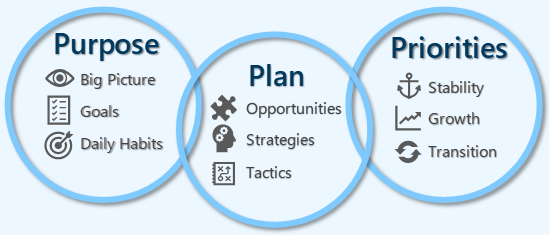
We believe that a flexible and adaptable personal financial playbook should include three important elements: 1) a well-defined statement of financial purpose, 2) prioritization of financial outcomes and 3) a financial operating plan.
-
Partnering with a trusted advisor can also potentially multiply your chances of achieving your financial goals and getting ahead in 2020.
Certainly, when it comes to getting ahead financially, households will face many near- and long-term financial market complexities and economic uncertainties in the years to come. And as we have noted in prior posts, the strategies for financial success that had worked in the past are not as effective as they once were, leaving many households financially insecure and unprepared for economic shocks. So, how can you prepare for the unexpected and position yourself to get ahead in life financially?
We believe that getting ahead financially means letting go of the notion of a traditional financial playbook, rules-of-thumb and other one-size-fits-all money solutions. We believe that taking an active role in creating a personal financial playbook tailored to allow for flexibility and adaptability can, over time, help you reduce money-related stresses, provide greater peace of mind and most importantly increase the likelihood of achieving life goals.
We believe that a flexible and adaptable personal financial playbook should include three important elements: 1) a well-defined statement of financial purpose, 2) prioritization of financial outcomes and 3) a financial operating plan.
Figure 1: Components of a flexible and agile personal financial playbook
A vision and purpose for your money
To the first point, a statement of financial purpose effectively helps to define the role that money will play in your life. More specifically, it articulates a clear “why” to your money habits and lays the foundation for developing strategies that help you acquire, save and spend financial resources prudently.
Formation of a financial purpose statement begins with a vision for how events would ideally unfold throughout the course of your life, beginning with your final moments and working your way back toward the present. One way to go about this is to answer questions like, “how do I want to be remembered by those closest to me?” or “what sort of legacy would I like to leave behind.” There are no easy answers to these questions by any means, yet the visualization process used to answer these and other similar questions can help crystalize the role that money will play in helping you navigate important life transitions.
Moreover, the process of vision clarification helps to prioritize financial outcomes and identifies the types of opportunities, strategies and tactics for use in achieving your financial goals. Taking the time today to develop a well-defined financial purpose statement has other long-term benefits as well, like creating a sense of financial stability by anchoring expectations during times of increasing economic and financial market uncertainty. Indeed, a quick reference of your financial purpose statement during a time of financial instability or market volatility can help to calm nerves and potentially alleviate a desire to tap long-term savings at inopportunely.
Prioritizing financial outcomes and developing financial strategies
Should you increase savings or reduce spending and if so by how much and when? Prioritization can help answer questions like these by identifying financial strategies relevant to three key financial outcomes: stability, growth and transition. The first outcome, financial stability, utilizes establishes everyday habits and leverages financial strategies that lay the foundation for financial asset growth by working to secure income, managing cash flows and becoming financially prepared when the unexpected strikes.
Figure 2: Key outcomes of financial prioritization
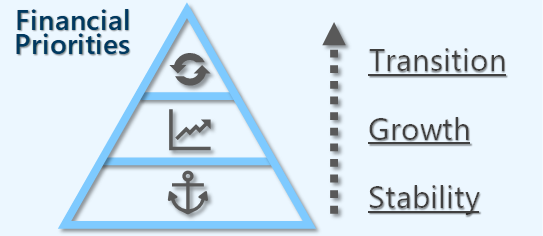
The next phase, financial growth, includes developing financial strategies that aligning practical financial outcomes with passions identified in your financial purpose statement. This can include developing strategies that maximize tax advantaged workplace benefits, increasing your earning potential, and acquiring and growing financial and other non-financial assets. These strategies can be used to fund goals like buying a house, paying for childhood education expenses or funding retirement goals.
In terms of prioritizing transitions, the third phase, we simply refer to the process of drawing down saved assets in a way that balances achieving your financial goals with capital preservation. While the definition is simple, the process is not always easy. Various considerations should be given to the transition outcome, including timing, magnitude and to whom assets are distributed, receiving income during periods of financial market volatility and various tax consequences of early retirement and leaving money behind to family.
Bringing the playbook together: a financial operating plan
The final piece necessary in putting together a flexible and adaptable financial playbook is creating a financial operating plan. Simply put, a financial operating plan outlines the actions necessary to bring together the passions defined in your financial purpose statement with the practical strategies outlined in your financial priorities. Developing a financial operating plan should begin with a thorough inventory of your financial affairs, including data from legal, tax, insurance and bank statements to measure typical cash flows, exposures to risk and an evaluation of assets and liabilities.
A financial operating plan should also include a projection of future or anticipated expenses associated with the vision, goals and habits defined in your financial purpose statement. This could begin with a set of ideal monthly cash flow projections and expand out to savings and growth needs to achieve long-term goals like saving for a child’s education, buying a house, starting a business or retiring comfortably.
Some analytical work will be necessary in the next step of your financial operating plan which includes evaluating your financial inventory against your financial projections. The objective here is to compare activities in your current and ideal financial states in order to select financial and lifestyle strategies that close the current-ideal gap and move you closer toward your desired life and financial goals.
One way a household may choose to close this gap, for example, is in freeing up more money for savings by downsizing lifestyle choices after having adhered to a conservative cash flow strategy. Others may choose to postpone retirement to increase benefits and look to supplement retirement savings with additional sources of savings or income. Whatever the strategies and actions defined in your personal financial playbook, the success of a personal financial playbook is only as good as its use and the degree to which the strategies outlined in it are followed through to completion.
Multiplying your chances of success with the help of a trusted advisor
Indeed, monitoring progress and making needed adjustments to your financial playbook throughout time is critical to ensuring long-term financial success. Yet, life often has a way of diverting our attention away from the things that should be done as more pressing needs arise in the present. Therefore, having the support of a trusted advisor can help keep you on track when the unexpected arises, ensuring that you execute on your financial playbook and increasing your chances of getting ahead in life financially.
Partnering with a trusted advisor has a few additional benefits: first, an advisor can identify financial lifestyle blind spots, like spending above one’s means, that you otherwise may not have been aware of. This unbiased outside perspective from an advisor can help get you back on track when certain financial habits or unexpected life events upset well laid financial plans. Next, working with a trusted advisor can bring a level of objectivity that can help during periods of uncertainty. For example, a trusted advisor can serve as an emotional buffer that keeps your savings plans on track when financial markets are experiencing increased levels of volatility.
Finally, working with a trusted advisor can increase your chances of financial success is by being your accountability partner, ensuring that you are taking the actions necessary today to see your personal financial playbook through to completion. A trusted advisor does this by lending their expertise in guiding you through the process of drawing out your long-term vision, goals and ideal financial habits as well as helping you establish priorities and strategies to get ahead financially.
Who is a trusted advisor?
A trusted advisor is also someone who meets with you regularly, setting up time to review your personal financial playbook progress, cheering you on, holding you accountable and helping you make necessary adjustments to your financial plans to ensure that you get ahead financially.
It is also important to note that not all trusted advisors are cut from the same cloth. So, what is a trusted advisor? Simply put, they have your best interests at heart and more often than not found in a fiduciary relationship. For example, doctors, lawyers and accountants are held to a fiduciary standard, meaning that they must always act in the best interest of their clients. To this point, not all financial advisors are held to a fiduciary standard, a fact that is determined by the type of firm that an advisor works for.
Another point to consider is that compensation can be an adverse motivator for financial advice when it leads to the sale of a security or insurance product. This can create conflicts of interest and potentially bias the advice that an advisor provides to their client. A bias in advice is not only limited to commissions on product sales but also includes asset under management (AUM) fees when an advisor’s compensation is based on the value of assets that he is overseeing. Either way care should be taken when selecting an advisor you can trust.
This post is an excerpt from our report, Getting Ahead Financially in 2020. You can download this report in its entirety by visiting franklinmadisonadvisors.com.
Important Disclosures
Broadview Macro Research is a division of Franklin Madison Advisors, Inc (“FMA”). The commentary provided on this website is limited to the dissemination of general information pertaining to Franklin Madison Advisors’ investment advisory services and general economic market conditions and are subject to change without notice. The information contained herein is not intended to be personal legal, investment or tax advice or a solicitation to buy or sell any security or engage in a particular investment strategy. For additional information about FMA, including fees and services, please contact FMA or refer to the Investment Adviser public disclosures.
Franklin Madison Advisors, Inc., is registered investment adviser firm with its registration and principal place of business in the Commonwealth of Pennsylvania. Registration of an investment adviser does not imply a certain level of skill or training. FMA is in compliance with the current notice filing requirements imposed upon registered investment advisers by those states in which FMA maintains clients. FMA may only transact business in those states in which it is notice filed or qualifies for an exemption or exclusion from notice filing requirements. Any subsequent, direct communication by FMA with a prospective client shall be conducted by a representative that is either registered or qualifies for an exemption or exclusion from registration in the state where the prospective client resides. For additional information about FMA, including fees and services, please contact FMA or refer to the Investment Adviser Public disclosures. Please read the disclosure statement carefully before you invest or send money.
To learn more, visit us at http://www.franklinmadisonadvisors.com
Adjusting to Seismic Shifts
In the blink of an eye the coronavirus has fundamentally changed our world in more ways than we can imagine. While it seems like an eternity ago, it only has been a matter of days since Pennsylvania Governor Tom Wolf issued his first stay-at-home order for a few counties in the state.
This week, the Governor expanded his order to all counties throughout the Commonwealth and for a period of at least 30 days. In recent weeks, many states have enacted their own stay-at-home measures being it necessary to mitigate the spread of the COVID-19 virus. Unprecedented times call for unprecedented measures.
It is needless to say that from a financial perspective, social distancing and self-isolation have created a seismic shift in the economy, in financial markets and in many people’s personal financial plans. Data this week showed that over 6 million people applied for unemployment benefits adding to last week’s catastrophic 3.2 million initial jobless claims.
Figure 1: A 50-fold increase in jobless claims
And to put this number into perspective, the 4-week average just prior to the virus outbreak was sitting at around 200,000 initial claims. That’s a fifty-fold increase in less than two weeks and at no time in post-war history have we seen so many people lose their jobs in such short order.
And so it goes: most people today know someone that has been fundamentally affected – whether it’s in their physical or mental health, finances or otherwise – by the coronavirus outbreak. Without a doubt the unexpected event has fundamentally changed the plans that nearly every single American has laid out for themselves this year and for years to come.
While a number of measures are underway to mitigate the financial fallout from the pandemic, many households and business owners are still struggling to grasp the gravity of the changes underway. With that said, during this time of change, we believe that the best way to rebound from a financial setback is by setting yourself up with a plan to navigate a world that has just gone through a seismic shift.
Government loosens its purse strings
So, what exactly has the government done to address the economic and financial fallout from social distancing measures? Well, in response to and anticipation of further virus mitigation efforts, the government has taken unprecedent actions to shore up the economy. For instance, on March 27, Congress passed the Coronavirus Aid, Relief, and Economic Security (or CARES) Act. This fiscal stimulus package provides more than $2 trillion in aid to individuals and businesses of all sizes and across the United States.
Such a dollar amount is certainly hard to grasp on its own, but in comparison to past stimulus measures, the CARES package is more than twice the size of the American Recovery and Reinvestment Act passed during the Obama administration back in 2009. In terms of what went into the CARES package, there are a number of items geared to help households and businesses. These measures include:
Figure 2: The government will borrow $2 trillion to support households and businesses
Overall, about a quarter of the money from this package will go directly to households, 40% will go to help businesses and roughly a third of the money will go to state and local governments and health and education institutions.
Fed pulls out all the stops
Now on the monetary side, the Federal Reserve has pulled out all the stops to support the proper functioning of the financial system and carry out its dual mandate of price stability and full employment. Put a different way, the Fed today is doing everything it can to support the financial system (and the economy) like it did back in 2008. In reality, under Jay Powell, the Fed is doing much more than it did a decade ago when Ben Bernanke was at the helm.
To this point, early last year the Fed signaled that it would stop raising interest rates, and pivot away from tightening monetary policy and toward easing as economic growth back then started to show signs of fraying. What’s more, in September, the Federal Reserve restarted its asset purchase program after certain events exposed issues in the Treasury market. At that time, the central bank had begun purchasing assets at a rate of $10-20 billion per month.
In March of this year, the Federal Open Market Committee (FOMC) surprised markets when it cut its target policy rate to around zero percent. What this means is that the Federal Reserve wants interest rates to go back to the same level that they were during the height of the Global Financial Crisis a decade ago.
Figure 3: Fed Assets Up Over $2 Trillion in Less Than 7 Months
Also last month, the Fed committed to purchasing corporate and local government debt, it increased the rate of its asset purchases up to $90 billion per day and committed to adding an unlimited amount of assets to its balance sheet for an indefinite period of time. Taken together, the actions from the Fed signal a willingness to get ahead of what is likely to be a very serious downturn in the U.S. economy.
A “V” shaped recovery not likely in the cards
So how do these measures relate to economic expectations? Well, a national poll released on Friday showed that less than half of respondents surveyed believe that the economy will return to normal by the month of June. What this suggests is that the majority of a sample of the American population do not believe that the economy will recover quickly and that the effects of the coronavirus will linger for longer than many policymakers are communicating to the public.
To be sure, we’ve been writing about the fact that global pandemics historically have come in three waves, each with their own recovery period. And so how does this apply today? Well, not only are we right now dealing with the first phase of the outbreak here in the U.S., there are now signs that the outbreak has returned to Asia where – until recently – many countries had thought they contained the coronavirus.
What this means is that social distancing measures in the U.S. are likely to remain in place for longer than most people expect. This also means that businesses may not reopen as quickly as some people anticipate and it means that more workers will likely remain unemployed for longer.
Figure 4: “V” Shaped Recoveries Tend to be Shorter Than “U” Shaped Recoveries
From this perspective, it’s possible that the U.S. and global economy will experience a prolonged “U” shaped rebound and not a “V” shaped recovery as hoped by many economy watchers. Indeed, this view is held by researchers at PIMCO, a widely known asset management firm, who estimate that stability in economic growth could take as long as 12 months to form.
We believe that the reason it could take longer for the economy to recover is because the virus will take longer to contain. And, until a vaccine or significant level of immunity is developed across the global population, the deadly effects of the virus will continue to hamper economic growth. The result is that many firms will simply not be able to restart operations as quickly as some people had hoped.
Adding insult to injury, we have yet to see whether the current fiscal and monetary support packages will be enough to mitigate a broad swath of corporate bond defaults that are now waiting in the wings. To be clear, there is a group of companies that for years have been sitting on the cusp of bankruptcy, if not for the support of the Fed’s money printing operations.
Figure 5: More than 50% of Investment Grade Debt is One Notch Above Junk
What this means is that, in addition to the COVID-19 related risks, the economy and financial markets could get yet another shock from a backlog of ailing companies now filing for bankruptcy protection. In such a scenario, it’s hard for us to see how household spending and business investment could rebound in short order without a sudden drop in new coronavirus cases globally.
"Nimble thought can jump both sea and land."

William Shakespeare
Setting up for a rebound
In terms of how we should be relating to these financially important events, it’s our belief that people should look for the silver linings whenever possible. Without a doubt the spread of the coronavirus has derailed life and financial plans for many people. While the devastation is unique and personal to each one of us, it is also worth noting that the current events provide a unique opportunity to stop and reassess. That is, to take a hard look at what’s really important in each one of our lives.
Illness has a way of naturally slowing us down and forcing us to reevaluate our current life priorities. Sometimes we get so fixated on a goal, or an outcome in our lives, that we lose sight of the really important things that are going on around us. And from a financial perspective, what may have been a priority or an important goal just a few weeks ago may no longer matter as much in light of the current circumstance. In other ways, the current developments may have taken away people and opportunities that have left us feeling lost and disorientated.
“…in life it doesn’t matter what happened to you or where you came from. It matters what you do with what happens and what you’ve been given.”

Ryan Holiday
In his book, “The Obstacle is the Way”, author Ryan Holiday tells us that, “…in life it doesn’t matter what happened to you or where you came from. It matters what you do with what happens and what you’ve been given.” From this perspective, we believe that the best way to rebound from a financial setback is by setting yourself up with a plan to navigate a world that has just gone through a seismic shift.
A Dutch proverb tells us that “he who is outside his door already has a hard part of his journey behind him.” Therefore, whatever the case may be regarding our financial circumstances, one of the most important things that we can do in the coming weeks and months is to simply do something about our financial circumstances.
This can begin by simply reprioritizing expenses to shore up emergency cash reserves to holistically reevaluating financial priorities, taking stock of resources and developing a plan to align financial resources with a new set of life goals. Whatever the case may be, we believe that one key to getting ahead in life financially in the coming weeks, months and years is to take action today.