

How Fast Can You Break Free from Student Loans?
Eliminating student loan debt can put you on the fast-track to achieving your essential life goals. If you’re one of the millions of Americans struggling with this vital issue, you know first-hand the challenges of student loan debt. As student loan balances continue to balloon from one year to the next, what can you do to conquer this overwhelming debt load? Well, many people are waiting for an act of congress to make their student loans disappear.
Yet, chances are that it will be on you to forge a path toward financial liberation. If you’re serious about freeing yourself from student loan debt, you’ll need to take steps that you might not have considered before. These actions include evaluating how much minimum payments on your student loans cost you, curbing unnecessary interest expenses, and finding simple ways to come up with extra cash to pay down loan principal. Making these steps a priority might enable you to eliminate debt sooner and give you the ability to focus your efforts on your most essential life goals.
The Burden of Student Loan Debt
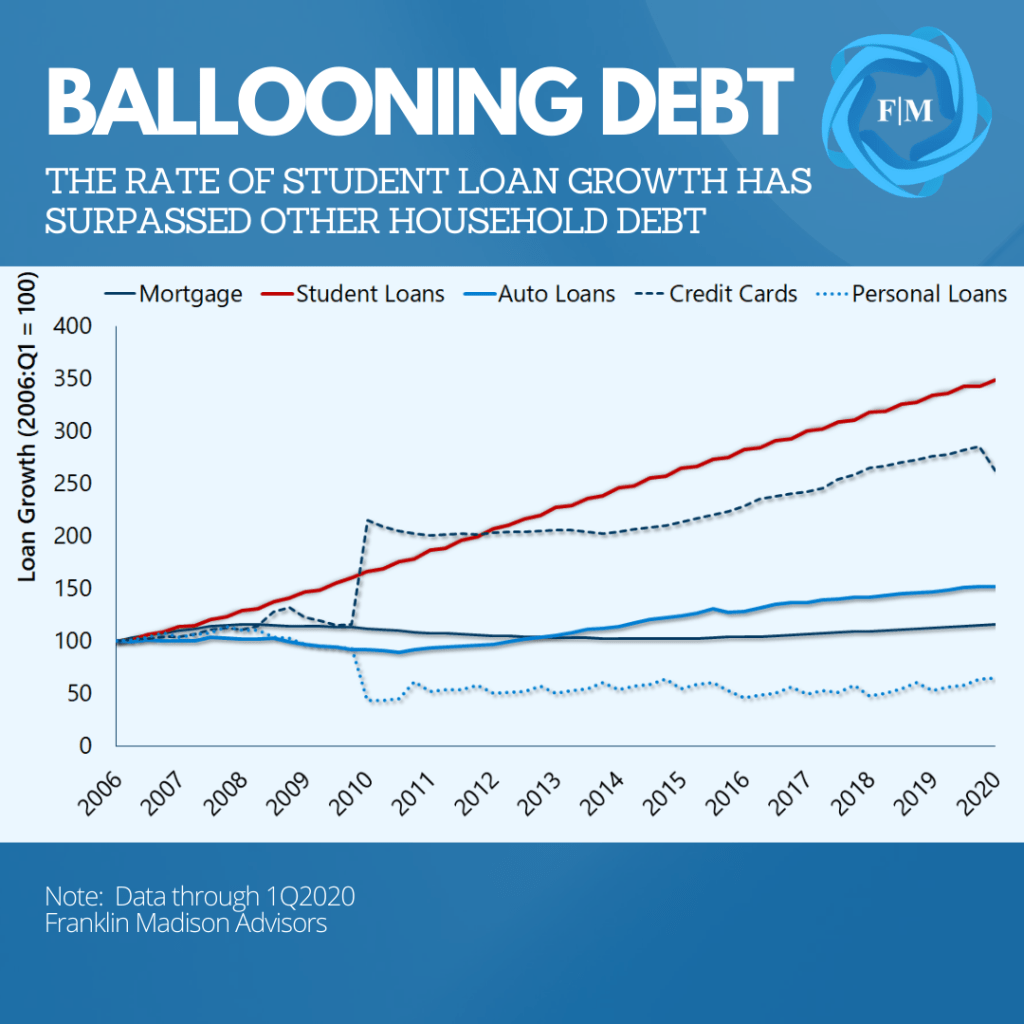
Student loan debt issuance has skyrocketed over the past decade. Government data out in the first quarter showed that total student loan debt outstanding reached $1.7 trillion. Of the amount outstanding, three-quarters were federal direct loans. This ownership share suggests that if you have a student loan, then there’s a good chance that Uncle Sam owns it. And if you feel like your debt burden is unreasonable today, you’re not alone.
Balances outstanding now average $35,000 for the nearly 40 million individuals who have federal student loans -- a figure that has doubled since 2007. And while the number of borrowers has increased by 40% over the past seven years, loan default rates have nearly tripled. If you want to pull yourself out of your student loan debt trap and forge a path to financial liberation, you’ll need to make decisions about your student loans that different than what most people are doing right now.
Relief in Times of Uncertainty
Many college students assume that money borrowed to finance education costs can be reasonably paid back over ten years. This seemingly short payback period is one reason some individuals choose to take on student loans in the first place. By the time they graduate, however, many students accumulate so much debt that they find it challenging to make their standard level payment. That’s when some borrowers choose to utilize income-relative repayment programs.
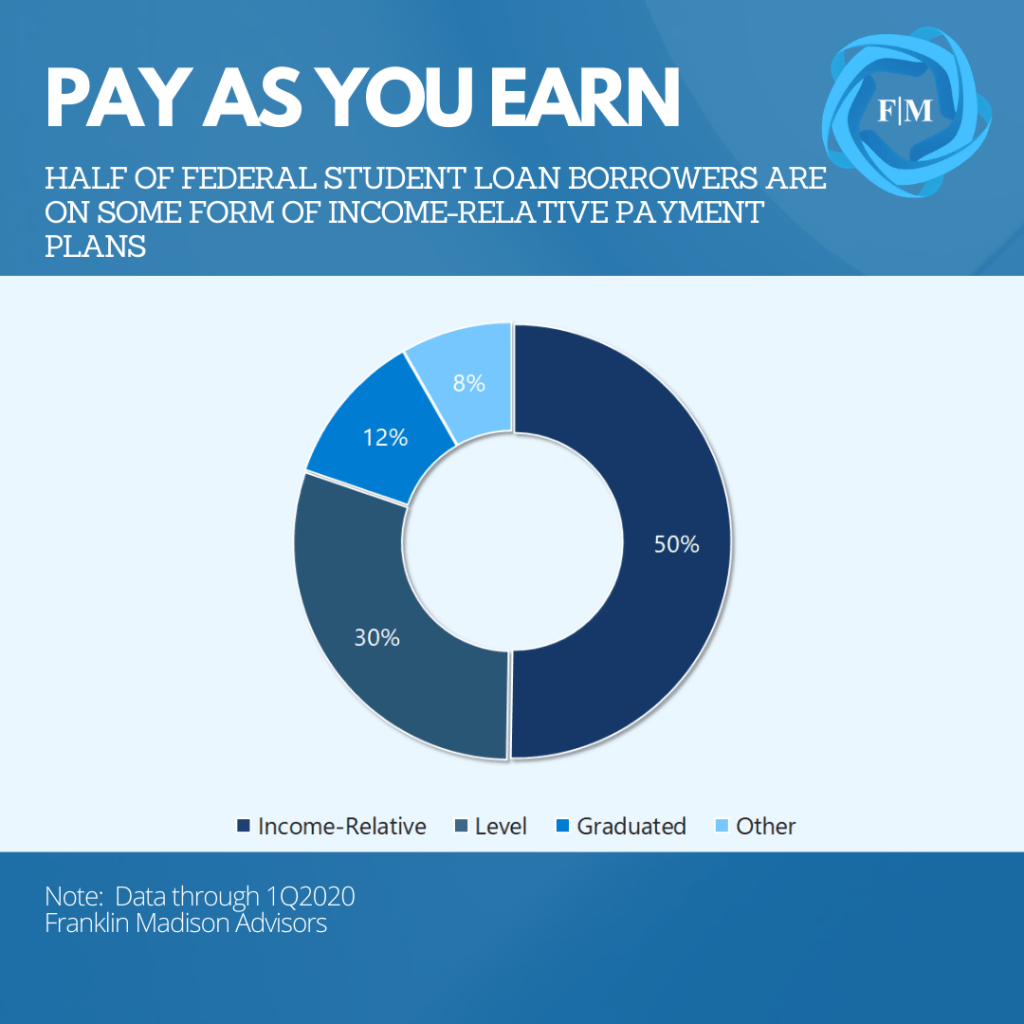
According to government data, over half of federal direct loans are in some form of an income-relative repayment as of the first quarter of 2020. These programs include Pay as You Earn (PAYE), Revised Pay as You Earn (REPAYE), Income-Based (IBR), and Income-Contingent (ICR) Repayment. The common thread running through these programs is that your monthly student loan payments are based on how much you take home per year rather than a level, amortized loan amount.
Income-Relative Plans: Not a Long-Term Fix
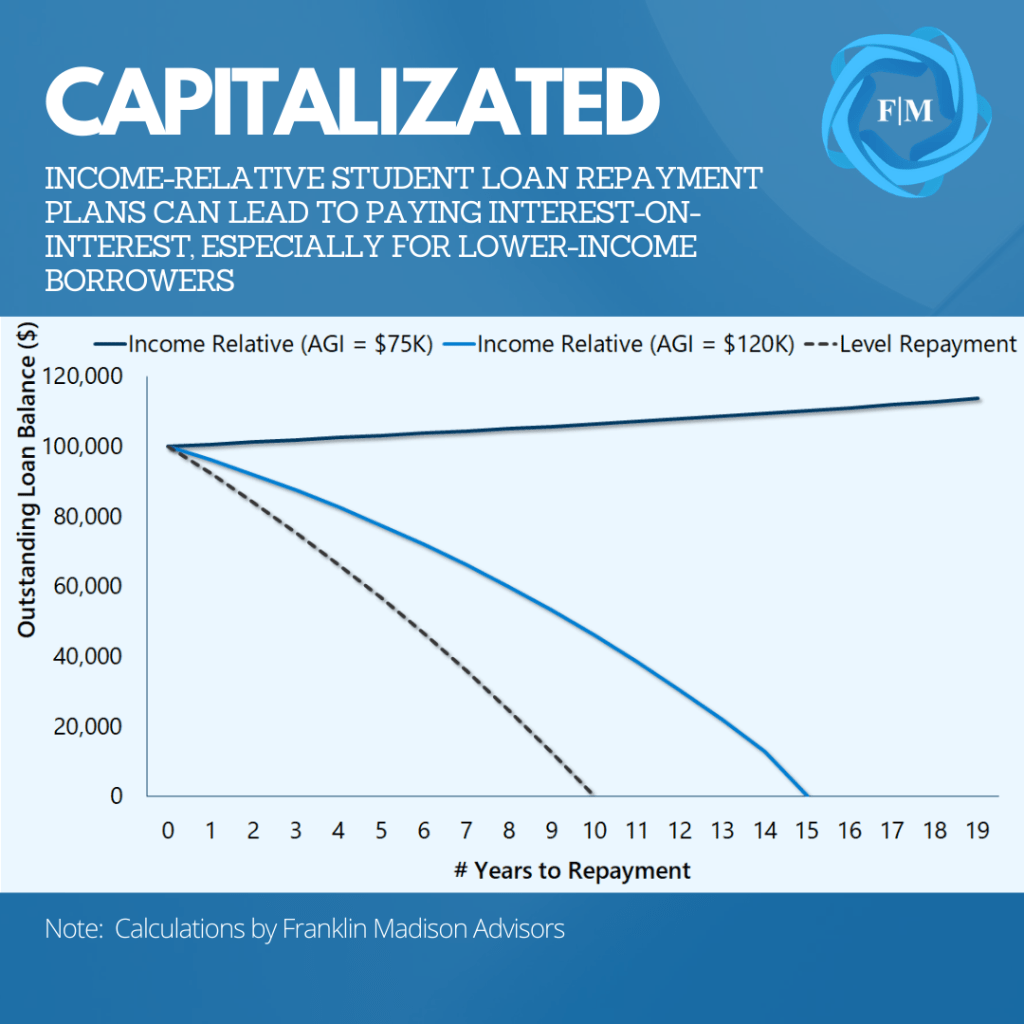
For example, consider a couple with an adjusted gross income (AGI) of $120,000 per year and $100,000 in student loan debt. Under an income-relative plan, the couple might pay an extra $18,000 in interest expense over the lifetime of their loan compared to level repayment. This difference is due to the fact that it would take 16 years to repay the debt compared to 10 years under a level repayment plan, therefore accumulating more interest.
The drawbacks of an income-relative plan become more evident as we move down the income scale. For a similar household with an AGI of $75,000 instead of $100,000, lifetime interest payments would be nearly $84,000 higher than compared to a level plan. What’s more, because monthly payments barely cover interest expenses in this scenario, the unpaid interest is capitalized or, in other words, added back to the principal amount of the loan.
The effect is that the borrower’s total loan outstanding rises over time rather than being paid down. While many income-relative plans allow for loan forgiveness after 20 or 25 years, these borrowers are not completely off the hook. Debt forgiven is, in some cases, considered taxable income. Therefore, the remaining balance might lead to a tax bill of $23,000 for this couple at the end of 20 years.
It is crucial to understand that income-relative repayment plans are an expensive way to pay down your student loan debt. While useful for addressing short-term challenges to your financial situation, these programs should not be relied upon as a long-term approach to paying down debt. If you’re participating in an income-relative repayment program, and are serious about conquering your student loan debt, it might be time to examine what this payment program is costing you.
Avoid Capitalizing Interest
If you’ve ever experienced hardship as a student loan borrower, you probably know how payment forbearance can help you manage obligations during times of financial uncertainty. Forbearance programs allow you to delay making payments on federal direct (and some other loans) for up to 12 months at a time. And today, there are approximately 3.8 million direct loan borrowers in forbearance with outstanding balances that are growing at a rapid rate.
While beneficial in the short-term, this program can undo the progress made on paying down your loans and, in some cases, leave you with a higher balance than with what you started. As noted earlier, capitalizing interest expenses is the quickest way to derail your student loan repayment plans. While income-relative programs might lead to higher debt levels for certain individuals, participating in a forbearance program will almost certainly cause your outstanding loan balance to rise. Let’s use an example to demonstrate this point.
The Cost of Forbearance
Recall the earlier illustration of a couple with a household AGI of $120,000 and $100,000 in student loan debt. Under an income-relative repayment plan, they might pay off their student loans in about 15 years, costing them about $152,000 over the lifetime of their loan. Now, what would happen if we introduced forbearance into the picture?
Assuming that this couple used forbearance to delay payments by 36 months, their student loan would cost over $191,000 by the time the debt is paid off and $40,000 more than had they avoided forbearance. Capitalized interest increases the outstanding loan balance and leads to paying interest on top of interest. What’s more, in this scenario, the payback period for the loan goes from 15 years to more than 20, leading to a hefty tax bill when the loan is forgiven.
And how does forbearance affect level repayment plans? Well, $100,000 in student loan debt amortized over ten years at 5.5% interest will accumulate about $33,000 in interest expense. Placing their loans into forbearance for 36 months, the couple would end up doubling interest expense. Because the borrowers are now making up for lost time when payments were postponed and paying interest on top of interest, it might take 15 years to repay their level loan versus the 10 years had the borrowers avoided forbearance.
The point here is that while forbearance is a useful tool that can help you navigate times of financial stress, when possible, it should be used only as a last resort. More to the point, if you do come upon tough financial times, prioritizing interest payments can help you avoid capitalization. Indeed, if your goal is to quickly conquer student loans and pay down your debt, then not paying interest on top of interest is crucial to this aim.

A Little Extra Goes a Long Way
Income-relative repayment plans can lengthen the time it takes to repay your student loans, while forbearance can lead you to pay interest on top of interest. If your aim is to eliminate student loan debt, consider alternatives to income-relative payment plans, and avoid forbearance. Then, create a strategy to make additional principal payments on your student loans.
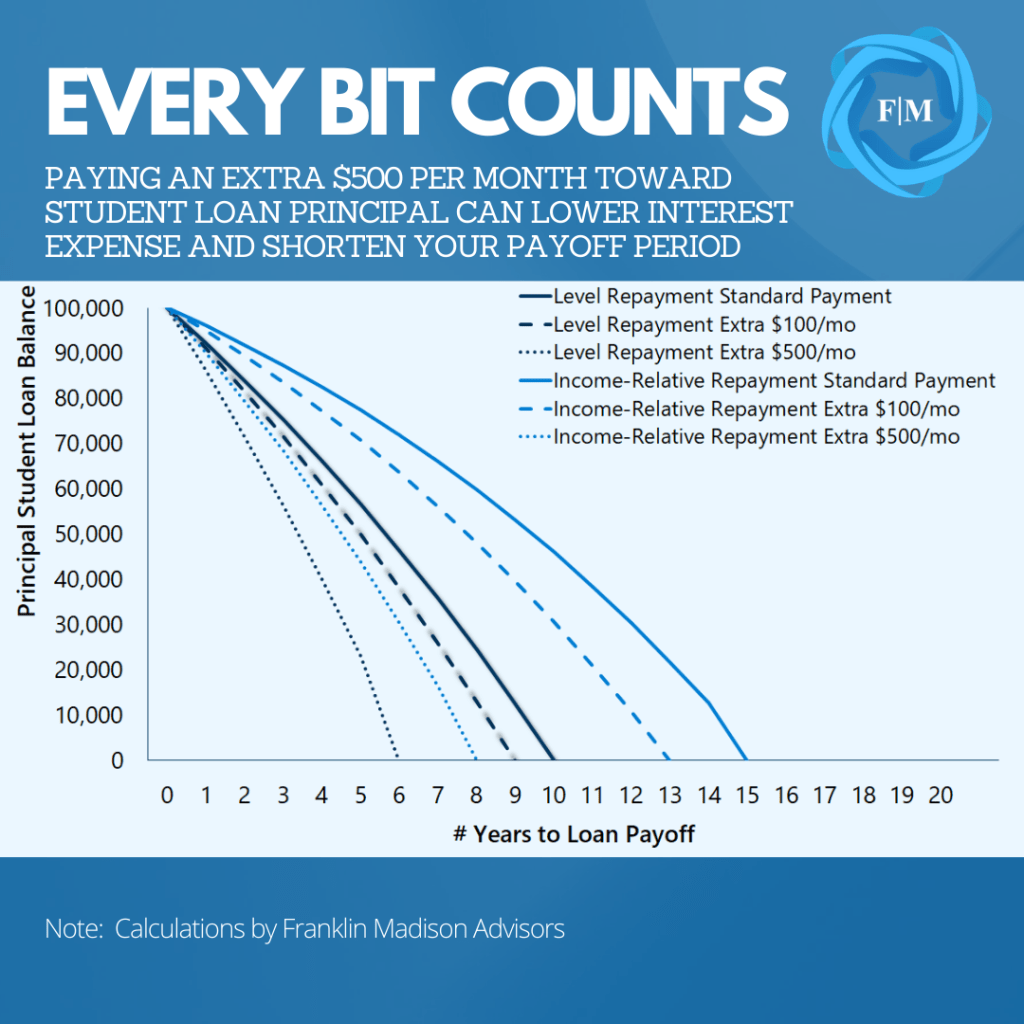
Indeed, whatever your chosen repayment program might be, every extra payment you can make on your loans can shorten the time it takes to pay off your debt and reduces interest expenses. For example, finding a way to pay an extra $100 per month on a $100,000, 10-year level repayment student loan can modestly reduce interest costs and cut your student loan payoff period by a full year.
How does this apply to income-relative payment plans? When using some of the same assumptions as before, making an extra $100 payment on your student loans can result in even more significant financial savings and shorten your payback period. Recall that for a couple with an AGI of $120,000 and $100,000 in debt, it might take them just over 15 years to pay down their student loans. By paying down an additional $100 in principal per month, they can eliminate debt in 13 years and save over $8,000 in interest expenses.
Taking this example one step further, let’s look at increasing principal payments from $100 to $500 per month. In our 10-year level payment scenario, committing $500 per month to principal reduction would reduce the repayment period to just over six years and lower interest expenses by a third. For the income-relative scenario, a similar contribution could cut lifetime interest costs and the repayment period in half. The point here is that every dollar that you can commit to paying down principal puts you one step closer to student loan debt liberation.
How to Eat an Elephant
Desmond Tutu was once quoted as saying that the only way to eat an elephant is a bite at a time. In the case of student loans, paying down your debt won’t happen overnight. However, as we just illustrated, finding ways to commit even a little extra money to pay down student debt principal can shorten your payback period and minimize interest expenses.
Even so, finding an extra $100 or $500 per month might seem like a daunting feat for some individuals. What can you do to come up with extra money to pay down your student loan debt faster? Here are a few suggestions:
- Make a Budget, Prioritize Debt Repayment– What gets measured, get managed. Knowing where your money is going every month can help you identify ways to reduce or eliminate spending and free up cash that can be applied to paying down student debt. The short-term sacrifice of prioritizing debt repayment by reallocating spending away from non-essential matters and toward paying down your debt for the next few years might lead to a lifetime of financial gain.
- Pay Down Smaller Debts First – If you have multiple student loans, prioritizing the payoff of your smallest balances can help free up cash to pay down your higher balances. The idea here is to quickly pay off debts with low balances and then apply the extra monthly cash flow to pay down your next smallest account balance, repeating until your student loans are paid off. Applying this same principle to credit card balances is another way to free up some extra cash. On average, Americans carry credit card balances of $6,200 and make minimum payments of $120 per month. Paying off your small credit card balance then applying those payments to your student loans is another way to reduce your student debt quickly.
- Consider Refinancing – Interest rates have fallen considerably over the past year. With student loan rates as low as 3.5%, refinancing higher interest student loan debt can lower your monthly payment. You can then use the money saved on your monthly payments to pay down principal . However, keep in mind that certain benefits afforded to federal student loans (like forgiveness) may not apply if refinanced with a private lender.
- Use Windfalls to Pay Down Debt – You’re likely to come into some financial windfalls during the year. For example, many people receive a bi-weekly paycheck yet pay expenses monthly. This means that twice a year, you’ll have “extra” checks coming your way. If your budget allows for it, consider using these additional paychecks to pay down student loan balances. Also, consider applying other windfalls, like a tax refund or your stimulus check toward your principal loan balance.
Student Loan Debt Liberation Begins with You
What could you do with an extra few hundred or thousand dollars per month right now? For some individuals, this additional cash might make the difference between buying a bigger house or a newer car. It could even mean getting closer to critical financial goals like funding a college savings plan for their children or shoring up retirement savings.
While many people are waiting on an act of congress to make their student loans disappear, you will likely need to forge your own path toward financial freedom. This includes limiting the use of costly income-relative repayment plans and avoiding capitalized interest. To be sure, taking a measured approach to paying off your student loans may liberate you from seemingly impossible debt and put you on the fast-track to achieving your essential life goals.


Personal financial playbook: your path to getting ahead
-
Households will face many near- and long-term financial market complexities and economic uncertainties in the years to come. A personal financial playbook can help people get ahead despite these challenges.
-
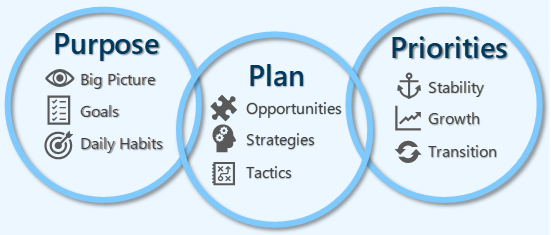
We believe that a flexible and adaptable personal financial playbook should include three important elements: 1) a well-defined statement of financial purpose, 2) prioritization of financial outcomes and 3) a financial operating plan.
-
Partnering with a trusted advisor can also potentially multiply your chances of achieving your financial goals and getting ahead in 2020.
Certainly, when it comes to getting ahead financially, households will face many near- and long-term financial market complexities and economic uncertainties in the years to come. And as we have noted in prior posts, the strategies for financial success that had worked in the past are not as effective as they once were, leaving many households financially insecure and unprepared for economic shocks. So, how can you prepare for the unexpected and position yourself to get ahead in life financially?
We believe that getting ahead financially means letting go of the notion of a traditional financial playbook, rules-of-thumb and other one-size-fits-all money solutions. We believe that taking an active role in creating a personal financial playbook tailored to allow for flexibility and adaptability can, over time, help you reduce money-related stresses, provide greater peace of mind and most importantly increase the likelihood of achieving life goals.
We believe that a flexible and adaptable personal financial playbook should include three important elements: 1) a well-defined statement of financial purpose, 2) prioritization of financial outcomes and 3) a financial operating plan.
Figure 1: Components of a flexible and agile personal financial playbook
A vision and purpose for your money
To the first point, a statement of financial purpose effectively helps to define the role that money will play in your life. More specifically, it articulates a clear “why” to your money habits and lays the foundation for developing strategies that help you acquire, save and spend financial resources prudently.
Formation of a financial purpose statement begins with a vision for how events would ideally unfold throughout the course of your life, beginning with your final moments and working your way back toward the present. One way to go about this is to answer questions like, “how do I want to be remembered by those closest to me?” or “what sort of legacy would I like to leave behind.” There are no easy answers to these questions by any means, yet the visualization process used to answer these and other similar questions can help crystalize the role that money will play in helping you navigate important life transitions.
Moreover, the process of vision clarification helps to prioritize financial outcomes and identifies the types of opportunities, strategies and tactics for use in achieving your financial goals. Taking the time today to develop a well-defined financial purpose statement has other long-term benefits as well, like creating a sense of financial stability by anchoring expectations during times of increasing economic and financial market uncertainty. Indeed, a quick reference of your financial purpose statement during a time of financial instability or market volatility can help to calm nerves and potentially alleviate a desire to tap long-term savings at inopportunely.
Prioritizing financial outcomes and developing financial strategies
Should you increase savings or reduce spending and if so by how much and when? Prioritization can help answer questions like these by identifying financial strategies relevant to three key financial outcomes: stability, growth and transition. The first outcome, financial stability, utilizes establishes everyday habits and leverages financial strategies that lay the foundation for financial asset growth by working to secure income, managing cash flows and becoming financially prepared when the unexpected strikes.
Figure 2: Key outcomes of financial prioritization
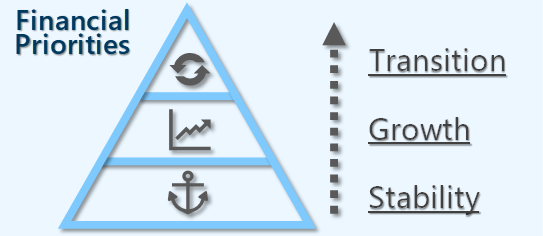
The next phase, financial growth, includes developing financial strategies that aligning practical financial outcomes with passions identified in your financial purpose statement. This can include developing strategies that maximize tax advantaged workplace benefits, increasing your earning potential, and acquiring and growing financial and other non-financial assets. These strategies can be used to fund goals like buying a house, paying for childhood education expenses or funding retirement goals.
In terms of prioritizing transitions, the third phase, we simply refer to the process of drawing down saved assets in a way that balances achieving your financial goals with capital preservation. While the definition is simple, the process is not always easy. Various considerations should be given to the transition outcome, including timing, magnitude and to whom assets are distributed, receiving income during periods of financial market volatility and various tax consequences of early retirement and leaving money behind to family.
Bringing the playbook together: a financial operating plan
The final piece necessary in putting together a flexible and adaptable financial playbook is creating a financial operating plan. Simply put, a financial operating plan outlines the actions necessary to bring together the passions defined in your financial purpose statement with the practical strategies outlined in your financial priorities. Developing a financial operating plan should begin with a thorough inventory of your financial affairs, including data from legal, tax, insurance and bank statements to measure typical cash flows, exposures to risk and an evaluation of assets and liabilities.
A financial operating plan should also include a projection of future or anticipated expenses associated with the vision, goals and habits defined in your financial purpose statement. This could begin with a set of ideal monthly cash flow projections and expand out to savings and growth needs to achieve long-term goals like saving for a child’s education, buying a house, starting a business or retiring comfortably.
Some analytical work will be necessary in the next step of your financial operating plan which includes evaluating your financial inventory against your financial projections. The objective here is to compare activities in your current and ideal financial states in order to select financial and lifestyle strategies that close the current-ideal gap and move you closer toward your desired life and financial goals.
One way a household may choose to close this gap, for example, is in freeing up more money for savings by downsizing lifestyle choices after having adhered to a conservative cash flow strategy. Others may choose to postpone retirement to increase benefits and look to supplement retirement savings with additional sources of savings or income. Whatever the strategies and actions defined in your personal financial playbook, the success of a personal financial playbook is only as good as its use and the degree to which the strategies outlined in it are followed through to completion.
Multiplying your chances of success with the help of a trusted advisor
Indeed, monitoring progress and making needed adjustments to your financial playbook throughout time is critical to ensuring long-term financial success. Yet, life often has a way of diverting our attention away from the things that should be done as more pressing needs arise in the present. Therefore, having the support of a trusted advisor can help keep you on track when the unexpected arises, ensuring that you execute on your financial playbook and increasing your chances of getting ahead in life financially.
Partnering with a trusted advisor has a few additional benefits: first, an advisor can identify financial lifestyle blind spots, like spending above one’s means, that you otherwise may not have been aware of. This unbiased outside perspective from an advisor can help get you back on track when certain financial habits or unexpected life events upset well laid financial plans. Next, working with a trusted advisor can bring a level of objectivity that can help during periods of uncertainty. For example, a trusted advisor can serve as an emotional buffer that keeps your savings plans on track when financial markets are experiencing increased levels of volatility.
Finally, working with a trusted advisor can increase your chances of financial success is by being your accountability partner, ensuring that you are taking the actions necessary today to see your personal financial playbook through to completion. A trusted advisor does this by lending their expertise in guiding you through the process of drawing out your long-term vision, goals and ideal financial habits as well as helping you establish priorities and strategies to get ahead financially.
Who is a trusted advisor?
A trusted advisor is also someone who meets with you regularly, setting up time to review your personal financial playbook progress, cheering you on, holding you accountable and helping you make necessary adjustments to your financial plans to ensure that you get ahead financially.
It is also important to note that not all trusted advisors are cut from the same cloth. So, what is a trusted advisor? Simply put, they have your best interests at heart and more often than not found in a fiduciary relationship. For example, doctors, lawyers and accountants are held to a fiduciary standard, meaning that they must always act in the best interest of their clients. To this point, not all financial advisors are held to a fiduciary standard, a fact that is determined by the type of firm that an advisor works for.
Another point to consider is that compensation can be an adverse motivator for financial advice when it leads to the sale of a security or insurance product. This can create conflicts of interest and potentially bias the advice that an advisor provides to their client. A bias in advice is not only limited to commissions on product sales but also includes asset under management (AUM) fees when an advisor’s compensation is based on the value of assets that he is overseeing. Either way care should be taken when selecting an advisor you can trust.
This post is an excerpt from our report, Getting Ahead Financially in 2020. You can download this report in its entirety by visiting franklinmadisonadvisors.com.
Important Disclosures
Broadview Macro Research is a division of Franklin Madison Advisors, Inc (“FMA”). The commentary provided on this website is limited to the dissemination of general information pertaining to Franklin Madison Advisors’ investment advisory services and general economic market conditions and are subject to change without notice. The information contained herein is not intended to be personal legal, investment or tax advice or a solicitation to buy or sell any security or engage in a particular investment strategy. For additional information about FMA, including fees and services, please contact FMA or refer to the Investment Adviser public disclosures.
Franklin Madison Advisors, Inc., is registered investment adviser firm with its registration and principal place of business in the Commonwealth of Pennsylvania. Registration of an investment adviser does not imply a certain level of skill or training. FMA is in compliance with the current notice filing requirements imposed upon registered investment advisers by those states in which FMA maintains clients. FMA may only transact business in those states in which it is notice filed or qualifies for an exemption or exclusion from notice filing requirements. Any subsequent, direct communication by FMA with a prospective client shall be conducted by a representative that is either registered or qualifies for an exemption or exclusion from registration in the state where the prospective client resides. For additional information about FMA, including fees and services, please contact FMA or refer to the Investment Adviser Public disclosures. Please read the disclosure statement carefully before you invest or send money.
To learn more, visit us at http://www.franklinmadisonadvisors.com

Getting ahead isn't what it used to be
-
Various economic and market indicators suggest the U.S. economy is in a better spot today than a decade ago.
-
While some are more well off today, the traditional life playbook for getting ahead has seemingly failed many households.
-
Looking ahead, we believe that the key to households getting ahead financially will be for households to customize their own personal financial playbooks.
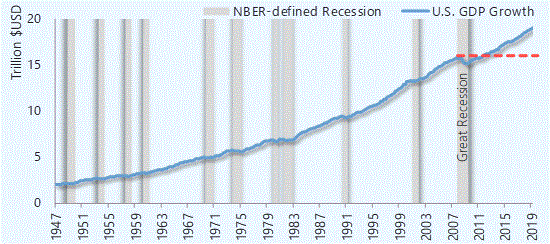
By many measures the U.S. economy is in a better spot today than it was a decade ago. In ten short years the size of the U.S. economy has expanded by $4 trillion, unemployment has fallen to a near 50-year low and household wealth is on the rise as stock market prices and home values have surpassed pre-Great Recession levels.
Yet, the improving economic and financial market landscape has left some people behind. In fact, the Great Recession has disrupted traditional financial playbooks and left in its wake many individuals and households who are finding it increasingly difficult to use today’s financial resources to make tomorrow’s important life transitions happen.
A traditional financial playbook and the broken path to success
For some individuals, a traditional financial playbook might have served as a guide to success in finances and life that included going to college, finding a good job, getting married, starting a family, putting some money away in savings and maybe envisioning a few comfortable decades in retirement thanks to a comfortable pension. Along the way they could buy a house, a car or two and spend modestly on home furnishings, personal luxuries and maybe a vacation once or twice per year.
Yet the reality for many is that college has become more of a financial burden than a ticket to financial security. What’s more, planning for retirement has become complicated by households’ increasing need to simultaneously support both younger and older generations all the while lower investment rates of return and increased financial market distortions have complicated traditional retirement savings strategies.
At the same time, a groundswell of geopolitical uncertainties and rising social unrest globally have generated more economic worries in the near term. This has led to a rise in job insecurity as business leaders curb discretionary spending and has reduced hiring activity. Moreover, financial market distortions, debt traps and rising political concerns have challenged the strategies contained in many people’s traditional financial playbooks.
Figure 1: The U.S. economy is $4 trillion larger today than in 2009
The need to redefine a traditional financial playbook
Looking ahead, simple rules-of-thumb and one-size-fits-all strategies that had helped many people get ahead financially decades ago are less likely to cut it in today’s economic and financial market environment. Indeed, navigating important life transitions in a time of increasing complexity and uncertainty likely means that many households will need to tailor a personal financial playbook to suit their own unique purposes and priorities, selecting strategies and developing plans that accommodate a household’s ever changing wants, needs and goals.
To this point, getting ahead financially will require households to become increasingly financially agile. Broadly speaking, this means incorporating creative strategies into their personal financial playbook that balance a suitable quality of life today with the need to build long-term savings for tomorrow.
More specifically, we believe that financially successful households will need to take a more functional role in crafting their personal financial playbook. This includes more actively defining a purpose for their money, prioritizing its use and developing processes used to test, monitor and alternate financial strategies that utilize today’s financial resources in preparation for expected and unexpected life events and to accommodate various life transitions.
In our next post we’ll look at some of the factors that have, in recent years, prevented some households from getting ahead.
This post is an excerpt from our report, Getting Ahead Financially in 2020. You can download this report in its entirety by visiting franklinmadisonadvisors.com.
Important Disclosures
Broadview Macro Research is a division of Franklin Madison Advisors, Inc (“FMA”). The commentary provided on this website is limited to the dissemination of general information pertaining to Franklin Madison Advisors’ investment advisory services and general economic market conditions and are subject to change without notice. The information contained herein is not intended to be personal legal, investment or tax advice or a solicitation to buy or sell any security or engage in a particular investment strategy. For additional information about FMA, including fees and services, please contact FMA or refer to the Investment Adviser public disclosures.
Franklin Madison Advisors, Inc., is registered investment adviser firm with its registration and principal place of business in the Commonwealth of Pennsylvania. Registration of an investment adviser does not imply a certain level of skill or training. FMA is in compliance with the current notice filing requirements imposed upon registered investment advisers by those states in which FMA maintains clients. FMA may only transact business in those states in which it is notice filed or qualifies for an exemption or exclusion from notice filing requirements. Any subsequent, direct communication by FMA with a prospective client shall be conducted by a representative that is either registered or qualifies for an exemption or exclusion from registration in the state where the prospective client resides. For additional information about FMA, including fees and services, please contact FMA or refer to the Investment Adviser Public disclosures. Please read the disclosure statement carefully before you invest or send money.
To learn more, visit us at http://www.franklinmadisonadvisors.com