

Plan Your Way into Tax-Free Income
Let’s face it, no one likes paying Uncle Sam more than his fair share. But what if there was a way to take advantage of financial planning techniques to not only grow your savings, but also help protect your family and transfer wealth tax-free?
Sounds too good to be true, right?
Well, it’s more possible than you think. And as a highly driven individual, you likely have multiple streams of income to consider, like your salary, bonuses, stock options, and perhaps even revenue from a side hustle or business.
And with these multiple income streams and your high earnings, you’re likely setting yourself and your family up for an even higher tax liability in the years ahead unless you do something about it today.
That’s where tax planning comes in.
Now, tax planning is essential because it provides a structured approach to minimize the taxes you owe. And without adequate tax planning, you could end up paying more to Uncle Sam than necessary, which reduces the amount of wealth available to you and your family.
To be sure, the financial decisions you make today can have significant tax implications on your future wealth. That’s why understanding how to harness techniques to gain tax-free income can help you avoid paying thousands to the IRS, leave more to your family, and to ultimately make more informed financial decisions.
Understanding Legit Ways to Produce Tax-Free Income
Alright, so, when you hear tax planning you might think to yourself, “isn’t creative tax planning what got Al Capone put away in jail?” Well, the truth is that the US tax code, as complex as it is, has features written into it that gives certain advantages to those individuals with the time and patience to see them through, like sidestepping taxes on income.
To be sure, tax-free income is like a treasure that’s hidden in plain sight. It's income you or your loved ones receive that, as the name suggests, is free from obligation to the IRS. And what this means is that every dollar you receive stays a dollar, without a portion being reduced by what you would otherwise owe to Uncle Sam.
Now, it’s essential to keep in mind that we all earn income under a progressive tax system here in the United States. And what does this mean? Well, a progressive tax system means that the more money you make, the more you will owe Uncle Sam because your tax rate rises, or progresses, with your rising income.
And this rising tax rate doesn’t apply just to your wage income. In fact, in many cases it also applies to your interest and investment income applied towards the substantial savings you’re likely to receive now and into retirement as well. That’s why it’s essential, now more than ever, for you to understand some of the basic techniques of creating tax-free income so you can substantially boost your wealth while legally mitigating your future tax liability.
And, so, what are those techniques?
Well, when it comes to reducing your future tax obligations, there are generally three ways to produce tax-free income for yourself and your family. The first is putting money away in a tax-free investment account. The second option is to purchase securities or insurance products that offer tax-free income now and into the future. And, finally, you can mitigate a significant tax liability through the decisions you make about your home, when you gift money to loved ones and the decisions you make before you pass away.
Tax-Free Investment Accounts: Vehicles to Hold Taxable Investments
Alright, so let’s talk about some ways to use investment accounts to mitigate your tax liability. Now, before diving deep down this rabbit hole, let’s take a moment to make a distinction here between tax-free investment accounts and tax-free investment products.
And why is this important?
Well, it’s important because investment accounts and financial products are in many ways entirely different beasts. For example, tax-free investment accounts, like Roth IRAs, 529 Plans and HSAs act as shelters or holding containers, that allow a range of otherwise taxable investments within them to grow tax-free.
On the other hand, tax-free securities or insurance products like municipal bonds or life insurance, offer tax advantages inherent to the instrument itself, regardless of the account they're housed in. Indeed, another way to think about this is that tax-free accounts shelter holdings from future tax liabilities, while tax-free products inherently sidestep income tax altogether.
Ok, so then with this distinction in mind, let's explore tax-free investment accounts in greater detail.
Roth IRA – Tax-Free Lifestyle Savings
More specifically, let's start with the Roth IRA. Now, a Roth is an individual retirement account and acts like a container that offers specific tax breaks for the otherwise taxable investments you hold inside. And the way it works is that you put money into a Roth IRA using after-tax, take-home dollars.
And now while you don’t get an immediate tax break for your contributions to this account, the magic happens as your investments grow and when you start to withdraw your funds later in retirement. That’s because all the withdrawals, including earnings from the investments, are received tax-free if you meet certain conditions.
529 Plan – Tax-Free Education Savings
Another investment account that allows you to earn tax-free returns is a 529 Plan.
Now you may have heard of a 529 Plan before.
But if you haven’t, a 529 plan is an education savings program designed to encourage you to save for your or your children’s future education costs. Now, these plans operate in much the same way as a Roth IRA, meaning that you fund them with money you've already paid taxes on.
And while there's no federal tax deduction on the front-end for these contributions, the investments still grow tax-free so that when it’s time to use these funds for qualified education expenses, the withdrawals often come out without owing a cent to the IRS.
HSA Savings – Tax-Free Healthcare Savings
And finally, when discussing tax-free investment accounts, we can’t forget about Health Savings Accounts, or HSAs. Now, these accounts are a little different from Roth and 529 accounts in several ways.
How so?
Well, for starters, these accounts allow you to set aside money on a pre-tax basis before Uncle Sam gets a cut of your pay. What’s more, the contributions you make to this account grow tax-free, meaning you don’t pay taxes on dividends, interest or capital gains and for an added benefit, the money comes out tax-free when it’s time to spend your savings.
Therefore, an HSA creates tax-free income by providing a tri-fold tax benefit which is pre-tax contributions, tax-free growth, and tax-free withdrawals for qualified medical expenses.
Tax-Free Considerations
So then, with all this discussion about tax-free income from these various investment accounts, you might be asking yourself, “these benefits all sound great, what the catch?” Well, while each of these accounts offer tremendous benefits, there are some things that you’ll want to consider.
For example, in most cases, you can’t money out of a Roth until you’re at least 59 ½ (or have a qualifying event) and there are limitations about when and how much you can put into the account. Now, there are ways around these limits, but that’s a discussion for another time. Even so, if you expect to be in a higher tax bracket by the time you reach retirement age, then looking into Roth contributions might be worth your time.
As for 529 and HSA accounts, there are a few things you’ll want to consider before you start putting money into these accounts. For starters, while you can begin taking money out of the accounts almost immediately after making contributions, you need to keep in mind that to qualify for tax-free status on those withdrawals, the money must be used for qualifying expenses.
Either way, the big takeaway here is that if you’re looking to put money to work now so you can fund your future lifestyle, education or healthcare expenses in a tax-free manner, then you should consider looking into a Roth IRA, 529 or HSA account.
Unlocking the Hidden Gems: Tax-Free Financial Products and Securities
Alright, so now that we’ve talked about certain tax-free investment account types out there, let’s talk about financial products and securities that offer similar tax advantages.
Here again it’s essential to make the distinction between accounts and products or securities. Remember, accounts are like baskets that hold all kinds of investments and shelter them from taxes.
And when it comes to securities and financial products, on the other hand, they can exist either inside or outside of a financial account and offer tax-free income.
Insurance Products: Tax-Free Income and Financial Security
For example, insurance products, like disability, long-term care and life insurance can be purchased directly from an insurer, or through your employers group coverage, without opening a specific type of financial account. That’s because these types of products are more like contracts between you and the insurer, rather than purchasing an investment security in the open market that needs to be held in an account.
And so, how does the tax-free aspect of these products factor in? Well, imagine that you decide to purchase a disability insurance policy. Essentially, what you're doing is entering into a contract with an insurance company to safeguard your income against the potential risk of being unable to work due to illness or injury.
Alright, now, fast forward to a situation where you unfortunately become disabled and start receiving benefits from this policy. In this situation, these benefits typically would come to you tax-free if you've paid the premiums with after-tax dollars.
And when it comes to long-term care insurance, this type of coverage operates in a similar way, except that it helps defray future costs associated with extended medical care with the benefits paid out from such a policy generally coming to you tax-free.
Now, life insurance is another insurance product that offers tax-free income, but this time not to you specifically, but to your loved ones instead. Here an insurance company offers what’s called a death benefit to your designated beneficiaries upon your passing. And, typically, this death benefit is like a gift received tax-free by your beneficiaries.
With all of this said, it’s essential to keep in mind that there are some situations where insurance payouts could be taxable. For example, in certain situations, if policy premiums are paid by your employer, then you could find a portion of your disability or long-term care proceeds taxable. And on the life insurance side, if your estate is the beneficiary of your policy, then you could find yourself paying estate tax on the state side, or federal tax if that life insurance policy pushes your estate above certain exemption limits.
Financial Securities: Exploring Tax-Free Investments
Ok, so now that we’ve talked about insurance products, let’s take a few minutes to talk about tax-free securities. Here again, whereas an insurance policy is a contract between you and the insurance company, purchasing a tax-free security, like a municipal bond, often times means holding the security in a financial account.
Now, municipal bonds, also known as "munis," are certain investments where you’re lending money to a municipality, such as a city, county, or state. And these entities often borrow money from investors to finance public projects, like building schools, highways, or sewage systems.
And here's where the tax-free part comes into play.
The borrowers pay you interest for lending them money, and, because of laws that are currently in place for these muni bonds, the interest income that you earn is typically exempt from federal income taxes. So, instead of giving a portion of your investment returns to the government, in many ways, you're allowed to keep all of your earnings.
What’s more, depending on the specifics of the bond and where you live, your interest income might also be free from state and local income taxes. And so, as a result, investing in municipal bonds from your own state could provide an even greater tax advantage and offer a completely tax-free source of income in some instances.
Now, when it comes to investing in tax-free securities like munis, there are some key caveats to keep in mind. For example, munis may offer lower interest rates than other bonds, so it’s crucial to evaluate whether the tax exemption makes them more attractive on an after-tax basis relative to taxable bonds.
And another thing to keep in mind is that while the income you receive from munis is often tax-free, you’re still likely to pay capital gains tax from selling a municipal bond before maturity. And finally, it’s crucial to keep in mind that you don’t get a double benefit from holding a muni in a tax-sheltered investment account like an IRA, 529 or HSA account, so that’s something to keep in mind as well.
Real Estate and Estate Planning: Strategies for Tax-Free Asset Transfers
Alright, so now that we’ve talked about how various financial accounts and products can help you navigate the tax man in the present, let’s talk about how navigating real estate and estate planning can also lead to tax-free asset transfers for yourself and your loved ones.
Tax-Free Income from Real Estate: Capitalizing on Home Sales
To start, let’s focus on how you can generate tax-free income from the sale of your home. Now, when you sell real estate, you’re likely to make a capital gain if the sales price is higher than what you originally paid for it. For example, if you bought your house for $500,000 and you sell it for $750,000, then your potential capital gain is $250,000.
Now, imagine that you've decided to sell your home in a high-cost part of the country so that you can move to a more affordable cost-of-living state. So, to go about this approach, you make your preparations and after the sale, you find that you've got a capital gain of $250,000. And because you met the necessary criteria, the entire amount is exempt from taxes, leaving you with a sizable sum of money you can now use however you want.
Now, it’s crucial to keep in mind that in order to make this all work you must meet certain criteria to be eligible for this exclusion. The first requirement is that you have owned the property for at least two years during the five-year period ending on the date of the sale. This is what’s known as the ownership test. The second condition is that the home must have been your primary residence for at least two years during that same five-year period, also known as the use test.
And finally, you’re not allowed to have excluded the gain from the sale of another home during the two-year period prior to the sale of your current home. That’s because this rule ensures that you’re not flipping homes and constantly taking advantage of this tax benefit over and over. Even so, if you meet all of the criteria to get the exclusion, you could tap your home as a source of tax-free income as a way to hasten your journey to financial independence.
Gifting Tax-Free Income: Sharing Wealth While Reducing Taxes
Alright, so now that we’ve talked about using real estate to generate tax-free income, let’s take a few moments to talk about gifting and estate planning to set your loved ones up for tax-free income in the future.
Now, some individuals may feel overwhelmed by the mere mention of the term estate planning. And if that’s you, that’s ok because we recently published a post on how to navigate the complexities of estate planning to make it work for you, so be sure to check out that resource.
But for now, let’s talk about a few ways that you can transfer assets to your loved ones without paying income tax. The first way is through gifting. Now, when you gift assets or money to someone while you’re still alive, it can potentially allow them to avoid giving a portion of that money to Uncle Sam.
How so?
Well, that’s because when you’re gifting an asset, what you’re doing is essentially passing on the responsibility for any income generated by those assets to the recipient. And, if the recipient falls within a lower tax bracket than you or if they have deductions or credits that offset the income, they may end up paying little or no tax on the gifted income.
Let’s look at an example to explain this a little better. Now, let's say that you have investments that generate significant income each year, and you’re in a high tax bracket. By gifting some of those investments to a family member or loved one who is in a lower tax bracket, any income generated from those investments may be taxed at a lower rate or possibly not taxed at all, which can result in tax savings for the receiver. Now, while we’ve talked about transfers of assets, this approach also applies to cash gifts.
Now, cash gifts are a little different than asset transfers, it's crucial to note here that there are specific rules and limitations surrounding gifting for tax purposes. For instance, there is an annual gift tax exclusion that allows you to give a certain amount to an individual each year without triggering gift tax consequences, which is currently $17,000 or $34,000 for a couple.
Tax-Free Inheritance: Step-Up in Basis and Its Wealth-Building Potential
Alright, while gifting allows you to provide tax-free income to your loved ones while you’re still alive, inheritance planning allows you to offer tax-free income after you pass away, and one way this is done is through a set-up in basis.
And how does this work?
Well, let's say you inherit a million-dollar investment property from your wealthy uncle Frank who recently passed away. Now, the trouble is that Uncle Frank has depreciated that property over the years, and it now has a low cost-basis. Normally, if you were to sell that asset, you would have to pay taxes on the capital gains.
However, with a step-up in basis, what happens is that the cost-basis of the inherited asset is adjusted to its fair market value at the time of the Uncle Frank’s death. In other words, the cost basis for tax purposes is "stepped up" to its current value, erasing any potential capital gains that may have accrued during Frank’s lifetime.
Now, when it comes to bequeathing, or transferring your assets, this step-up in basis can come as a substantial advantage for individuals who inherit assets with significant appreciation. That’s because it allows them to potentially sell the asset and realize a profit without owing capital gains taxes on the appreciation that occurred before the inheritance.
So then, from an estate planning perspective, thinking about which assets you want to gift now and which ones you want to leave as an inheritance is a critical component of creating tax-free income through the estate planning process.
Plan Your Way into Tax-Free Income
Indeed, by now, you’ve likely come to realize that tax planning is a cornerstone of a sound wealth management strategy. In many ways, it's the unsung hero that safeguards your hard-earned wealth, curtails tax liabilities, and unearths the chance for tax-free income. And by mastering these techniques and tactics, you can sail through the labyrinth of the US tax code and harness many strategies to create wealth that lasts a lifetime.
To be sure, tax-free income can come from tax-advantaged investment accounts like Roth IRAs, 529 Plans, and HSAs. That’s because they offer tax-free growth of otherwise taxable investments, and, eventually, tax-free withdrawals for specific purposes like funding your lifestyle, healthcare, or education expenses.
Beyond investment accounts, certain financial products and securities carry their weight in gold when it comes to tax-free income. That’s because insurance policies like disability, long-term care, and life insurance can serve up tax-free benefits under certain situations, which ensures that your income is secure and offers financial protection for you and your loved ones. And, at the same time, investments in tax-free securities like municipal bonds can provide you a tax edge, which can exempt the interest income from federal, state, and even local income taxes.
And, as we just discussed a moment ago, it’s essential to remember that real estate and estate planning can be a real game-changer in generating tax-free income. Indeed, by decoding various tax strategies and deploying them effectively, you can take one step closer to becoming the master of your own financial independence journey.


Is a Roth Conversion Right for You?
A Roth conversion is a critical consideration for many high-earning tech professionals and business owners, but is it right for you?
To be sure, as you delve into the work of planning for your financial independence journey, it's essential to understand the intricate dance between taxable and tax-free retirement accounts. And as we've pointed out in recent articles, with a strategic approach, you can make the most of your hard-earned money and ensure a comfortable retirement that aligns with your aspirations.
But, now, at what point should you consider a Roth conversion?
Well, picture this: You're diligently setting aside a portion of your earnings in a traditional 401k or a similar taxable retirement account. It's a tried-and-true method, offering immediate tax benefits, but there are long-term implications that you may not have considered.
For example, as your savings grow, so does the potential tax liability. From this perspective, then, the question arises, "how can you strike a balance between receiving tax advantages today and dealing with a future tax burden?"
That's where tax-free retirement savings vehicles like Roth IRAs come into play.
That’s because with a Roth IRA, you pay taxes on your contributions upfront, but the growth and withdrawals are entirely tax-free in retirement. It's like planting seeds today that will blossom into a tax-smart future.
But, again, the big question here is is this the right strategy for you? Should you maximize your 401k contributions to take advantage of immediate tax benefits? Or would it be wiser to prioritize Roth IRA contributions, offering tax-free growth potential. So then, how do you navigate these choices and find your optimal balance?
Now, make no mistake, retirement planning is rarely a one-size-fits-all endeavor because it's about crafting a strategy that suits your unique circumstances. That’s why as you embark on the journey of maximizing your retirement savings, understanding the interplay between taxable and tax-free accounts is paramount.
By strategically considering your order of operations, leveraging 401k contributions, evaluating your traditional and Roth IRA options, and even delving into the realm of Roth conversions, you can lay a solid foundation for a financially secure future.
Understand the Difference Between Tax-Deferred (Taxable) and Tax-free Retirement Accounts
Now, as you embark on your journey towards financial independence, it is crucial to grasp the distinction between taxable and tax-free retirement savings contributions. This understanding likely will empower you to make informed decisions about your savings options, optimize tax efficiency, and potentially enhance the longevity of your retirement savings.
Now, to achieve these objectives, one powerful tool at your disposal is a Roth conversion. Before delving into its benefits, let's explore the concept of taxable retirement savings options like the 401(k) and Traditional Individual Retirement Account (IRA), as well as tax-free options such as the Roth IRA. That’s because by understanding these choices and how they differ, you can strategically plan for your future in a more thoughtful manner.
Tax-Deferred (Taxable) Retirement Savings
So, what exactly is a taxable retirement account? In simple terms, it refers to savings accounts like 401(k)s and Traditional IRAs, where contributions grow without tax consequences in the present, but future withdrawals are subject to ordinary income taxes.
401(k) Plans
And how does this work with a 401(k)?
Well, as you’ll recall, these types of accounts are employer-sponsored retirement savings programs enabling you to allocate a portion of your pre-tax earnings towards your retirement fund.
Now, one notable benefit of these accounts is that the contributions you make are not taxed in the year that the income is earned. This reduces your taxable income, allowing your savings to grow tax-deferred and potentially reducing your overall income tax liability. Furthermore, any employer matching contributions effectively yield a 100% return on your own savings.
However, when it comes time to withdraw funds from your 401(k), these distributions are treated as ordinary income and subject to taxation. This makes 401(k)s tax-deferred accounts, as all distributions are typically taxed either upon withdrawal or when required minimum distributions (RMDs) become mandatory.
Traditional IRA
Now, let's shift our focus to the tax-deferred cousin of the 401(k): the Traditional IRA. Similar to a 401(k), a Traditional IRA allows you to defer taxes on contributions made with after-tax income.
Contributions to this type of account are typically tax-deductible, reducing your taxable income for the year. Like a 401(k), capital gains, dividends, and interest earned within a Traditional IRA remain untaxed until you start withdrawing funds.
Even so, upon withdrawal or when RMDs are required, the distributions are taxed as regular income, with the tax bracket in retirement determined by your total annual income.
Tax-Free Retirement Savings
Alright, now that we’ve explored tax-deferred accounts, let's now turn our attention to tax-free retirement savings options. These include accounts like the Roth IRA, where contributions are made with after-tax dollars, and withdrawals are completely tax-free.
Roth IRA
And how does a Roth IRA work?
Well, as we mentioned earlier, a Roth IRA is funded with after-tax income, meaning you contribute to the account using your take-home pay. And while this may seem less advantageous compared to pre-tax contributions, the real benefit lies in tax-free withdrawals during retirement.
That’s because, as long as the Roth IRA has been open for at least five years, and you are at least 59 ½ years old, any distributions you make from this account will be entirely tax-free.
And this makes the Roth IRA a compelling choice if you anticipate being in a higher tax bracket during retirement, expect future tax rate increases, or simply want to avoid mandatory distributions altogether.
Now, after exploring the differences between taxable and tax-free accounts, the question remains, “how do you decide which type of account to fund?” Well, the answer depends on several factors.
Current vs. Future Tax Bracket
If you anticipate being in a lower tax bracket during retirement compared to your current situation, sticking with a 401(k) or Traditional IRA may be advantageous. That’s because by deferring taxes now and paying a lower tax rate upon withdrawal, you can potentially minimize your overall tax burden.
However, if you expect to be in a higher tax bracket in retirement, a Roth IRA becomes a more appealing option. That’s because paying taxes upfront allows you to enjoy tax-free withdrawals later, effectively sidestepping potentially higher taxes in the future.
Now, it's crucial to note that you don't have to choose one account type exclusively. In fact, a mix of both taxable and tax-free retirement savings accounts can provide optimal flexibility and tax diversification. This approach allows you to manage taxable income in retirement and hedge against future changes in tax rates.
Indeed, understanding the differences between taxable and tax-free retirement savings options is a crucial step when considering a Roth conversion. Both types of accounts offer unique advantages and disadvantages, and the right choice depends on your individual circumstances, including your current income, expected future income, and retirement goals.
Consider Your Order of Operations
Alright, now that we've discussed the differences between taxable and tax-free accounts, let's review your order of operations when it comes to savings contributions. Just like solving a complex math equation, there's an ideal way to put your income to work before fully converting your savings to a Roth IRA.
Maximizing Your 401k Contributions
So, then, where should you put your money to work first?
Well, when it comes to saving for retirement, your employer-sponsored retirement plan, such as a 401k, can be a potent resource. That’s because these plans offer unique advantages that significantly enhance your long-term savings strategy.
And as we’ve mentioned before, one of the biggest benefits is the potential for an employer match. Now, this happens when your employer contributes additional money to your 401k based on how much you contribute in the first place.
And it's essentially free money, providing an immediate 100% return on your investment that you can't get through most other retirement savings strategies. And the fact is that many people leave money on the table every year by not taking full advantage of the employer match.
And so, why is an employer match so important?
Let's consider an example to illustrate why matching is so important. Suppose your employer offers a 100% match on your contributions up to 6% of your salary. If you contribute 6%, your employer adds an additional 6% (i.e., 100% of your 6% contribution). That’s why failing to contribute that 6% in the first place means missing out on that extra 6% from your employer, effectively leaving money on the table.
So then from this perspective, the first step in maximizing your retirement savings should always be to contribute at least enough to your employer-sponsored retirement plan to fully capture your employer's matching contribution.
Now, it’s also worth noting that the Internal Revenue Service (IRS) sets limits on how much you can contribute to these types of retirement accounts each year. As of 2023, the maximum contribution limit for a 401k, 403(b), or TSP is $22,500. And if you're aged 50 or older, you can contribute an additional $7,500 per year. And this catch-up contribution is designed to help individuals who are closer to retirement age bolster their savings.
So then, if your financial situation permits, consider maximizing your contributions to these accounts up to their limits. Doing so not only allows you to take full advantage of the tax benefits these plans offer but can also significantly enhance your long-term savings due to the power of compounding on a pre-tax basis.
Taking Advantage of Traditional IRA Contributions
Alright, so now that you’ve taken full advantage of your employer's 401k match or reached your contribution limit, another smart strategy to consider is funding a Traditional IRA. A Traditional Individual Retirement Account (IRA) offers numerous advantages that can help you grow your retirement savings more effectively and efficiently.
And the primary advantage of a Traditional IRA is the tax deductibility of contributions. That’s because any money you contribute to a Traditional IRA can be deducted from your income for a given tax year, effectively reducing your taxable income. This means you'll owe less income tax, freeing up more of your money for saving or investing.
And as of 2023, the contribution limit for a Traditional IRA is $6,500 per year. And this contribution limit applies collectively to all of your IRAs, including both Traditional and Roth accounts.
While the tax benefits of a Traditional IRA are notable, it's crucial to be aware of certain limitations that apply if you or your spouse have a retirement plan through work. The IRS imposes income limits that can reduce or even eliminate your ability to deduct your Traditional IRA contributions if you or your spouse are covered by a workplace retirement plan.
For example, in 2023, if you're covered by a retirement plan at work, the deduction for contributions to a Traditional IRA is phased out for singles and heads of household with modified adjusted gross incomes (MAGI) between $73,000 and $83,000.
For married couples filing jointly, where the spouse making the IRA contribution is covered by a workplace retirement plan, the income phase-out range is $116,000 to $136,000. If you're not covered by a workplace retirement plan but your spouse is, the deduction is phased out if your combined income is between $204,000 and $214,000.
Now, it’s important to note that these income ranges are subject to change and can vary from year to year, so it's essential to verify the current ranges with the IRS before making a contribution.
So then, if you're eligible, it's wise to contribute the maximum amount to your Traditional IRA each year. Doing so provides you with an immediate tax deduction and allows your savings to grow tax-deferred over time. This means you won't owe taxes on your investment earnings until you start taking distributions in retirement, enabling your money to compound more effectively.
Prioritizing Roth IRA Contributions
Now, once you've maximized your contributions to your 401k and Traditional IRA, the next logical step in your retirement savings journey is to consider a Roth IRA. While Roth IRA contributions don't provide an immediate tax deduction like Traditional IRA contributions, they offer several unique benefits that make them a valuable part of a balanced retirement savings strategy.
Now, before we talk about these benefits, let’s take a step back and recap what makes a Roth different from a Traditional IRA or employer-sponsored plan.
Unlike 401k and Traditional IRA accounts, contributions to a Roth IRA are made with after-tax dollars. This means you pay income tax on the money before contributing it to the account. While this might seem like a disadvantage compared to tax-deductible contributions, it still offers a significant payoff down the line in the form of tax-free withdrawals.
To be sure, with a Roth IRA, both your contributions and the earnings on those contributions can be withdrawn tax-free during retirement, provided the withdrawals meet certain qualifications. This means the money you invest in a Roth IRA today could grow substantially over time, and all of that growth will be yours to keep when you retire.
Now, as of 2023, the Roth IRA contribution limit is the same as that of a Traditional IRA which is $6,500 per year and $7,500 for those aged 50 or older. Even so, with a Roth IRA it’s essential to note that certain income restrictions can limit your ability to put money into these accounts.
For those filing single and head of household, the ability to contribute to a Roth IRA begins to phase out at a modified adjusted gross income (MAGI) of $129,000 and is eliminated entirely at $144,000. For married couples filing jointly, the phase-out range is between $204,000 and $214,000.
Put simply, if you make too much money, more often than not you likely can’t make a direct contribution to a Roth IRA.
Even so, the Roth IRA is a powerful retirement savings tool because it allows you to pay taxes now in exchange for tax-free income later. This can be particularly beneficial if you anticipate being in a higher tax bracket in retirement than you are currently or if you believe that tax rates are likely to increase in the future.
And by contributing to a Roth IRA, you're essentially locking in your current tax rate. This could result in substantial tax savings in the long term, as you won't owe taxes on the growth of your investments when you start taking distributions.
Additionally, Roth IRAs aren't subject to required minimum distributions during the account owner's lifetime, unlike Traditional IRAs and 401ks. This flexibility allows you to manage your retirement savings and withdrawal strategy on your terms.
Calculate the Benefit of a Roth Conversion Using the NPV Approach
Alright, so what if you find yourself in a position where you’ve maximized your contributions to your employer-sponsored plan, and taken full advantage of your Traditional IRA but make too much money to contribute to a Roth IRA? Well, you could consider doing a Roth conversion.
And what is a Roth conversion?
Well, a Roth conversion is the process of transferring assets from a traditional IRA or 401k into a Roth IRA. Now, as we’ve mentioned before, this is a strategic financial decision that can offer significant tax benefits, enabling you to maximize your retirement savings. However, like any financial decision, it entails complexities and requires careful consideration.
Indeed, understanding the benefits of a Roth conversion is just one aspect of the puzzle. To determine if it is the right move, you need to compare the cost of the conversion which is essentially the taxes you would have to pay now versus the potential benefits which is mainly the tax-free withdrawals in the future.
And how do you do this comparison? Well, this is where the net present value (NPV) approach comes into play.
The NPV approach is a financial calculation used to determine the present value of an investment while taking into account the time value of money. In essence, it calculates the worth of future cash flows in today's dollars.
And when applied to a Roth conversion, the NPV calculation helps compare the current tax cost of the conversion with the present value of future tax-free withdrawals. And so, how do we determine if the NPV is good or bad?
Well, if the NPV is positive, it suggests that the present value of the future benefits of a Roth IRA outweighs the immediate tax cost, indicating a beneficial conversion. Conversely, a negative NPV suggests that the conversion may not be advantageous.
How to Calculate NPV for a Roth Conversion
To calculate the NPV for a Roth conversion, several variables need to be estimated:
- Current Tax Cost: This represents the tax amount you would pay if you converted your traditional Individual Retirement Account (IRA) to a Roth IRA today. For example, if you have a traditional IRA worth $100,000, and your current tax rate is 25%, the tax cost of converting to a Roth IRA would be $25,000.
- Future Tax Savings: This estimates the value of the tax you would save on distributions from a Roth IRA in the future. Unlike traditional IRAs, Roth IRA withdrawals are tax-free during retirement. To calculate this, you need to estimate your future tax rate and the expected annual withdrawal amount. For instance, if you anticipate withdrawing $50,000 per year from your Roth IRA in retirement and expect your tax rate to be 25% at that time, your annual tax savings would amount to $12,500.
- Discount Rate: This is an estimate of the rate of return you could expect to earn on your investments if you didn't convert to a Roth IRA. For example, if you expect your investments to earn an average of 6% per year, this would be your discount rate.
- Investment Horizon: This refers to the number of years until you plan to start withdrawing money from your retirement account. If you intend to retire in 20 years, your investment horizon would be 20 years.
Once you have estimates for these variables, you can use the following formula to calculate NPV:
NPV = (Future Tax Savings / (1 + Discount Rate)^Investment Horizon) - Current Tax Cost
The result of this calculation will provide you with the net present value of your Roth conversion in today's dollars. A positive NPV suggests that the conversion is likely a good financial decision, while a negative NPV suggests that you may be better off not converting to a Roth IRA.
Considerations When Using the NPV Approach
Make no mistake, the Net Present Value (NPV) approach is a powerful tool in the decision-making process when considering a Roth IRA conversion. With that said, this approach is not without its complexities, that’s because this approach relies on several estimates and assumptions that can significantly influence the results.
The Impact of Changes in Tax Law
Now, one fundamental assumption in an NPV calculation is that current tax laws will remain constant. However, tax laws are subject to political forces and can change over time.
For example, future changes could affect the tax benefits associated with Roth IRAs, such as tax-free distributions, or modify the tax rates applicable to Traditional IRA distributions. If income tax rates were to decrease in the future, the tax savings from a Roth conversion would be less than what you might have estimated using current rates.
Predicting Your Future Tax Rate: A Not-So-Certain Exercise
Another factor to consider when conducting conversion analyses is that the trajectory of your future specific tax bracket is largely unknown. Indeed, while determining your current tax rate is relatively straightforward in the present, estimating your future tax rate can be much more challenging. That’s because numerous factors can influence this rate, many of which are difficult to predict accurately.
And these factors can include changes in your income, whether from employment, investments, or retirement distributions, which can significantly impact your future tax bracket. And even your personal circumstances, like a change in marital status, can also alter your future tax liabilities.
The Role of the Assumed Rate of Return
And, finally, another key assumption in the NPV calculation to take into consideration is the discount rate, which represents the assumed rate of return on your investments. This rate plays a pivotal role in determining the present value of future tax savings or costs.
Now, while history is typically a useful indicator of market direction, predicting the rate of return can be challenging due to the variability of market conditions and investment performance. And this uncertainty is a key consideration when performing an NPV analysis because the rate of return significantly influences the results of the NPV calculation.
That’s because a higher assumed rate of return reduces the present value of future tax payments, making a Roth conversion appear less attractive. Conversely, a lower rate increases the present value of these future tax savings, potentially favoring the conversion.
Either way, using the NPV approach to evaluate a Roth IRA conversion is a powerful method for understanding the potential long-term financial impact of this decision. However, it's important to remember that this calculation relies on estimates and assumptions that are subject to change. That’s why it’s essential to consider multiple scenarios and work with a professional who can provide personalized advice based on your specific circumstances.
Is a Roth Conversion Right for You?
Taken together, in the ever-evolving landscape of preparing for financial independence, the thing that remains constant is the need for a strategic and informed decision-making process. And, as high-earning tech professionals and business owners, you possess the power to shape your financial destiny and secure a measure of financial independence that reflects your purpose and values.
Remember, the path to financial freedom is as unique as your fingerprint. That's why it's essential to understand the intricacies of balancing taxable and tax-free accounts, strategically leveraging your 401k contributions, and making informed choices regarding traditional and Roth IRA contributions.
And by calculating the net present value of a Roth conversion, you can gain a clearer understanding of the potential benefits and make decisions that align with your long-term goals and help ensure that you're making a decision that's right for you.
Indeed, by understanding the various tradeoffs, considering the order of operations, and harnessing the power of Roth conversions, you'll be well-equipped to make confident and informed decisions about your wealth. Even more crucial, doing so will take you one step closer to becoming the master of your own financial independence journey.

Asset Location vs. Asset Allocation: The Winning Formula for Wealth
Have you ever wondered why your savings aren't growing even though you're contributing to an investment account? It may be because you haven't set your investment strategy.
That's what happened to Mariam.
Now, Mariam knew the importance of investing and that her bank account wouldn't cut it when it came to satisfying her long-term financial independence goals. But, like many uninitiated investors, Mariam misunderstood the concept of investing and believed that simply opening an investment account would guarantee high returns.
Sound familiar?
Well, in Mariam's case, she opened a Roth IRA, because that's what she's heard she's supposed to do. In fact, Mariam believed that her Roth IRA was all she needed, not realizing that the account itself was just a vessel for her investment strategy.
And how many of us have ever made that same mistake?
Well, everything changed when Mariam discovered that her Roth IRA wasn't performing as well as she had hoped. And it turns out that her account was all sitting in cash and not actually invested. That's when she realized that she had focused too much on the account itself and not enough on the underlying investment strategy.
So, what did she do?
Well, frustrated with her situation, Mariam took the time to track down resources and professional assistance that helped her discover that focusing solely on her Roth IRA may not have been a solid strategy from the start.
To be sure, Mariam discovered that the key to a solid investment strategy begins with putting her savings not only in suitable buckets, but also in choosing an ideal mix of stocks, bonds, and other assets that align with her near- and long-term life and savings goals.
Now, with a renewed sense of confidence, Mariam implemented her new investment strategy. And it was at that point that she knew she was making informed decisions and using all available savings vehicles, like her brokerage, employer retirement plan, and her IRA in an orderly manner.
So, what's the moral of the story here? Well, to build real wealth, it's essential to not just put money in an investment account, but also to understand the difference between asset location (that's the types of investment accounts) and asset allocation (or your investment strategy) and use them effectively within your overall financial plan.
Understand Your Investment Account Options
Indeed, understanding the difference between asset location and asset allocation is just as crucial as knowing which type of account to stash your cash in and how to make that money work for you once it's saved.
Account Asset Location
So, what is asset location? Well, this approach refers to placing your savings contributions into different savings buckets, or types of accounts based on their tax treatment. Now, these accounts might include taxable accounts, tax-deferred accounts (like a 401k and traditional IRA), and tax-free accounts (like a Roth IRA).
And, what's the whole point of asset location? Well, the point of asset location is to maximize the tax efficiency of your investment portfolio. And while you're likely aware of some of the immediate tax benefits of putting your money into these various accounts, the real focus should be on how your investments will be taxed when the money comes. That's because not being aware of your tax location could mean having less money to cover your living expenses when you need it the most.
So then, how does asset allocation differ from asset location? Well, asset allocation is the art of spreading your investments across various asset classes like stocks, bonds, cash, and other investments. The goal here is to build a balanced and diversified portfolio that vibes with your risk tolerance, time horizon, and financial goals.
Indeed, a well-diversified portfolio keeps your overall risk in check since your investments are spread across different assets, which react differently to market ups and downs. Now, before we talk about how to invest your savings, let's discuss the various savings buckets, or account types, and what they're typically used for.
Brokerage Accounts
Let's begin by taking a look at brokerage accounts. Now, a brokerage account is the most basic type of investment account that you'd open at a firm like Schwab, Fidelity, or Vanguard. And you can think of a brokerage account as your flexible platform for chasing various financial goals, like growing your wealth, saving for retirement, or funding major life expenses.
These accounts let you buy and sell various assets, like stocks, bonds, mutual funds, and ETFs, which promotes portfolio diversification and long-term growth.
Now, unlike retirement accounts such as 401ks and IRAs, brokerage accounts don't offer tax-deferral benefits. This means that you fund these accounts with after-tax dollars, and you'll likely have to pay taxes on your capital gains, dividends, and interest in the year they are earned. Now, it's possible to reduce these tax burdens through various investment strategies, but we'll save that discussion for a future report.
For now, what's essential to note here, though, is that while brokerage accounts don't have the same tax perks as other tax-advantaged accounts, they still allow you to put your savings to work for the long-term while giving you the flexibility to pull your money out penalty-free anytime you need it.
Retirement Accounts (401k, 403b, IRA)
Now, retirement accounts like 401ks, 403bs, and IRAs are tailor-made to help you save for your golden years. Now, when it comes to retirement accounts available through your employer, what’s essential to note is that in most cases these account types allow you to make contributions on a pre-tax basis, which means that you're putting more money to work before Uncle Sam gets his share of your earnings.
And in the case of Traditional IRAs, after-tax contributions can be tax deductible in certain circumstances. Either way, money in these accounts grow tax-free until you’re ready to take the money out.
Sounds good so far, right? What's the catch, you ask?
Well, the catch is that you typically can't access these accounts penalty-free until age 59 1/2, and when you do, you'll likely be taxed at ordinary income tax rates. Even so, because more money is going in on a pre-tax basis in the early years as far as your contributions are concerned, the more money you're putting to work and allowing to compound over time.
Now, one caveat to note here when it comes to retirement accounts is the Roth IRA. A Roth IRA is an account that you typically set up with a brokerage firm (or Roth 401k if your employer offers it), and is funded with after-tax dollars. While you generally can't access the funds penalty-free until age 59 1/2, the benefit of a Roth IRA is that the money grows tax free, and you typically pay no tax when you take the money out.
Education Savings Accounts (529 Plans)
Now, education savings accounts, like 529 Plans, are another kind of savings bucket designed to help families save for future education expenses. And they're useful because these accounts offer a tax-advantaged way to invest and grow funds for educational purposes.
That's because earnings in a 529 Plan grow tax-free, and withdrawals for qualified education expenses don't get hit with federal income tax. What's more, some states offer tax deductions for 529 Plan contributions, which make them a compelling savings vehicle in certain situations.
Health Savings Accounts (HSAs)
And finally, health savings accounts (or HSAs) allow you to save and pay for qualified medical expenses while offering some nice tax advantages.
In fact, HSAs offer a triple tax advantage and that's because 1) contributions are made on pre-tax basis and lower your taxable income; 2) earnings grow tax-free; and 3) withdrawals for qualified medical expenses are also tax-free. And these combined tax perks make HSAs an attractive option for healthcare expenses.
So, to sum it up, there are plenty of investment accounts designed to address specific savings goals, each with its own unique tax advantage. Brokerage accounts, for example, serve as a flexible platform for pursuing various financial goals, while retirement accounts, like IRAs and 401(k)s, are all about helping you save for your retirement, offering tax-deferred growth and, in some cases, tax-deductible contributions.
Asset Location in Action
And so, why is it important to understand the difference between taxable and tax-advantaged accounts?
Well, in the book, "The Bogleheads' Guide to Investing," the authors highlight the importance of asset location in maximizing after-tax investment returns. They point out that different investments are subject to different tax treatments, and placing them in the right types of accounts can significantly impact your overall tax bill.
The authors suggest prioritizing tax-advantaged accounts, like 401(k)s and IRAs, for tax-inefficient investments, such as actively managed mutual funds and real estate investment trusts (REITs). These investments generate more taxable income, so holding them in tax-advantaged accounts can potentially shrink your overall tax bill.
On the flip side, tax-efficient investments, like broad-based index funds and municipal bonds, might be best held in taxable accounts. These investments generate less taxable income, so holding them in taxable accounts can potentially reduce your overall tax liability.
Taken together, understanding these investment accounts and their respective tax benefits can empower you to make informed decisions that align with your unique financial goals and help optimize your savings strategies.
Understand How Asset Allocation Puts Your Money to Work
Okay, so now that you understand where your savings should go and why, let's discuss how you can actually put your money to work through asset allocation.
And, what is asset allocation?
Well, as we mentioned earlier, asset allocation refers to the process of dividing your savings among different asset classes in order to balance risk and return. Again, these assets include stocks and bonds, and US and international investments. And we take this approach because what we're trying to do is not only grow your savings, but reduce the chance for losses by diversifying risk across various assets.
The Power of Asset Allocation
So how much does asset allocation matter? Well, years ago a group of financial researchers led by Gary Brinson, Ralph Hood, and Gilbert Bebower wanted to figure out which factors influenced the returns investors earned from their portfolios.
So, to do this, they looked at the performance of a big group of pension funds. And what they found was that there are generally three main factors that determine the returns earned by the funds themselves, including security selection, market timing, and asset allocation.
Now, when it comes to security selection, this process refers to the act of choosing individual investments held in a portfolio, like which stocks or bonds to buy. And what the researchers wanted to understand was whether fund performance was driven by terrific stock picking, or some other factor.
And, so what did they find? Well, what the researchers found in their study was that stock picking was actually the least important factor in determining a portfolio's long-term returns.
In fact, the researchers found that the asset allocation decision was the most critical factor in determining a portfolio's returns. Indeed, the paper shows that even trying to time the market was less important than getting the asset allocation right.
And why's that?
Well, that's because different types of investments have different levels of risk and return. For example, stocks are generally riskier than bonds, but also have the potential for higher returns. Cash, on the other hand, is less risky but also has lower returns.
And the fact is that, over the long-term, markets typically don't move up, or down, in a straight line. Therefore, by choosing a mix of investments that matches your goals and risk tolerance, you can maximize your chances of earning solid returns over the long run. Indeed, trying to time the market or pick individual investments is less important in the grand scheme of things than holding a diversified basket of investments.
The Benefits of Diversification and Risk Management
So, what makes asset allocation the most important decision when it comes to long-term investors? Well, when it comes down to it, as the old adage goes, it doesn't matter how much you make but how much you keep.
Indeed, Benjamin Graham, once a professor at Columbia Business School and regarded as the father of value investing, says that "the essence of portfolio management is the management of risks, not the management of returns."
Indeed, if we were to boil down the purpose of asset allocation to its essence, it could be encompassed in that single quote from Graham. Now, I know what you're likely going to say at this point and that's, "doesn't a diversified portfolio produce returns that are less than those of a single stock, or highly concentrated investment position?"
And, well, the answer here is, "it depends…"
The fact is that asset allocation is not so much about optimizing returns as it is about managing risk so you can stay in the investing game when markets inevitably fall, allowing you to achieve your long-term savings goals.
What do we mean here? Well, let me give you an example from the perspective of workers who concentrated their retirement savings in employer stock.
Now, in 2008, Wachovia, one of the largest financial institutions here in the US, suffered significant losses due to its exposure to toxic mortgage assets which ultimately led to its failure. Now, at its peak, the company had over 3,400 retail banking branches and employed more than 120,000 people.
Even so, a few bad business decisions combined with a perfect storm that was the Global Financial Crisis, led to a steep decline in the value of Wachovia's stock, ultimately wiping out the retirement savings of many of its workers.
More recently, many tech investors who had jumped on board the tech stock rally that took place between 2020-2021 ultimately saw their savings diminished after inflation, war tensions and aggressive rate hikes led to a notable tech stock selloff in 2022. Indeed, remember all of the unicorn IPOs and SPACs that were supposed to make many millionaires? Well, there are likely many unfortunate souls out there who decided against diversification in exchange for diamond hands, and are now paying the price of holding onto their concentrated positions.
Make no mistake, diversification and risk management are essential elements of successful investing. That's because diversification helps investors spread their risk across different types of investments, while risk management helps minimize losses and maximize returns. And, by understanding the benefits of diversification and risk management, you can build an investment portfolio that is well-positioned to weather market volatility and help you achieve you long-term financial goals.
Risk Management's Role in Asset Allocation
Alright, now that we've covered the basics, let's talk about how asset allocation and asset location work together to put your money to work in a tax-efficient manner.
To this end, you'll recall that asset allocation is all about putting together your investment dream team. It's like picking players from all the different asset classes like stocks, bonds, and other risk assets. Then, by spreading your money across these various options, you're tapping into their unique strengths and making sure market ups and downs don't mess with your overall life and savings goals.
Sounds like a winning strategy, right?
Well, before you can put this money to work, you'll need to determine where your investments will hang out. More specifically, you'll need to determine how much of your investments are held in taxable accounts, tax-deferred retirement accounts, or tax-exempt places like Roth IRAs. Remember, each account type has its own set of tax advantages and distribution setbacks.
The trick here is to be savvy about which investments go where, so you get the biggest bang for your tax buck. That means putting tax-inefficient investments in tax-advantaged accounts and tax-efficient investments in taxable accounts. This way, you keep more of your hard-earned money and preserve it for the long-term.
For example, you can stash tax-inefficient investments, like high-yield bonds, in tax-deferred accounts, and tax-efficient investments, like index funds or municipal bonds, in taxable accounts.
How to Put Asset Allocation and Location to Work for You
So then, now that you know why asset location and asset allocation are essential investing decisions, the next big question that you likely have is, "where do I start?"
Saving in the Right Buckets
Well, the first decision in any disciplined investment strategy is to identify what you're saving for, and how much you need to have saved. Now, you'll likely recall that this is a topic that we've covered at length in previous reports, so we won't go into it here today. Even so, be sure to check out our previous posts if you need help on figuring out how to calculate your savings need.
Alright, so once you figure out how much you need to have saved, then the next thing we need to do is to determine which accounts need to be funded to meet your savings goals.
As you'll recall, you have three investment buckets to which you can contribute your savings, and these are taxable, tax-exempt and tax-free accounts. The key difference between these account types is the tax treatment of the investments held in each account and how gains are taxed when they occur.
Remember, in taxable accounts, for example, you could be subject to taxes on any income or capital gains generated by the investments, which can reduce your overall investment return. In tax-exempt and tax-free accounts, however, you're likely not subject to taxes on the income or gains generated by the investments, which can result in higher overall returns if you have a long enough savings horizon.
Now, to this point, when making asset location decisions, Larry Swedroe, in his book, "The Only Guide You'll Ever Need for the Right Financial Plan", recommends that you prioritize first making contributions to your tax-advantaged accounts, such as your 401(k)s, IRAs, and HSAs. That's because these accounts provide tax benefits, such as tax-deductible contributions, tax-free growth, and employer-matching contributions. Therefore, it makes sense to take advantage of these benefits as much as possible whenever you can.
Swedroe also suggests that you should consider holding tax-inefficient assets, like bonds or REITs, in your tax-advantaged accounts. By doing so, you can allow these investments to grow tax-free and reduce your tax burden on the income generated by them.
On the other hand, it may be better to hold tax-efficient assets, like stocks or ETFs, in your taxable accounts. Again, these types of investments generate less taxable income and therefore have a lower tax impact on your overall investment returns.
What's more, Swedroe believes that prioritizing tax efficiency in your asset location decisions is essential because taxes can significantly eat away at your investment returns over time. And by following a disciplined asset location strategy, you can maximize your after-tax returns and achieve your financial goals more efficiently.
Identify Your Risk Tolerance
Alright, so now that you've identified the ideal buckets to contribute money into, you're ready to invest, right?
Not so fast.
Before your money goes into your taxable, tax-exempt or tax-free account, the next decision in any disciplined investment strategy is to identify your risk tolerance.
And what is risk tolerance, you ask?
Simply put, risk tolerance reflects the amount of money you're willing to put at risk over a period of time for a given amount of gain. As the saying goes, the higher the risk, the higher the reward.
Now, in his book, "The Little Book of Common Sense Investing", Vanguard founder Jack Bogle talks about how you can identify your own investment risk tolerance by evaluating your time horizon, financial goals, comfort with volatility, and prior investment experience.
For example, when it comes to your time horizon, the longer you're willing to hold onto your investments before selling, the higher your risk tolerance. On a similar note, if you made it through the recent market selloffs without batting an eye and can handle taking short-term losses with the hope for longer-term gains, then that may be a sign that you're more risk-tolerant.
On the other hand, if your investment goal is to save for the down payment on a house, or retire in less than five years, then you may likely have a lower tolerance for risk than someone who otherwise has life goals that are years down the road. And if you're still not sure about your risk tolerance, you can complete a questionnaire to help provide you with a better gauge of where you stand.
And what is a risk tolerance questionnaire?
Well, a risk tolerance questionnaire typically consists of a series of questions about your financial situation, investment goals, time horizon, and comfort level with various investment risks. And based on your responses, the questionnaire generates a risk profile that suggests an appropriate asset allocation strategy for your investment portfolio.
Either way, Bogle believed that you should be honest with yourself about your risk tolerance, as it can be a crucial factor in determining your investment strategy. And by understanding your own risk tolerance, you can make more informed decisions about asset allocation and portfolio diversification.
Find Your Ideal Asset Allocation Framework
Now, once you have a better understanding of your risk tolerance, it's time to identify your ideal asset allocation framework. Now, you'll recall that asset allocation refers to the ideal mix of stocks and bonds held in a portfolio that reflects, in addition to your risk tolerance, your overall investment goals, income needs, and savings time horizon.
Now, generally speaking, securities like bonds have lower risk than stocks do. Therefore, if you have a low-risk tolerance, you'll likely have an investment portfolio with more bonds than stocks. Alternatively, if you have a higher risk tolerance or a longer savings horizon, you'll likely have a higher allocation to riskier assets like stocks in your portfolio.
So, how do we put these pieces together? Well, let me illustrate these two points about varying asset allocations by sharing Warren and Rebecca's story.
Now, Warren was a seasoned investor, who had spent decades building his wealth. Now on the verge of retirement, his focus was on preserving his capital and generating a steady income to support his golden years. He spent his days evaluating his portfolio, seeking out stable income-generating assets, and reminiscing about the financial lessons he had learned over the years.
Rebecca, on the other hand, still had years to go in her investment journey. To be sure, with many years ahead of her until retirement, she was keen to grow her wealth and embrace the power of compounding. That's why Rebecca spent her nights researching high-growth opportunities and learning from experienced investors like Warren.
Now, one day, Warren and Rebecca decided to learn from each other's investment strategies by sharing their insights and experiences.
That's when Warren, with his retirement just around the corner, explained to Rebecca how he crafted his own conservative asset allocation strategy. He emphasized that his strategy centered on the importance of low-risk assets such as government bonds, blue-chip stocks, and dividend-paying stocks. That's because he wanted to ensure that his investments were safe from market volatility and so his portfolio could provide a steady income stream.
Rebecca, on the other hand, shared her perspective on taking advantage of her long investment horizon. She explained to Warren that her strategy involved a more aggressive asset allocation, focusing on high-growth opportunities. She allocated a significant portion of her portfolio to emerging markets, small-cap stocks, and disruptive technology start-ups. And, she believed that the potential for outsized returns outweighed the risks, because she had plenty of time to recover from any short-term losses.
Now, as months passed, the two friends watched the markets move in different directions. Warren's portfolio, with its emphasis on stable investments, slowly but steadily gained in value. He knew that his primary goal was capital preservation and income generation, rather than chasing high returns.
Rebecca's portfolio, however, experienced substantial fluctuations, soaring to new heights one day, only to plummet the next. And throughout the year, they continued to share their experiences and insights, learning from each other's successes and failures. And by the end of the year, they discovered that both of their portfolios had performed quite well overall.
Indeed, Warren's cautious approach had provided the stability and income he needed for his impending retirement, while Rebecca's bold strategy had produced some impressive gains, setting her up for long-term wealth accumulation.
Overall, they each realized that their different investment horizons had led them to different asset allocations, and ultimately, different paths to success. Warren’s conservative approach was well-suited to his impending retirement, while Rebecca's growth-oriented strategy was ideal for her long investment horizon.
Don’t Forget About Your Investment Strategy
Warren and Rebecca’s story illustrates how different investment horizons and risk tolerances can lead to distinct asset allocation strategies, each tailored to an investor's unique circumstances and objectives. But more importantly, the big takeaway here is that by understanding the differences between various account types and their tax implications, you can avoid a common mistake of confusing account contributions with an investment strategy.
And this knowledge is essential because it can help you create personalized, effective financial plans that align with your unique goals and circumstances. And, when you understand the distinction between accounts and strategies, you can better allocate your financial resources, choose appropriate investments, and monitor their progress toward your financial goals. More importantly, having this understanding and actually doing the work can put you one step closer to becoming the master of your own financial independence journey.

Manage Your Tax Anxiety and File Your Returns with Confidence
Is tax anxiety causing you to wait until the last minute to file your tax returns? If so, then you’re in good company.
According to one survey, over thirty percent of respondents said they waited until the tax filing deadline to prepare their returns last year.
Now, if you’re one of these individuals, there’s likely many reasons why you’ve chosen not to file your taxes yet.
Maybe you anticipate owing money to the government this year and you’re using every last moment to wait to pay Uncle Sam his owed money. Or, you might find the process to file your returns complicated and it just stresses you out. Or maybe, you haven’t found the time to sit down and complete your returns and you just need to put it on your to do list.
Whatever your case may be, you should know that the April 18 deadline to file your tax returns is just a few weeks away. And while it may seem like you have enough time to get the work done, in some instances, the longer you delay, the more it could cost you.
Indeed, for many individuals, filing your taxes is just a process of sitting in front of your computer, entering your tax documents into planning software and either choosing how you want to receive your tax refund or cutting a check to the IRS.
So, what can you do if you find yourself paralyzed by indecision and hesitant to prepare your returns?
Well, the truth is that you can overcome the anxiety that comes with filing your returns by following a simple process to get the job done. Indeed, knowing what you should do before, during and after you file could give you the motivation to finally complete your returns sooner rather than later.
And, at a basic level, using a stepwise approach to navigating your returns process may help you reduce your anxiety levels and avoid some costly mistakes commonly associated with procrastination and avoidance this tax season.
What to do Before You File Your Returns
Now, depending on your situation, one of the first things that you'll likely want to do before filing your returns is to evaluate whether you should file your returns on your own or take the time to go about hiring a professional to help complete your returns.
If you're still trying to determine which route you should take, be sure to take a moment to review our recent article where we discuss the criteria for evaluating when to go it alone and when hire a tax pro.
Either way, before you begin calculating your tax for the year, you’ll likely want to make sure that you have gathered all the proper documents to complete your tax return. Doing so will ensure that you’re accurately accounting for all income received, and not missing out on potential tax penalties or opportunities down the road.
And, so, how do you know whether you've gathered all the necessary information to complete your return?
Well, start by creating a checklist of all the documents and forms needed to complete your tax return, such as W-2s, 1099s, and receipts for charitable donations, medical costs, and other deductible expenses.
And if you need help figuring out where to start with your checklist, take a moment to review last year's tax returns. Indeed, by reviewing last year's return, you can identify the documents and forms that were required to complete your return and can help ensure that you have not overlooked any necessary paperwork.
Another option for ensuring that you have all the necessary documents to file your return is to log in to online portals for your current and former employers, financial institutions, and other organizations that may be required to provide tax documents, such as W2s, 1099s, mortgage or interest statements.
And finally, you can complete a tax organizer to ensure that you have gathered all of the documents necessary to prepare your return.
And, so, what is a tax organizer?
Well, a tax organizer is a tool that is used by tax professionals to help individuals gather and organize the information needed to prepare an accurate tax return. It typically includes a list of questions and prompts to help you identify and provide all the necessary information to complete your return, as well as worksheets to organize and summarize the data.
And when in doubt, completing your organizer can facilitate better communication between you and your tax professional, ensuring that all necessary information is obtained and questions are answered promptly.
Either way, before you get started with filing your returns, be sure to organize all tax-related documents in a secure and easily accessible location, such as a dedicated digital vault or online storage service.
And if you’re not sure how to go about this process, be sure to check out our FI|Mastery January action items for tips on ideal storage locations for critical documents and how tax organizers work.
Which institutions should I contact if I have problems?
Now, it's vital to note that reporting institutions can and do make errors in the tax documents they send to you. These errors can be as simple as omitting a taxpayer ID number to something as costly as reporting the wrong cost basis on a 401k rollover that could potentially cost you thousands of dollars in taxes due.
So, what can you do if you discover an error in one of your tax documents?
Well, first things first, contact the issuer of the tax document, such as your employer or the financial institution that sent you the tax form, and inform them of the error as soon as you discover it. Then, explain the nature of the error and provide any supporting documentation if necessary.
Next, request that the issuer provide a corrected tax document as soon as possible. In most cases, they’re required to provide a corrected form by January 31st, but, given that we’re past that deadline now, it will likely take a week or two to receive the updated document so plan accordingly.
That’s why getting started on your taxes sooner rather than later can help you avoid the anxiety related to working against a tight deadline. And when you do receive the corrected tax document, take a moment to review it to ensure that the error has been corrected and that all other information is accurate.
Now, keep in mind that if you discover an error on a tax document after you've already filed your return, you have the option to file an amended tax return to correct the error. With that said, the amended return must be filed within three years from the original filing deadline or two years from the date the tax was paid.
Overall, however, as you’re working to get your tax documents corrected, keep records of all communications with the document issuer regarding the error, as well as copies of the original and corrected tax documents and any other relevant paperwork.
These records may be necessary if the error is not corrected or if the IRS questions your returns down the road. And when in doubt or if the error is complex and you're unsure how to proceed, you may need to seek the assistance of a tax professional or accountant.
Finally, before you begin the process of preparing your returns, you’ll likely want to evaluate whether you should make a prior year contribution to an IRA before the tax filing deadline. This approach makes the most sense if you want to take advantage of a traditional IRA tax deduction for the prior year if you have the cash to do so.
For instance, if you didn't reach the annual contribution limit for the previous tax year, or came into windfall income in 2023, such as a bonus or inheritance, you have the option of using your current income to make a prior year IRA contribution.
Now, it's critical to note that the contribution limits and tax benefits associated with IRAs can vary depending on several factors, such as your income level, age, and marital status. Therefore, carefully consider your specific situation to see if it makes sense to make a prior year IRA contribution.
Things to Consider as You File Your Returns
Alright, now that you've organized your documents, gathered all of the necessary data, and tied up loose ends on contributions, it's time to begin filing your returns. As you do, however, there are a few critical tax choices you'll likely need to consider as you begin filing your return, including your filing status, understanding the difference between tax credits and deductions, knowing when to itemize, and being mindful of considerations for reporting cryptocurrency assets to the IRS.
Determine Your Filing Status
Now, determining your filing status is often as simple as evaluating whether you're single or married. If you're single and have no children, then your filing status can be rather straightforward. But what if you're unmarried, paid more than half the cost of keeping up your home for the year, and you have a qualifying person living with you, such as a dependent?
Well, in this case, claiming the "head of household" filing status could make sense. Why would you choose this route? Well, compared to the standard deduction of $13,850 for a single filer in 2023, an individual filing as head of household could qualify for the higher standard deduction of $20,800 so long as you meet the qualifying requirements.
And for you married folks out there, more often than not, it makes sense to simply file as "married filing jointly". But how do you know when it might make sense to choose the "married filing separately" route?
Well, here are a few situations where it might make sense to take the filing separately route, and so let’s look at a few examples.
High Itemized Deductions
First, if one spouse has a significant amount of itemized deductions, such as medical expenses or charitable donations, these can only be claimed if they exceed a certain threshold. Depending on your income level and unique situation, filing separately may result in a larger tax benefit in this instance.
Separate Finances
Next, if each spouse has separate finances and wants to be responsible only for their own tax liability, filing separately may work for you. This approach is common in situations where a couple is recently married and one spouse has significant tax liabilities or unpaid taxes from previous years.
Income-based Deductions or Credits
Now, being able to claim certain tax deductions or credits, such as the Earned Income Tax Credit or the Child and Dependent Care Credit may also be another reason to file separately. That’s because these credits have income limits, and so in some situations, it can be more advantageous for married couples to split their financial situation to claim the credit rather than filing jointly and missing out on the benefit altogether.
Student Loan Payments
And finally, if one spouse has significant student loan payments and is enrolled in an income-driven repayment plan or a Public Service Loan Forgiveness Program (PSLF), filing separately can result in lower monthly payments and improve qualification criteria to receive loan forgiveness.
Now, with all that said, in many cases, if you’re married, filing jointly can result in a lower tax liability overall, as it allows you to take advantage of certain tax deductions and credits that are not available to those filing separately.
Either way, it's critical for you married couples out there to carefully consider your options and consult with a tax professional to determine the most advantageous filing status for your specific situation.
What's the difference between a tax credit and tax deduction?
Another critical concept to understand as you're filing your returns is the difference between a tax credit and a tax deduction.
So, what is a tax credit?
Well, a tax credit is a dollar-for-dollar reduction of the amount of tax owed. For example, if you owe $5,000 in taxes and are eligible for a $1,000 tax credit, your tax bill could be reduced to $4,000.
What’s more, tax credits can either be refundable or nonrefundable. For instance, refundable tax credits can result in a refund if the credit exceeds the amount of tax owed, while nonrefundable tax credits can only reduce the amount of tax owed to zero.
Now, a tax deduction, on the other hand, reduces the amount of income that is subject to taxation. Deductions are subtracted from your gross income to arrive at your taxable income, which is then used to calculate the amount of tax owed.
For example, if you earned $150,000 and were eligible for a $20,800 deduction, your taxable income would be reduced to $129,200, which would result in a lower tax liability.
Either way, when planning for future taxes, it's essential to consider both tax credits and tax deductions to determine the most effective tax strategy. This may involve maximizing deductions to reduce taxable income, while also taking advantage of available tax credits to further reduce your tax liability.
Indeed, understanding the difference between these two tax concepts can help you make informed decisions about your tax planning strategies and ultimately reduce your overall tax burden this return season.
Itemize or Standard Deduction?
Another point to consider as you’re preparing your returns is whether to itemize or take the standard deduction for the year. And in the current environment, more often than not, it makes more sense to take the standard deduction than to itemize.
Indeed, fewer and fewer individuals have itemized their deductions since the Tax Cuts and Jobs Act (TCJA) was passed in 2018. That's because this legislation provided a significant boost to the standard deduction, and in 2019, this figure nearly doubled for single filers from $6,500 to $12,000 and from $13,000 to $24,000 for married filers.
And this change in policy was so effective that the number of itemized deductions filed in the year after this change in legislation was introduction fell by nearly half as individuals chose the higher standardized deduction.
Now, while the standard deduction is generous, there are still several reasons why you may want to consider itemizing deductions on your tax return this year.
For example, there are certain deductions that are only available if you choose to itemize, such as charitable contributions, medical expenses, and state and local taxes. If you don't itemize, you won't be able to take advantage of these deductions, even if they would result in a lower tax liability.
Itemizing your deductions can also provide greater flexibility in your tax planning. For example, if you have a large number of deductible expenses in one year and few deductible expenses in another year, itemizing allows you to maximize your deductions in the year when you have the most expenses.
And while the TCJA limited the amount of state and local tax (SALT) deductions that taxpayers can take, if you live in a high-tax state or have significant property taxes, your SALT deductions may still exceed the standard deduction, making it beneficial to itemize.
Even if you believe that your standard deduction will be higher than their itemized deductions, it is still essential to consider itemizing your deductions if you're a high-income earner, have had significant medical expenses recently, or have made considerable gifts or charitable contributions in the past year. Indeed, itemizing can provide greater flexibility and access to certain deductions, potentially resulting in a lower tax liability.
Cryptocurrencies and Your Taxes
And finally, don’t forget about Cryptocurrencies as you prepare to file your taxes this year. This topic is especially salient if you have bought or sold cryptocurrencies because the IRS treats crypto as property for tax purposes, which means that gains or losses from buying, selling, or exchanging crypto are all taxable.
Along these lines, it's critical to keep accurate records of all cryptocurrency transactions, including the date, value, and purpose of the transaction. This information will be needed to calculate any capital gains or losses for the tax year.
And when calculating gains or losses, you'll need to determine the cost basis of your cryptocurrency, which is the amount you paid for the crypto, including any fees or commissions and the cost basis which is used to calculate the gain or loss when the cryptocurrency is sold.
And if you think that your crypto is anonymous and you can avoid reporting your transactions for the year, think again. The IRS has recently introduced steep penalties for individuals who try to hide their cryptocurrency dealings, which, more often than not, can be discovered through a simple audit should you be subject to one. Either way, when in doubt, consult with your tax pro to evaluate the best path forward for reporting taxes on this speculative asset class.
Wrapping Up Your Returns
Now that you've gone through the process of collecting your tax documents and making critical elections for your returns, there are likely a few loose ends that you should consider as you wrap up your return filings, including whether to make estimated payments or prepay next year's tax from your return, evaluating tax planning opportunities or even deciding whether to file for an extension if you need more time to prepare your return.
Now, if you've filed your taxes and find that you owe Uncle Sam a considerable amount of money this year, you will likely understand the sting of the IRS's underpayment penalty. One way to avoid this same sting next year is to begin making estimated tax payments this year.
Indeed, if you owed a substantial amount to the government this year, then you may need to make estimated quarterly tax payments if you anticipate the same circumstances that led to your high tax liability last year to persist this year.
And, generally speaking, you are required to make estimated quarterly tax payments if:
You expect to owe at least $1,000 in tax for the year after subtracting your withholding and refundable credits, or if you expect your withholding and refundable credits to be less than 90% of the tax you owe for the current year, or 100% of the tax you owed in the previous year.
If either of these conditions apply, then you likely must make estimated quarterly tax payments to avoid underpayment penalties and interest.
It's also critical to note that in certain instances, you can simply adjust the withholding on your W4 form to increase the amount of tax withheld from your paychecks throughout the year to ensure that you’re paying enough tax and to avoid having to make estimated quarterly tax payments altogether.
Now, another option for avoiding an underpayment penalty next year is prepaying your tax liability for the coming year from your tax refund, if you received one this year. Indeed, applying a tax refund to an anticipated tax liability for next year can have several benefits.
For example, it can help reduce your future tax liability by paying some of the taxes owed in advance. This approach can help you avoid coming up with a large lump sum payment should you have taxes due next year and also reduces your risk of owing additional penalties and interest.
Applying a tax refund to an anticipated tax liability the coming year can also simplify your tax planning. Indeed, by knowing in advance that you have already paid some of your taxes owed, you can more accurately plan your cash flow, budgeting, and financial decisions.
Reviewing Tax Planning Opportunities
And, along these same lines, now may also be a good time to evaluate your tax planning opportunities for the coming year now that you have a better understanding of your current tax situation.
So, how do you go about the tax planning process?
Well, to start, review the amount of taxes withheld from your paychecks or other income sources to ensure that you’re paying no more or no less than needed based on your tax liability for the prior year.
If necessary, adjust your withholding by filing a new W4 form with your employer to ensure that you're paying just the right amount of tax for the coming year. And if you’re not sure how to adjust your withholdings, the IRS has a tool on their website that you can use to evaluate whether you’re withholding the right amount of money, so be sure to check that out.
And if you're not maximizing your retirement savings, now may be the time to consider increasing your contributions to an employer-sponsored retirement plan such as a 401k or 403b, or a traditional IRA as a way to reduce your future taxable income.
Also, if you participate in a High Deductible Health Plan (HDHP), now’s a great time to review your current health savings account (HSA) contributions and consider increasing this amount during your next benefits election cycle if you’re not already maxing out your contributions. Doing so can help reduce taxable income and provide a tax-free source of funds for medical expenses down the road.
Finally, reviewing your investment strategy is also a key component of tax planning. Here, you'll want to evaluate the kind of income produced by your investment portfolio to ensure that the right assets are located in the appropriate tax-advantaged accounts, and to evaluate ways to optimize income-producing assets for your particular tax bracket.
When to File an Extension
Now, if your anxiety has gotten the best of you and you’ve put off filing your returns for too long, you may finally come to realize that you need more time to prepare your returns. This situation may apply if you have incomplete tax paperwork, an unexpected life event, or you simply need more time to make a strategic tax decision.
And if you begin filing your returns and find yourself in this situation, before you stress out, consider filing an extension.
Indeed, if you need more time to file your federal income tax return, you can request an extension from the IRS by obtaining Form 4868, or the Application for Automatic Extension.
This form is available on the IRS website or can be obtained from a tax professional. And you can submit the form electronically using the Free File service online or by mailing a paper form to the IRS.
Finally, once the request is processed, the IRS will grant an automatic six-month extension, moving the filing deadline from April to October. And it’s worth noting that no explanation or documentation is necessary to receive the extension.
It's also important to note that filing an extension only extends the time to file the tax return, not the time to pay any taxes owed. You should work with your tax filer to estimate the amount of taxes owed and make a payment by the original due date to avoid penalties and interest. If you fail to pay the full amount owed on time, then you may be subject to penalties and interest on the unpaid balance.
Manage Your Anxiety and File Your Taxes with Confidence
If you're feeling anxious about filing your tax returns and tend to procrastinate, just know that you're not alone. However, delaying filing your taxes could end up costing you more in the long run than you had initially planned. The good news is that you can overcome your tax anxiety by following a simple process to complete your returns.
This approach may involve evaluating whether to file your taxes on your own or with the help of a professional, organizing your documents, understanding tax credits and deductions and deciding whether to itemize or take the standard deduction.
Once you've filed your returns, it's important to evaluate tax planning opportunities for the coming year and make adjustments to your withholdings as necessary. And if you find that you need more time to file your returns, consider filing for an extension.
Either way, don't let your tax anxiety get the best of you.
Indeed, by taking control of your finances and filing your tax returns with confidence, you can take one step closer to becoming the master of your financial independence journey.

3 Essential Steps to Start a Stress-Free Tax Season
Most individuals can't stand preparing their taxes. It's often a complex, confusing process that leaves many fearing the dreaded audit from the IRS.
And according to the latest data from the IRS, 1.8% of tax filers with reported total positive income between $1 and $5 million received an audit letter from the IRS in 2021.
While this number seems low, it certainly is higher than your chances of winning the Powerball lottery (currently 1 in over 292 million) and a key reason to have all of your ducks in a row before you file your returns this year.
Audits aside, being adequately prepared to complete your returns this tax season is essential to a stress-free and smooth filing season, especially if you have a complex financial situation.
Indeed, waiting until the April deadline to file your taxes this year could leave you with a last-minute scramble and the potential for lost opportunities (or unnecessary penalties) without proper preparation.
To be sure, the deadline for filing your taxes is months away, and you likely haven't received all of your critical tax documents from your employer and financial institutions yet. However, you can still do several things right now to prepare for the tax filing season.
This month, we'll cover a few essential items to consider as we head into the tax season, including what you should do with your tax documents, whether to file on your own or hire out help, and some key deadlines to consider ahead of the filing season.
To begin, let's take a look at one approach to efficiently organizing your tax return documents.
Establish a Place to Secure Your Return Documents
Now, whether you're filing your returns on your own or working with a tax professional, organizing all your essential tax documents in one place will simplify the process of completing your returns and shorten the time it takes to complete the task.
Over the coming weeks, you'll likely receive copies of your W2s, 1099s, and other essential documents, either digitally or in hard copies, by mail.
Many individuals who receive these documents in the mail set the envelopes aside in a kitchen drawer without taking a look at what they've received until it's time to file and then scramble to find all the necessary paperwork days before the filing deadline.
So, what should you do when you receive these tax documents?
Well, when you receive your tax documents, open the envelope or visit your financial institution's website and take a moment to review the records immediately. Believe it or not, it's common for financial institutions to make reporting errors.
Indeed, in several instances, we've had some clients receive 1099s with cost-basis errors on transferred securities and rollovers that could have cost them tens of thousands of dollars in taxes if we didn't catch the error early.
So, be sure to review those tax documents before you file them away.
Another big question when the emails or tax documents begin rolling in through the mail is, "where do I store these documents?"
The simple answer here is: digitize your documents. Even if you enjoy working with paper, take a few moments to take a quick picture of your tax document with your phone and email it to yourself. Doing so right away can ensure that you capture this critical paperwork correctly before you begin your filing prep.
And when it comes to storing digital copies of documents, some individuals prefer to store these documents on their computer or phone.
Now, while this approach works, consider saving these essential documents to a secure cloud-based server or digital vault like the one offered through your financial planning website.
Why?
Well, here are a few benefits to storing your essential tax documents on the cloud:
First, your documents will remain safe if something happens to your computer or phone.
This fact is especially salient if data is not recoverable from your computer or phone. It could also prevent essential documents from being inadvertently deleted or overwritten as many cloud providers offer backup services.
What's more, if you inadvertently download malware or ransomware, a fraudster could gain access to your computer, steal your personal information, or hold it hostage until you can pay them a ransom.
Another benefit to using a cloud-based approach to store your tax documents is that it likely will give you access to your records when you're away from your computer.
For example, suppose you're working with a CPA to prepare your returns and, for whatever reason, your professional has not received a critical document from you. In this case, having followed the simple steps we outlined earlier, you could simply log in to your cloud and send it to your tax professional without waiting until you get back to your computer.
To Do: Establish a Place to Secure Your Return Documents
So, what are your options for storing your tax return documents on the cloud? Well, some noteworthy options include Apple's iCloud service, Microsoft OneDrive, Google Drive, and Dropbox, to name a few.
Another alternative for storing your tax return documents securely is using the digital vault in your personal financial planning website provided to you by your financial planner. This approach offers the same conveniences as a cloud-based solution and also ensures that all of your critical financial documents are stored in the same place.
Whichever approach you choose during this year's tax season, be sure to take a look at your tax documents to catch errors early, grab a picture of your documents and store them in a cloud-based solution to avoid losing critical paperwork ahead of key filing deadlines.
Determine Who Will Prepare Your Return
Now that we've talked about organizing your paperwork, another essential component to being prepared this tax season is determining who will file your returns.
Now, whether you decide to file your own tax returns or work with a professional, knowing where you stand now will save you time and headaches down the road.
What to consider when self-preparing returns
If you have a simple financial situation and typically file a 1040EZ, then it likely would make sense to prepare your taxes on your own using online services like H&R Block or TurboTax.
If you've used services like these before, great! You're likely familiar with their features and benefits.
Either way, be sure to log in now, update your personal information, and familiarize yourself with any changes to the providers' products, services, and processes as you wait for your income and financial documents.
Doing so likely will make your tax preparations straightforward this year.
Another key consideration for many of you self-filers out there is, of the two biggest prepares out there (H&R Block and TurboTax), which would should you use? Well, when it comes down to it, most online services use similar approaches and get the job done.
H&R Block, however, is in many ways a lower cost option overall, and I've used their service personally for simple and complex returns over the past two decades without issue. Again, many of the major online tax prep services offer the same features and benefits. Which one you choose likely will come down to a matter of preference.
Either way, take time to evaluate your options and familiarize yourself with the various self-filing options out there. That way, you're not changing service providers a week or two before the April deadline and scrambling to learn a new system under the pressure of teh filing deadline.
When to hire a professional to complete your returns
Now, if you've had significant life changes in 2022 or your financial situation is more complex, then you're likely best served working with a professional.
So, if you decide to hire out the work and still need to find an accountant, you had better get looking sooner rather than later.
Make no mistake, it's getting harder to find qualified tax pros in recent years.
Indeed, given recent changes to the tax code, retirements, and other structural challenges, there has been a need for more qualified tax preparers.
And if you're in the market to have your taxes prepared for you, then you had better act now, as CPA bookings are filling up quickly.
So, what should you look for when hiring out your tax prep work? Well, as you go about looking for someone to prepare your taxes, consider asking the following questions before hiring a professional:
Ask about their specialization: CPAs (Certified Public Accountant) and EAs (Enrolled Agents) can specialize in many accounting areas, including business, government, and forensic accounting, as well as tax preparation. For preparing and filing your taxes, consider finding a professional specializing in individual income tax returns or business returns. If you have stock options, restricted stock, or other forms of stock awards, make sure your preparer is familiar with the tax consequences of these income sources.
Ask whether they're licensed: Believe it or not, there are some bad apples out there taking advantage of the accountant shortage and holding themselves out as CPAs when they're not. That's why it's essential to know that the state licenses CPAs, so before hiring one, you can search their records with your state's board of accountancy. Most states offer CPA databases that allow you to search by name and find important information on a CPA's license status, issue, expiration dates, and disciplinary actions and suspensions.
Ask if your preparer is experienced: While all CPAs are credentialed before offering their services, CPAs with several years of experience will more likely have a deeper understanding of the tax code than a newly certified individual. Surprisingly, not all professionals understand the tax consequences of equity compensation.
Ask if your preparer will sign your returns: Verify that your CPA or EA will sign your tax return and represent you before the IRS for any tax matter related to your return. If not, consider finding a professional who will.
Ask if they offer tax planning advice: A good tax CPA or EA will not only prepare and file your return for the current tax year, but they can also offer year-round tax planning advice to help you maximize your tax savings for years to come.
Ask how much they charge: CPAs and EAs can charge by the hour, flat fee, or other payment options based on the complexity of your taxes. This includes how many schedules and supporting forms you'll need to file with your return. Also, be sure to find out if their fees include federal, state, and local filing. Finally, CPAs generally are not allowed to base their fees on a percentage of your tax refund, so you may want to avoid this type of pay arrangement.
Ask if your preparer will file your returns electronically: The IRS lists several reasons why you should e-file your federal tax return. Chief among them is to ensure better accuracy and completeness for your return, but also because it adds safety and security for your information and results in faster refunds if you're due one. What's more, the IRS requires tax preparers who file 11 or more tax returns per year to provide e-filing services, so if a CPA or EA does not offer e-filing, they may not be very experienced.
Finally, ask how your preparer will support you if you get audited: No one wants to get audited, but they still happen, as we mentioned earlier. In that event, you'll want a qualified tax professional like a CPA to represent you before the IRS or Tax Court. They can gather your documentation to prepare your return and deal with the IRS directly if you authorize them to do so on your behalf. Having a licensed CPA discuss your tax return with the IRS is likely a better option than you doing it alone.
Taken together, if you're self-preparing your returns this year, be sure to identify your online tax prep service if you haven't already.
And if you're looking for help to file your returns this year, acting sooner rather than later may ensure that you find a qualified preparer before they get overbooked.
Stay Ahead of Key Deadlines & Milestones
Finally, as you secure a safe place for your return documents and settle on a service to prepare your taxes, you'll also want to ensure that you stay on top of crucial filing deadlines for the year.
To Do: Stay Ahead of Key Deadlines
Certainly, April 18, 2023, is likely the critical deadline you'll want to pay the most attention to this year.
But there are also other events leading up to and following the individual filing dates:
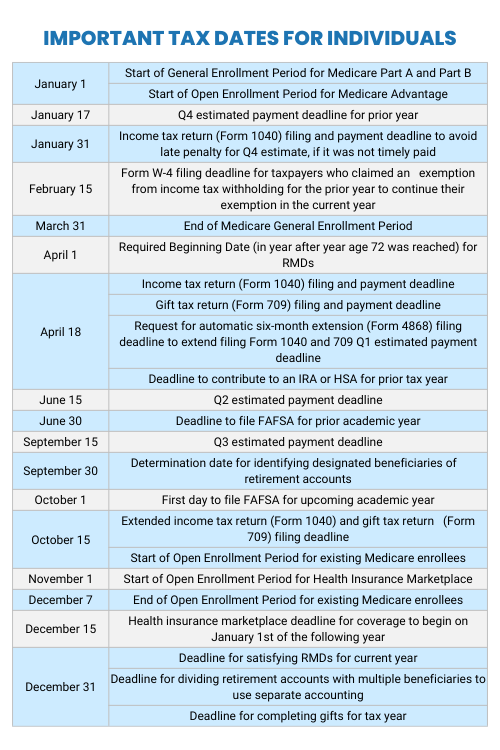
It's Not Too Early to Begin Preparing for Tax Season
While the April 15 deadline is still months away, there are still many things you can do right now to prepare for what is likely to be another hectic tax filing season in 2023.
This includes 1) taking a quick look at your tax documents and making a digital copy immediately upon receipt, 2) determining whether to self-prepare or hire out your tax returns this year, and 3) staying informed about key tax deadlines to avoid missing out on planning opportunities or tax penalties this year.
In our other posts, we cover essential life changes and events that could affect your taxes and last-minute tips to consider before filing your returns.
Either way, taking these first steps to prepare to file your returns could set you up for a stress-free tax season. But more essentially, doing the work now to get your financial house in order likely will put you one step closer to mastering your journey to financial independence.

Year-end Planning: 20 Things You Can Do to Organize Your Finances
It's November and there’s not better time than the present to get your financial house in order. Indeed, we're in that sweet spot before things begin to wind and just ahead of a busy holiday season.
While preparing a comprehensive financial plan is essential to financial independence mastery, today we're talking about doing the simple stuff: reviewing and making last-minute retirement savings contributions, fine-tuning your investment portfolio, reviewing your spending plan, and some general housekeeping regarding your equity compensation.
Taking a few minutes to check these items could put you on track to starting 2023 on the right track.
Here are 20 things you can do to organize your finances before the end of the year:
- Rebalance Your Investment Portfolio
- Top Off Your Child's 529 Account
- Maximize Your IRA Contributions
- Consider a Backdoor Roth Conversion
- Rollover Your Old 401k/403b
- Tax Loss Harvesting
- Review Your Restricted Stock Concentration
- Review Equity Compensation Tax Withholding
- Review Expiration Dates for ISOs
- Sell ISOs that are Down in Value
- Evaluate Your Expenses and Create a Spending Plan
- Review Your Fixed Income Needs
- Look Over Your Credit Report
- Set a Budget for Holiday Spending
- Review your Employer Benefits Statement
- Spend Down Your Flexible Spending Account
- Review Your Estate Plan
- Update Your Designated Beneficiaries
- Review your Insurance Policies
- Review Your Emergency Savings Need
1. Rebalance Your Investment Portfolio
If you still need to do so, now may be a good time to rebalance your investment portfolio. To start, ensure that you've appropriately evaluated your risk tolerance and identified a suitable diversified asset allocation strategy that suits your goals, needs, and objectives.
With your long-term strategy in mind, sell investment holdings above your target allocation, and use the proceeds to add to positions where your holdings are underweight.
Doing so may ensure that you're not taking more investment risk than you're already comfortable with while ensuring that your overall portfolio is aligned with your long-term investment goals.

2. Top Off Your Child's 529 Account
Depending on your circumstances, a 529 account may be an excellent way to save for a child's college education expenses. If extra cash is available, try topping off your child's 529 if you still need to maximize contributions for the year.
While there is no limit for annual contributions, the gift tax exclusion for the year is $16,000 per child ($32,000 for couples).
3. Maximize Your IRA Contributions
If you've maxed out your 401k/403b and still have some cash in savings, consider contributing money to your IRA. Putting money in an IRA allows your money to grow tax-advantaged, potentially boosting the overall value of your account compared to a taxable brokerage account.
In 2022, your total contribution limit to traditional and Roth IRAs can be at most $6,000 ($7,000 if you're age 50 or older). And be mindful of income limits before making contributions.
4. Consider a Backdoor Roth Conversion
If you've maxed out your 401k/403b and are otherwise not eligible to contribute to a Roth IRA this year, consider a Backdoor Roth Conversion.
As you'll recall, the way a Roth conversion works is that the government gets its share of your money now (compared to being taxed when funds are withdrawn years later), allowing investments in a Roth to grow tax-free. When it's time to take the funds out of the account, the money comes out tax-free.
What's more, a Roth account is not subject to required minimum distributions (RMDs), reducing unnecessary cash distributions in retirement.
5. Rollover Your Old 401k/403b
If you've left a job this year, go back and ensure you have a plan for that old 401k or 403b. Generally, you have two options for your money with an old employer retirement savings plan.
First, if your new employer's plan allows it, you can move the funds from your old retirement plan into your new plan.
Your second option is to open an IRA with a trusted advisor and transfer the funds over to your individual account. As long as the transfers are custodian-to-custodian, and you avoid holding back funds from the withdrawals, the transfer likely will be treated as a non-taxable event.
6. Tax Loss Harvesting
We've experienced arguably one of the most volatile financial markets since the Global Financial Crisis in 2008. As a result, you're likely holding onto losses in your investment portfolio that could provide you with a tax benefit this year. And that's where tax loss harvesting comes in.
Tax loss harvesting is the process of offsetting long-term capital losses against gains. This process applies to taxable investment accounts and involves identifying and selling holdings in a loss position to offset gains in other holdings. Before you implement tax loss harvesting in your portfolio, beware of wash-sale rules that could disqualify you from recognizing the benefit of tax loss harvesting.

7. Review Your Restricted Stock Concentration
Do you have a plan for your restricted stock? It's quite common for restricted stock recipients to simply allow their vested awards to accumulate in their employer plan's brokerage account.
Market volatility this year, particularly in tech-related sectors, is an important reminder of why investment diversification is essential to preserving your wealth for the long term. That's why you'll likely want to take a moment to review your company stock holdings and develop a plan to reduce your risk exposure.
8. Review Expiration Dates for ISOs
If you've recently left a job where you had ISOs, or are approaching your ten-year anniversary with an employer who has offered this benefit to you, now may be the time to evaluate the expiration date for your stock options.
Review expiration dates for outstanding stock options and deadlines for option exercises. If you've left a job in the past year, go back and review your previous benefits and ensure that you're not leaving money on the table.
9. Sell ISOs that are Down in Value
If you have vested ISOs that have fallen in value this year, now may be an excellent time to exercise those options. Remember, if you plan to hold your company stock for the long term, you may be subject to the Alternative Minimum Tax (AMT) when you exercise your options and don't immediately sell your holdings.
One way to lower your AMT due is to exercise your options when your ISOs' fair market value (FMV) declines, narrowing the spread between the FMV and strike price of the option.
10. Equity Compensation Tax Withholding
Review your withholding rate for equity compensation, such as restricted stock or stock options. If your employer has set your flat withholding rate for supplemental income (equity compensation) at the 22% standard rate, you'll likely need to come up with cash to pay taxes due this coming April.
Nevertheless, to avoid underpaying taxes next year, you can change your withholding rate by updating your W-4 form through your employer's HR system.
11. Evaluate Your Expenses and Create a Spending Plan
With the holiday season just around the corner, now may be a good time to review your spending trends to evaluate whether your spending is aligned with your long-term financial planning goals.
More specifically, take a close look at your discretionary spending (outside of insurance, mortgage, utilities, etc) and look for areas where your spending may be inconsistent with your overall plan for the year.
12. Review Your Fixed Income Needs
If you're already Financially Independent and living off of your savings, now may be a good time to review your anticipated spending need for the coming year. This evaluation is crucial given that inflation has run well above its 2% average over the past year.
This means that your living expenses will likely be higher in the coming year, and so you'll want to ensure that your current savings distribution is sufficient to meet your lifestyle needs without derailing your retirement plans.
13. Look Over Your Credit Report
A best practice we recommend around here is reviewing your credit report no fewer than once per year. And there's no better time than year-end to check your credit report. Pulling your credit report will not affect your credit score, and you can typically download a copy of your credit report for free from either of the three major credit reporting services (Equifax, Experian, and Transunion).
You want to look for suspicious activity, like a new account that you may not have opened or balances on cards that may have been dormant. If you find inconsistent activity on one or more of your accounts, call the reporting institution (bank, credit card company) to get more information. If you feel that the activity reported is inaccurate, you can file a dispute with each reporting agency to get your report corrected.
Either way, check your credit report to gain some peace of mind that your financial accounts are secure and in good order.
14. Set a Budget for Holiday Spending
With Christmas and the holidays right around the corner, many individuals may be tempted to put all spending on their credit cards and deal with the balances in the new year. More often than not, however, spending blindly might leave you with debt that you have to deal with all of next year.
That's why it's essential that, before heading into your holiday spending routine, you set limits you're your spending. One way to do so is to list all the people you want to purchase gifts for this year.
Track this list on your phone, in a notepad, or in a spreadsheet. Then, set a budget for each individual. Tally up the total amount you plan to spend this year and ask yourself, "do I feel comfortable spending this much money?" If the answer is no, consider revising your list. Either way, move forward with a spending plan and stick to your budget.
15. Review your Employer Benefits Statement
The end of the year is typically when most employers offer their annual enrollment period. As you head into this time, consider whether you've experienced life changes or anticipate major life changes in the coming year.
Then, take a moment to review your elections and evaluate whether your medical/dental/vision plan, related deductibles, and out-of-pocket expenses are consistent with your current lifestyle.
You'll also likely want to review your group insurance benefits. For example, your employer may offer optional life or disability insurance coverages above and beyond the basic plans you may already be enrolled in.
Many employers offer an opportunity to make last-minute changes in December if you missed your window to change your benefits elections. Either way, review your benefits to understand your coverages for the upcoming year.
16. Spend Down Your Flexible Spending Account
A flexible spending account (FSA) is a limited savings vehicle offered by some employer-sponsored medical plans that allow workers to set aside funds to pay for medical expenses on a pre-tax basis.
While the tax benefits give you more money towards paying for doctor's visits or supplies, the downside is that the account is typically a use-it-or-lose-it situation.
If you have a good chunk of change in your FSA, now may be the time to schedule a visit with a care provider for a check-up, buy a new pair of glasses, or stock up on medical supplies before the money is lost for good.
Here's one list of FSA Eligible Expenses: https://www.wageworks.com/takecare-mynewfsa/healthcare-fsa-carryover-overview/eligible-expenses/

17. Review Your Estate Plan
Estate plans aren't just for the mega-rich. They're relevant to most individuals and, at the basic level, include a Will, Healthcare, and Financial Powers of Attorney.
At this time of the year, you'll want to consider putting together your estate plan. Preparing your estate plan can be as simple as answering:
- where will your assets go should you and your spouse pass unexpectedly and
- who will be responsible for managing your financial affairs when you're unable to do so yourself.
If you already have an estate plan, now is an excellent time to look it over. Ask yourself whether you've experienced any life changes that may warrant an update to your estate plan.
At the same time, review your designated agents (executor, powers of attorney) and determine whether the individuals you've elected to manage your financial affairs are still appropriate, given your current circumstances.
18. Update Your Designated Beneficiaries
You can designate beneficiaries for your various financial accounts outside of an estate plan. Such designations include elections in your employer-sponsored retirement plan (401k/403b), IRA, and life insurance policies.
Additionally, titling your bank account with your spouse or partner can help you shorten the estate planning process and simplify financial choices when needed. Take the time to review the beneficiaries of your various financial accounts and make updates where necessary.
19. Review your Insurance Policies
Got a few extra minutes on hand? If so, now may be the time to evaluate your property and casualty premiums and shop around for some savings.
For example, many firms offer discounts for package policies that include homeowners and auto policies combined at one insurance company. As you shop around, ensure that your coverage limits reflect your assets and lifestyle. While you don't want to be underinsured, you may be paying for coverage already offered by an existing plan, like your employer's group policy.
Also, take the time to evaluate other coverages you may have yet to consider. For instance, if you have children, a term life insurance policy could be beneficial to providing your family extra financial protection and peace of mind. An Umbrella Policy can also help you avoid the financial setbacks related to potential lawsuits if someone were to get injured on your property.
20. Review Your Emergency Savings Need
Do you have money saved for a rainy day? Maybe you do, but do you have enough money saved to cover an unexpected loss of income?
Whether your furnace goes out or if your car is out of warranty and you have an unexpected expense, ensure that your savings are adequate to cover unexpected expenses.
How much should you have saved? The actual amount likely will vary from household to household, but one rule of thumb we use is having enough money saved to cover six months of living expenses.
At the very least, use this time to ensure that you have set aside enough money to cover the unexpected as you look ahead into the new year.
Next Steps
Certainly, there are many things to keep you busy heading into the holiday season. Nevertheless, before things get hectic in the coming weeks, my challenge to you is to identify at least three of the above items to tackle before the holiday hustle distracts you from your financial goals. You can spend as few as 90 minutes over the coming month working through these items. And yet every little step moves you one step closer to mastering your journey to financial independence.

How to Get the Most Money Back on Your Tax Return
Between gathering the necessary paperwork and working through complicated scenarios, tax season can be a stressful time. You’ve worked hard throughout the year, and you want to be sure you’re taking the right measures to get the maximum amount back on your return. Achieving this, however, takes diligence and research.
As you prepare to file for the 2019 tax year, it's important to note that the Tax Filing Relief for America Act was passed in March 2020. Due to the widespread COVID-19 pandemic, taxpayers have been granted an extension. The 2019 tax filing deadline is now July 15, 2020, as opposed to the standard April 15 deadline. With this three month extension, taxpayers can take the time needed to work with their trusted financial professional to file confidently this season.
5 Considerations to Make During Tax Season
By taking a look at your whole financial picture, you’ll have a better idea of the actions you can take to minimize your tax obligation and maximize your return. While this can take some time, it’s worth thinking through all of your expenses in order to increase your potential to receive a sizeable tax return. Luckily, we’ve compiled a list of five key considerations to make when aiming to maximize your return.
Consideration #1: Claim Your Retirement Tax Deduction
You can make a contribution to your IRA (up to $6,000 if under 50 and $7,000 if 50 and older) up until the filing deadline to receive a tax deduction.1 If you are covered by a plan at work, you’ll be eligible for either a partial or full deduction depending on whether you’re filing separately, jointly or if you’re single or the head of the household. If not covered by work, you can claim a full deduction.2
Consideration #2: Claim All Other Possible Deductions
Many expenses can qualify as a deduction, meaning they can be claimed to help minimize the amount of taxable income. Common qualified expenses include charitable contributions and state and local income, sales and property taxes. However, there are a number of other deductions that all taxpayers should remember. This includes anything related to work education, including tuition, books, supplies, transportation and travel costs.3 If you needed to complete work to maintain a professional certification, for example, anything related to doing so may qualify. Other deductions relating to work include unordinary travel expenses or anything you spent on job-hunting to land the job you are currently in.
Consideration #3: Make Sure to Claim All Dependents
A dependent is not limited to children, as it could be a relative who lives in your home as a member of your household. For example, a relative who is not physically or mentally able to care for themselves. If the individual has an income of less than $4,200 and is not a dependent on another individual’s return, they may qualify as your dependent.4 Additionally, the person must be a U.S. citizen, U.S. alien or U.S. national.
As of the Tax Cuts and Job Act changes in 2017, personal exemption deductions were suspended from 2018 until 2025. However, until then, you can still receive tax credits for children and dependents.5 You may receive up to $500 in tax credits for a qualifying dependent who is not a child of yours. However, this credit may be eliminated or reduced if your adjusted gross income exceeds $200,000 when filing alone or $400,000 when filing jointly.5
Consideration #4: Consider Itemizing Deduction if You’re Able
If the sum of your allowable deductions is higher than the standard amount, it’s recommended to itemize your deductions.6 In some cases, you’ll be able to get a bigger refund than taking the standard deduction. If you’re at the cusp of the standard amount, double-checking your receipts and expenses over the year may be an important step in determining whether or not to itemize your deductions. You can itemize deductions on expenses such as medical and dental care, mortgage interest, charitable giving and theft losses.6 However, in certain cases, you’ll be required to opt for one or the other. If you file a joint return with your spouse and you wish to itemize, for example, you and your spouse both must then itemize your deductions.
Consideration #5: Claim Refundable Tax Credits
Unlike a deduction that minimizes what you owe or a nonrefundable tax credit that only refunds up to what you owe, a refundable tax credit is money returned to you - such that even if you owe $0, you’ll be sent the remaining balance from the IRS. Refundable tax credits come in many forms. For example, credits may be given to those with expenses in a foreign country in order to avoid double taxation.7 You can also receive a credit when contributing to retirement savings, paying adoption fees or paying higher education expenses.
If you’re dealing with a complex tax scenario, you can always lean on the assistance of a CPA. Filing for your taxes can feel like a daunting task, but taking the extra time and effort to make sure you’re taking full advantage of your tax return can pay off.
- https://www.irs.gov/retirement-plans/plan-participant-employee/retirement-topics-ira-contribution-limits
- https://www.irs.gov/retirement-plans/plan-participant-employee/2020-ira-contribution-and-deduction-limits-effect-of-modified-agi-on-deductible-contributions-if-you-are-covered-by-a-retirement-plan-at-work
- https://www.irs.gov/taxtopics/tc513
- https://www.irs.gov/publications/p503#en_US_2019_publink1000203270
- https://www.irs.gov/pub/irs-pdf/p5307.pdf
- https://apps.irs.gov/app/vita/content/globalmedia/4491_itemized_deductions.pdf
- https://www.irs.gov/individuals/international-taxpayers/foreign-tax-credit

Why is Tax Efficiency Crucial to Retirement Savings and Income?
Let's face it: nobody likes taxes, and no one (save for a few accounts) enjoys talking about taxes. The truth is that not paying attention to tax-efficient savings decisions might leave you with a smaller nest egg and cost you more in retirement. For some individuals, gaining a high investment rate of return is their top savings priority.
But did you know that being more mindful about the tax consequences of your savings and investing decisions could leave you with more money in retirement than focusing on investment returns alone? There's no doubt that tax issues are complex, complicated, and sometimes a matter you'd rather avoid altogether. Even so, simple decisions like selecting the right savings plan and being selective with investment income might lead to potentially higher savings and more money to spend throughout retirement.
Decision 1: Saving in a Qualified vs. Taxable Account
Whether you're a do-it-yourselfer or have worked with a financial professional, you likely know that contributing to a qualified investment account is a sure-fire way to build a retirement nest egg. So, what is a qualified account? These vehicles enable you to save for retirement and include employer plans like a 401k or 403b and individual retirement accounts (IRAs).
Qualified retirement accounts matter because they give you a sort of tax holiday, either allowing you to save for retirement before Uncle Sam gets a cut of your paycheck or providing you with an income tax benefit at the end of the year. Many people know these kinds of savings vehicles are a good thing, but how exactly might they help you from a tax perspective? To understand the potential tax benefit, let's start by taking a look at the tradeoff between saving in an employer retirement plan versus a simple, taxable brokerage account.
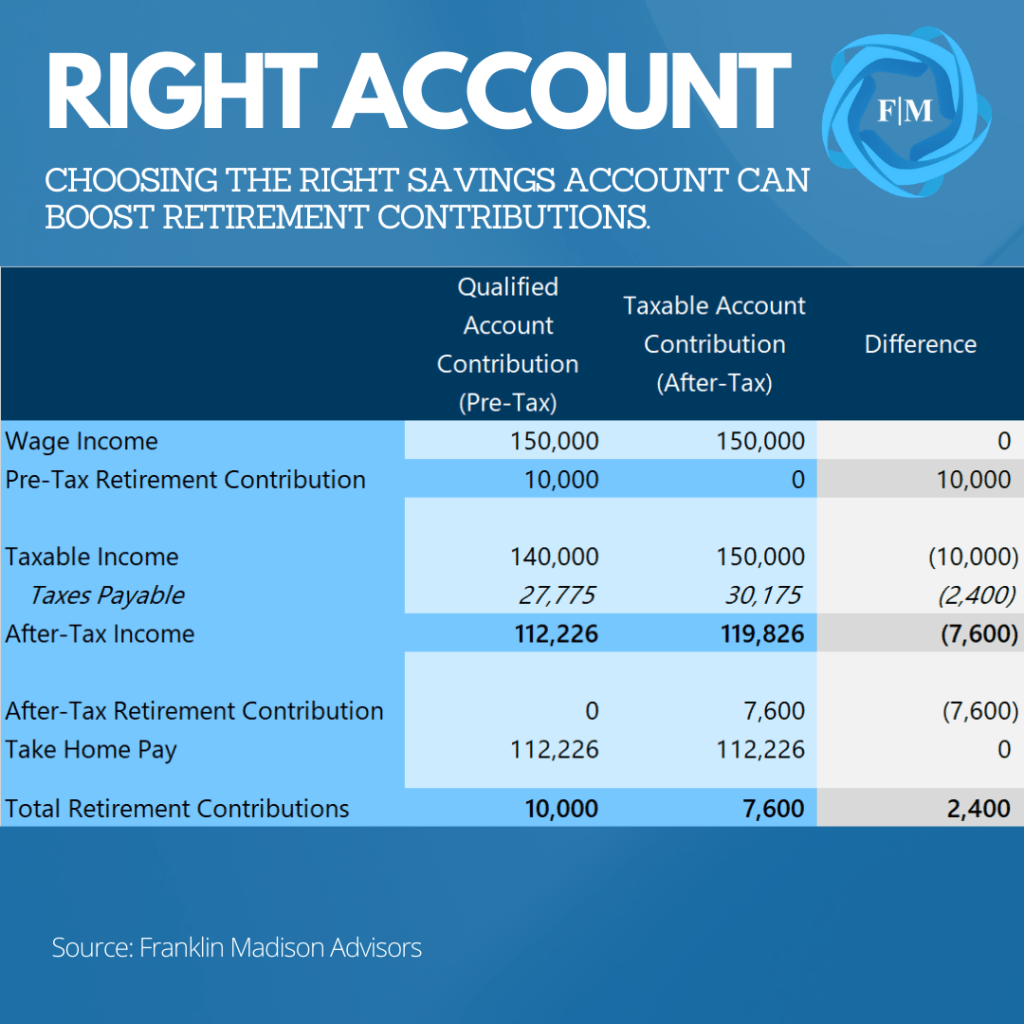
Example: 401k and 403b Tax Savings
For illustrative purposes, let's assume that you are married, earn $150,000 per year, and want to put away cash for retirement. Should you contribute to an employer retirement plan or invest your savings in a brokerage account? While money invested in either one of these accounts might produce a similar investment experience, contributions to the qualified account might provide you with more cash to invest from the start. How is this possible?
Well, contributions to employer retirement plans are considered above the line deductions. This adjustment means that the government gets its cut of your gross take-home pay after you've made a retirement contribution, allowing more money to go into retirement savings. So, for example, a $10,000 retirement contribution would leave you with take-home pay of $112,200 after accounting for taxes. And what if you decided to invest on an after-tax basis?
Put simply, not making the pre-tax contribution might leave you with less money to invest. That's because your income is taxed at $150,000, rather than $140,000. While you may initially have a higher after-tax income of $119,800, you may only be left with $7,600 to invest if your goal is to maintain $112,200 in after-tax income. While this difference, $7,600 versus $10,000, may seem small now, every little bit of tax savings adds up over time.
To put the difference into perspective, assume that you have $100,000 saved, invest $7,600 per year and earn a return of 5.5%. At this rate, you could end up with a retirement savings of $556,000 after 20 years. How does this compare with contributing $10,000 to a qualified savings account? Applying the same assumptions, you could build a retirement nest egg of $640,000, which is $170,000 higher than investing on an after-tax basis. In this situation, contributing on a pre-tax basis, or before Uncle Sam gets a cut of your paycheck, lowers your income taxes, and allows you to save more money from the start.

Example: Traditional IRA Tax Savings
Now, if you've maxed out your 401k or 403b contributions, or otherwise are not able to participate in such a program, then investing in a traditional IRA may be another way to take advantage of favorable tax treatment. Whereas a 401k or 403b plans allow you to contribute to retirement savings on a pre-tax basis, an IRA uses after-tax dollars to fund your retirement savings.
Rather than providing an immediate tax benefit, the savings come at the end of the year when you file your taxes. As of this writing, the IRS allows individuals who have wage income to contribute $6,000 per year ($7,000 if over 50) in an IRA. Your IRA contributions might be eligible for an income tax deduction depending on your ability to participate in an employer retirement plan and household income levels.
In this case, while you may be able to contribute only $6,000 per year, this tax-deductible contribution may enable you to save over $1,400 on your tax bill. The simple takeaway here is that qualified accounts may empower you to accumulate more money, supercharge your retirement savings, and provide you with a tax benefit compared with saving in a simple brokerage account alone.
Decision 2: Being Selective with Retirement Income Investments
If you're nearing retirement or are already retired, then sustainable retirement income will likely be a top priority for you. Stock dividends and bond interest payments are often two means for generating this much-needed income. Even so, not being aware of the tax consequences of income sources may leave you with less money in your pocket after the tax man comes calling. That's why qualified dividends and tax-exempt interest are crucial to minimizing taxes when income generation is a retirement priority.
Before discussing qualified dividends and tax-free bonds, it's crucial to understand how some investment income is taxed. For example, ordinary dividends and corporate bond interest income are typically subject to ordinary tax rates. This means that the income payments you receive from some of these securities would be taxed at the same rate as regular wages. On the other hand, qualified dividends are taxed at a rate lower than ordinary dividends, while tax-free bonds may be exempt from federal income taxes.
Qualified Dividends
So, what distinguishes a qualified dividend from an ordinary dividend? Well, the IRS considers ordinary dividends to be regular income paid out by a corporation's or mutual fund's earnings and profits and thus subject to ordinary income tax rates. On the other hand, a qualified dividend is income received from 1) a U.S. corporation or qualified foreign corporation making the dividend payment and 2) subject to a specific holding period for the investment producing the dividend.
And what difference might it make to hold qualified versus ordinary dividends? Let's look at an example. Two investment portfolios each have a value of $1,000,000 and receive a dividend yield of 2.5% per year. At this rate, each portfolio will generate interest income of $25,000 per year. Assuming that your effective tax rate is 24%, what might the difference be in taxes paid?
Because ordinary dividends are taxed as ordinary income, the $25,000 income you receive will generate a tax bill of $6,000. Qualified dividends, on the other hand, are currently taxed at a lower rate. Under the current tax regime, assuming a capital gains tax rate of 15%, you would owe the government $3,750 on $25,000 of income, saving you $2,250 per year on taxes. The point here is that simply taking the time to identify securities that offer qualified dividends can save you money over the long-term. And what about interest income?
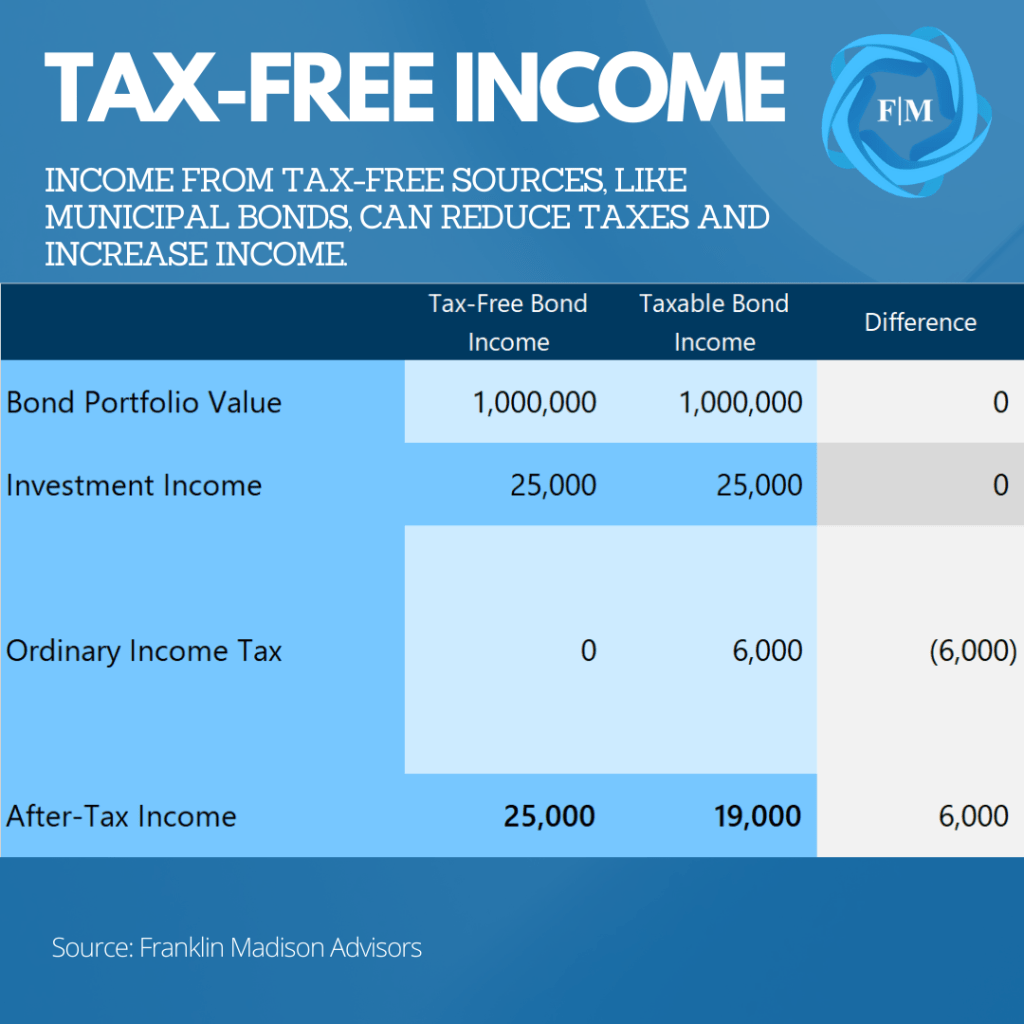
Tax-Exempt Bonds
Bond interest payments are another way to generate retirement income, but like ordinary dividends, these sources' income might subject you to ordinary income tax rates. That's why if you're looking for a way to lower your tax burden and generate retirement income, tax-exempt bonds could help. This bond designation means that the interest payments you receive are generally tax-free at the federal level while some state taxes may apply. Even so, income from tax-exempt instruments, like municipal bonds, might provide you with higher after-tax retirement income.
So, what is a municipal bond? Well, municipal bonds, or Munis, differ from corporate bonds. They are often issued by a city, county, or state and used to pay for capital expenditures like roads, bridges, schools, and other infrastructure projects. Let's look at an example of how Munis might save you money on taxes.
Let's say that you invest $1,000,000 in a corporate bond that pays a 2% coupon per year. Carrying forward some of the assumptions we used earlier, income received on this bond would be subject to tax at an ordinary effective income rate of 24%. So out of the $20,000 interest income you receive, $4,800 would go to paying the IRS, leaving you with $15,200 on an after-tax basis.
Because of their tax-exempt status, a municipal bond offering the same sort of coupon rate might provide you with $20,000 income, which is nearly $5,000 more than the taxable bond when we ignore state and local taxes. Now, in practice, you're likely to find that yields on Munis are lower than those of taxable bonds and mainly reflects the tax advantage of Munis.
Even so, a key benefit of income derived from qualified dividends and interest income from municipal bonds is that their income does not affect your overall adjusted gross income. This can be particularly helpful during tax season if you're drawing retirement income from multiple sources and are looking for ways to stay in a lower overall income tax bracket. Either way, being mindful of your income source's tax implications can help you save more money and make your savings go further in retirement.
Become Tax-Efficient with Your Retirement Savings and Income
Let's face it: nobody likes taxes, and most people don't enjoy talking about taxes. The truth is that not paying attention to tax-efficient savings decisions might leave you with a smaller nest egg and cost you more in retirement. There's no doubt that taxes are complex, complicated, and sometimes a matter you'd rather avoid altogether. Even so, simple decisions like selecting the right savings plan and being selective with investment income might lead to potentially higher savings and more money to spend throughout retirement.
The CARES Act and Thriving During a Downturn
By the time the U.S. economy reopens weeks from now, tens of millions of people will have lost their jobs and thousands of small businesses will remain shuttered on account of the COVID-19 outbreak. Estimates of the economic impact differ widely and it’s very likely that the ultimate financial cost of the coronavirus will take months if not years to fully understand.
As we pointed out in our report last week, Congress has stepped up to support ailing households and businesses in an effort to mitigate some of the real financial pain being experienced today by real people. But what sort of help is on offer and what can people do to weather the financial storm?
We believe that people can still thrive financially during this economic downturn by understanding the resources available to them and by taking solid steps today to set themselves up for a rebound for when the economy eventually recovers. So, what sort of help can people get today? Let’s begin by taking a look at the resources available to small business owners.
Small Business Resources from the Government
The Coronavirus Aid, Relief and Economic Security Act (CARES Act) was passed by Congress last month and is central to small business financial relief efforts currently underway. This Act sets aside $350 billion in support through the Paycheck Protection Program (PPP) which offers forgivable loans to small business owners. How does it work?
Well, if you have a business with less than 500 employees, you can apply for a loan to cover 8 weeks-worth of payroll and other things like mortgage interest, rent and utilities. Sole proprietors, freelancers and independent contractors are also eligible to participate, but payroll is capped at a $100,000 annual rate.
Figure 1: CARES Act - Support for Small Business Owners
The loan covers up to 2.5 times monthly payroll (at last year’s levels plus 25%) and up to $10 million for all eligible expenses. Not only is the loan forgivable, it does not require a personal loan guarantee. Sounds great, right, what’s the catch? Well, there are a couple of things to consider.
First, the government itself is not issuing the loans, so small business owners will need to initiate the process by reaching out to their local bank or SBA lender. While some banks have been slow to get started with the program, more are coming online everyday which eases the burden of applying for a PPP loan.
The other thing to consider is the requirements for loan forgivability. Why is the government calling it forgiveness, when businesses need to take out a loan in the first place? When the law was being drafted, members of Congress were concerned that business owners would just take the cash to keep their businesses afloat without consideration for their employees’ wellbeing.
Figure 2: Payment Protection Program - Loan Forgiveness
From this perspective, what the loan does is it incentivizes businesses to keep their workers employed, or bring them back to work, during this economic downturn. More specifically, in order for the PPP loan to be forgiven, two key criteria must be met:
What this means is that debt forgiveness will be reduced as employers cut headcount or payroll falls by more than the 25% threshold. Using the money for something other than what is outlined in the loan forgiveness criteria, like an owner paying themselves above and beyond the 25% limit, will put the business owner on the hook for part or all of the PPP loan. So that’s the Paycheck Protection Program in a nutshell. What if you’re a startup or otherwise don’t qualify for a PPP loan?
Other Small Business Resources
The good news is that you still have a few options. For instance, the Federal Reserve earlier this week announced its Main Street Lending Program. The program makes available $600 billion in loans to small and medium sized businesses with fewer than 10,000 employees and with revenues of less than $2.5 billion. You’ll need to talk to your bank to apply for this program and qualification and terms will follow the those laid out for PPP loans. While the loan is not forgivable, the program offers a lifeline to businesses in the form of a 4-year loan, with principal and interest payments deferred for the first full year.
Another resource for business owners is the Small Business Administration. The SBA is now working directly with state governors to provide relief through its Economic Injury Disaster Loan (EIDL) program. The EIDL program is open to business owners with a need of up to $2 million, offered at favorable rates and also provides an immediate cash injection of up to $10,000 that, if you qualify, won’t have to be paid back.
There are a few stipulations about applying for an EIDL alongside the PPP loan. For example, using the EIDL and the PPP for the same purpose could lead to either one of your applications being rejected. So, the point here is to think carefully about which loan program best suits your financial needs right now before applying.
Figure 3: Other Resources for Small Business Owners
There are also a number of other initiatives on offer by private organizations aimed at helping small business owners make it through the economic downturn. For example, GoFundMe and Yelp have partnered to start the Small Business Relief Initiative. Their aim is to help raise money for local restaurants and small businesses during the COVID-19 related economic downturn. Facebook is also getting into the act by offering $100 million in cash grants and ad credits for business owners. And Amazon has also launched its own Neighborhood Small Business Relief Fund. Truly, many large businesses are finding ways to help out, and there are a number of other resources available at the city, county and state level as well.
Here in Pittsburgh, the Urban Redevelopment Authority and the Pittsburgh Technology Council have provided a constant stream of important information as far as how businesses can adapt to COVID-19 related issues. Also, other really important venues to get a handle on what’s going on in your local area are chambers of commerce and small business development centers. At a national level, the U.S. Chamber of Commerce has been very active in providing knowledge, like in depth articles and webinars and links to financial resources for business owners. So, we’ve spent a good deal of time covering programs for businesses, what about financial resources for individuals?
Financial Resources for Individuals
Let’s go back to the CARES Act for a moment. Inside this relief package, Congress set aside about half a trillion dollars and a few provisions to help out individuals and households affected by the COVID-19 outbreak. This includes 1) direct income payments to households, 2) additional unemployment insurance benefits and 3) some help with education expenses. Let’s talk about the payments to households first.
Late last month, Congress announced that it would give cash handouts to people with no strings attached. That is, the money does not have to be paid back and it can be used for any purpose that the recipient sees fit. The amount on offer includes $1,200 for adults, $2,400 per couple and $500 for each child in the household. There are certain limits, however, on who can receive the cash handouts. In order to qualify for the full amount, recipients must have filed taxes with a social security number, have income less than $75,000 in 2019 or $150,000 if filing jointly to receive the full benefit.
Figure 4: Who Qualifies for CARES Act Stimulus Payments?
Payments will be issued by the Treasury Department in the coming weeks and if the IRS has your bank information on hand, you can probably have your stimulus check directly deposited into your bank account. If you’re taking Social Security benefits, the way you get paid today is probably going to be the same way you will receive your government stimulus check.
If the IRS does not have your bank information on file, don’t fret just yet. The Treasury Department is working on an online portal where you can log in to input your bank information and to receive a direct deposit of your stimulus check. Otherwise, you can expect a check in the mail or prepaid debit card sometime in the coming months. If you have become unemployed or are close to being unemployed, know that the CARES Act includes some additional provisions for you as well.
If you become unemployed, you’ll need to contact your state’s unemployment office to see if you’re eligible for benefits and to start a claim. The U.S. Department of Labor has resources for tracking down this information on its website located here. The unemployment provision in the CARES Act is there to augment benefits provided at the state level. More specifically, the legislation provides for an additional $600 payment per week to an unemployed worker. This amount is in excess and addition to the benefit a person would normally receive in their state unemployment insurance amount.
Figure 5: The Rising Burden of Student Loan Debt
Finally, education costs are a large burden for many households. If you fall into this group, the government may have you covered. The Student Aid Provision in the CARES Act suspends all payments due on student loans, halts interest accruals and suspends involuntary collection efforts on defaulted loans through September 30, 2020. In order to qualify, however, your student loans must be either Direct Loan or Federal Family Education Loans (FFEL). Unfortunately, private loans may not qualify for this benefit. So, what are some things that you can be doing today to set yourself up for a rebound when the economy eventually recovers?
Setting Yourself Up for a Financial Rebound
What can you do if you’ve lost your source of income? Well, we believe that one of the first things that you should do is take time to assess your current situation with a mind for how you would like your life to play out on the other side of this this crisis. That is, think about what you can do right now to not only keep your head above water, but also set yourself up for a financial rebound when the world eventually heals and your circumstances improve.
Figure 6: Setting Yourself Up for a Financial Rebound
If you’ve lost your source of income, there are a few priorities that you should probably be thinking about right now. That includes 1) how to preserve and increase cash flows, 2) evaluating saleable assets and 3) assessing your borrowing power. Whatever the case, do not stop paying your bills without checking with your service providers, lenders or landlord first. It’s true that foreclosure and eviction orders have been suspended for a time, but you should carefully consider the potential consequences of what may occur after the suspension is lifted.
Survival is of the utmost importance during this time, but you also want to be mindful of the fact that this station in life is only temporary. From this perspective, every financial decision you make today will have consequences from which a misstep could take years to recover. Take a page from history and consider the Great Recession. People who walked away from their homes, whether they wanted to or not, had to sometimes wait seven years before they could qualify for a conventional mortgage.
Figure 7: Lifetime Mortgage Interest Payments
Therefore, preserving a solid credit profile throughout the recession means that you may be in a strong financial spot once your source of income returns and you’re in a position to spend money again. This is notably important when making big-ticket purchases. For example, with a $200,000 mortgage, the payment difference between a borrower with a low credit score and one with higher credit score can be as much as $200 per month.
Spread over the lifetime of the loan, this difference ads up to tens of thousands of dollars in additional interest that a person with a higher credit score would otherwise avoid in their mortgage payments. While we may be talking about houses here, the example also applies to the additional cost of taking out an auto loan, student loan or credit card when you have a relatively lower credit score.
Either way, if you are in a position where you’ve lost your source of income, remember that there are people ready to help and resources available to you right now. Besides some of the things that we’ve shared in this report, there are other ways to get help if you need it. For example, Food Banks across the country are ramping up their operations to help keep families fed regardless of their financial situation. People are also raising money in a pinch through crowd funding sites like GoFundMe or Facebook. If you’re in Pittsburgh, other local resources to help pay bills and cover medical expenses are available at the local and national level as well.
Some Tips for the Employed
It’s true that not everyone will lose their jobs during this economic downturn. If you’re still employed, you have an even greater opportunity to set yourself up for a financial rebound when the economy eventually recovers. So, what can you do today? Well, the stay-at-home orders have given many of us more time to ourselves and time to think. We suggest using this time to 1) create an action plan outlining how you can be prepared should you lose your source of income and 2) use the time to reevaluate your life goals and financial priorities.
To the first point, we recommend going back and looking through some of the resources mentioned earlier in this report. Having a plan in place before things hit the fan will make you better prepared to weather a financial setback and give you time to focus on thriving financially. In terms of reevaluating your financial priorities, ask yourself whether the things that mattered before the COVID-19 pandemic will mean as much or mean more to you when your world heals.
Then, take some time to determine whether your current wealth creation habits and financial resources are in sync with the priorities that you’ve just laid out for yourself. If you’re finding a disconnect between your life priorities and financial resources, one place to start is by focusing on upping your wealth creation habits. This includes taking a hard look at where your financial resources are going every month, reviewing your credit report to find ways to refinance high cost debt and looking for opportunities to make your money work for you.
Stimulus Check: How to Spend It
Finally, many may be wondering what to do with their stimulus check when it eventually arrives. For some people, the priority may be obvious: buy food, pay bills or simply use the money to take care of friends and family. For others, the check may represent a windfall with an unassigned use. To be sure, there are a lot of interesting ideas out there about what you can do with your stimulus check.
If you are in a solid financial situation, meaning that you have adequate cash reserves to see you through 6-12 months of living expenses, we believe that now may be the time to think about how you can support your community. Demand on charities has gone up in recent weeks. And at the same time, many charities and non-profits are seeing a drop in charitable contributions. One thing to consider is that the CARES Act allows for a charitable tax deduction even if you do not itemize your taxes in the coming year.
Another thing to consider is that many small business owners are understandably struggling during this uncertain time. Your stimulus check alone may not seem big enough to help a business owner, but when paired up with your neighbor’s contributions we’re talking about millions of dollars injected into your local community, helping out your local independent restaurant, coffee shop, retailer or other important business. For example, $6 million dollars could flow through a community even if only 10,000 people used half of their stimulus money to buy gift cards or increased their spending at local small businesses today.
The Key to Thriving Financially: Getting Started Today
We believe that the best way to recover from a setback is to set yourself up for a financial rebound ahead of when the economy eventually improves. If you’re a business owner or individual who has lost their source of income, do everything within your power to remain solvent and stay in the game. There are a number of public and private programs available to you right now.
If you’re fortunate to still have a source of income, we suggest thinking about ways you can help out businesses and individuals in your local community as much as possible. Also, take the time to make plans for your financial life amidst the downturn and ahead of an economic recovery. Whatever your circumstance may be, leave no stone unturned when it comes to finding the help you need and know that the key to thriving financially is to take action today.