

2025 Year-in-Review: A Market That Felt Uncertain, Yet Finished Strong
If I had told you at the start of this year what the headlines would look like, you probably would have guessed the market would struggle.
Trade tensions. Tariffs. Policy whiplash. Growth scares. Interest rates. Post-election political noise.
And yet, here we are near year-end with stocks having logged another record-setting year.
So, what happened? And more importantly, what should we take from it as we head into 2026 with your plan intact?

The Thread That Ran Through the Whole Year: Policy Didn’t Just Matter, It Moved Markets
Well, after the election and into the January inauguration, markets began pricing in a new policy direction. Early optimism around pro-growth expectations gave way to something more complicated and that’s uncertainty.
And the fact of the matter is that uncertainty does not just make headlines feel louder. It changes behavior as consumers hesitate spending, businesses delay investing and market participants reprice risk.
And that policy uncertainty became the steady drumbeat behind most of 2025’s major moves.
Q1: From Optimism to a Valuation Reset
Now, to understand where we’re going, we often need to understand where we came from.
Indeed, you’ll likely recall that the S&P 500 hit an all-time high in February before markets took a breather.
So, what changed?
Well, simply put, valuations reset. What this means is that many investors became less willing to pay top dollar for future earnings as plans out of Washington led to more uncertainty. And when the market’s mood shifts, prices can fall even if fundamentals are still solid.
At the same time, the mega-cap tech stocks that carried the market in 2024 became a drag in early 2025. In other words, yesterday’s winners stopped winning, at least for a season.
Then we got the Q1 GDP headline that the economy shrank, which got the market’s attention.
In fact, the data put a spotlight on why growth dipped, and a big part of the answer came from behavior around tariffs.
To be sure, what the data showed was that imports surged as businesses and consumers pulled forward purchases to get ahead of higher prices. Government spending also appeared to fall on a quarter-to-quarter basis, which mechanically dragged GDP lower.
In other words, the data was real, but the story underneath it was nuanced.
And that is why we kept coming back to the same point: the economy can slow without breaking, and markets can fall without it meaning that something is fundamentally wrong.

April: The Market Tantrum (and the Quick Recovery)
Now, if Q1 felt uneasy, then early April felt like panic.
That’s because a sweeping tariff announcement from the Trump administration escalated the trade war narrative, prompting the S&P 500 index to drop more than 10% in a week.
But where things got interesting is that shortly thereafter, the administration paused tariffs, and the market clawed back most of the decline by month-end.
This behavior was essentially a preview of what we saw repeatedly this year which included policy headlines creating short-term market drama that moved faster than the underlying economy.
So then, by mid-year, we had lived through two completely different quarters.
Q1 was caution. Q2 was rebound.
Indeed, markets found their footing as some tariff fears proved less disruptive than expected, headlines softened, and corporate earnings held up better than many feared.
But even then, things still did not feel settled. For many of us, it felt like there was still another shoe to drop. That’s because markets can recover faster than confidence does.
Nevertheless, the market snapped back near highs while sentiment stayed shaky, in part because tariffs were paused in 90-day windows and deadlines kept moving. While this approach didn’t lead to a concrete resolution to trade uncertainties, it did give markets breathing room.
In other words, the real story wasn’t “everything is fine.” The story was, “markets are pricing in a middle path, and they’re doing it before the human heart feels ready to believe it.”
Q3: New Highs, Softening Labor, and a Fed That Finally Moved
Either way, investors began looking past the uncertainty and in the third quarter, markets pushed to new highs again.
Earnings stayed resilient as AI continued to dominate headlines, trade tensions eased somewhat as tariff deadlines were repeatedly pushed out, and market breadth improved.
What this means is that more parts of the market contributed to the overall rally, including small caps which finally broke above their old 2021 highs.
These optimistic moves in the market happened even as incoming data showed that the US economy was in transition. That’s because by late summer, labor market data softened as unemployment rose to around 4.3% and job growth slowed meaningfully.
And that shift mattered because it changed the Federal Reserve policymakers’ position on interest rates.
Indeed, after a long pause, the Fed cut rates in September, framing it as a risk-management move to keep the expansion on track, not an emergency response.
And this distinction is important because a “panic cut” feels like trouble, while a “risk-management cut” feels like a central bank trying to extend the runway.
Q4 Into Year-End: Record Highs… With a Quieter Story Under the Surface
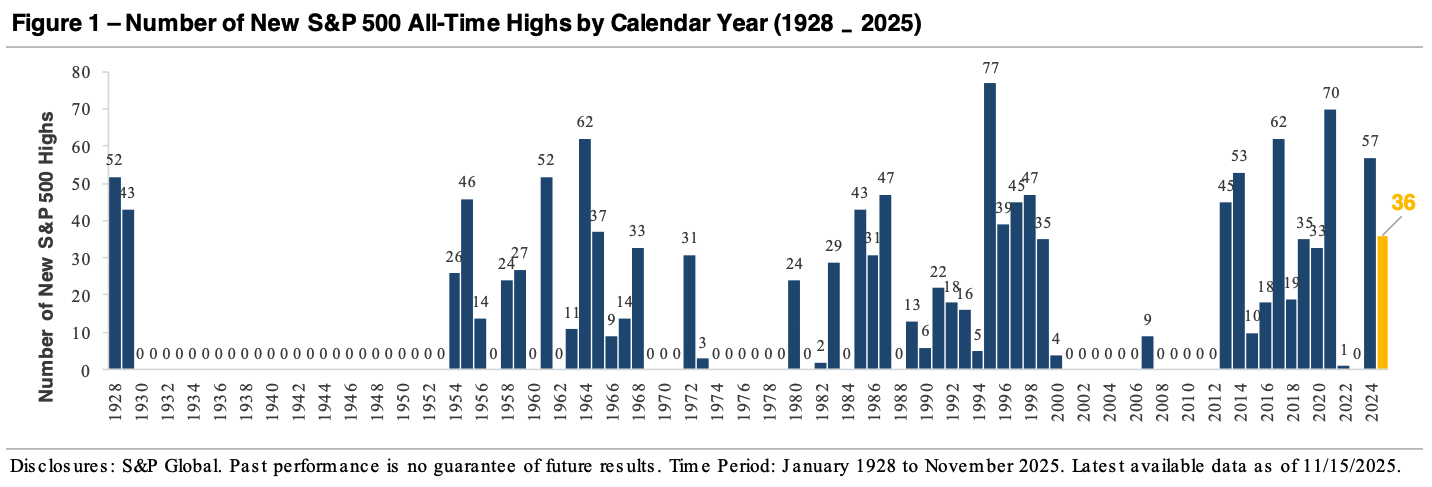
No matter how you cut it, it has not felt like a normal year. And yet the market has quietly spent a lot of time at record highs, with the S&P 500 setting dozens of new all-time highs.
But the more important detail is that even with breadth improving from earlier in the year, much of the strength has been narrow.
That’s because AI has remained the dominant theme, with enormous investment flowing into chips, cloud infrastructure, and data centers. Those moves have boosted major indexes because the biggest companies have the biggest weight.
So, you can have a market that looks strong in headlines while the “average” stock feels far less exciting.
And that disconnect is why the emotional experience of investing rarely matches the scoreboard.
Even so, this is why we keep emphasizing two principles at the same time throughout the course of the year: Stay invested and stay diversified.
The Planning Lesson of 2025: Don’t Waste a Good Rally, and Don’t Fear the Next Dip
To be sure, one of the most practical messages we repeated this year was that pullbacks are not unusual, and in fact, they are to be expected.
Dips of a few percent happen regularly, and 5% corrections happen multiple times in many years.
So, what do we do with that?
We prepare.
And that preparation is not pessimism. It’s how you participate in the upside without losing your footing when markets take a breather.
So then, as we look to the year ahead, we continue to home in on two key principles:
- Cash reserves
Working investors: typically 6–9 months.
Retirees or near-retirees: often 12–18 months.
Because the last thing you want in a downturn is to be forced to sell at the wrong time. - Tax-aware opportunities when markets dip
Market weakness can create windows for strategies like Roth conversions and other planning moves that can improve long-term after-tax outcomes.
Remember, the goal is not to predict the next pullback. The goal is to know what you will do when it comes.
A Look Ahead to 2026: AI Optimism, Real Opportunity, and Real Risk
As we step into 2026, it helps to start with a simple expectation that the economy does not need to be great for your plan to work.
Right now, the most reasonable base case is continued expansion, just not a boom like parts of the post-pandemic expansion. Think steady but unspectacular growth that looks more like low two percent than the kind of upside that makes every risk feel justified.
Indeed, the first half of 2026 may also feel slower as a few of the same forces we wrestled with in 2025 keep showing up. Tariffs are still a drag at the margin, more folks are choosing to retire and the productivity boost everyone wants to see usually arrives later than the market hopes.
Inflation Concerns Linger
And while growth is one immediate concern, inflation is the second part of the equation where investors can get tripped up. That’s because inflation does not have to reaccelerate to create stress. It simply has to stay sticky enough that the Federal Reserve cannot pivot quickly and aggressively the moment markets get uncomfortable.
In that environment, rate cuts can still happen, but they are more likely to be measured than dramatic. And this matters because “easy money” is not the same tailwind it was in prior cycles, and it means returns tend to feel more earned.
So then, when you put those pieces together, you get a familiar setup historically that includes a normal economy, inflation that stays above 2%, and a Fed that has less room for deep cuts below what it considers neutral.
Market Outlook
And what does this mean for the markets?
Well, the key narrative is still likely to be AI, and the capital spending wave is real. We anticipate that this investment cycle can support growth and earnings. Nevertheless, the market has already built a lot of optimism into prices, especially in the biggest growth names.
And when expectations get stretched, the risk is not that the theme disappears. So then, the risk is that the timeline disappoints, competition shows up faster than expected, or leadership rotates while investors are still anchored to the last set of winners.
This is why I want to be careful about how we think about “upside” in 2026. Yes, there are scenarios where things run hotter than expected and risk assets do very well.
Nevertheless, our expectation is for a year where the economy keeps moving, inflation stays firm enough to keep the Fed cautious, and markets have less room to absorb surprises.
In that kind of year, concentration risk tends to show itself faster, and valuation matters more than it did when liquidity was abundant.
That brings me to what I think is the most practical takeaway heading into the new year.
Staying Disciplined for the Long-term
If 2025 reminded us how quickly narratives can change, 2026 looks like the year where discipline gets rewarded. Not by avoiding every bout of volatility, but by being positioned so you are not forced to make decisions on the market’s timetable.
This is also a moment where bonds deserve more respect than they have gotten in the past decade. When yields are meaningful, high-quality fixed income can do two jobs at once. It can provide real income, and it can add stability if stocks go through a period where expectations cool off.
That’s why the best forward-looking risk-return profiles are increasingly found in high-quality fixed income, and why a more balanced stock-bond mix has a stronger case than it did when yields were near zero.
On the equity side, I still expect the market to be pulled in two directions. In the near-term, earnings can remain supportive, even with modest growth. And in the longer-term, the market is wrestling with a more complex reality with high expectations, crowded leadership, and the simple truth that technology cycles tend to produce new winners over time.
That is one reason value-oriented stocks and international developed markets look more compelling on a forward-looking basis than simply doubling down on U.S. growth at any price.
The Big Takeaway
When it comes down to it, as we head into 2026, AI remains the central economic and market storyline likely to dominate attention. And while it may feel like this theme is growing tired, there is still a balanced way to hold the story.
AI can be a genuine economic tailwind through capital investment and productivity gains. At the same time, solid economic upside does not automatically guarantee strong stock returns from today’s market leaders, especially when expectations and valuations are already high.
That’s why, heading into next year, we continue to emphasize quality, diversification, and the discipline to avoid building a portfolio that is overly dependent on one theme.
Because even when a theme is real, leadership can change.
And history has a way of reminding us that tomorrow’s winners often look different than today’s.

New Highs, Old Lessons: Staying Invested and Diversified in an AI-Driven Market
It has not felt like a normal year in markets.
Between headlines about trade tensions, elections, and interest rates, many investors describe this year as "uncertain" or even "uncomfortable." Yet when you step back from the day-to-day noise and simply look at the scoreboard, you see something very different:
The stock market is quietly having another record-setting year.
A Market that Keeps Finding New Highs
So far this year, the S&P 500 has set 36 new all-time highs. And while that's fewer than last year's pace, it still ranks 18th out of the past 98 years. In other words, this is not an ordinary year, it's a year in which the market has spent a lot of time in record territory.
And it is not just one index. The S&P 500's strength is part of a broader pattern across major equity markets. For example, the Nasdaq composite index has logged 36 new highs, the Dow has posted 17, and even the small-cap Russell 2000 index, which spent years stuck below its 2021 peak, and has now recorded six new highs after finally breaking through that old ceiling.
So then, if you only checked your account periodically, you might simply see "up double digits" and move on. But, the more interesting story lives beneath those numbers: what is driving these gains, and how healthy is this advance?
The AI Boom: Powerful Tailwind, Narrow Leadership
And so, what's been driving this year's rally? Well, the clearest theme this year has been artificial intelligence (AI).
That's because companies are spending hundreds of billions of dollars to train AI models, to build and cool data centers, and to secure the power needed to run it all. To this point, Nvidia recently became the first company to reach a market value above $5 trillion. At the same time, large technology firms such as Microsoft, Amazon, Alphabet, and Meta are reporting strong growth that is directly tied to demand for their cloud and AI-related services.
And as capital flows into this theme, AI-linked stocks have moved sharply higher. Because many of these companies are very large, their gains have an outsized effect on the indices they belong to. That's one reason the broad market can look very strong at the index level even while many individual companies are treading water or declining.
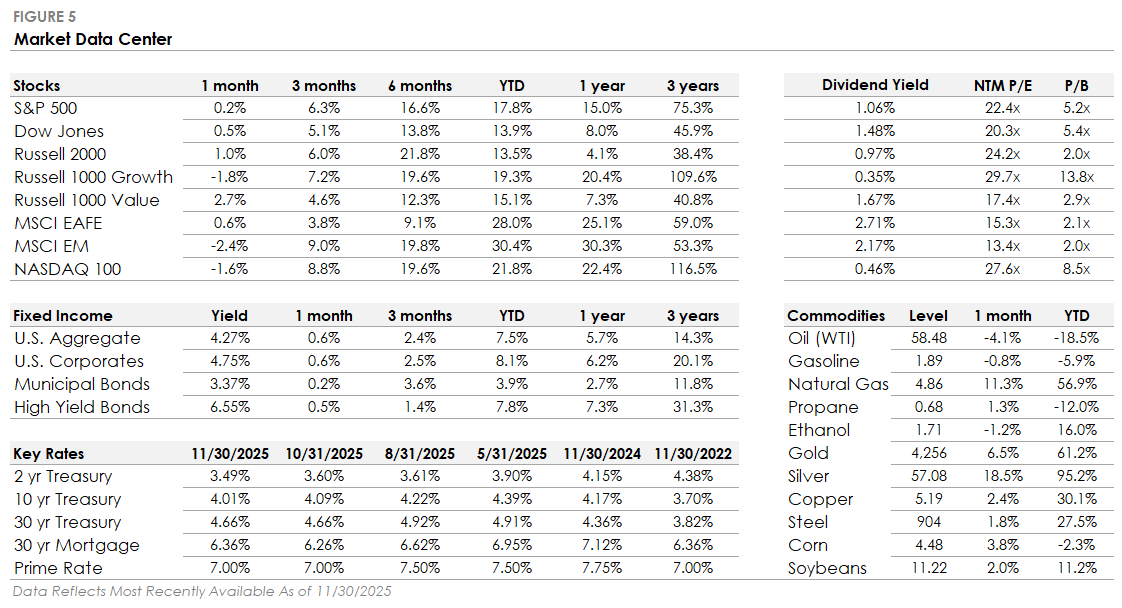
Indeed, you can see this in the Russell 1000 Index, which tracks a wide universe of large and mid-sized U.S. companies. For example, on a market-cap-weighted basis, the Russell 1000 is up about +14% year-to-date, which is a number you are most likely to see in headlines.
However, if you give every stock an equal weight, the return is closer to +6%. And if you line up all the individual companies and look at the one in the middle, the median stock is up only about +2%. Put differently, nearly half the companies in the index are actually negative for the year, with 462 names in the red.
What this tells us is simple: A relatively small group of very large companies, powered by the AI theme, is doing a lot of the heavy lifting. With this narrow leadership, the average stock is not enjoying the same party the indices suggest.
Beyond AI: the Fed, the Economy, and Earnings
With all that said, while AI is getting the headlines, it's not the only driver of this market.
That's because after a nine-month pause, the Federal Reserve restarted its rate-cutting cycle in September. And over the past two months, the Fed has lowered interest rates by a total of 0.50%. This is important because lower borrowing costs help ease pressure on consumers and businesses alike. And they also support higher valuations for risk assets like stocks. On top of that, markets tend to look ahead. Expectations for additional cuts in the coming year have created a tailwind for equities.
At the same time, the U.S. economy has proven more resilient than many expected as it has continued to grow while navigating a long list of headwinds, including trade policy and tariffs, geopolitical tensions, political noise, and even a government shutdown. And make no mistake, none of those issues are trivial, and yet the economy has continued to move forward.
At the same time, corporate earnings tell a similar story. Profit growth remains solid, and third-quarter earnings came in ahead of expectations. This is imporant because over long periods of time, stock prices tend to follow earnings. And while it doesn't mean that they move in a straight line, what it does mean, is that healthy, growing profits provide a fundamental foundation underneath the price action we see.
Put together, you have a powerful combination of an economy that is bent but not broken, a central bank that has shifted from "higher for longer" to modest cuts, and a highly visible growth theme in AI that is attracting both capital and optimism.
The Emotional Challenge: Good Markets, Bad Headlines
For many investors, this year has not felt like a year in which the S&P 500 returned nearly +15% and notched 36 new highs.
The reason is that the emotional experience of investing rarely matches the outcome in the numbers.
Because here's the thing: if you had known the headlines in advance at the start of the year, you might have assumed the market would struggle with trade tensions, policy uncertainty, geopolitical flare-ups, a government shutdown, and elections on the horizon.
In that environment, it would have been very easy to say, "I will step aside until things calm down."
The problem is that markets often climb a wall of worry.
By the time the news feels "safe," a significant portion of the returns is already behind you. So then, stepping aside means you not only have to decide when to get out, you also have to decide when to get back in. That is the essence of market timing, and history shows that it is extremely difficult to do consistently.
This year has been another reminder that trying to outguess the market based on headlines can be costly. Missing just a handful of strong days or weeks can put your long-term goals at risk.
The Planning Lesson: Stay Invested, then Stay Diversified
Every year offers a different lesson for investors.
And this year has underscored the value of staying invested through periods of uncertainty. That's because investors who allowed headlines to push them to the sidelines risked missing out on meaningful returns and the long list of new highs.
Looking ahead, the next lesson may focus on a different lesson: diversification.
When a relatively small group of AI-linked stocks is carrying much of the market's gains, it can be tempting to chase what's working and load up on whatever has gone up the most. And that approach may feel smart in the moment, especially when everyone is talking about the same names.
But here's the thing: true diversification is less exciting. It means owning parts of the market that are not currently in the spotlight. It means keeping exposure to areas that have lagged, even when the story feels old or uninspiring. It means remembering that the goal is not to win every short-term race, but instead to finish the marathon.
If 2025's lesson is that staying invested matters, then 2026 may remind us that how we stay invested matters just as much. That's where a portfolio that is thoughtful, diversified, and aligned with your financial plan is better positioned to weather changes in leadership, economic surprises, and policy shifts.
Bringing it Back to Your Plan
As always, the most important market is the one that lives inside your own financial plan.
The question is not, "Can I predict the next 36 new highs?" The better questions are:
- Are my investments aligned with the goals I want to accomplish?
- Is my portfolio diversified across different asset classes, sectors, and regions, or is it overly dependent on a single theme?
- Am I relying on headlines to make decisions, or am I following a clear, disciplined process?
Our work together is designed to keep you anchored to that process. Markets will continue to move from one narrative to another: AI, interest rates, elections, something else after that. Your plan should remain the steady reference point that guides how we respond.
If you have questions about how this year's market dynamics are affecting your portfolio, or if you are wondering whether your diversification is where it needs to be, let us talk. The goal is the same as always: to pursue returns in a way that supports your long-term purpose and provides clarity, confidence, and peace of mind along the way.

Staying Grounded in a Soft-Landing Market
Markets carried their strong momentum from Q2 into Q3, with the S&P 500, Nasdaq, and small-cap stocks each hitting new highs. Investor sentiment remained optimistic despite soft labor market data and mixed economic signals, and stocks traded higher due to strong corporate earnings, the Federal Reserve’s pivot toward rate cuts, and easing trade tensions.
The technology sector remained an important contributor, as artificial intelligence (AI) companies reported strong earnings growth. At the same time, improving market breadth added fuel to the rally, and small-cap stocks finally broke above their 2021 highs.
A Quarter of Transition in the Economy
The quarter opened on solid footing. Economic activity had recovered from the tariff-driven volatility earlier in the year, and incoming data pointed to steady consumer and business demand. Job growth was solid, consumers continued to spend, and business surveys showed sentiment was improving. The stock market traded higher in July, driven by confidence that the economy could withstand high interest rates and trade uncertainty without slipping into a recession.
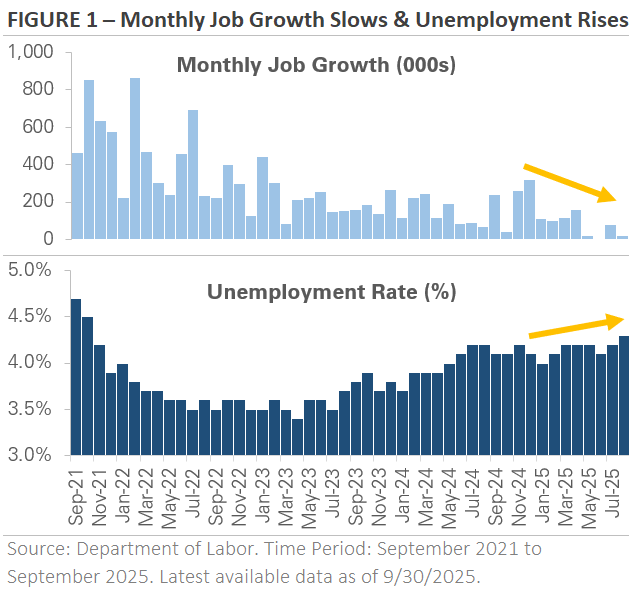
By late summer, cracks began to emerge in the labor market. Figure 1 shows job growth slowed sharply starting in May, with two consecutive months of weak job growth in July and August and negative revisions to prior months. The unemployment rate rose to 4.3%, the highest since 2021. While the labor data raised concerns about an economic slowdown, separate data showed consumer spending remained solid. Economic growth was still positive, but the economy was softening.
The shift in the economic backdrop was significant because it changed the conversation around Federal Reserve policy. As labor market data softened, the market adjusted its forecast to price in a more accommodative Fed and multiple interest rate cuts before year-end. In the market’s view, slowing job growth wasn’t a recession signal but rather a catalyst for the Fed to resume its rate-cutting cycle.
The question was when, not if, the Fed would deliver its next cut.
Fed Cuts Interest Rates After a 9-Month Pause
The Federal Reserve held interest rates steady at its late-July meeting, citing a solid labor market and lingering inflation risk. However, the outlook changed two days later when the July jobs report missed expectations.
In his Jackson Hole speech a few weeks later, Fed Chair Jerome Powell laid the groundwork for a September rate cut. He noted that monetary policy appeared restrictive and said softening labor market data might justify a rate cut, despite inflation still above target. Powell’s remarks reinforced expectations for a September cut and marked a clear shift from fighting inflation to supporting the labor market.
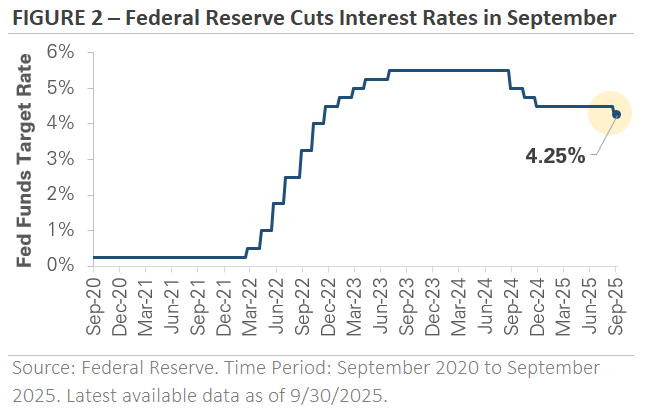
As expected, the Fed delivered a -0.25% rate cut in September, ending its 9-month pause (Figure 2). In his press conference, Fed Chair Powell framed the move as a “risk management” cut, describing it as a proactive step to keep the economic expansion on track rather than concern about a recession. The central bank updated its policy forecast to include two more rate cuts before year-end, with the potential for more in 2026. The revised forecast and Powell’s remarks signaled a measured and gradual rate-cutting cycle rather than an aggressive one.
The market initially celebrated the Fed’s decision, with stocks climbing to record highs and interest-rate-sensitive sectors outperforming. However, sentiment cooled in late September after a batch of stronger-than-expected data suggested the economy may need fewer rate cuts. New home sales rose sharply, Q2 GDP growth was revised higher, and consumer spending remained solid. The data caused investors to dial back their rate cut expectations, and by quarter-end, the market was pricing in a slower pace of cuts.
Artificial Intelligence Theme Dominates Headlines
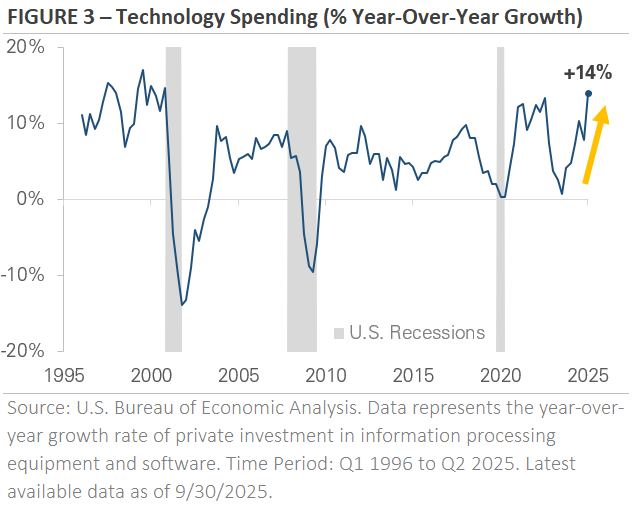
Artificial intelligence continued to be a top market theme during the quarter. Figure 3 shows technology-related investment grew +14% year-over-year in Q2, the second consecutive quarter and the fastest pace since the late 1990s. The spending is tied to the AI industry buildout, with billions being spent on high-performance computer chips, cloud architecture, data center construction, and the power and cooling needed to run it all.
The spending boom has become a significant contributor to economic growth and helped offset softness in rate-sensitive areas, such as housing, manufacturing, and non-AI business investment.
Management teams across the AI supply chain continue to report strong demand. Spending plans measure in the hundreds of billions, and order backlogs span years, not quarters, into the future. The commentary and scale of investment reinforce the market’s belief that AI will drive capex budgets in the coming years, and investors see AI infrastructure spending as a durable theme with room for growth.
In the equity market, AI enthusiasm has fueled outsized gains in specific technology and semiconductor stocks, creating a wide divide between AI-infrastructure leaders and the broader market.
While investors view AI as a multi-year investment cycle rather than a one-off spending burst, a more balanced conversation around AI is also taking place. Some question whether spending is outpacing potential revenue growth, and early studies have questioned whether the productivity gains from the new technology justify the high level of investment. These concerns have triggered periodic volatility, but they haven’t derailed the broader narrative that AI will continue to be a key driver of corporate earnings growth, economic growth, and market returns.
Equity Market Recap: Stocks Rally to New Highs as Market Leadership Broadens
Stocks climbed to new highs in Q3, boosted by the Fed’s rate cut, resilient earnings, and continued enthusiasm around AI.
The Fed’s rate cut marked a shift toward policy support and fueled optimism for a “soft landing”, a scenario whereby the economy slows but avoids a recession. Trade policy was another tailwind, and progress on deals with major trading partners reduced the near-term risk of escalation.
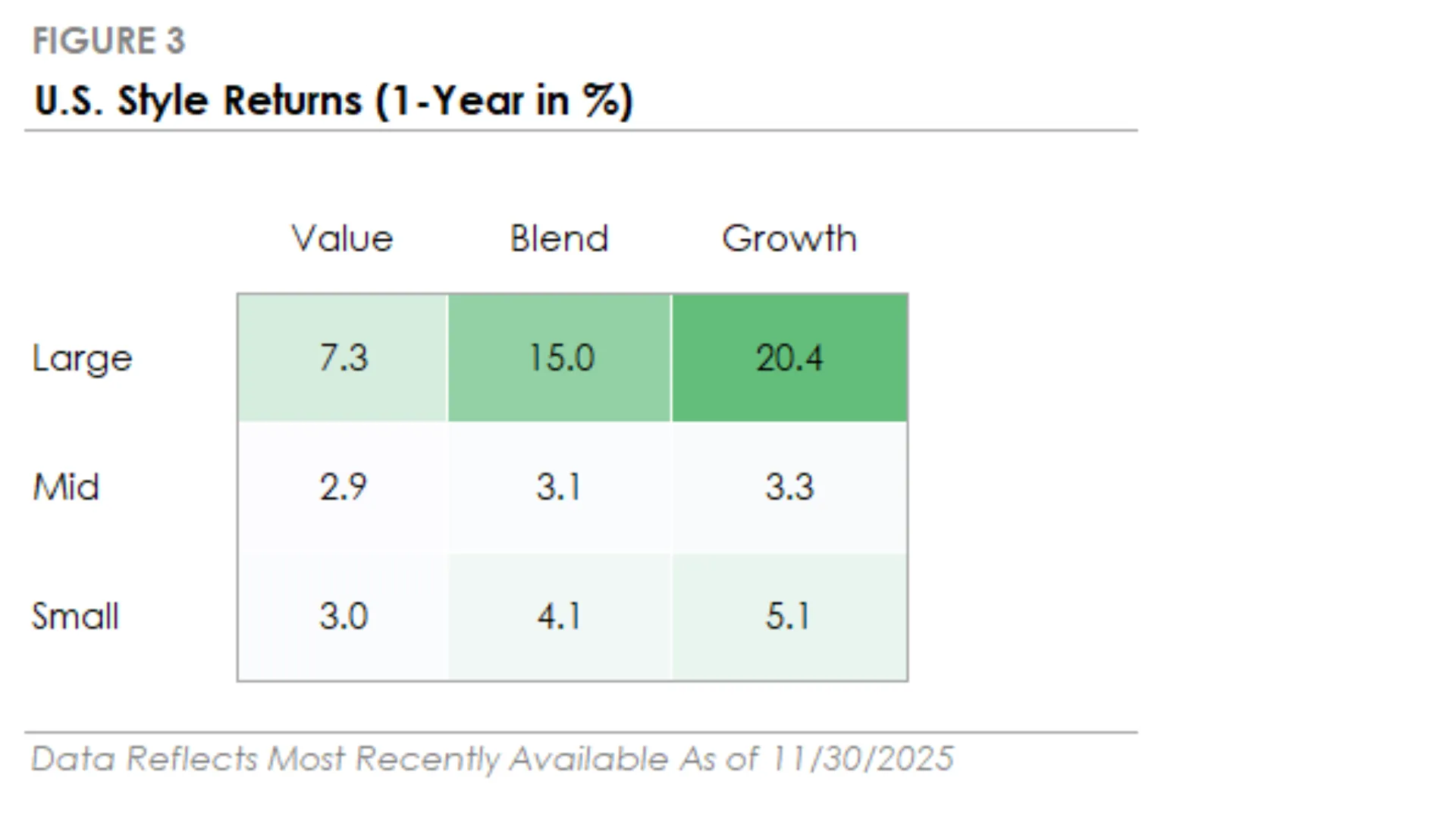
The S&P 500 gained more than +8% in Q3, bringing its year-to-date return to over +14%. Technology stocks remained a key driver, but broader market leadership also provided a tailwind. Small-cap stocks rallied sharply in anticipation of the Fed’s rate cut.
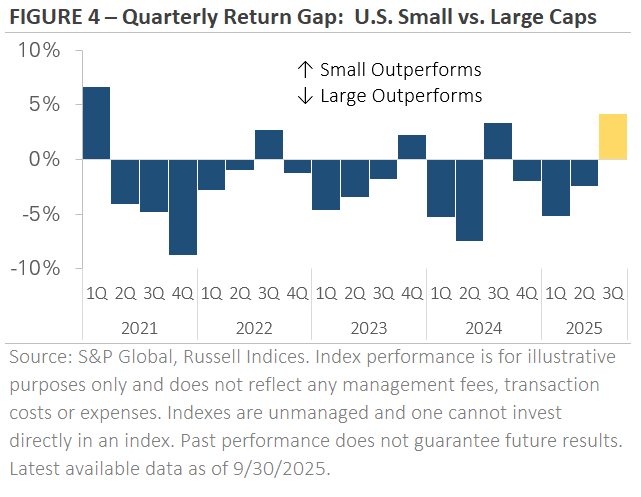
The Russell 2000 surpassed its previous high from 2021 and returned nearly +12% as investors bet that rate cuts would benefit smaller companies. Figure 4 shows small caps posted their biggest quarter of outperformance over the S&P 500 since Q1 2021. In another sign of the market’s optimism, cyclical sectors broadly outperformed their defensive counterparts.
International stocks performed in line with the S&P 500 in Q3, but headline results masked significant divergence beneath the surface. Emerging markets outperformed U.S. stocks, driven by renewed stimulus efforts in China and strong gains from AI-related companies in Asia.
The Fed’s decision to resume its rate-cutting cycle provided another tailwind, as emerging markets, like U.S. small caps, are often viewed as more sensitive to rate cuts and shifts in global financial conditions. In contrast, developed markets underperformed U.S. stocks. European equities ended the quarter modestly higher as they consolidated gains from earlier this year.
Despite the quarter’s mixed returns, both emerging and developed markets have gained more than +25% year-to-date. The two indices are each outperforming the S&P 500 by more than +10% since the start of 2025.
Credit Market Recap: Bonds Trade Higher as the Fed Resumes Its Rate-Cutting Cycle
Interest rates fluctuated in Q3 but ended the quarter lower. Treasury yields rose in July as stronger-than-expected economic data pushed back the expected timing of Fed rate cuts. However, yields reversed sharply lower in August after the soft labor market data and Chair Powell’s speech. Treasury yields declined further in early September after the weak August jobs report, but they ticked higher later in the month as economic data stabilized.
The decline in Treasury yields caused bonds to trade higher. Longer-maturity bonds outperformed due to their higher sensitivity to falling interest rates, while shorter-maturity bonds underperformed. This outperformance extended to corporate bonds, where investment-grade outperformed high-yield as the combination of falling interest rates and credit spread tightening produced gains.
Corporate credit spreads remain tight by historical standards. Investment-grade and high-yield spreads are at their tightest levels in decades, a reflection of investor confidence in corporate earnings growth and the economic outlook. While spread tightening has supported corporate bond returns recently, it means valuations are no longer cheap.
Corporate bonds offer compelling yields for income-focused investors, but they also come with important trade-offs. When credit spreads are this tight, there’s less margin of safety if earnings or economic growth disappoint. If either of these scenarios occur, Treasury bonds could outperform corporate bonds despite their lower yields.
Staying Grounded in a Soft-Landing Market
As we move into Q4, the outlook for the economy remains positive yet cautious. Growth is moderating but still positive, inflation continues to ease, and the Federal Reserve has shifted from tightening to gradual rate cuts. Together, these dynamics have fueled renewed optimism across equity and credit markets.
Yet, history reminds us that markets rarely move in straight lines. Even in strong years like this one, pullbacks of 3% to 5% are normal and often healthy. They serve as natural pauses in longer-term uptrends, helping to reset expectations and valuations.
Now is an ideal time to stay grounded, reaffirming liquidity reserves, reviewing portfolio allocations, and preparing to take advantage of opportunities when markets inevitably take a breather. Maintaining 6–9 months of cash reserves for working investors and 12–18 months for retirees helps avoid selling assets at unfavorable times.
Market dips also present planning opportunities. Declines in asset prices can create favorable conditions for tax-aware strategies such as Roth conversions, portfolio rebalancing, and tax-loss harvesting, all of which strengthen long-term after-tax outcomes. While short-term volatility will always be part of investing, the key is not to fear it but to plan for it.
Remaining disciplined, maintaining liquidity, and using volatility as an ally, not an adversary, ensures investors can participate fully when the next leg of the rally begins.
As always, I’ll continue to monitor market developments and stand ready to help you navigate what’s ahead, keeping your plan aligned with clarity, confidence, and peace of mind.

Here’s How to Prepare for the Next Market Dip
Who doesn’t love a good market rally? It’s the time when investment account balances continue to move higher and retirement options continue to solidify.
Market Rallies and the Reality of Pullbacks
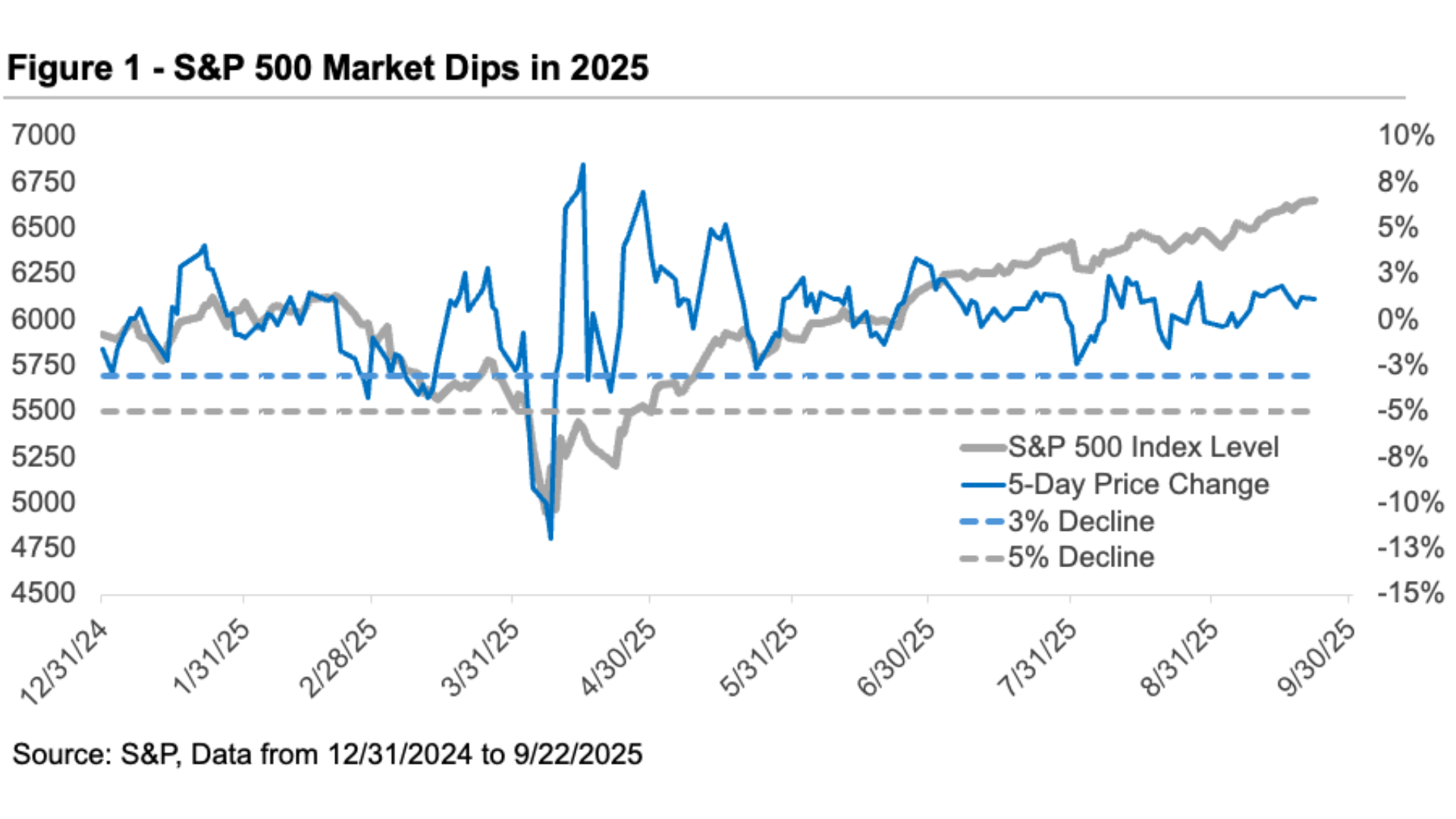
But we know that markets don’t move up in a straight line, despite what we’ve seen over the past few months. According to Ned Davis Research, market dips of around 3% happen about seven times per year on average, and corrections of 5% or more occur roughly three times annually.
In other words, pullbacks aren’t unusual, they’re a normal part of the investing landscape that investors should anticipate even when the backdrop is strong.
And here’s the thing: since April’s selloff, the S&P 500 index has not experienced a sustained market dip greater than 3% and that’s worth noting.
What goes up, must come down, right? Maybe for a bit, then often right back up. That’s the mindset we want to focus on: enjoy the rally, yet be ready for the routine setbacks that come with healthy markets.
Staying Grounded is Essential
That’s why now, more than ever, is the right time to stay grounded and position your portfolio for an inevitable bout of market volatility. Now, preparation doesn’t necessarily mean pessimism, but rather it’s how you participate in the upside while keeping your footing when markets take a breather.
Because if you don’t, you could end up leaving money on the table when the market pulls back.
How so?
Well, the fact of the matter is that there are two key areas that you'll want to be prepared for when the markets eventually take a turn.
First, not giving up gains unnecessarily by avoiding mistakes that leave money on the table.
Second, not missing out on potential tax planning opportunities when asset prices do pull back.
Taken together, these help you stay constructive and benefit across cycles.
Let's take a look at this more closely.
What the Current Market Is Telling Us
So far this year the S&P 500 index is up over ten percent. And while this double-digit return for domestic stocks is quite notable, it's also worth noting that international stocks are up well over 20% so far this year.
There's a case to be made for the ongoing rally in international stocks and risk assets in general, especially as interest rates fall and the dollar continues to weaken.
Even so, while risk assets continue to rally higher on expectations that the Federal Reserve cutting interest rates will make it more favorable for risk assets to rally, the very backdrop that prompts policymakers to cut rates suggests U.S. economic growth could still face headwinds.
And while the U.S. economy has been generally steady in 2025, there’s a very real potential that any incoming data pointing to fractures in the solid growth story could give investors reason for pause, leading to a market pullback.
That kind of pause is consistent with history and with the Ned Davis data on frequent, modest setbacks, not a reason to abandon a long-term plan.
Why Cash and Taxes Matter Most
In anticipation of this market pullback, there are two things to consider doing before the market actually turns, and some actions you can take when the markets are actually in a pullback.
To start, cash is king when it comes to periods of heightened market volatility. That’s why now is the time to evaluate your cash management plan and make sure that your reserves are properly topped up to cover the unexpected.
This means that if you're still in your working years, make sure you have between 6 to 9 months of cash on hand or liquid assets available just in case to cover unexpected expenses.
And if you're already retired or approaching retirement, now would be the time to make sure that you have between 12 and 18 months of liquid cash reserves available to cover your living expenses. The last thing that you want to do during a market downturn is sell assets at an inopportune time and lock in losses.
Think of cash as both a defensive buffer and an offensive enabler that lets you avoid forced selling and gives you flexibility to act on opportunities when others can’t.
The second approach to take and consider when the inevitable market pullback does come is to think about how you're positioning yourself from a tax perspective. More specifically, one of the big things that we focus on during periods of market weakness is taking advantage of Roth conversions.
That's because market sell-offs temporarily lower asset values, giving us an opportunity to realize lower taxable amounts when moving money from qualified accounts like IRAs or 401(k)s into a Roth IRA and positioning those assets for future tax-free growth and withdrawals. This is a clear example of not leaving money on the table: using normal volatility to improve your after-tax outcomes.
Staying Grounded with Cautious Optimism
When it comes down to it, nobody wants to be the person who washes away a market rally by thinking about or talking about the potential for a pullback.
Nevertheless, history has shown repeatedly that all good things include periodic setbacks. And when they do, they often happen without warning, happen suddenly, and lead to regret for the unprepared.
Acknowledging that reality is part of being cautiously optimistic: we respect the risks so we can stay invested for the rewards.
While there's a case to be made for assets to continue to rally in the months ahead, there's no better time than the present to practice prudent portfolio management.
Sticking to a disciplined investment strategy, keeping appropriate cash reserves, using volatility-aware tax strategies like Roth conversions, and rebalancing your portfolio help ensure you're not leaving money on the table and not paying Uncle Sam any more than his fair share.
That’s how you remain grounded and prepared for when the markets eventually rally once again.

How Withdrawal Rates Impact Your Portfolio in Retirement
Many people spend years preparing for retirement by saving and investing, but planning shouldn’t stop once the paychecks do. Transitioning from earning income to withdrawing it from your portfolio is a major shift with a new set of risks and decisions. This period, known as the distribution phase, requires careful thought.
How much you withdraw each year can have a bigger impact on long-term financial security than many people realize. Without a well-structured strategy, even a sizable retirement account can be depleted faster than expected.
The Impact of Withdrawal Rates
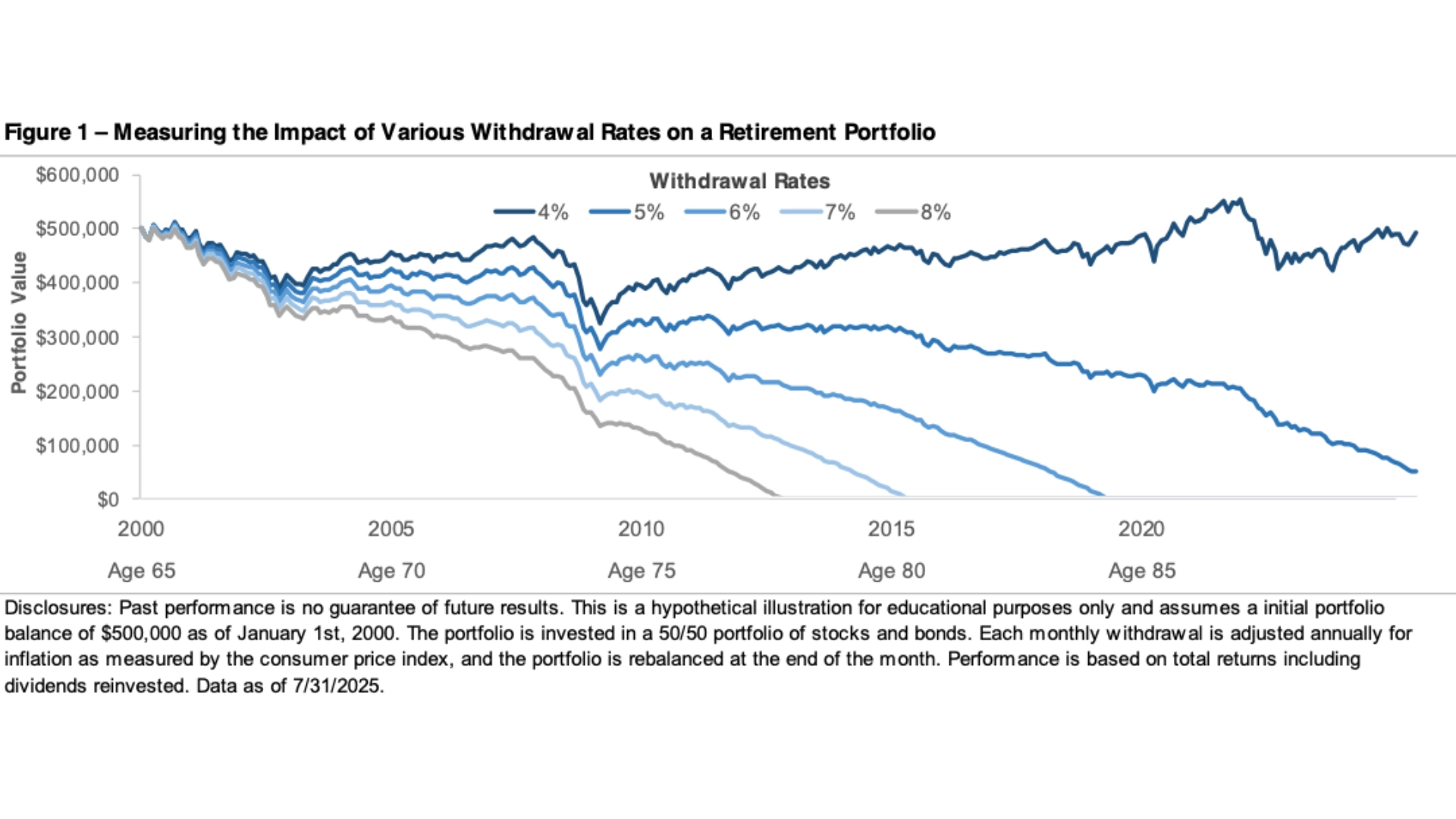
The chart below shows how different withdrawal rates can impact a retirement portfolio’s lifespan. It assumes an individual retired in 2000 at age 65 with $500,000 and started taking monthly withdrawals.
Each line reflects a different withdrawal rate between 4% and 8%, showing how the portfolio fared through age 85. While all scenarios start at the same point, the paths quickly diverge, especially during periods of market volatility. The chart illustrates how a retiree’s withdrawal strategy can determine whether the portfolio lasts or runs out.
The message is clear: higher withdrawal rates tend to exhaust a portfolio sooner, while lower rates can extend its life. In this example, withdrawing 7% or 8% caused the portfolio to run out of money before age 85. In contrast, the 4% and 5% withdrawal rates helped the portfolio weather market declines.
Does a 4% Rate Still Cut It?
The 4% strategy not only preserved the portfolio but grew it over 20 years, showing how compounding can work even during retirement. No strategy can eliminate market risk, but a smaller withdrawal rate can extend the portfolio’s life and reduce the risk of outliving your savings. Taking a more conservative approach in the early years of retirement gives your portfolio time to recover from short-term losses and grow with the market.
A thoughtful withdrawal strategy is an important part of retirement planning. It’s not just about how much you’ve accumulated, but how you manage it. There’s no one-size-fits-all approach, and the method you start with doesn’t have to be permanent. Fixed withdrawal rates can provide a good starting point, but many retirees may benefit from more flexible approaches.
The Big Takeaway
For example, you could adjust withdrawals based on market conditions, taking smaller distributions in down years and larger ones in strong years. Another option is the bucket strategy, which divides assets into short-, intermediate-, and long-term segments.
By keeping at least 18 months worth of expenses in cash or short-term investments, you can avoid selling stocks during major market declines, such as those in 2008 or 2020. This gives long-term investments time to recover and can help create a steadier income stream over time. Everyone’s retirement looks different. Our goal is to help you create a withdrawal strategy tailored to your unique needs and goals when that time comes.

Two Quarters, Two Stories: A Market That Came Full Circle
The first half of 2025 delivered a tale of two very different quarters.
After stumbling out of the gate with a sharp selloff in the first quarter of the year, markets found their footing in the second quarter.
Indeed, what began as a year marked by caution, driven by rising policy uncertainty, slower growth concerns, and questions surrounding the durability of the AI boom, sentiment shifted dramatically as headlines softened, tariffs proved less disruptive than feared, and corporate earnings came in stronger than expected.
And yet, for all the twists and turns, markets ended the first six months surprisingly close to where they began.
The S&P 500 returned a gain of 6.1% through June, which is a notable rebound from being down more than -15% earlier in the year. Long-term interest rates told a similar story with the 30-year U.S. Treasury yield swinging widely between 4.40% and 5.10%, but finished June just a touch below where it started, near 4.80%.
To the casual observer, it may seem like little has changed. But under the surface, the story is far more nuanced, and still worth watching as we head into the second half of the year.
Markets Ride a Wave of Policy Whiplash
Now, if there’s one word that’s defined the first half of 2025, it’s “whiplash.”
And trade policy was at the center of it all. That’s because what started as a steady drumbeat of tariff escalation early in the year gave way to a flurry of de-escalation efforts just weeks later which left businesses, investors, and global partners scrambling to make sense of the shifting landscape.
As you’ll likely recall, the escalation phase took hold in February and March, with sweeping tariffs targeting imports from China, Canada, Mexico, and broader categories like steel, aluminum, and autos.
Then, just as tensions peaked in early April with the announcement of tariffs on nearly all imports, the tone reversed. A week later, the Trump administration paused reciprocal tariffs for every trading partner except China. And by early May, a new trade agreement with China signaled further cooling.
Yet, despite this pivot, the uncertainty still hasn’t gone away.
Because in late May, a U.S. trade court ruled the sweeping tariff measures unconstitutional, and by June, the administration was already signaling the possibility of reinstating certain tariffs. With July and August deadlines looming for tariff exemptions, we’re entering another chapter of policy ambiguity.
So then, for markets and businesses alike, the story that we’re tracking is not just the tariffs themselves, it’s the pace and unpredictability of change that’s creating the most friction.
And until clarity returns, volatility may remain part of the ride in the months ahead.
Tariff Talk Hits the Economy, But Not How You Might Expect
Now, one of the more surprising outcomes of this year’s trade drama is how quickly it filtered into the economic data and not through slowdown as we had expected, but through acceleration.
How so?
Well, in the first quarter, businesses and consumers raced to front-run potential price increases by pulling forward purchases. Imports of consumer goods and industrial supplies spiked, while vehicle sales surged in March and April, reflecting a scramble to buy ahead of expected tariffs.
These moves weren’t part of a typical economic activity, it was a strategic move by business and consumers. It was less about improving demand and more about beating the clock on higher prices.
And this kind of behavior can distort short-term data. Because what might look like strength may simply be a shift in timing. And that makes it harder to assess the true underlying trend.
Another dynamic worth watching is inflation, specifically, the growing gap between what consumers expect and what’s actually showing up in the data. As shown in Figure 1, consumer inflation expectations have surged, even as official inflation readings, like the Consumer Price Index, continue to trend lower.
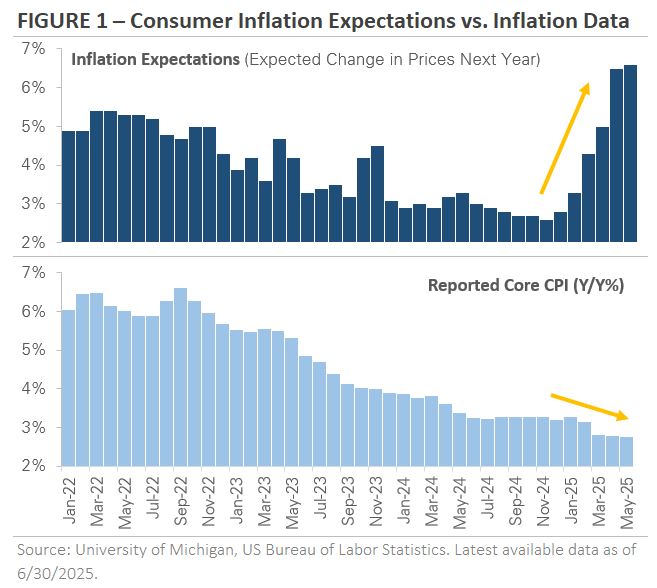
It’s a disconnect that speaks volumes because while prices haven’t materially risen yet, consumers are clearly bracing for what might come next.
Whether those expectations become reality remains to be seen because of different factors.
For example, some economists warn that inflation could pick up as tariffs ripple through supply chains over time, just as they had during the pandemic.
Yet others argue companies may absorb the cost increases to stay competitive. And the earnings season may offer early insight, particularly into how businesses are adjusting their pricing strategies and how much of the tariff story is already baked into forward guidance.
For now, however, the hard data remains calm. But expectations are restless. And in markets, that’s often where the story begins.
The Fed Stays Put While Markets Wait for Clarity
Now, uncertainty doesn’t just spook investors, it complicates policymaking as well. And for the Federal Reserve, this year’s shifting trade landscape has added a new layer of complexity to an already delicate balancing act.
On one hand, policymakers are contending with the fact that tariffs could ignite inflation.
On the other, tariffs might slow the economy if higher costs start to weigh on consumer demand and business investment.
So then, caught between those risks, the Fed held rates steady at both its May and June meetings, signaling that it needs more data before making its next move.
In other words, it’s a time for patience, which is now playing out in the markets.
Indeed, figure 2 illustrates the market’s evolving expectations for interest rates. The Fed’s current target range stands at 4.25% to 4.50%.
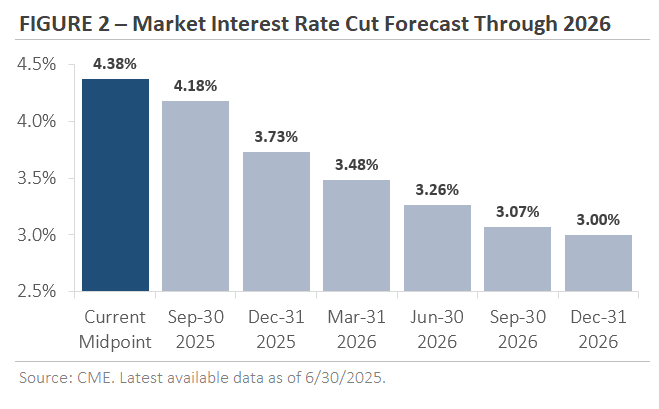
However, futures markets are now pricing in a gradual path of rate cuts beginning in September, with momentum picking up into 2026.
In other words, by the end of that year, investors expect the Fed to lower rates by approximately -1.25% from current levels.
That forecast reflects a kind of economic middle ground of inflation risks persisting, but the damage from tariffs appears contained for now. Still, as always, the path forward is highly dependent on what comes next.
Markets are adjusting their expectations in real time and so is the Fed. Therefore, any shift in inflation trends, labor market strength, or trade policy could quickly rewrite the script which is what we’re keeping an eye on.
But for now, the message is clear: until the dust settles, both the Fed and the market are content to wait.
Valuations Bounce Back as Sentiment Shifts
So, how has this trade and central bank policy affected the stock market? Well, after a rocky first quarter, investors seemed to flip the script in the second quarter.
That’s because, despite lingering uncertainty around trade and interest rates, the stock market staged an impressive rebound. And this came not because earnings surged, but because investors became more willing to pay up for the earnings already expected.
In other words, valuations (the price investors are willing to pay) not profits (earnings that support those prices) did the heavy lifting.
Figure 3 tells this story. The dashed light blue line tracks Wall Street’s 12-month earnings forecast for the S&P 500. The darker navy line shows the index’s price-to-earnings (P/E) ratio, or the multiple investors assign to those expected earnings.
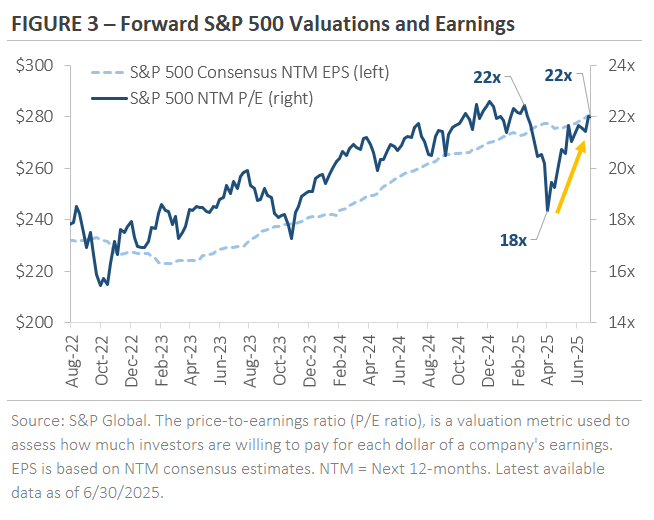 And at the end of 2024, the S&P 500 traded at roughly 22-times forward earnings. You’ll recall that at that time there was optimism around AI and pro-growth policies supported those higher valuations. But as trade tensions escalated in early April, sentiment cracked, and the P/E multiple fell to 18x almost overnight.
Here it wasn’t earnings that changed, it was mood.
But then came the rebound. As tariff concerns cooled and companies delivered better-than-expected first-quarter results, confidence returned. By late June, the P/E ratio had climbed back to where it started the year at just above 22x.
This kind of valuation whiplash is a reminder of how quickly investor sentiment can swing and why trying to time your way into (and out of the market) can be disadvantageous.
It also underscores the importance of understanding what’s driving market moves, not just earnings, but how much investors are willing to pay for them.
And so, with earnings season ahead, the focus now shifts to whether companies can meet or exceed the expectations embedded in these renewed valuations.
From Flight to Risk to Return to Risk-On
Now, we know that markets have rebounded, but it’s essential to also note that the players that previously led market moves higher (and lower) have changed hands this year.
Indeed, the first half of 2025 saw a dramatic rotation in market leadership, one that played out almost like two separate market cycles in rapid succession.
That’s because in the first quarter, uncertainty dominated and defensive stocks outperformed.
How so?
Well, during the uncertain times, investors sought stability in low-volatility names like utilities and healthcare, while higher beta, economically sensitive sectors lagged behind.
Then things changed on a dime in the second quarter.
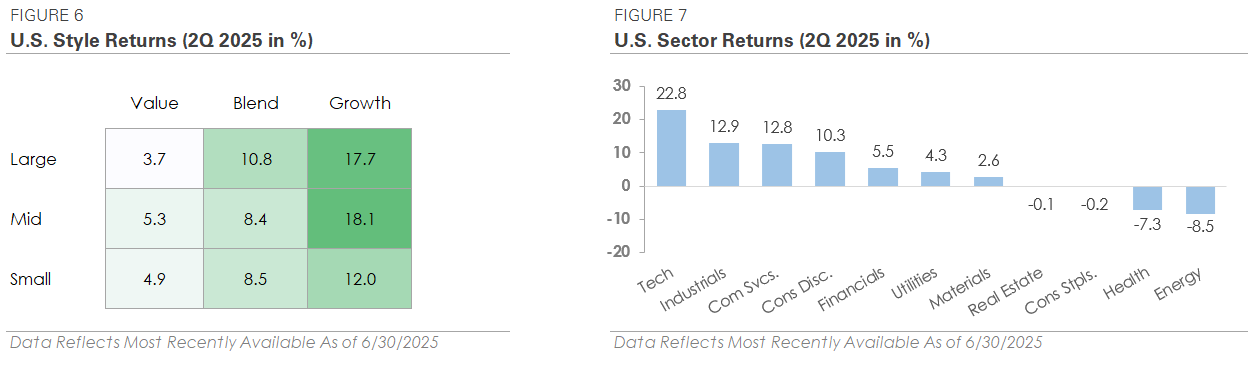
As policy tensions cooled and growth fears receded, risk appetite returned in force. Figure 4 highlights the shift by tracking the performance of low-volatility versus high-beta stocks.
In the first quarter, low volatility led by nearly 20%. And in the second quarter, high volatility outpaced low volatility by over 25% which fully erased its earlier underperformance.
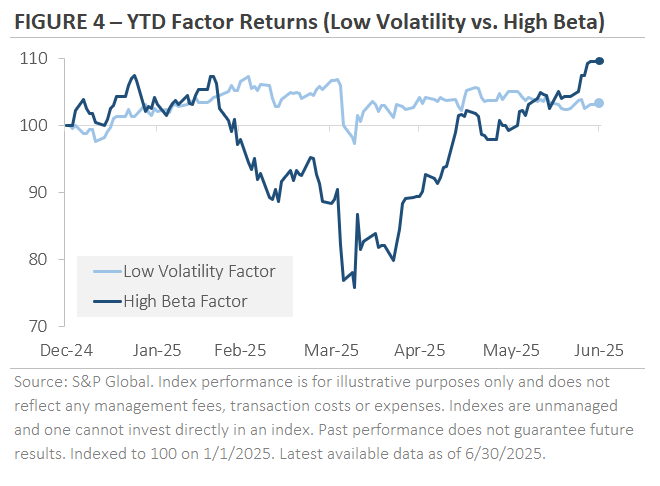
That reversal extended beyond factors to asset classes and sectors.
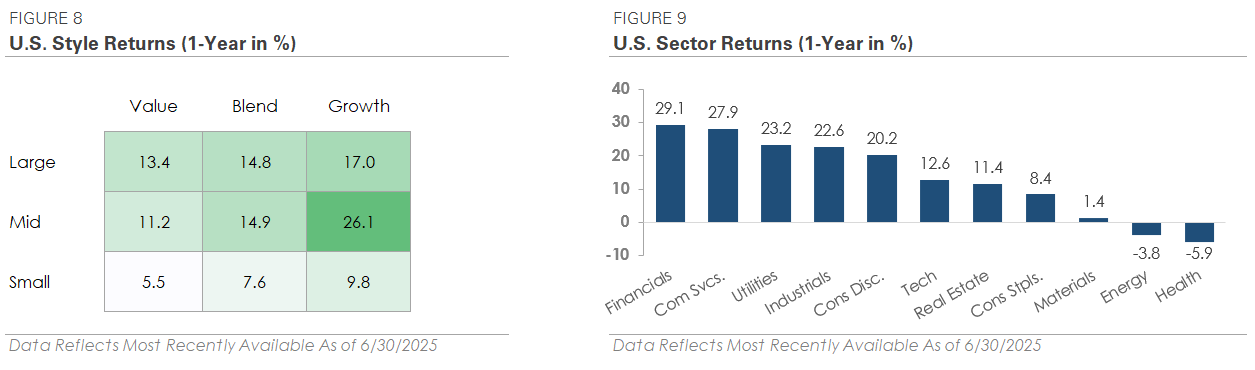
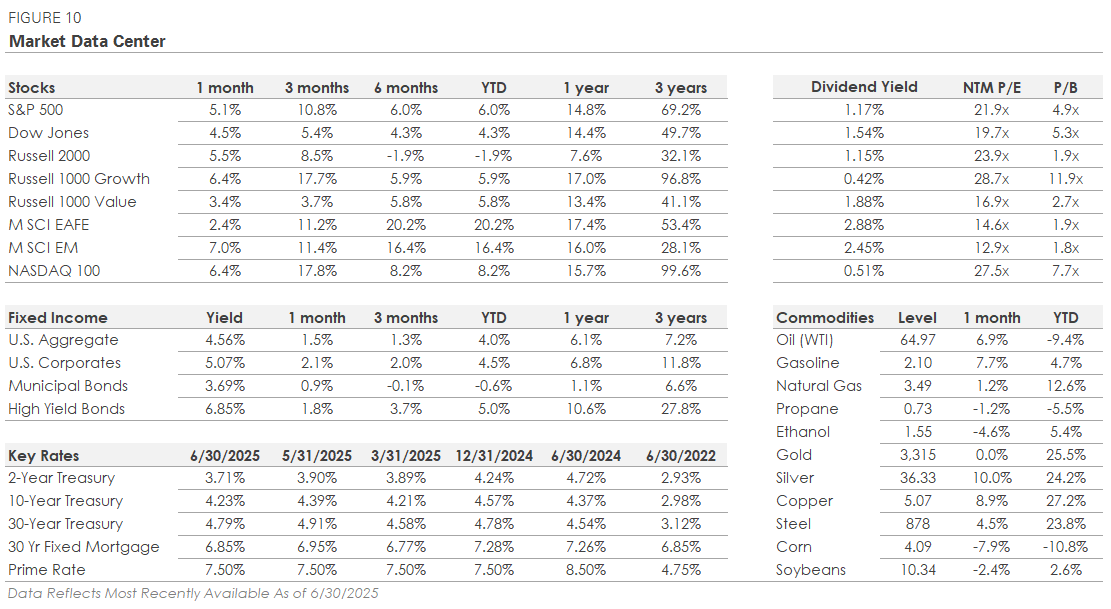
- The S&P 500 rose 10.8% in Q2 after falling -4.3% in Q1.
- Small caps, which had been hit hard early in the year, bounced 8.5% in Q2.
- Growth stocks reclaimed leadership: the Nasdaq 100 rallied 17.8%, and the Russell 1000 Growth Index surged 17.7%.
- The “Magnificent 7” tech giants, down -15.7% in Q1, came roaring back with a 21.0% return in Q2.
Meanwhile, value stocks posted more modest gains, as measured by the Russell 1000 Value Index which rose just 3.7% and is a reflection of the market’s clear tilt back toward risk and momentum.
International markets also quietly delivered another standout quarter. For example, developed and emerging market equities returned over 11% in Q2, outpacing U.S. stocks for a second straight quarter. However, it’s essential to note that much of that performance has been currency-driven, as a weaker dollar, pressured by tariff uncertainty and a shift in global flows, provided a tailwind for non-U.S. assets.
So then, if the first quarter was a flight to safety, then the second quarter was a return to growth and a powerful reminder of just how quickly market leadership can change.
Bonds Caught Between Calm and Concern
And what about the bond market?
Well, much like equities, the bond market experienced its own version of a two-act play in the first half of the year, though the themes were more subtle and the signals more nuanced.
At the start of 2025, long-term interest rates fell as investors digested policy uncertainty and softening growth expectations. For example, the 30-year U.S. Treasury yield, a barometer for long-term sentiment, slipped from 4.80% to 4.40% by early April.
This move came as investors were seeking safety, and longer-dated Treasuries provided it.
But things changed here just as quickly as the narrative changed.
As tariff tensions eased and inflation expectations crept higher, long-term yields reversed course. And so, by late May, the 30-year yield climbed back above 5.10%, before settling at 4.79% by quarter-end and almost exactly where it began the year.
Indeed, figure 5 captures this round-trip in yields, reflecting the market’s attempt to weigh slowing growth against rising fiscal uncertainty and sticky inflation.
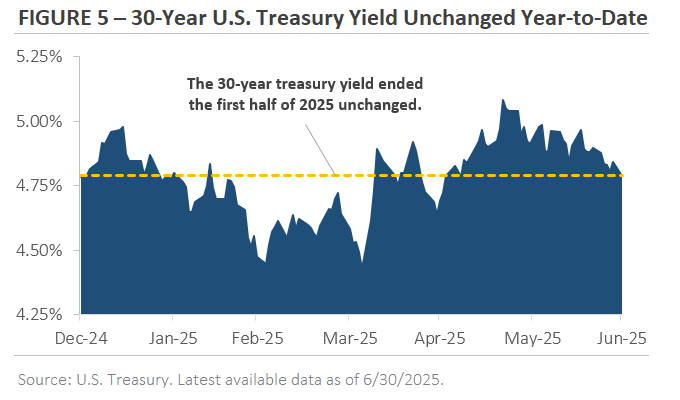
Within credit markets, sentiment shifted as well.
In the first quarter, corporate credit spreads widened, particularly in high-yield bonds, as investors grew more cautious. But the second quarter also brought renewed confidence, with recession fears fading and earnings holding up, and credit spreads tightened.
High-yield bonds outperformed, delivering a 3.7% return in the second quarter, versus 2.0% for investment-grade corporates. That marked a sharp reversal from the risk-off posture earlier in the year.
So where does that leave us in the bond market?
Well, treasury yields have gone nowhere, but not quietly. Volatility and rotation have made the ride anything but smooth. Credit markets, meanwhile, appear cautiously constructive, suggesting that while risks remain, investors are still finding value in income-generating assets.
As always, bonds continue to serve their purpose in a well positioned portfolio, providing diversification, stability, and ballast when equity markets are on the move.
Looking Ahead: Focus on What You Can Control
So then, where do we go from here?
Well, we’ve watched the market swing from fear to relief, from sharp selloffs to near-record highs. We’ve navigated escalating tariffs, surprise de-escalations, legal rulings, and changing forecasts. And through it all, the numbers may have ended close to where they started, but it hasn’t felt that way.
Because volatility isn’t just about what’s happening in the markets. It’s also about what it stirs up in us.
In uncertain seasons like this, it’s natural to question what comes next or whether your strategy needs to change.
But here’s the good news: the plan we’ve built together already accounts for times like these.
Your portfolio isn’t built on perfect predictions. It’s built on the first principles of diversification, risk awareness, discipline, and a long-term perspective.
The truth is, we can’t eliminate uncertainty, but we can prepare for it. And we have.
So, if you find yourself wondering whether to act or adjust, here’s a better question to ask: “Is my plan still aligned with my long-term goals?”
If the answer is yes, then the best response may be no response at all.
And as we look to the second half of the year, we’ll continue monitoring policy developments, economic data, and corporate earnings. But more importantly, we’ll continue guiding your strategy with calm, clarity, and consistency, just as we always have.
Because peace of mind doesn’t come from chasing the perfect forecast. It comes from having a plan you can trust, and a partner walking through it with you.

One Big Beautiful Bill: What Smart Families Are Doing Now
A few weeks ago, we shared our perspective on the One Big Beautiful Bill and why it marked a defining moment for retirement savers, tax-conscious investors, and families thinking about legacy.
And since then, we’ve had the chance to review the full scope of the legislation, and the practical steps some families are already taking.
What we’re seeing is this: The ones who act early, with clear intent, are the ones who tend to benefit most.
So today, I want to walk you through the strategic moves that are rising to the top, moves you might want to consider before the window closes:
Revisiting the Estate Plan
One of the more overlooked outcomes of the new law is what it does to the estate and gift tax exemption.
Starting in 2026, the lifetime exemption jumps to $15 million per person, and for now, it’s permanent.
Now, if you’ve already put an estate plan in place, you might be tempted to move on. But here’s the thing: the landscape has shifted underneath that plan.
Because when exemption amounts increase, so do the opportunities to move assets off your balance sheet, whether to heirs, to trusts, or to charitable causes, without triggering transfer taxes. And depending on how your documents were drafted, you may not be taking full advantage.
For some, this may be the time to revisit old credit shelter or bypass trusts that no longer serve their purpose. For others, it might mean accelerating gifts, funding multi-generational trusts, or finally setting up that family limited partnership.
But the bottom line is this: the cost of doing nothing just went up.
Rethinking Generosity
For families who give consistently, whether through tithing, donor-advised funds, or community causes, the new law brings both opportunities and limitations.
Starting in 2026, non-itemizers will be able to deduct up to $1,000 in charitable contributions, or $2,000 if filing jointly. That’s a nice gesture.
But here’s the catch: for those who itemize, charitable gifts will now only count to the extent they exceed 0.5% of your adjusted gross income.
Said differently? Your giving has to cross a higher bar before it starts working for you on your tax return.
That doesn’t mean you should give less. But it might mean you give differently.
It might mean consolidating gifts into one year instead of spreading them out. It might mean funding a donor-advised fund now while deductions are fully available, then distributing those gifts over time. And for some, it may mean rebalancing how you give, cash, stock, appreciated assets, so generosity stays tax-smart.
Because while your heart’s in the right place, your strategy should be too.
More Options for Education Planning
If you’re already funding a 529 plan for a child or grandchild, you’ve probably been doing it for one reason: college.
But starting next year, the rules expand, and that changes the game.
Beginning in 2026, you can use up to $20,000 per year, per beneficiary, for K–12 expenses. And not just tuition, also tutoring, online curriculum, test prep, even educational therapy for kids with learning challenges.
That means families who value private school, specialized support, or just more choice in education now have a stronger planning tool.
It also means that if your 529 plan was funded with a long-term view, you may want to revisit how it fits into your shorter-term needs.
And for those thinking beyond college, toward vocational training, certifications, or post-high school credentials, the bill opens the door to use 529s for those costs too.
Bottom line: the tax advantages are broader, the use cases more flexible, and for families who plan ahead, education just got a little more customizable.
Business Owners, Take Note
If you run a business, own real estate, or generate income through a pass-through entity, the new law offers some of the most substantial and durable benefits we’ve seen in years.
Several key provisions have been made permanent, including the 20% Qualified Business Income (QBI) deduction. That’s the deduction that lowers the taxable income for sole proprietors, S corps, LLCs, and partnerships. If that’s you, this isn’t just a line item, it’s foundational.
At the same time, bonus depreciation is back at 100%, and Section 179 expensing has been expanded to $2.5 million. So if you’ve been thinking about making investments in equipment, vehicles, or other capital assets, this may be the time to act, not just to grow your business, but to reduce your taxable income in the process.
For real estate investors, this also means a window to revisit cost segregation studies, accelerate depreciation, and reconsider how your income is being characterized across properties.
And if your long-term strategy includes developing or investing in underserved areas, the Opportunity Zone rules just got new life, giving you the ability to defer gains, enhance basis, and potentially eliminate future capital gains altogether.
In short: If your business is your biggest asset, this is your reminder to make sure it’s also your most tax-efficient one.
One Last Shot at Green Energy Incentives
For years, the government has offered generous tax credits for homeowners who invest in energy-efficient upgrades, solar panels, heat pumps, insulation, new windows, and more.
That window is closing.
Under the new law, many of those incentives expire after 2025. And not in a vague, “we’ll see what happens” way, these provisions are scheduled to end, full stop.
So if you’ve been thinking about making upgrades to your home, vacation property, or rental units, this may be your final chance to get a federal tax credit worth up to 30% of the project cost.
That could mean thousands in tax savings if you act this year.
And while we don’t recommend rushing into a big-ticket project just to chase a deduction, we do recommend reviewing your broader property strategy. Because combining energy efficiency with tax efficiency? That’s a win worth planning for.
The SALT Cap Relief, But Don’t Get Comfortable
For those of you living in high-tax states, there’s a bit of breathing room coming, at least for a while.
Starting in 2025, the cap on state and local tax (SALT) deductions increases to $40,000 for joint filers. That’s a significant jump from the $10,000 cap we’ve been dealing with since 2018.
But before you get too comfortable, know this: it’s temporary.
This expanded cap is scheduled to last through 2029, and then it drops right back down. There are also income phaseouts that start at $500,000 of modified adjusted gross income for couples, and $250,000 for individuals. Those phaseouts increase gradually over the next few years.
In short: yes, it’s an opportunity. But it’s also a countdown.
So if you’re considering strategies like bunching deductions, charitable stacking, or shifting income across years to make the most of a higher SALT limit, now’s the time to plan. Because in a few short years, we’ll likely be having this same conversation all over again.
What Smart Families Are Doing Right Now
If there’s one pattern we’re seeing from families who are positioned well, it’s this: they aren’t waiting for things to “settle down” in Washington.
They’re moving early. Strategically. And with the long game in mind.
They’re updating estate plans before attorneys get overwhelmed. They’re modeling multi-year Roth conversions while tax rates are still low. They’re adjusting charitable strategies, reviewing education plans, and taking advantage of incentives before the door closes.
Not reactively. But proactively.
Because they understand something important, these opportunities have a shelf life. And by the time most people realize it, the window has already started to close.
So if it’s been a while since you revisited your tax or estate strategy… if your charitable giving hasn’t kept pace with the rules… or if you’re simply not sure whether you’re taking full advantage of this planning environment…
Then let’s talk.
This isn’t just about taxes. It’s about creating clarity for your future, and peace of mind for your family.
Roth Conversion Opportunities Now that Tax Cuts are Law
While many of us have been easing into the holiday weekend, policymakers in Washington have been working overtime.
Yesterday, the House passed Donald Trump's One Big Beautiful Bill Act of 2025 (OBBB), and today, the president is expected to sign it into law.
But, let's be honest: When Washington passes something with a name like "One Big Beautiful Bill," most of us tune out, right?
Because it sounds political.
Because it sounds complicated.
Because frankly, we might not care.
But here's the truth: if you're saving for retirement or already living in it, this bill just changed your wealth blueprint.
How so?
Strategic Roth Conversion Opportunities
Well, one of the biggest changes in the bill is that it makes the individual tax cuts from the 2017 Tax Cuts and Jobs Act (TCJA) permanent.
And while that may sound like a Washington talking point, it carries real weight for investors.
Why's that?
Because it extends what might be the longest window we've ever had for historically low income tax rates. And for those with sizable pre-tax retirement balances, that opens the door for one of the most powerful tax strategies available: Roth conversions.
Whether you're still saving, newly retired, or years into retirement, this is an opportunity worth paying attention to.
For example, if you're in the pre-retirement phase, converting to Roth now means locking in today's known tax rates, rather than gambling on what future tax policy might bring. And given the projected trillions in national debt added by this bill, the odds of higher taxes down the road just got higher.
And if you're already retired, this could be your moment to smooth out future Required Minimum Distributions (RMDs). Indeed, converting during your lower-income retirement years might reduce future taxable income and potentially save tens or even hundreds of thousands in lifetime taxes.
But Roth conversions aren't just about your tax bracket today. They're also about preserving your legacy for your heirs.
Because when you convert now, you're essentially prepaying the tax bill for your heirs at today's rates. And that's an enormous advantage, especially given the SECURE Act rules that now require most non-spouse beneficiaries to deplete inherited IRAs within 10 years.
At the same time, if your children are in their peak earning years when you pass on, then inheriting a traditional IRA could push them into higher brackets, eroding much of what you hoped to pass on.
But a Roth IRA, on the other hand, grows and distributes its proceeds tax-free and still gets ten years of tax-free compounding after your death.
No RMDs for you. No tax bill for them.
In short: A Roth conversion is one way to say to your family, "I've got this part covered for you."
What This Means for Your Retirement Strategy
Ultimately, Roth conversions are a powerful tool, but they're not without complexity.
That's because converting too much in one year can drive up your income, affecting more than just your tax bracket, it can increase your Medicare premiums.
At the same time, it can cause more of your Social Security to be taxed and for some, it may trigger the 3.8% net investment income tax or other surtaxes.
That's why this isn't a "just convert and see" strategy, it needs to be a coordinated, multi-year focused approach.
You need to time conversions wisely and you need to understand your marginal brackets, IRMAA thresholds, charitable giving opportunities, and how other deductions might offset conversion income.
Because you're not just trying to minimize taxes this year, you're trying to manage taxes and asset growth over decades, across generations.
And when lawmakers eventually raise taxes down the road, those who've already paid taxes at today's lower rates may be in a far stronger position, especially those with Roth assets.
So the smartest move right now might not be deferring taxes. It might be paying them strategically, while the sale is still on depending on what phase of retirement you're still in:
Pre-Retirement: You're Still Working
If you're still a few years away from retirement, the bill gives earners like you a bit of short-term breathing room: lower tax rates, enhanced deductions, and even some new savings tools.
That's good news on paper.
But zoom out.
The national debt is rising, future benefits could shift and market volatility may increase as policymakers navigate these tradeoffs in real time down the road.
That's why now's the time to take a fresh look at your tax strategy, both in terms of contributions (Roth 401k), Backdoor Roths and Roth conversions.
If You're Already Retired
If you're already retired, then the message here is even clearer: don't count on the government to do what it used to do.
Medicare and Social Security rules are evolving. Medicaid funding is tightening and support systems that once felt secure are becoming more fragile.
That's why clarity matters.
You can't control Washington, but you can create a retirement income strategy that works regardless of what happens there.
With smart planning, you can reduce your taxable income by taking advantage of income tax valleys to covert, preserve benefits, and make the most of the resources you've spent a lifetime building.
Where to From Here?
If you're still not sure how this bill affects your financial picture or how to use the current tax landscape to your advantage, then let's schedule some time to talk.
Because the key takeaway here is that there's likely a limited-time opportunity to make smart, strategic decisions that could save you and your family thousands in taxes over time, and position your retirement savings for tax-free growth long after this bill fades from the headlines.
That's why this moment presents a planning opportunity, especially for families with meaningful income, sizable retirement assets, or a desire to transfer wealth efficiently.
If you've been thinking about a Roth conversion, accelerating future income into the present, unwinding a concentrated stock position, or gifting assets to heirs or charitable causes, this may be the most favorable tax environment we'll see to do so for quite some time.


What to Make of One, Big, Beautiful Budget Bill?
Washington is moving forward with a new budget proposal that could reshape the tax landscape for years to come. And while the details are still being finalized, it’s crucial that you take the time to understand the broad strokes because they’re worth paying attention to.
Here’s what this means:
Lower Tax Brackets
At the center of the proposal is a permanent extension of the 2017 Tax Cuts and Jobs Act (TCJA).
These were the sweeping tax cuts that congressed passed during President Trump’s first term.
Those lower income tax rates were supposed to expire at the end of next year and this bill will now make them permanent.
What this means is that historically low tax environment we’ve been living in may stick around a bit longer, at least for the next four years.
Higher Itemized Deductions
The bill also adds in a few new deductions. There’s talk of expanding the child tax credit, offering tax breaks for things like tips and overtime, and even bringing back a deduction for interest on car loans.
One change that could really matter to higher-income households is a significant expansion of the deduction for state and local taxes, or SALT.
That’s because the TCJA capped SALT to $10,000 per household, which for many individuals in high-value zip codes, has been a thorn in their sides ever since.
Some Drawbacks
Now, not everything in the bill is a giveback. That’s because the Big Beautiful Bill would also roll back several recent reforms.
For example, remember the IRS’s free tax filing tool? Gone.
Or how about funding for IRS enforcement? Slashed.
And many of the tax credits for clean energy investments would also be reversed.
At the same time, there’s also a push to reduce spending on government assistance programs, like Medicaid and food benefits, by introducing stricter work requirements.
And while those cuts may not directly affect many affluent individuals, they nevertheless reflect a broader shift in where the government’s priorities are headed.
It All Comes at a Cost
When it comes down to it, all of these tax cuts come with a price tag.
Indeed, the Congressional Budget Office (CBO) estimates that the bill would add roughly three trillion dollars to the national deficit over the next decade.
And that’s not going unnoticed. Because credit rating agencies are already sounding alarms, with Moody’s downgrading the U.S. outlook just this past week.
So yes, there are plenty of changes packed into this bill, both good and some maybe not so good.
Some may feel beneficial in the near term, but others raise important questions about what’s sustainable, especially when it comes to how the government will eventually address its growing debt load.
What This Means for You
Now, if this bill passes (which it likely will) it will signal that the window for historically low tax rates may be closing.
How so?
Well, we’re in a rare moment where the rules are still in our favor. But that could change quickly.
But the fact is that the national debt is climbing at an unsustainable rate. At the same time, the budget deficit continues to grow with little sign of letting up.
And while this bill offers short-term tax relief to many high-earners, it does so at a long-term cost for the nation as a whole.
Eventually, future lawmakers may have little choice but to raise taxes to close the gap should borrowing costs rise .
That’s why this moment presents a planning opportunity, especially for families with meaningful income, sizable retirement assets, or a desire to transfer wealth efficiently.
If you’ve been thinking about a Roth conversion, accelerating future income into the present, unwinding a concentrated stock position, or gifting assets to heirs or charitable causes, this may be the most favorable tax environment we’ll see for quite some time.
Now, this isn’t about reacting to the news.
It’s about staying proactive and using what we know today to reduce uncertainty tomorrow because if lower tax rates are extended, that gives us more time to work strategically.
And if they’re not? Well, then we’ll be glad we took action while we still had time.
As always, we’re watching the developments closely. And we’re here to help you think through how this moment might apply to your financial picture.
If it’s been a while since we’ve reviewed your tax strategy, or if you’re wondering whether you’re making the most of this window, let’s talk.
Market Update: What’s Behind the Market Rally (and Why It Doesn’t Feel Like One)
Have you ever had one of those days where everything looks fine on the outside, but on the inside, you're still uneasy? Like you're waiting for the other shoe to drop?
That’s kind of what the markets feel like right now.
The numbers say we’re back near all-time highs. The headlines might even tell you everything’s recovering nicely.
But if you’ve found yourself thinking, “Something still feels off…” then you’re not alone. So what’s really going on here?
Well, the fact is that this year has been a whirlwind.
We’ve watched the market drop sharply and then bounce back just as fast. One moment it feels like the sky is falling. The next, everything seems fine again.
It’s enough to make anyone feel a little dizzy.
But here’s the truth we often forget: markets move fast, but confidence takes time to recover.
And right now, underneath the surface, there’s still a lot of uncertainty, especially when it comes to trade policy, inflation, and what the Fed does next.
The Story Behind the Numbers
Indeed, since late February, markets have been tossed around by headlines related to shifting trade policy.
For example, the S&P 500 dropped nearly 20% between February and April, then rebounded strongly and is currently sitting just a few percentage points off its all-time high.
But while the market has snapped back, sentiment hasn’t.
Business and consumer confidence have taken a hit in recent months as inflation expectations are rising again. And the Federal Reserve has paused its interest rate cuts, choosing to wait and see how the inflation picture plays out.
Behind the inflation worries is the lingering Trade War 2.0 we’ve covered in recent months. And so far, a full-scale trade war looks less likely at this stage.
That’s because the administration has introduced several 90-day tariff pauses, and most of them run through early July. At the same time, an agreement with China extends through mid-August.
So, there’s breathing room, but not a resolution to the over-arching trade war concerns.
And if things weren’t already complicated enough, a recent court ruling has also added some uncertainty by challenging the government’s authority to impose tariffs. That ruling is under appeal, but it’s another factor that’s keeping businesses, household and investors on edge.
Despite all this, early economic data suggests the impact of tariffs so far has been limited.
The U.S. economy entered 2025 with strong momentum, and current pricing in the market implies investors expect only a modest drag from these policies.
But here’s the thing: the full effects of policy changes like these don’t always show up right away. That’s because it could take months before we see the real impact on earnings and growth.
What Do We Do with All This Uncertainty?
So then, with the markets heading back to all-time highs, is it safe to say that we’re out of the woods?
Well, have you ever noticed how markets sometimes rally when the news is bad, and drop when the headlines are good?
That’s because markets aren’t just reacting to the present, they’re constantly adjusting based on what investors expect the future to look like.
This explains why we’ve seen a sharp selloff followed by a rapid recovery in recent weeks and it also explains why making short-term decisions based on today’s headlines rarely works.
That’s precisely why our approach to investing and how we approach the markets doesn’t change when the narrative does.
To be sure, this kind of environment is exactly what your financial plan was designed for. Because the thing is that we can’t avoid uncertainty, but we certainly can prepare for it.
Periods like this remind us why emotional discipline matters and also reinforces why we diversify.
It also shows us how costly it can be to react impulsively, particularly wanting to get out of the markets when things feel scary, and missing the upside when markets recover before the story fully plays out.
So then, if you’ve been wondering whether it’s time to change course, I’d encourage you to pause and ask a different question, “Is my plan still aligned with my long-term goals?”
If the answer is yes, then the best course of action may be no action at all.
If the answer is no, then we should talk.
So, What’s Next?
Either way, maybe you’re feeling a little uncertain right now.
Maybe the ups and downs of the past few months have made you question whether the plan is still working, and that’s normal.
Just know this: It’s not about knowing exactly what the market will do. It’s about knowing exactly what you will do, no matter what the market does.
The truth is that success doesn’t come from reacting to every headline.
Rather, it comes from staying grounded in a plan that was built for seasons like this because we know that volatility will come.
So if you’re feeling unsettled, here’s the invitation: come back to the plan.
Come back to the first principles that offered you clarity, confidence and peace of mind so you don’t have to figure this out alone.
Because peace of mind doesn’t come from predicting the future.
It comes from preparing for it.