

Open Enrollment – Tips to Avoid Costly Mistakes
This quick video guide offers practical tips on tackling open enrollment without stress. From understanding deadlines to exploring additional benefits and choosing between an HSA and FSA, we cover everything you need to make the most out of your healthcare benefits.
Key Benefits
- Save Time: Quick tips to streamline your enrollment process.
- Ensure Accuracy: Avoid common mistakes that could cost you.
- Increase Savings: Uncover hidden benefits and tax advantages.
- Reduce Stress: Proactive steps to manage enrollment smoothly.
- Make Informed Choices: Understand the nuances between HSA and FSA to make better decisions.
Next Steps
- Act Early: Set reminders for reviewing your benefits options two weeks before the deadline.
- Explore Benefits: Thoroughly investigate all available fringe benefits for additional savings.
- Understand Your Accounts: Decide whether an HSA or FSA is more appropriate based on your health plan and financial strategy.
FAQs
Q: What’s the difference between an HSA and a general-purpose FSA?
A: HSAs are available only to those with a high-deductible health plan and allow you to contribute pre-tax income. FSAs are less restrictive but cannot be combined with HSAs for medical expenses.
Q: Can I change my benefits choices after the enrollment period?
A: Typically, you cannot change your benefits post-enrollment unless you experience a qualifying life event such as marriage, divorce, or the birth of a child.
Q: Are there benefits to enrolling early in the open enrollment period?
A: Enrolling early gives you ample time to review and compare plans without the pressure of a closing window, potentially leading to better decisions and less stress.
Schedule a Consultation
If you need more personalized assistance or have specific circumstances to discuss, schedule a consultation with one of our experts today
We're here to help you navigate your benefits confidently and make choices that best suit your needs.


What to Do with Vested Stock After Taking that New Job?
Congratulations on the new job!
Now, what are you going to do about all that vested stock?
As you likely well know, navigating a career change in the tech industry involves critical financial decisions, particularly concerning what to do with Restricted Stock Units (RSUs) that have vested and are held in your former employer's brokerage account.
Now, for many of you out there, this stock represents a significant portion of your wealth concentrated in one company.
And this situation presents a unique set of questions including do you hold onto the stock or sell it all now that you’re no longer personally vested in its growth?
The truth is that the answer to this question does not need to be a binary one. In fact, depending on your situation and risk appetite, it’s possible to have your cake and eat it too.
Why Managing Vested RSUs is Critical
Now, you might be tempted to sit back and let the stock ride and not do anything, right?
Why not leave the stock alone and see how things turn out?
Well, the truth is that management of your vested RSUs during a transition between companies can significantly impact your financial and mental well-being.
In a quickly changing environment, you know how one company’s fortunes one year, can be their demise in the next. And so, imagine no longer having that “insider’s edge” to know how well the company whose stock your holding is actually doing?
All it takes is one bad earnings, legislative or industry event to wipe out your hard earned wealth.
So then, waiting too long to make the right moves can lead to excessive tax burdens, missed opportunities for growth, and a general risk imbalance in your investment portfolio.
That’s why each decision you make after you transition from one role to the next should be strategized not just for immediate financial benefit but for securing long-term financial stability.
A Step-wise Approach to Managing Concentrated Wealth
So then, what can you do if you find yourself in a situation like this?
Well, consider the case of Alex, a senior software developer who recently switched companies following a big career move.
Now, Alex had a substantial amount of vested RSUs from his previous employer, which had appreciated significantly over the years.
And so, naturally, after moving to a new company, Alex faced the dilemma of managing his concentrated stock position.
Should he hold onto this position or sell it all?
Well, by consulting with his wealth manager, Alex and his advisor created a strategy where they staggered the sale of his former employer stock in a tax-efficient manner and explored diversification options to mitigate risks associated with market volatility and his previous employer's stock performance.
Alex didn’t need to commit to an all-or-nothing strategy.
In fact, this careful planning helped Alex balance his investment portfolio more effectively, reduce risk and better position himself for his early retirement and financial independence goals.
Navigating Vested RSUs After a Career Transition
When it comes down to it, managing vested RSUs after a career transition isn't just about making a single decision—it's about crafting a strategic approach that aligns with your broader financial goals and risk tolerance.
Remember, you're not locked into an all-or-nothing choice.
Like Alex, you have the opportunity to create a nuanced strategy that balances potential growth with prudent risk management. Whether you choose to hold, sell, or adopt a gradual divestment approach, the key is to make informed decisions that complement your long-term financial aspirations.
As you navigate this journey, consider these final thoughts:
- Take time to thoroughly understand your vested RSU position and its implications.
- Develop a transition strategy that reflects your unique financial situation and goals.
- Integrate your RSU decisions into your comprehensive financial plan.
- Don't hesitate to seek expert advice to guide you through this complex landscape.
By thoughtfully managing your vested RSUs, you're not just dealing with stock—you're actively shaping your financial future.
So, take that first step, evaluate your options, and set yourself on the path to long-term financial stability and success.

From PE Ratios to Discounted Cash Flows – Which Valuation Method is Best?
Are your holding onto employer stock that’s over- or under-valued?
Well, you've likely tried to read reports, blog posts, or talked to colleagues about the value of your company's stock.
And so, when you're faced with evaluating whether to hold your company stock for the long run or cut your holdings, the road ahead can seem fraught with a number of complex choices.
But you know, getting the answer to your question about the value of your company stock is actually simpler than you think.
That's because when it comes down to it, there are two methods that professionals use to determine whether the price of a company's stock is fairly valued or not.
And that's the absolute valuation and relative valuation methods.
How do these approaches differ?
So, how do these approaches differ?
Well, an absolute valuation model like the Discounted Cash Flow (DCF) method looks at what's called a stock's intrinsic value.
This method forecasts expected future cash flows and adjusts for risk and time value of money—much like estimating all future earnings of a company and converting them into today's dollar value.
On the other hand, relative valuation methods involve comparing a company to its industry peers.
Here, what we're doing is using ratios such as Price-to-Earnings (P/E) so you can get a market-based perspective on whether what you're holding is cheap or expensive.
The Strategic Advantage of a Dual Valuation Approach
So, which one should you use when it comes to valuing your equity compensation?
Well, consider both.
Because here's the thing: if you're a tech professional receiving equity as part of your compensation, then understanding both absolute and relative valuation methods will empower you to make informed, nuanced investment choices.
For example, when looking at absolute valuations, what you're doing is isolating a stock's value based on its internal potential and risks. In other words, does the price of the stock reflect the company's future earnings potential?
In contrast, relative valuation situates a stock within the landscape of its peers, offering you a market-relative perspective on whether it's time to hold or sell. In other words, is the dollar of earnings you're paying for higher or lower compared to industry peers?

Why not just use one versus another?
And so, each method gives you a different lens to look through.
So then, why not use one versus another?
Well, by applying solely an absolute valuation approach, you're potentially at risk of evaluating your company's stock in a vacuum based on expected profits and risks.
However, by adding in relative valuation into the mix, what you're doing is measuring how your company's stock stacks up against similar companies. This approach ensures that you're not just holding onto a high-flyer but also getting a good deal compared to its peers.
In fact, a study by the CFA Institute reveals that over 80% of successful equity fund managers use both techniques to build their portfolios.
They seek out stocks that are not only fundamentally solid but also attractive within their sector, striking a balance between intrinsic worth and extrinsic factors.
The Big Takeaway
Either way, when it comes down to it, this approach can help you assess your company's stock's true value and strategically decide when to hold or sell your equity stakes, which is crucial in a sector where innovations and market shifts often happen at a moment's notice.
With that said, however, it's worth noting that each method comes with its own challenges.
That's because absolute valuations hinge heavily on the accuracy of your future earnings projections and discount rates, which can be highly subjective and vary with market conditions.
At the same time, relative valuations, while useful for contextual analysis, might lead you astray if the broader market is distorted by speculative bubbles or volatile investor sentiments.
That's why merging these valuation strategies offers you a holistic view that reduces the risks associated with relying on a single method.
Nevertheless, staying informed and flexible in your approach can allow you to make smarter, more stable investment choices and position you for a more disciplined approach to managing a key component of your wealth.


Look Beyond Equity Comp Before You Accept That Offer
Switching jobs?
Sure, you might be ready to negotiate a compensation package that safeguards your current stock awards.
But what about the other benefits you might be leaving on the table?
From comprehensive retirement benefits to premium health insurance plans and robust life insurance coverage, these elements are essential to your financial health.
That fact is, however, that many professionals, especially high-earning tech employees, often concentrate solely on financial compensation without considering the broader implications of a change in the benefits package on their broader financial lives.
And this oversight can lead to gaps in retirement savings, unexpected changes in benefits coverage, and unforeseen risk management vulnerabilities.
That’s why, adopting a more strategic and integrated approach to negotiating your compensation package during a career change is of the utmost importance.
Navigating the Big Picture
Now, when it comes to choosing to take that next job, you’re more likely interested in the scope of the role, and more importantly, how much you’re getting paid every two weeks, right?
Well, if you don’t consider the totality of your compensation package, including all benefits, you could end up earning less at your new job than you did in your current role.
How so?
Practical Example
Imagine you're in a senior tech role, earning a substantial base salary of $350,000 annually.
Along with this, your compensation package includes a number of benefits, including comprehensive health insurance fully covered by your employer, and an employer match of up to $19,500 on your 401(k) contributions, maximizing the IRS limits.
At the same time, you receive equity in the form of Restricted Stock Units (RSUs) that vest over a four-year period which contributes significantly to your long-term wealth building strategy.
Now, consider that you receive a job offer from a startup promising rapid growth and a higher base salary of $400,000.
That’s a nice boost in pay, right?
Maybe.
That’s because this new role presents different financial implications where the health insurance requires a $1,000 per month premium contribution from you and your family.
At the same time, the retirement benefits are being offered at a less generous match, which are capped at $10,000.
With an additional $12,000 annually required for health insurance and a reduced retirement match that could mean $9,500 less in employer contributions, your apparent $50,000 salary increase is effectively reduced by $21,500.
Every Job Change Needs a Comprehensive Financial Review
That’s why, before making the leap to that next new opportunity, a comprehensive review with a financial advisor is essential.
This review should cover not only the immediate salary increase but also how changes in equity compensation, retirement benefits, and tax implications affect your overall financial strategy, including your goals for wealth preservation, estate planning, and philanthropic endeavors before your make the leap.
By thoroughly evaluating the entire compensation package and its implications on your financial situation, you can ensure that any career move not only meets your immediate needs but also aligns with your broader life and financial goals.
So then, start by evaluating the impact on your retirement savings, particularly any changes in employer contributions that could affect your long-term plans.
Then, review any changes to your other benefits, including your health and life insurance benefits to ensure you maintain continuous and adequate coverage.
The Big Takeaway
And if you really want peace of mind knowing that you’ve covered all of your bases, be sure to involve your wealth manager during this crucial time in your life and career.
This way, by embracing a comprehensive approach to your financial planning, you can navigate career transitions with confidence knowing that the move you’re about to make will help you secure your retirement and financial independence goals.

Wealth in Focus: RSUs - Navigating the Golden Handcuff Dilemma
“It’s time for a change, but I don’t want to leave money on the table.”
It's a common refrain in the tech industry, where high-earning professionals often face the so-called golden handcuffs of Restricted Stock Units (RSUs).
That’s because these RSUs can tie you to your current employer until they vest, making job changes a complex, high-stakes decision.
The Heart of the Matter
The primary concern for many in this scenario is the potential forfeiture of substantial future wealth if you leave your current role before your RSUs vest.
Now, this isn’t just about the immediate financial impact—losing out on stock that will soon vest—but also about the broader implications for your long-term wealth building.
However, staying in a role that no longer suits your career goals can stifle your professional growth, whereas leaving could mean facing significant financial repercussions.
That’s why understanding the specific terms of your stock award and the implications of your vesting schedule is essential because these decisions can have a profound impact on your overall financial health and your family's future security.
A Case in Point
How so?
Well, consider Brian, a software engineer in his mid-thirties at a large tech firm, who faced this very dilemma.
Now, Brian planned to switch jobs for a better role aligned with his long-term career goals but was hesitant due to substantial unvested RSUs at his current job.
And so, after much deliberation, Brian sought the advice of a wealth advisor who specialized in such transitions.
Together, they devised a strategy that included maximizing his vested stock, timing his departure to align with his existing vesting schedule, and negotiating with his new employer for compensation that accounted for the RSUs he was leaving behind.
Navigating the Golden Handcuff Dilemma
When it comes down to it, navigating the maze of RSUs requires a clear understanding of your current compensation package.
And so, before making a career move, it's essential to evaluate how this change can impact your long-term financial plans and your wealth-building goals.
That’s why seeking advice from a financial professional can provide you with tailored strategies to manage and mitigate these risks.
And by embracing a comprehensive financial planning approach, you can overcome the analysis paralysis of potential RSU forfeiture.
This proactive strategy ensures that when new opportunities arise, you are fully prepared to navigate them without compromising your financial future.
Doing so empowers you to align your career progression with your financial security and legacy-building goals, ultimately freeing you from the golden handcuffs and putting you in control of your career and financial trajectory.

Risk Sentiment Improves as Economic Data Fuels Rate Cut Expectations
Risk-on sentiment has returned to global markets this week, fueled by easing inflation data that continues to support the case for more accommodative rate cuts by the Federal Reserve at its next FOMC meeting. Overall, market expectations suggest that policymakers can "thread the needle" of cutting interest rates to support a soft landing in the economy and ultimately avoid a recession.
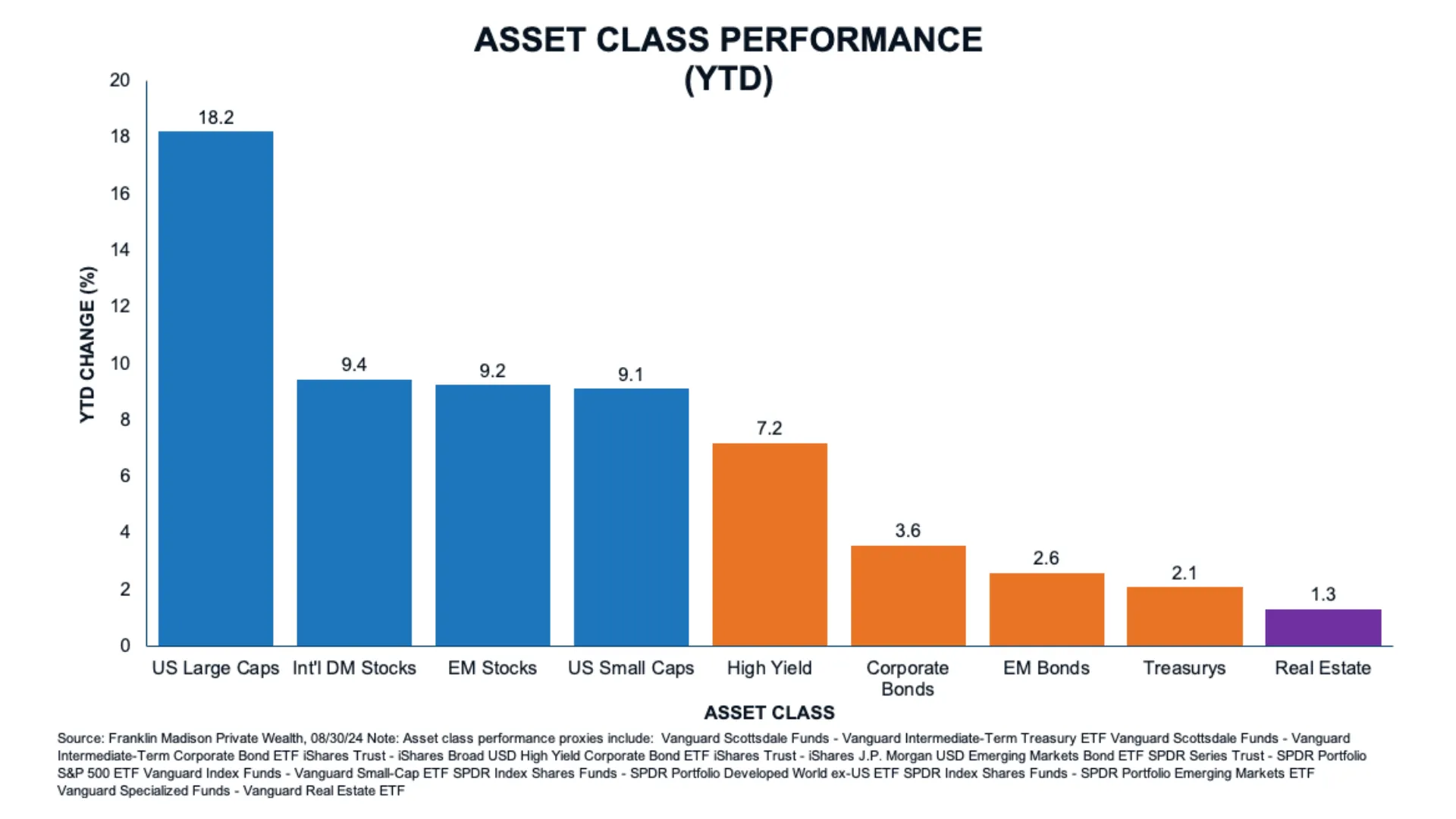
This optimistic view has been bolstered by incoming economic data. A revised second look at GDP figures revealed that the US economy grew faster than expected in the second quarter. This positive trend was further supported by a solid expansion in retail sales during July. Simultaneously, while initial jobless claims have remained relatively flat, job openings are slowly starting to dwindle. This labor market dynamic likely supports the Fed's case for cutting rates to put a floor under potentially slowing growth.
In Asia, stocks largely closed the week out in mixed fashion, led lower by China due to concerns about the country's waning growth prospects. This outlook comes on the heels of news that policymakers are considering plans to allow homeowners to refinance $5.4 trillion worth of debt, as sagging property prices have weighed on spending and household wealth. Despite these challenges, stocks in mainland China rallied into Friday's close but still ended down for the week, with the Shanghai Composite off 0.40% and the CSI 300 largely flat.
Other Asian markets managed to look past China's concerns, with stocks in Hong Kong gaining 2% on the week, spurred by positive economic data from the US. Japanese stocks also moved higher despite concerns surrounding a potential rate hike by the Bank of Japan, with the Nikkei closing up around 1.2% for the week. Indian and Australian markets followed suit, with the Sensex up 1.6% and the ASX adding nearly half a percent.
In Europe, the mood is solidly risk-positive as investors digest data showing waning inflation and moderating economic growth across the region. Most major European markets are higher this week, with Italian stocks leading the way with a gain of roughly 2.2%. German stocks are trading flat on Friday but still up nearly two percent for the week, while the UK's FTSE has posted a solid gain of around 1%.
On Wall Street, stocks are set to close out the week in mixed fashion. The big story this week was NVIDIA's earnings and whether demand for the company's AI-related products would be enough to support the broader rally in tech stocks this year. As a result, we're seeing mixed performance, with the Nasdaq down around one percent for the week, large-cap stocks as measured by the S&P 500 mostly flat, while the Dow and small-cap stocks carried US equity market performance.
In the fixed income market, rates have stabilized, with 10-year Treasury yields falling to 3.9% from about 4.25% a month ago. The expectation that the Fed will cut rates in September is being priced into the market. Internationally, yields on 10-year German bunds and British gilts are trading largely flat for the week, while Japanese JGBs have caught a bid recently, with yields falling and prices supported by BOJ intervention.
In currency markets, the US dollar is trading modestly higher this week, with the DXY US dollar index at 101 on Friday morning, off around 0.75% over the past week. As a result, the euro is down around one percent, trading at 1.10 to the dollar, while the British pound has pared about 0.25% but remains at its highest level in over two years at 1.31 to the dollar. The Japanese yen is up modestly as BOJ policymakers signal readiness to continue raising interest rates, and the Chinese yuan closed at its strongest level since June 2023.
Looking ahead to next week, we'll be entering a new month in which the Fed is expected to cut rates for the first time since the start of the pandemic. Key economic releases include business sentiment data on Tuesday, followed by trade and JOLTS data on Wednesday. However, the main focus will be on jobs data, with the ADP report on Thursday and the crucial Non-Farm Payrolls data on Jobs Friday.
As we enter the back-to-school season, portfolio managers will be reassessing their holdings and evaluating whether their current positions still make sense after this year's strong run in prices. Investors should be prepared for potentially volatile conditions in risk assets in the month ahead as the market digests new economic data and central bank decisions.

Avoid These Three Home Buying Mistakes
Everyone makes mistakes when buying a new home.
But the wrong mistakes can cost you money and your sanity as well.
So then, with mortgage rates falling, and more homes hitting the market, here are three common mistakes you’ll likely want to avoid so you can buy with confidence:
Mistake #1: Neglecting All-in Costs
Underestimating the true cost of homeownership can quickly turn your dream home into a financial nightmare.
One major oversight I've seen time and again is neglecting the all-in costs of home ownership.
Sure, it's tempting to think that if you can afford $5,000 a month in rent, you can afford the same in mortgage payments.
But that doesn't account for the additional thousands you might need to cover property taxes, insurance, and upkeep, especially in pricier locales.
And this gap in budgeting can steer you toward an emotionally charged purchase.
That's why it's essential to understand every cost down to the last dollar before you even think about calling a real estate agent.
Mistake #2: Rushing the Buying Process
The best thing you can do for yourself when buying a home is to slow down.
Sure, it's exciting to find a house you love when inventory is up, but moving too fast can lead to missed details and costly mistakes.
How so?
Well, one of my clients overlooked an aging roof and an outdated heating system because they were eager to get to closing.
And so, this oversight ended up costing them more than $40,000 one year after their closing date.
So then, when buying a home, remember: patience isn't just a virtue; it's essential.
Slow down, take your time, scrutinize the fine print, and make sure that your investment is as sound structurally as it is financially.
Mistake #3: Not Considering the Local Community
Finally, it's essential to do your homework on the local community where you're planning on buying.
Sure, you're likely more interested in commute times, and access to local dining and entertainment, but the biggest disservice you can do to yourself is not to get a feel for the local community.
Listen, I've lived across the West Coast, Midwest, and East Coast and can tell you firsthand that the vibe changes not just from city to city but from one neighborhood to the next.
Real estate isn't just about the four walls and a roof, it's also about the community surrounding them.
You may have seen it in San Ramon, but it's likely not the same in Ladue.
Indeed, if you're not careful, you could find yourself the odd man out in your own neighborhood. And if this happens, guess what? You'll be back on Zillow looking for your next new home sooner than you think.
Now, you might not plan on joining every community committee. But, understanding the local economy, the quality of public services, and even the daily bustle at the nearest grocery store can impact both your quality of life and the long-term value of your new home.
So then, take the time to understand not just what you’re buying but also where you're buying and the kind of people you'll likely interact with on a daily basis.
Remember, these people could be your neighbors for the next ten years or more!
So, visit, explore, and maybe even chat with some future neighbors to really get a feel for the place you're planning to settle into.
Either way, when it comes to real estate, being thorough and deliberate is the key to securing not just any home but the right home for you and your family.
Always remember that a thoughtful approach to home buying goes beyond securing a reasonable price, it's about protecting your investment and ensuring your home meets all of your needs for years to come.

Tech is Selling Off, Now What?
Markets are selling off. What should you do?
Well, you might feel the urge to sell, and that's normal.
Because when stocks fall, your first instinct is to do something, right?
But let's talk about what doing something can look like without making decisions you'll later regret:
Step #1: Anchor Yourself to Your Financial Plan
Before you follow the crowd into selling, take a deep breath and revisit your financial plan.
Now, this plan is the rock on which your investment decisions should stand, especially when the markets are falling.
Ask yourself: "What am I investing for, and according to my plan, what should my next step be?"
Now's a great time to reassess your current strategy and ensure it still aligns with your long-term goals.
Remember, a well-crafted plan keeps you looking ahead, no matter what's going on in the markets.
Step #2: Evaluate Your Cash Reserves
If you're retired or depend on your investments for daily living, market drops can feel especially frightening.
That's why it's crucial to ensure you have enough liquidity on hand to cover your immediate needs without compromising your investment strategy.
To this end, ask: "How much cash on hand do I need to keep the lights on for the next six months?"
Then, check your cash reserves. Are they sufficient?
If not, and you absolutely need to sell, do so strategically.
Sell just enough to cover your short-term expenses. This way, you can leave room for your assets to recover and grow over time.
Step #3: Limit Your Exposure to Market Noise
Finally, it's easy to get glued to financial news, but too much noise can lead to stress and poor decisions.
So then, take a few moments and ask: "Am I consuming too much media, and is it affecting my investment choices?"
Often, the wisest action is inaction.
If your financial plan is in order and your cash needs are met, consider stepping back from the media frenzy.
Markets go up and down but remember, this isn't new, especially given the tech sector's rally this year.
Ultimately, success is about not letting the herd mentality sway you. Stick to your plan, keep calm, and carry on investing wisely.
Remember, it's about staying sane, solvent, and strategically set for the future.

What to Do With That Old 401k?
$1.65 trillion (with a T). That's how much is sitting unclaimed in forgotten 401k accounts as of 2023.
Could some of that be yours?
You never know, there could be a retirement account or two from a past gig that's slipped your mind.
It happens!
That's why now might be the perfect time to round them up and get your retirement strategy dialed in.
Let's face it: life gets busy, careers change, and sometimes, the last thing on your mind is that 401k from a job you left years ago.
And here's the thing: every dollar in those accounts is a step closer to the retirement life you've been dreaming about.
So then, if you haven't planned for those funds yet, there's no better time than the present to start.
Because here's the thing: the most essential thing to know now is that leaving those accounts unchecked could mean missing out on money that should be contributing to your retirement strategy.
So, what can you do about it? Here's a simple plan:
✓ First, reach out to past employers.
Get on the phone or shoot an email to the HR departments of places you've worked before. They can help you figure out if you left any retirement money on the table.
✓ Next, keep track of your progress.
As you confirm each account, jot down details like which employer it was with, the account balance, and who's currently managing the money.
✓ Finally, plan your next move.
Got all your account info? Great!
Now, you can either roll them into your current employer's plan if that's an option. Doing so will allow you to manage your retirement savings in one spot.
Or, if you have multiple accounts and want more flexibility, you can set up a rollover IRA with a custodian like Schwab, Fidelity, or Vanguard. This approach gives you more control over your investments and could simplify your financial life.
So then, take an hour this week to reclaim your forgotten accounts and get closer to the retirement you deserve.
Sorting them out could not only tidy up your finances but might even let you hit that retirement goal sooner than expected!
What Can We Learn from Big Government Bond Investors?
Did you know that nearly a quarter of all US government debt outstanding is held by foreign investors?
And, what if I told you that this number has been falling in recent years?
In fact, This figure was at a peak of 35% in 2014 but has declined to 24% as of the end of 2023.
Well, this shift might remind you about concerns about the US dollar's dominance, right?
The Decline in Foreign Holdings: A Sign of Shifting Trends
Well, as a high-achieving professional, you likely understand that these global movements can provide valuable insights into managing your own investment portfolio.
And you see, this market development actually highlights a critical lesson in financial wisdom: the importance of diversification.
How so?
The Real Story: Global Asset Diversification
Well, while some may argue that fewer foreign investors holding Treasuries reflects a decline in US dollar dominance, the fact is that the USD is still the world's preeminent reserve currency.
So then, the decline in foreign holdings must be attributed to something else, right?
So, what's really happening?
Well, it looks like what we're seeing is a broader trend towards global asset diversification as global economic and financial conditions have evolved over the past decade.
The Evolution of Foreign Investment in US Debt
In fact, recent research from the Treasury Department shows that the percentage of US debt held by foreigners has started to decline from its peak in 2015, signaling a shift towards a more diversified global investment strategy.
You see, at the turn of the century, treasuries held by foreign investors accounted for about 18% of total federal debt outstanding, which is a figure that’s substantially less than it is today.
Think about this: after surging during events like the Global Financial Crisis and the European Debt Crisis, when US treasuries were the go-to safe haven, the percentage of US debt held by foreigners has begun to moderate.
Why?
Because as markets stabilize, investors start looking for opportunities beyond the US. It's like they're spreading their bets rather than putting all their eggs in one basket.
Case Study: The European Debt Crisis and Its Aftermath
For example, during the European Debt Crisis, investors flocked to US treasuries as a safe haven, which spiked the percentage of US debt held by foreigners.
But once the dust settled and global markets got back on their feet, these investors started diversifying their portfolios with a mix of assets, showing a savvy approach to investment that we can all learn from.
So then, the main takeaway here is not just that diversification is wise; it's a necessary strategy in today’s interconnected financial landscape.
Personal Portfolio Implications
Why should you, as a tech professional with significant earnings, care about this?
Well, diversification isn't just a practice for institutional investors. It’s equally crucial for your personal portfolio.
By diversifying your investments, you’re not only protecting yourself from unforeseen market shifts but also positioning yourself to take advantage of various global opportunities.
And this kind of positioning ensure that your portfolio captures upside potential while spreading out risk even as you spend your precious little time on things that truly matter to you.
Evaluating Your Investment Strategy
So then, take a lesson from foreign investors and ask yourself, “is my portfolio truly diversified, or am I relying on a single big position to carry my retirement and financial independence goals?”
Remember, building a disciplined investment strategy is not just about picking stocks or sectors; it’s about preparing for the future, wherever it might lead.
So then, take this opportunity to make sure your investments are as globally savvy as you are.